Posts tagged ‘bar-restaurant’

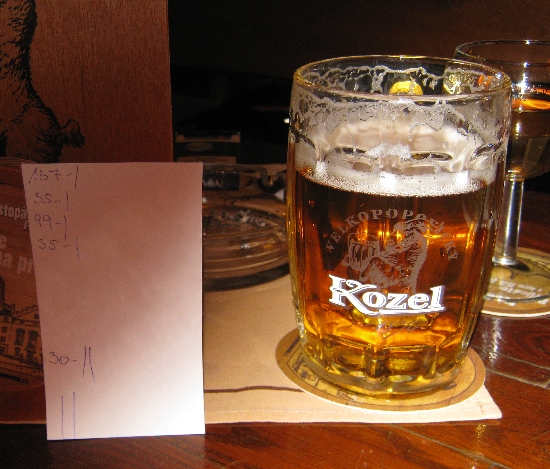
Running tab on slip of paper with beer & wine © Ricky Yates

One thing that I have increasingly realized living in Prague, is that most Czech people do not expect non-Czechs to necessarily be able to speak their language – many of them recognize what a difficult language it is to learn! But what Czech people do expect is that foreigners should understand, respect and follow their cultural manners and practices.

I have previously written a post entitled ‘Eating and drinking in a Czech Bar-Restaurant’, explaining what to expect in contrast to the UK and elsewhere. In this post, I’m going to expand and illustrate a practice I mentioned briefly in that previous post – something that is quite commonplace in many bar-restaurants throughout the Czech Republic.

When your first drinks order has been delivered to your table, the person doing so will produce a slip of paper, mark it accordingly, and leave it on your table. If you have only ordered normal 0.5 litre glasses of beer, then a simple mark will be placed at the bottom of the slip, one for each beer that has been ordered. If you order small 0.3 litre glasses of beer, then a cross for each one will be put there instead.

If after the drinks have arrived, you then also order food, then the cost of each dish is recorded on the top part of the slip. The slip in this first photo shows that we ordered one main dish for 137 Kc with a side dish for 35 Kc, together with a second main dish for 99 Kc with a side dish for 35 Kc. By the time I took this photo, I was on my second glass of beer. On this occasion, Sybille was drinking wine and was on her second glass, each of which cost 30 Kc.

At the end of the evening when you are ready to leave, saying “Zaplatim prosim” – “May I pay please”, will bring the waiter/waitress to the table to add up your tab. Below is ours from this occasion, duly totted up – the extra 45 Kc was a digestif slivovice. The total bill of 463 Kc translates to around £16.00, a reminder of how ridiculously cheap eating out can be here in the Prague suburbs. But don’t expect a printed receipt – this simple paper slip is all you’ll get!

The tab totted up © Ricky Yates

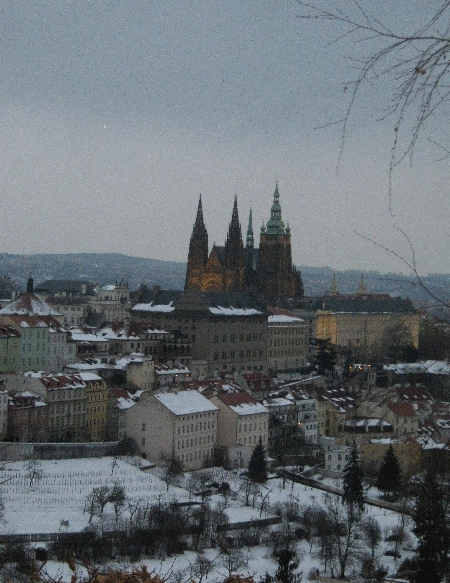
St. Vitus Cathedral, Prague photographed from Petrín Hill on New Year's Day 2011 © Ricky Yates

“Do you like living in Prague?” This is a question I’m frequently asked by Czech people once they discover that I’m not a tourist but that I’ve actually chosen to live and work here. Many Czechs cannot understand why someone from Western Europe might actually want to come and permanently reside in their country.

The same question is also frequently posed by English-speaking visitors who join us for worship at St. Clement’s Anglican Episcopal Church and by family and friends when they write or speak with me. So for my first post of 2011, I’m going to set out some of the reasons why I enjoy living particularly here in Prague and more widely in the Czech Republic. Some of these I’ve mentioned in previous posts so there are an inevitable number of links to things I’ve written previously in this blog.

Metro station at Jirího z Podebrad © Ricky Yates

Public Transport

Prague has the most wonderful public transport system consisting of buses, trams, the Metro and even a number of little ferries. Why is it wonderful? Because it is:

Incredibly cheap - Last week, Sybille and I went to renew our annual season tickets for the Prague public transport system. It cost each of us 4750 Kc – at current exchange rates, just over £160.00 / €193.00 / US$250.00. For this sum we can travel anywhere in Prague, at any time, for a whole year! The Church reimburses me for my season ticket – we just have to pay for Sybille’s.

Escalator on the Prague Metro © Ricky Yates

Integrated – Each part of the system links to the other. At Dejvicka, the current terminal of the A/Green line of the Metro and the nearest Metro station to our flat, you walk out of the station and immediately in front of you is place where buses depart to take you out further into the suburbs or to the airport. The Dopravní podnik hravního mesta Prahy or dpp for short, have a wonderful website that speaks Czech, English and German. Put in the starting point of your journey and your destination, the time you either want to start or arrive and then click. Out comes a journey plan with times, where to transfer from one form of transport to another, etc.

Frequent – If you know where you are going and you are travelling on a weekday between 07.00 and 19.00, there is no real need to visit the dpp website. Once you reach your point of departure you will only need to wait a few minutes at the most. Even on Sunday mornings, there is a tram every twenty minutes which will take us from the Podbaba tram terminus near our flat, all the way to Dlouhá Trída, just around the corner from St. Clement’s Church.

Reliable – there is a timetable and nearly always, it is adhered to. Sometimes buses and trams do get delayed by other vehicular traffic, but usually only at peak periods. And when it snows, everything keeps running – it doesn’t grind to a halt as in Britain.

It isn’t just within the city of Prague. The Czech Republic, along with Slovakia, has the densest rail network of any country in the whole of Europe. One member of my congregation lives in Milovice, about 50 km from the centre of Prague. But in 45 minutes, he can travel by train into the city centre and then have a 10 minute walk to Church. I don’t exactly know what his rail fare is for the return journey but he assures me it is extremely reasonable.

Bar-Restaurace U Topolu © Ricky Yates

Eating and Drinking

Prague has an abundance of bar-restaurants. And provided you avoid the expensive tourist traps in the city centre, ‘eating out’ can be remarkably inexpensive. As I’ve written previously, some single people tell me that it is often cheaper for them to ‘eat out’ rather than buy food from the supermarket and cook for themselves.

Half a litre of Kozel beer © Ricky Yates

The photo on the left is of U Topolu which, since it’s refurbishment in July 2010, has become our favourite local place to eat and drink. A main course here, even with a side dish, costs no more than 150 Kc / £5.00. The quality is excellent and portions are generous.

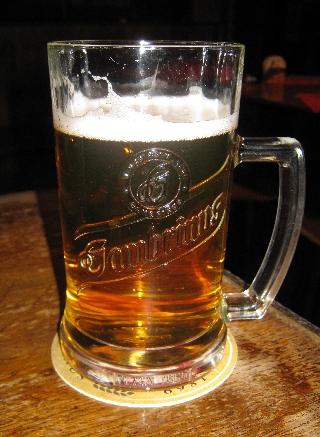
The further great attraction at U Topolu is the beer. As well as Pilsner Urquell and Gambrinus, they have Kozel beer, directly from the tank. It is light, fresh and costs 26 Kc for half a litre. In British terms that is under £1.00 a pint! What more do I need to say?

Architecture and Buildings

As I’ve previously written, Prague suffered remarkably little structural damage during the Second World War. And whilst many historical buildings suffered years of neglect during the Communist era, since 1989, great effort has been put into restoration. What is really pleasing is how well restoration work has been done.

Restored building in Vinohrady © Ricky Yates

This photograph is of a building just around the corner from where my dentist has her surgery in the suburb of Vinohrady. It consists of residential flats on four floors with retail outlets on the ground floor level. But as you can see, all the intricate detail above the windows on each level has been lovingly restored, together with the ironwork that forms the railings to each balcony. Likewise, the render on the outside of the building has been repaired before being attractively painted.

These buildings are typical of those which form much of the inner suburbs of Prague. Yes – there are still ones like these that are crumbling. But increasingly they are a minority. And rather than wholesale demolition, buildings like these are being preserved and their interiors sympathetically modernised.

I could write and illustrate several blog posts about the architecture of Prague which I promise I will do during the coming months. But for the time being, just let me say that walking the streets of the centre of Prague, together with the inner city suburbs, is always a delight to the eyes.

Not too big but not too small

Prague only has a population of about 1.3 million people. Therefore, as cities go, it is relatively small meaning that the nearby countryside can be easily reached. Yet because it is the capital of the Czech Republic, (10.3 million population), it has all the assets and facilities of a capital city.

There are many more things that I could list as to why I like living here in Prague, but this post is probably long enough already. And yes – there are also a small number of things that I don’t like. But they are minor irritants compared to the joy of living in this delightful city.

U Slabé vule - The Weak Willed © Ricky Yates

U Slabé vule - The Weak Will © Ricky Yates

Although Saint Clement’s Church is located in the centre of Prague, it does lie slightly away from the streets most frequented by visiting tourists. It is situated in Klimentská, the street taking its name from the Czech form of Saint Clement, Svatý Kliment. Klimentská is accessed from Revolucní, which runs from Námestí Republiky to the River Vltava. Whilst Námestí Republiky is bright and busy, particularly since the opening in October 2007 of the Palladium Shopping Centre, Revolucní has always struck me as being a little run down, with a number of empty premises at street level.

It was therefore a most pleasant surprise a couple of months ago, when alighting from the Number 8 tram at the Dlouhá Trída tram stop on Revolucní, to see that one of these vacant premises directly alongside the tram stop, had been transformed into a new Bar-Restaurant entitled U Slabé vule. A quick examination of their menu and price list displayed in the window convinced us to try it out for Sunday lunch after our service.

For their city centre location, prices at U Slabé vule are remarkably reasonable. 0.5l of Staropramen is 25 Kc (£0.90). Meal prices range from 120 – 150 Kc (£4.00 – £5.00) with generous portions very nicely presented. Their printed menu, in Czech, German and English, is most notable for the almost complete absence of ‘Czenglish‘.

The premises themselves are large, reaching through as far as the street parallel to Revolucní to the west. It is almost divided in two by the kitchen and bar with the whole of the section on the Revolucní side being ‘non-smoking’, a rare provision in the Czech Republic. What is more, they enforce it!!! In several other bar-restaurants we have frequented, whilst there is nominally a non-smoking area, as soon as a smoker lights up, rather than telling him/her to move, the waiter brings an ashtray. At U Slabé vule, the customer is told to move to the smoking area – Halelujah!

The last two Monday evenings, U Slabé vule has become the venue for a new activity in the life of St. Clement’s Anglican Episcopal Church – Czech conversation classes led by my native English, Czech-speaking Churchwarden, Gerry Turner. Over a glass or two of various varieties of liquid refreshment and a simple nicely presented meal, a small group of us are trying to lose our inhibitions and converse in Czech.  Will I be successful or will I have what the name U Slabé vule actually means which is  – ‘The Weak Will‘!!

PS – As you will see from the photo above, vule should really have a kroužek (ring) above the ‘u’ which is meant to lengthen the vowel sound by 30%. As with many other diacritics, most web browsers can’t cope and would render it as ‘?’, hence I’ve had to leave it out.