Posts tagged ‘Czenglish’

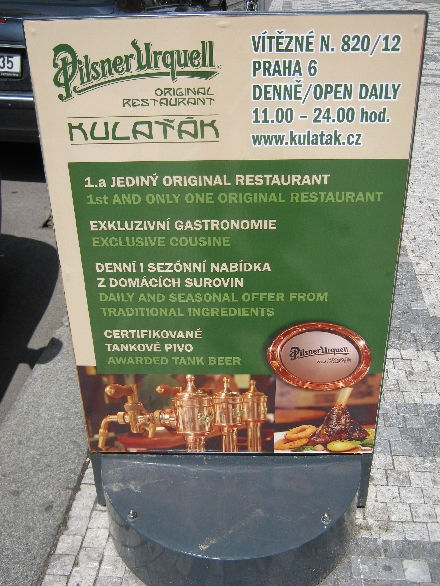
Would you like an exclusive French female cousin? © Ricky Yates

I’ve written many times previously about this strange language that I regularly encounter in the Czech Republic which I call Czenglish. I’ve found it on menus, on market stalls, on buildings and on public notices. If you want to see other examples besides those I’ve just linked to, put ‘Czenglish’ into the search box on the top right-hand-side of this page and hit ‘enter’.

On the left is my latest example of this strange language. The Kulat’ák Restaurant here in Praha 6, is proud to offer an exclusive French female cousin to its customers. For the benefit of the proprietors of Kulat’ák, it should be ‘Exclusive Cuisine’.

And when correcting this hilarious mistake, the first statement also needs to be amended to read ‘The first Pilsner Urquell Original Restaurant’, both to correct the grammar to acknowledge that there are now other restaurants based on this concept which have since opened in Prague. In the third statement, the word ‘offer’ needs to be corrected to the plural – ‘offers’. And the last statement should read ‘Award-winning tank beer’.

The sign in my photo is of one of several identical ones that the proprietors of Kulat’ák have had made to display around the area nearby, in order to attract customers to their restaurant. They are quite substantial and no doubt each cost  a considerable  amount of money to be manufactured. And yet no one could be bothered to actually ensure that the English text was accurate and made sense. I just cannot understand the thinking – or lack of it – that lies behind such a decision. However, following a conversation that Sybille had a few months ago with one of the joint owners of U Topolu, a bar-restaurant that we quite regularly frequent, it finally dawned on me why so much Czenglish abounds.

U Topolu only has one copy of its menu in English as, being situated in the suburbs, it isn’t visited that often by non-Czech speakers. And to be fair, the English in the menu is relatively error free except for a few incorrect prepositions and the suggestion that you enquire as to the ‘desert of the day’. But because of the relative proximity of the Crown Plaza Hotel, which frequently has numerous German tourists staying there, on occasions a few of them are slightly more adventurous and patronise U Topolu.

Sybille therefore kindly offered to the joint owner, that if he would like to have a copy of his menu translated into German, she as a native speaker, would be happy to do it for him. His response was a real eye-opener. If he wanted his menu in German then he could do it himself because he could perfectly well make himself understood in German.

What this gentleman articulated is the mindset of almost all Czech people who have ever travelled beyond the borders of their own country. Czech is a minority language – I hope Czech people will forgive me saying so. Other than 10 million fellow Czechs together with 5 million Slovaks, nobody else understands Czech. Therefore as a Czech, if you are going to communicate outside of your own country, you have to make yourself understood in another language – usually English or German.

With the exception of a few hotels and resorts in the Greek islands that specifically set out to cater for Czech and Slovak tourists and consequently employ some Czech or Slovak staff who can then write the menu in Czech or Slovak, nowhere else would a Czech person find, or expect to find, a menu in their native language. Instead, Czech people have to have at least a limited capability in another well-known language, most commonly English, or if in Germany, Austria or Switzerland – German. Therefore they never see a menu or notice written in badly constructed Czech because nobody ever sees the need to translate anything into Czech in the first place!

Because since the Velvet Revolution, many Czech people have travelled abroad and succeeded in making themselves understood in English when ordering a meal or booking a hotel room, they therefore believe that their English is sufficiently good to translate a menu or compile a notice. But as all my examples clearly show – it isn’t! Part of the problem is that Czech people can usually speak English far better than they can write it. Hence ‘desert’ rather than ‘dessert’; ‘sunrice’ rather than ‘sunrise’ and ‘hallowed’ rather than ‘hollowed’.

Am I correct in my analysis? I’d love to hear from both expats and Czechs. And I do promise that this is the last time I will write about Czenglish – that is until I see the next example that leaves me creased up with laughter!

Advice in Czenglish as to where not to subside © Ricky Yates

On Monday 21st March, Sybille & I visited the re-built Bethlehem Chapel in central Prague where the leader of the Bohemian Reformation Jan Hus, used to preach to a congregation of up to three-thousand people. I’m planning to write an extensive blogpost about Hus very shortly. But in the meantime, here is my latest example of Czenglish which I came across inside the Bethlehem Chapel.


Czenglish on the blocked up doorway of St. Clement's Church, Prague © Ricky Yates

St. Clement’s Church, Prague, where the English-speaking Anglican congregation worship, does not belong to us – it belongs to the Ceskobratrské Cíckve Evangelické / the Evangelical Church of Czech Brethren. They are a joint Lutheran/Reformed Church and by far the largest protestant grouping in the Czech Republic. The CCE have their service at 09.30 each Sunday – we therefore have ours at 11.00. We pay them a very modest rent for the use of their Church building.

Over the past few weeks, the CCE have arranged for the various exterior doors of the Church building to be taken down, one pair at a time, so that they can be taken away and renovated. Initially it was the west doors, ones which we rarely use. Then it was the south doors, the entrance our congregation normally do use. Now the south doors are back, the external vestry door has been taken away & that entrance temporarily blocked up.

The company carrying out the renovation are clearly keen that both people walking past the Church, and those who worship there, should know who is carrying out the restoration work on the doors. And so they have made a board which has been erected in front of each entrance to the Church, whilst the doors for that particular entrance have been missing. Realising that an English-speaking congregation also use the Church, somebody in the hierarchy of Restaurátorské Dílny Zbraslav S. R. O. obviously decided that this notice should not only be in Czech but also in English. But as you can see – it isn’t in English. It is in Czenglish!!!!!

Czech speakers are extremely quick to correct any foreigner who fails to decline a noun or adjective correctly when trying to speak Czech. Yet many of those self-same people regularly make an absolute shambolic mess of the English language, reproducing their various mistakes in menus and notices like this one, with absolutely no realisation of how ridiculous their attempts at written English actually read and sound.

Therefore, for the benefit of the management of Restaurátorské Dílny Zbraslav S. R. O., and for any other Czech person reading this blog post, ‘Restore works on this object are made by’ is completely incorrect English! ‘Restoration work on these doors is being undertaken by’ or ‘Work to restore these doors is being carried out by’ is what should have appeared on this notice. One simple phone call to me would have been all that was required for Restaurátorské Dílny Zbraslav S. R. O. to avoid appearing absolutely stupid.

Can someone please explain to me why so many Czech people are so unwilling to ask a native English-speaker to check their English text before putting it into print? If you really want to make an impact on English-speakers, please try writing in English and not in Czenglish!

Besídka Restaurant & Hotel, Slavonice © Ricky Yates

Less than 30 km south of Telc lies the little town of Slavonice. On the morning of Thursday 7th October, we drove from Telc to Slavonice, stopping off to briefly explore the intervening town of Decice en-route.

Slavonice has some of the best examples of buildings with sgraffito decoration in the whole of the Czech Republic. The reason that so many of these architectural gems have survived is because of the town’s somewhat unfortunate history. A prosperous town in the latter part of the sixteenth century from which period, many of the town’s historic buildings date, it lost much of its prosperity during the Thirty Years War (1618-1648) and suffered a further economic downturn when the main road between Prague and Vienna was re-routed in the eighteenth century.

In the twentieth century, two further events had a dramatic effect on Slavonice. At the end of the Second World War in 1945, most of the minority German-speaking population of Czechoslovakia, the Sudeten Deutsche, were expelled. This included the majority of the population of Slavonice. Less than three years later, following the coup that brought the Communist Party to power in February 1948, because the town lies less than 2 km from the Austrian border, it was made part of a restricted zone which was off limits for most of the Czechoslovak population, for fear that they might try to escape from their Communist ‘paradise’.

It is ironic that, a combination of economic degradation followed by a period of social isolation, has maintained so much of Slavonice’s architectural heritage. Fortunately, since the Velvet Revolution of 1989, a considerable effort has been made to both restore and preserve it.

One of the many restored buildings with sgraffito decoration is now the Bar-Restaurant Besídka. We ate lunch here soon after our arrival and enjoyed the English version of the menu which has several humorous items on it and a total absence of Czenglish. Clearly it had been translated by someone who had a very good understanding of the English language rather than using ‘Google translate’.  The food was very good too! The interior walls are used to display a fascinating collection of pictures and other artwork and it is worth stepping inside Besídka just to see these.

Sgraffito decorated buildings in Slavonice. Ubytování Eva Giordanová is the building on the far right of the picture © Ricky Yates

A few doors along from Besídka, we saw a sign on the large wooden doors of Ubytování Eva Giordanová declaring Zimmer frei. So we went in, climbed the stairs to the first floor office and enquired about their rooms. We were shown a very attractive room with simple kitchen facilities adjacent, all for a very reasonable price. I was also able to move the car from the main square and park it securely in the yard at the rear of the building.

Not only does Ubytování Eva Giordanová have accommodation, it also houses a museum of old agricultural and household machines and implements. And on the first floor, adjacent to our room, is a former Lutheran prayer room, with the walls decorated with sixteenth century frescoes, illustrating scenes from the Book of Revelation. They date from the time when there was a strong Protestant community in Slavonice before the re-imposition of Roman Catholicism at the end of the Thirty Years War. I was not allowed to take any photos of the frescoes but there are pictures of them on their website, together with some very interesting Czenglish descriptions!

Gateway into Slavonice © Ricky Yates


Gateway into Slavonice © Ricky Yates

Here are two of the gateways that lead into the historic centre of Slavonice, one of which also features sgraffito decoration.

More sgraffito decorated buildings in Slavonice. The one on the left features scenes from the Old Testament © Ricky Yates

Sgraffito illustration of the story of 'Jacob's ladder' © Ricky Yates

One building that particularly fascinated me was the one on the left in the picture above. It is covered with scenes from stories recorded in the Old Testament, together with the associated biblical reference.

It was still fairly grey and cloudy when we walked around the town in the afternoon which meant the light was not so good for taking detailed pictures of the individual illustrations. However, I was pleased with this one on the left, which illustrates the story of Jacob’s dream at Bethel, recorded in Genesis chapter 28, where he saw a ladder or stairway between earth and heaven with angels ascending and descending.

Slavonice was a place that Sybille & I very much enjoyed. Whilst is has visitors, it is a little more off the tourist track than Telc. Being so close to the Austrian border, German is often spoken and understood – a great help with our relatively limited Czech! However, it doesn’t suffer from the blight that affects so many towns and villages in the Czech Republic that border Austria or Germany – a proliferation of casinos and gambling places together with associated prostitution that I have described previously in this blog. There is just one Herna Bar, (bar with slot machines), and even that wasn’t open all the time.

The surrounding countryside consists of rolling wooded hills with many waymarked walking routes and cycleways. Certainly a place we plan to re-visit at some future date.

Sgraffito decorated house in Slavonice © Ricky Yates

Sgraffito decorated house in Slavonice © Ricky Yates

Do you fancy a pasta salad with a horse called 'Fruity' galloping through it? © Ricky Yates

In a valley between wooded Moravian hills, lies the small town of Rožnov pod Radhoštem which is where we drove to after leaving Ceský Tešín. Rožnov had been recommended to us as a place to visit by several people as it is the home of the Wallachian Open-Air Museum where an amazing variety of historic wooden Moravian buildings have been preserved since the founding of the museum 85 years ago in 1925.

We arrived just before dusk and eventually found a place to stay within our price range in Penzion Becva, which didn’t appear in our guidebook, but which I fortunately spotted as we were about to leave the town to look elsewhere. Having been so well-fed at lunchtime, we then went out that evening looking only for a place to have a drink and a snack.

Not far from the hotel, we found the very pleasant Restaurace U Janíku. We ordered two beers and asked to also see the menu and the waitress gave us their ‘English version’. A few minutes later we were both killing ourselves with laughter upon seeing the description of the last item on the page photographed above. Each of us had visions of a female horse called ‘Fruity’, galloping through 420 grams of Pasta Salad!

It is yet another example of that wonderful language called Czenglish of which I have cited many examples in previous blog posts. Maybe I should actually call this example Czfrenglish. What the menu is trying to say is on offer is ‘Pasta Salad with seafood’. But the compiler of the ‘English Menu’ has instead sought to adapt the French for seafood, fruits de mer, literally ‘fruit of the sea’. He has tried to make the word ‘fruit’ plural but has done it in the Czech manner by the addition of the letter ‘y’. He has then put in the definite article, which doesn’t exist in Czech. Finally for reasons known only to himself, he has converted ‘mer’ to ‘mare’.

After breakfast the next morning, we drove the short distance to the edge of Rožnov, to the ticket office and car park for the Wallachian Open-Air Museum. There were no cars in the car park and the ticket office was shut. Then it dawned on us – like so many art galleries and museums in Prague and elsewhere in the Czech Republic, the Wallachian Open-Air Museum does not open on Mondays! So, despite all the positive recommendations, we didn’t get to make our planned visit and it must wait until we visit Moravia once again sometime in the future.