Posts tagged ‘Podbaba’

Statue of Soviet Marshall Ivan Konev with floral tributes © Ricky Yates

Inscription alongside the statue © Ricky Yates

Today is a public holiday here in the Czech Republic, as it is in several other European countries. The public holiday marks the ending of World War Two, sixty-seven years ago, on 8th May 1945.

I took the photograph on the left today. It is of a statue that stands in Námestí Interbrigády, a large square on one side of Jugoslávských partyzánu, the main thoroughfare leading from our nearest Metro station at Dejvická, to Podbaba where we live. And the person it portrays is Marshall Ivan Stepanovich Konev of the Soviet Red Army, who led the troops that liberated Prague from Nazi occupation, finally entering the city early on 9th May 1945, just a few hours after the unconditional surrender of all Nazi troops across Europe, had come into force.

As I wrote in an earlier post on this same topic two years ago, this statue is a rare sight today, anywhere in the Czech Republic or Slovakia, as it features a leading figure of the Soviet Army which, during nearly forty-two years of communism, was regarded as an army of occupation by the people of Czechoslovakia. Nearly all public monuments featuring or seeking to celebrate, ‘Soviet friendship and brotherhood’ have, since the Velvet Revolution of 1989, been quietly removed. But, because it commemorates an event that took place before the communist coup in 1948, it remains standing.

As you can see, a large number of floral tributes have been placed at the foot of the statue in recent days. Some are official, such as the ones from the Czech Military and from the Defence Office of the Czech President. Others are simple bunches of flowers, left by private individuals. Although there is a considerable dislike of Russia and Russians amongst the Czech people today, (see some of the comments on my previous post), there is a recognition that it was the Soviet Army that was responsible for liberating Prague and two thirds of what is now the Czech Republic, early in May 1945.

Floral tribute with Cyrillic writing © Ricky Yates

However, I was intrigued by one large floral tribute pictured here, whose ribbons have an inscription written in a language using the Cyrillic alphabet, presumably Russian. If anyone can tell me what it says or which organisation might be responsible for it, I would love to know.

Inscription behind the statue which refers to the Czechoslovak Socialist Republic © Ricky Yates

And I was also intrigued by this inscription on the low wall behind the statue, which refers to the country as the Czechoslovak Socialist Republic, the name used only during the years of communist rule. Whereas elsewhere in the Czech Republic, specific communist logos and references have been removed from war memorials such as in Tábor, here communist nomenclature remains.

Whilst the liberation of the country from Nazi occupation is still marked each year here in the Czech Republic, what has changed since the Velvet Revolution, is the attitude of Czech people towards Germany and the German people. Most Czechs are now freely able to distinguish between Nazi Fascist ideology as exemplified by Hitler’s Third Reich, and present-day democratic Germany, still very much aware of it’s relatively recent past history.

Therefore these days, Germany is the Czech Republic’s biggest trading partner. Germans also travel here in considerable numbers to enjoy the delights of what this country has to offer and in doing so, make a major contribution to the Czech Republic’s tourist income.

On the other hand, although the part played Russia and the Soviet Red Army to liberate the country from Nazi occupation is still acknowledged each year, those who liberated, in turn became an army of occupation. And although all Russian troops had left Czech soil by June 1991, there remains a strong feeling that Russia still wants to control its former republics and satellite states using its economic power, particularly with regard to the supply and distribution of natural gas.

The Vltava River in central Prague © Ricky Yates

The longest river wholly within the Czech Republic is the Vltava, known to Germans as the Moldau. It rises in the Šumava mountains near the Austrian border and then flows north through the centre of Prague going on further north to join the Labe/Elbe at Melník.

The Vltava was portrayed musically, by the nineteenth century Czech composer Bedrich Smetana, in the second of six symphonic poems that form his symphonic cycle called Má vlast – My Fatherland. Click on this link below and listen to the music whilst enjoying my illustrated guide to the river.

The picture at the beginning of this post is the view most tourist visitors to Prague have of the Vltava, overlooked by St Vitus Cathedral and the walls of Prague Castle. On the river in the foreground, is an ancient paddle steamer, one of the many boats that offer trips on the river through the centre of the city.

The Vltava River seen from Letna Park © Ricky Yates

Above is a view looking upstream from Letna Park. The second of the bridges is the first and most famous crossing of the river – Karluv most/Charles Bridge.

The Vltava River looking downstream from Letna Park © Ricky Yates

And here is a view looking downstream from the same spot, with Cechuv most, the bridge in the foreground.

Karluv most/Charles Bridge © Ricky Yates

Here is a view of Karluv most/Charles Bridge which, until 1841, was the only crossing of the Vltava within the city of Prague.

Ostrov Štvanice/ Štvanice Island © Ricky Yates

This is Ostrov Štvanice/ Štvanice Island – the building located where the river divides is a former small hydro-electric plant. Behind it lies the navigation channel leading to a lock whilst the rest of the river flows over a weir in the foreground.

Dumb barge being pushed upriver © Ricky Yates

The Vltava is still used for the commercial carrying of freight, in particular sand and gravel. Large dumb barges are pushed upriver by powerful tugs.

Podbaba Lock © Ricky Yates

Major engineering works were carried out in the nineteenth century to improve navigation with the construction of locks and new artificial channels to bypass obstructions. This is Podbaba Lock which is located very close to the Chaplaincy Flat where we live.

Loaded dumb barge being pushed upstream above Podbaba Lock © Ricky Yates

And here is a loaded dumb barge being pushed upstream, above Podbaba Lock.

Commercial port at Holešovice © Ricky Yates

Most freight is unloaded here at the wharfs in Holešovice, north-east of Prague city centre.

Pleasue craft moored below Vyšehrad © Ricky Yates

The Vltava is now increasingly used by private pleasure craft, many of which moor here below the ancient citadel at Vyšehrad, south of Prague city centre.

Markers showing past flood levels © Ricky Yates

Beautiful and useful as the Vltava is, like any river, it can overflow and cause serious flood damage. Here is a reminder of past flood levels, reading upwards they mark the floods of 1890, 1845, 1784 and 2002.

Standing on the end of the Baba ridge on my 60th birthday © Sybille Yates

As many readers of my blog will already know, today Sunday 26th February 2012, I celebrated my 60th birthday. As I wrote in a previous post, just like Her Majesty Queen Elizabeth II, in 2012, I am also celebrating my Diamond Jubilee.

Overall, I have quite positive feelings regarding reaching this landmark. As I wrote previously on this blog, in October 2011, I passed the age my father was when he died. Over the past year, I’ve shed around 10 kg in weight and feel fitter now than I have for a number of years. I can still keep wicket in a forty overs-a-side cricket match and just over half a year ago, I successfully climbed the highest mountain in the Czech Republic.

The one thing I have become aware of during the past year is how much greyer my hair has become. But whilst the hairline does continue to recede and the hair becomes increasingly thinner on top, I still have more hair than I can ever remember my father having.

I firmly believe that God has a great sense of humour. This was very clearly brought home to me when I sat down on Saturday 25th February, the day before my birthday, to say Morning Prayer. The Psalm set was Psalm 71. In particular, two verses brought a smile to my face as I read them. In verse 9, the Psalmist pleads,

‘Do not cast me away in the time of my old age;

Forsake me not when my strength fails.’

And further on in verse 18 he cries,

‘Forsake me not, O God, when I am old and grey-headed,

till I make known your deeds to the next generation and your power to all that are to come.’

The ‘old and grey-headed’ bit did somewhat ring true. But I also liked the challenge of the second half of the verse – my responsibility to make God’s deeds and power known to the next generation. It is a reminder to me that I still have at least a further five years of full time ministry ahead of me before I can consider retiring. And even when I am retired, so long as my health permits, I intend to apply for ‘Permission to officiate,’ to whichever Anglican bishop’s jurisdiction I am then living under.

So how did I celebrate my birthday today? Well, I had known for quite some time that my 60th birthday would fall on a Sunday – a working day. Of course, as all clergy have heard ad infinitum, it is the only day we work! But any proposed celebrations became much further curtailed when two days beforehand on her own birthday, Sybille went down with a hacking cough and cold.

Then this morning started off even more inauspiciously, when the first sound I heard as a woke up at around 06.45, was our elderly black and white cat Oscar, being sick somewhere. Fortunately, it was only on the floor of our bedroom and therefore fairly easy to clean up. A little while later, as Sybille awoke, I was greeted with ‘Alles Gute zum Geburtstag’. But not wanting to pass on her infection, Sybille decided that her best course of action was to stay home, rather than accompany me to Church.

However, it was at Church this morning that the highlight of my day occurred, not least because it caught me completely unawares. In the absence of our regular organist, Professor Michal Novenko, the organ was being played by Larry Leifeste, a Texan who moved to Prague with wife Celieta, in August last year and have both joined the St. Clement’s congregation. Since then, Larry has very happily deputised on the organ, whenever Michal has been ill or away.

I duly announced the first hymn from the back of Church as Hymn 190, ‘Forty days and forty nights’. But instead of striking up the tune ‘Auf der Tiefe’, to which the hymn, so appropriate for the First Sunday of Lent, is set, Larry instead started playing ‘Happy Birthday to you’. The congregation soon twigged, (several of them already knew it was my birthday), and they duly joined together and sang ‘Happy Birthday’ to me as I walked up the aisle.

Early this afternoon, after I got back to the Chaplaincy Flat, Sybille said she felt well enough to walk up the hill through woods behind the Podbaba complex, to Restaurace na Staré Fare where we ate a late Sunday lunch. By the time we had finished eating, there was sunshine and bright blue sky, in contrast to the mixture of rain and snow of the morning. So before returning home, we walked out to the end of the Baba ridge where there is a wonderful view across Prague and where my 60th birthday photo at the top of this post was taken.

The west front of St. Vitus Cathedral, Prague © Ricky Yates

Last Monday evening, Sybille and I took the tram from Podbaba to Vozovna Strešovice and from there, walked through the back lanes to Hradcanské namestí, the large square lying immediately to the west of Prague Castle. As we did so, the only other people we saw were a young couple who were walking the same way as we were and whom we thought were probably Russian. Whilst we can tell when people aren’t speaking Czech, we have yet to be able to clearly distinguish between other Slavic languages!

In front of the west gates of the castle, there was a small group of Spaniards with a native Spanish speaker as their guide. But as we entered the first two quadrangles of the Prague Castle complex, we were surrounded by the amazing array of architecturally beautiful floodlit buildings, including the west front of St. Vitus Cathedral, with hardly a soul in sight. We basically had the whole place to ourselves. We were enjoying Prague – minus the tourists!

This is our fourth winter since moving to Prague in September 2008. Therefore we knew from previous experience that, following the Epiphany weekend in early January, through until late March, Prague has what can best be described as its non-tourist season. It is the period when you can walk around all the amazingly attractive sights of the historic centre of Prague, with very few foreign visitors surrounding you. But even then on Monday evening, we were still astonished as to how few people there were around.

For anyone reading this blog and wondering when is a good time to visit Prague, the answer I would give is between now and the third week in March. And if you want a really good financial deal, be adventurous and come without having pre-booked accommodation. At this time of year, there are regularly signs outside of hotels in the city centre saying, “Rooms available tonight” at remarkably reasonable prices.

Of course, you need to come prepared for the weather. Normally by now, there would be snow on the ground. But as I wrote in my earlier post, ‘Winter weather and walks’, we still have yet to experience really cold weather this current winter.

As someone who has chosen to live in Prague, I realise how very easy it is to complain about how, for much of the year, the city can feel almost overwhelmed by the number of tourist visitors. And yet they make a major contribution to the Czech economy and keep a considerable number of people in employment.

Likewise, they also make quite a contribution to the life of St. Clement’s Church. It very rare for us to have a Sunday service without visiting tourists in the congregation. Nearly all of them express grateful thanks for the opportunity we give them to worship in English, whilst they are visiting Prague. And some of them are quite generous towards us financially which we greatly appreciate. However, you would be amazed at the variety of  currencies that appear in the collection!

The most recent example was Christmas Day morning 2011. For our Family Eucharist that day, we had a congregation of about 110 people. Of those, only about 25 were regular members of our worshipping community, as so many of them go back to their home countries over the Christmas season. All the rest were visitors spending Christmas in Prague.

I shall seek to make the most of the next two relatively tourist-free months in Prague. But I am very aware that much of what I enjoy living here only exists because Prague attracts so many visiting tourists.

Sunset over Podbaba © Ricky Yates

Where is winter? It is a question I’ve been asking for several weeks. This time last year, there had been snow lying on the ground for about seven weeks. Until yesterday, when we finally had a few heavy snow showers, there had been no snow at all in Prague this winter.

The temperature this evening has just dropped below freezing and the forecast is for temperatures of below 0 degrees Celsius for the next four nights at least. But there is still no sign of any serious snow.

There is a very good reason why I want some serious snow and for temperatures to remain below freezing for many days at a time. To ensure that the mosquitoes are kept at bay!

In the Autumn of 2008 when we first arrived in Prague and throughout the warmer months of 2009, we suffered from an abundance of mosquitoes here in the Chaplaincy Flat and elsewhere. Then two successive severe winters caused their numbers to drop to a handful. I fear that a mild winter might just allow the Prague mosquito population to recover!

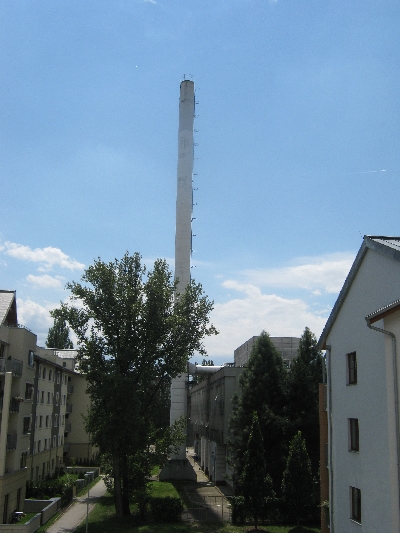
In the meantime, a few evenings ago, we did experience this wonderful sunset, the picture being taken from one of the balconies of our flat. The floodlight pylon belongs to the stadium of FK Dukla Praha who, like the rest of the football clubs in the Czech Gambrinus liga, are on their mid-season break which started in early December and doesn’t conclude until late February. In view of the mild weather we have experienced so far this winter, they could still be playing!

As I mentioned in my recent sad post about Sam the dog, one of the many great things he did for Sybille and I was to get us out walking far more than before we adopted him. He became our ‘weight loss programme’ because he exercised us as we exercised him! We are both determined to continue walking just as much as we did when we had Sam so as to maintain our weight loss which between us now exceeds 30 kilos.

Most days, we would walk from the Chaplaincy Flat to the extensive and beautiful Stromovka Park, which lies about twenty-five minutes walk away from where we live. Through doing this, we got to know numerous other Czech and expat dog owners and improved our ‘dog Czech’ no end.

Talking on my mobile phone © Ricky Yates

However, one behavioural habit which I regularly observed and continue to observe, annoys me intensely – dog owners and parents of young children, who go to the park, but then spend the whole time they are there, talking to someone else on their mobile phones!

The most extreme example I remember was of a woman we met, just by the entrance to Stromovka. She was pushing a buggy with a baby in it; was also holding onto the hand of a toddler and had a dog on a lead. She also was responsible for a slightly older toddler walking in front of her and for a second dog who was off-lead. But at the same time as all of this, she had her head bent to one side to hold her mobile phone next to her shoulder, in order to have a long conversation with one of her friends. I know women are meant to be able to multi-task, but…….

What conscious or sub-conscious message does such behaviour send to either the children or to the dogs? Why do people need to have such phone conversations if they are going to the park in order to spend quality time with their children &/or their dog(s)? Mobile phones are incredibly useful but they can also be a curse.

My photo is of a young woman walking across Václavské námestí/Wenceslas Square, also talking on her mobile, though admittedly, without dog or child in tow. But I hope I make my point – it is perfectly easy to say in response to a call, “I’m in the park with my dog/my children. I’ll call you back when I get home”.

Historical 'Restaurat' in Malá Strana © Ricky Yates

As part of our ongoing walk programme, as well as walking to and around Stromovka Park, Sybille and I have also recently started walking around some of the more central areas of the city, particularly as they are currently relatively free of tourists! However, I’m afraid I cannot resist posting this further wonderful example of Czenglish we spotted one evening recently in Malá Strana. What might be on the menu at a ‘Restaurat’?

Finally for this post, below are two photographs, both of which brought a smile to my face as I hope they will for the many readers of my blog.

This year, New Year’s Day was a Sunday. Our Church Treasurer Gordon is a Scotsman and marked Hogmanay, by coming to Church in his kilt. I did jokingly suggest that he could put the collection in his sporran to take it home to bank the following day! I should add that it is post-Eucharistic coffee rather than a wee dram that he is drinking!

And alongside is an invitation to ‘Explore the meaning of life’ – in Czech!

Gordon in his kilt on New Year's Day © Ricky Yates

An invitation to 'Explore the meaning of life' - in Czech!