I’ve written many times previously about this strange language that I regularly encounter in the Czech Republic which I call Czenglish. I’ve found it on menus, on market stalls, on buildings and on public notices. If you want to see other examples besides those I’ve just linked to, put ‘Czenglish’ into the search box on the top right-hand-side of this page and hit ‘enter’.
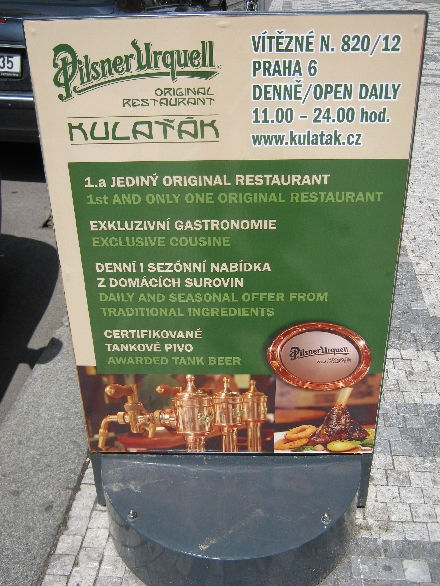
On the left is my latest example of this strange language. The Kulat’ák Restaurant here in Praha 6, is proud to offer an exclusive French female cousin to its customers. For the benefit of the proprietors of Kulat’ák, it should be ‘Exclusive Cuisine’.
And when correcting this hilarious mistake, the first statement also needs to be amended to read ‘The first Pilsner Urquell Original Restaurant’, both to correct the grammar to acknowledge that there are now other restaurants based on this concept which have since opened in Prague. In the third statement, the word ‘offer’ needs to be corrected to the plural – ‘offers’. And the last statement should read ‘Award-winning tank beer’.
The sign in my photo is of one of several identical ones that the proprietors of Kulat’ák have had made to display around the area nearby, in order to attract customers to their restaurant. They are quite substantial and no doubt each cost a considerable amount of money to be manufactured. And yet no one could be bothered to actually ensure that the English text was accurate and made sense. I just cannot understand the thinking – or lack of it – that lies behind such a decision. However, following a conversation that Sybille had a few months ago with one of the joint owners of U Topolu, a bar-restaurant that we quite regularly frequent, it finally dawned on me why so much Czenglish abounds.
U Topolu only has one copy of its menu in English as, being situated in the suburbs, it isn’t visited that often by non-Czech speakers. And to be fair, the English in the menu is relatively error free except for a few incorrect prepositions and the suggestion that you enquire as to the ‘desert of the day’. But because of the relative proximity of the Crown Plaza Hotel, which frequently has numerous German tourists staying there, on occasions a few of them are slightly more adventurous and patronise U Topolu.
Sybille therefore kindly offered to the joint owner, that if he would like to have a copy of his menu translated into German, she as a native speaker, would be happy to do it for him. His response was a real eye-opener. If he wanted his menu in German then he could do it himself because he could perfectly well make himself understood in German.
What this gentleman articulated is the mindset of almost all Czech people who have ever travelled beyond the borders of their own country. Czech is a minority language – I hope Czech people will forgive me saying so. Other than 10 million fellow Czechs together with 5 million Slovaks, nobody else understands Czech. Therefore as a Czech, if you are going to communicate outside of your own country, you have to make yourself understood in another language – usually English or German.
With the exception of a few hotels and resorts in the Greek islands that specifically set out to cater for Czech and Slovak tourists and consequently employ some Czech or Slovak staff who can then write the menu in Czech or Slovak, nowhere else would a Czech person find, or expect to find, a menu in their native language. Instead, Czech people have to have at least a limited capability in another well-known language, most commonly English, or if in Germany, Austria or Switzerland – German. Therefore they never see a menu or notice written in badly constructed Czech because nobody ever sees the need to translate anything into Czech in the first place!
Because since the Velvet Revolution, many Czech people have travelled abroad and succeeded in making themselves understood in English when ordering a meal or booking a hotel room, they therefore believe that their English is sufficiently good to translate a menu or compile a notice. But as all my examples clearly show – it isn’t! Part of the problem is that Czech people can usually speak English far better than they can write it. Hence ‘desert’ rather than ‘dessert’; ‘sunrice’ rather than ‘sunrise’ and ‘hallowed’ rather than ‘hollowed’.
Am I correct in my analysis? I’d love to hear from both expats and Czechs. And I do promise that this is the last time I will write about Czenglish – that is until I see the next example that leaves me creased up with laughter!