Posts tagged ‘Czech language’

Would you like an exclusive French female cousin? © Ricky Yates

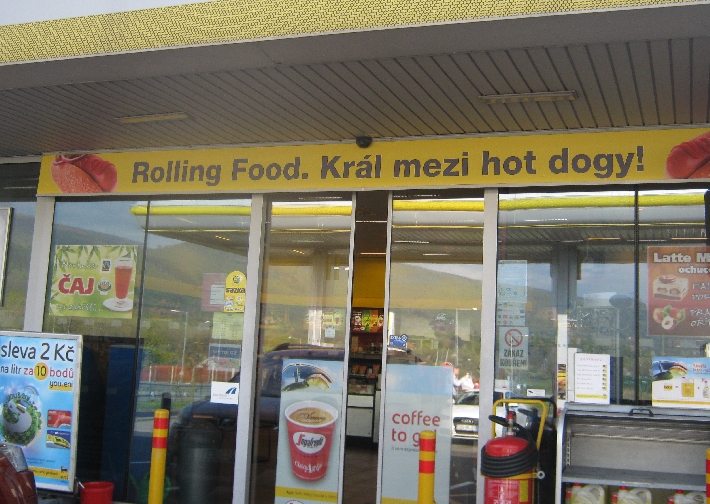
I’ve written many times previously about this strange language that I regularly encounter in the Czech Republic which I call Czenglish. I’ve found it on menus, on market stalls, on buildings and on public notices. If you want to see other examples besides those I’ve just linked to, put ‘Czenglish’ into the search box on the top right-hand-side of this page and hit ‘enter’.

On the left is my latest example of this strange language. The Kulat’ák Restaurant here in Praha 6, is proud to offer an exclusive French female cousin to its customers. For the benefit of the proprietors of Kulat’ák, it should be ‘Exclusive Cuisine’.

And when correcting this hilarious mistake, the first statement also needs to be amended to read ‘The first Pilsner Urquell Original Restaurant’, both to correct the grammar to acknowledge that there are now other restaurants based on this concept which have since opened in Prague. In the third statement, the word ‘offer’ needs to be corrected to the plural – ‘offers’. And the last statement should read ‘Award-winning tank beer’.

The sign in my photo is of one of several identical ones that the proprietors of Kulat’ák have had made to display around the area nearby, in order to attract customers to their restaurant. They are quite substantial and no doubt each cost  a considerable  amount of money to be manufactured. And yet no one could be bothered to actually ensure that the English text was accurate and made sense. I just cannot understand the thinking – or lack of it – that lies behind such a decision. However, following a conversation that Sybille had a few months ago with one of the joint owners of U Topolu, a bar-restaurant that we quite regularly frequent, it finally dawned on me why so much Czenglish abounds.

U Topolu only has one copy of its menu in English as, being situated in the suburbs, it isn’t visited that often by non-Czech speakers. And to be fair, the English in the menu is relatively error free except for a few incorrect prepositions and the suggestion that you enquire as to the ‘desert of the day’. But because of the relative proximity of the Crown Plaza Hotel, which frequently has numerous German tourists staying there, on occasions a few of them are slightly more adventurous and patronise U Topolu.

Sybille therefore kindly offered to the joint owner, that if he would like to have a copy of his menu translated into German, she as a native speaker, would be happy to do it for him. His response was a real eye-opener. If he wanted his menu in German then he could do it himself because he could perfectly well make himself understood in German.

What this gentleman articulated is the mindset of almost all Czech people who have ever travelled beyond the borders of their own country. Czech is a minority language – I hope Czech people will forgive me saying so. Other than 10 million fellow Czechs together with 5 million Slovaks, nobody else understands Czech. Therefore as a Czech, if you are going to communicate outside of your own country, you have to make yourself understood in another language – usually English or German.

With the exception of a few hotels and resorts in the Greek islands that specifically set out to cater for Czech and Slovak tourists and consequently employ some Czech or Slovak staff who can then write the menu in Czech or Slovak, nowhere else would a Czech person find, or expect to find, a menu in their native language. Instead, Czech people have to have at least a limited capability in another well-known language, most commonly English, or if in Germany, Austria or Switzerland – German. Therefore they never see a menu or notice written in badly constructed Czech because nobody ever sees the need to translate anything into Czech in the first place!

Because since the Velvet Revolution, many Czech people have travelled abroad and succeeded in making themselves understood in English when ordering a meal or booking a hotel room, they therefore believe that their English is sufficiently good to translate a menu or compile a notice. But as all my examples clearly show – it isn’t! Part of the problem is that Czech people can usually speak English far better than they can write it. Hence ‘desert’ rather than ‘dessert’; ‘sunrice’ rather than ‘sunrise’ and ‘hallowed’ rather than ‘hollowed’.

Am I correct in my analysis? I’d love to hear from both expats and Czechs. And I do promise that this is the last time I will write about Czenglish – that is until I see the next example that leaves me creased up with laughter!

Map showing those areas with a majority German population in the 1930s, superimposed on an outline of the current Czech Republic. Fair use assumed as the map is from a now defunct website

Czechoslovakia was formed in 1918, as part of the break-up of the Austro-Hungarian Empire following the end of the First World War. The country’s first President, Tomáš Garrigue Masaryk, was very keen that the western boundaries of this new nation should be the historic ones of Bohemia and Moravia which predominantly follow the ridges of the surrounding hills and mountains. This was to ensure that the new nation had defendable borders and that also nearly all Czech speakers would be living within those borders.

However, one important consequence of the adoption of these borders was that many people of German ethnic origin were also incorporated into Czechoslovakia. According to a census taken in 1921, just over three million Germans lived in Czechoslovakia accounting for around 23% of the country’s total population. The areas where Germans formed a majority were known as Sudetenland and the people themselves as the Sudetendeutsche.

Throughout the 1920s, there were controversies and tensions between the Czech authorities and the Sudetendeutsche. These became more intensive in the 1930s, partly because of the economic depression which particularly impacted on the Sudetenland as it was home to much of the country’s heavy industries such as glass making, paper production and textiles. These industries suffered because of a large drop in demand and from protective measures taken by other countries.

Following the Anschluss, the annexation of Austria by the Third Reich in March 1938, Hitler turned his attention to the Sudetendeutsche living in Czechoslovakia. Aided by Konrad Henlein, the leader of the Sudeten German Party, troubles and disputes were actively encouraged to create a sense of crisis within the Sudetenland, which Hitler then used to press his claim to incorporate the area and people into a greater Germany.

The whole issue came to a head at the Munich Conference held at the end of September 1938. At this conference, the leaders of the United Kingdom, France and Italy adopted a policy of appeasement towards Hitler and signed an agreement with Nazi Germany, allowing it to take control of the Sudetenland in return for a promise that this would be the end of German expansion. The government of Czechoslovakia was not represented at the conference nor a party to the consequent agreement.

As a result, Czechoslovakia lost about one third of its territory including much of its heavy industry. It also lost all of its frontier fortifications with Germany. Thus six months later in March 1939 and despite promises to the contrary, Hitler was freely able to march in and take over the rest of Czechoslovakia without hardly a shot being fired. As I explained in an earlier post entitled ‘Correcting History’, Czechoslovakia has the distinction of being the country which suffered the longest period of Nazi occupation as it was not fully liberated again until the early days of May 1945.

The Czechoslovakian government-in-exile, which was based in London for the duration of the Second World War, made two demands that it wanted to see implemented once Hitler and his Nazi forces were defeated. The first was the restoration of Czechoslovakia to its pre September 1938 borders. This was achieved with the exception of some territory in the far east of the country which was ceded to the Soviet Union and is now part of Ukraine.

The second demand was for the expulsion of the Sudetendeutsche population from Czechoslovakia. This was both to punish them for their support and cooperation with the Nazi invasion and occupation as well as being seen as a way to avoid any repartition of German nationalism within Czechoslovakia in the future. This policy was formerly agreed at the Potsdam Conference in August 1945 but had already begun to be implemented in a sporadic and on occasions, violent manner, almost as soon as Czech control over the Sudetenland had been re-established.

The Krkonoše Mountains or das Riesengebirge, where we spent the first week of our recent holiday, was part of the Sudetenland. It is the area immediately below the name Reichenberg (Liberec in Czech) on the map above. Being there and exploring the history and culture of the area, is what has prompted the writing of this blog post. On the walls of Penzion Nikola where we stayed, there were old black and white photographs of Pec pod Snežkou or Petzer as it was known in German. They show buildings with German names and German signs. There is every possibility that these photographs were left behind by the former Sudetendeutsche owners of the building as those expelled usually could take very little of their possessions with them, only what they could carry by hand.

Arcade in the main square of Žaclér © Ricky Yates

Deciding who would be expelled and who would not, varied from place to place. Because of inter marriage between Germans and Czechs, defining who was German wasn’t always clear. Today there are many Czech people who have very Germanic surnames. The current Czech Foreign Minister is Karel Schwarzenberg – a young Czech organist, who sometimes plays for us at St. Clement’s, has the surname Axmann. As we have discovered in our time here, many older well-educated Czechs are able to speak fluent German.

Germans who held crucial positions in major industrial plants were exempt from expulsion as were those who were deemed to have been anti-fascist. The final decision was usually left to the different local authorities.

On Monday 18th July, we made a slight detour to our journey from Pec pod Snežkou back to Prague, in order to  visit the little town of Žaclér (German name; Schatzlar) which lies on the eastern extremity of the Krkonoše Mountains National Park. From my map it looked like an interesting place but I could find no reference to it in any guidebook.

Attractive ancient wooden hose in Žaclér © Ricky Yates

In the historic centre of the town was this attractive arcade and nearby were two fascinating ancient wooden houses. And just off the main square was the Church which sadly, like most Czech Churches, is kept locked except when services are taking place. However, what intrigued both Sybille and I was a notice on the Church door giving details of the funeral arrangements for a man with a Germanic surname and with the text of the notice being in both Czech and German.

Even more revealing was a large walled burial ground immediately behind the Church. Outside the main gates was an explanatory notice in four languages, (Czech, German, English and Polish), giving a little bit of town history together with information about the graves of certain notable local people buried there. But as we walked down the central path through the burial ground, we noticed a large number of graves of people who had died after 1945 but who had  Germanic surnames and with inscriptions in German rather than in Czech. Clearly, for whatever reason, Žaclér was a town from which many Sudetendeutsche were not expelled in 1945/6 and where they and their descendants, continue to live.

Memorial to two French prisomers of war in the burial ground at Žaclér © Ricky Yates

One other feature of the burial ground is the presence of two memorials to prisoners of war who are buried there. One commemorates two Frenchmen – one from Le Havre and the other from Paris. The other commemorates several citizens of the former Soviet Union and is an extremely rare example of a memorial in the post-communist Czech Republic that still bears the hammer and sickle emblem.

Over sixty-five years after the expulsion of the Sudetendeutsche from Czechoslovakia, there remains a legacy of what happened. Despite the movement of Czech people into the former Sudetenland, these areas still are remarkably under populated. One article I read claimed that the current population of Pec pod Snežkou, is only one third of what it was before 1939. Many buildings which once housed the permanent local German-speaking population, are now used to house visiting tourists, especially those who come to ski in winter.

However, there doesn’t seem to be any latent anti-German sentiment amongst Czech people today, despite past history – certainly none that we have experienced as an Anglo-German couple resident here. German tourists now visit in large numbers and Germany has become the Czech Republic’s foremost trading partner. And whilst there are organisations within Germany, who continue to argue for either the restitution of confiscated Sudetendeutsche property or for the payment of compensation by the current government of the Czech Republic, there political clout and influence is small.

Memorial to several Soviet prisoners of war in the burial ground at Žaclér. Note the hammer & sickle emblem. © Ricky Yates

With Rev'd Dr. Karen Moritz outside St. Clement's Church on Sunday 1st May 2011 © Gerhard Frey-Reininghaus

In recent months it has been a great privilege to have another lady called Karen join the St. Clement’s congregation.  She is not to be confused with Karen the TEFL teacher, who has been the subject of several of my previous blogposts and who now lives in Istanbul, but remains a very regular and faithful commenter here. Nor is she to be confused with Czech/Australian Karen, who helped us with adopting Sam the dog. Nor is she Karin, (note the slightly different spelling), who has also previously worshipped at St. Clement’s, currently lives on the Greek island of Paros and, from time to time, also leaves comments here.

This latest Karen is the Rev’d Dr. Karen Moritz, an ordained minister in the Presbyterian Church (USA). She came to Prague at the end of September last year as a Mission Co-worker with the Evangelical Church of Czech Brethren (ECCB), the joint Lutheran-Presbyterian Church who are the largest Protestant grouping in the Czech Republic and who own Kostel Sv. Klimenta where we worship.

Between Monday and Friday each week, Karen works in the Ecumenical Department at the Headquarters of the ECCB. She is also having Czech lessons three times a week and has become far more conversant with the Czech language in seven months, than we have managed in two and a half years. Since late October 2010, she has made her Czech worshipping home with the ECCB Kliment congregation. She attends their 9.30am service each Sunday, joins them for coffee after their service in the hall on the third floor of Klimentská 18, but then she returns to worship with us at 11am because she likes our liturgy and hearing a sermon in a language that she fully understands!

I was delighted to discover when I enquired earlier this year, that under the Ecumenical Canons of the Church of England, it is possible for Karen to be licensed to do within our worship, what a licensed Anglican Reader can do, namely preach, administer the chalice and lead a non-Eucharistic services. We are currently getting her through the various hoops of child protection procedures and references being taken up, to enable this to happen.

We are still waiting for the official formal permission but, in anticipation of it being granted, it was a great pleasure to have Karen preach for us on Sunday 1st May, the Second Sunday of the Easter Season. This was Karen’s first time ‘back in the pulpit’ since leaving the USA last year. Her boss in the ECCB Ecumenical Department, Rev’d Gerhard Frey-Reininghaus, very kindly attended the service to support her and also took the photograph above. The photograph below was taken by Sybille using Gerhard’s camera.

From l. to r. ; John, a Canadian member of the congregation, myself, Rev'd Dr. Karen Moritz, Rev'd Gerhard Frey-Reininghaus © Gerhard Frey-Reininghaus

Having Karen join our congregation has been a great joy and the possibility of using her gifts and talents within our worship in the coming months and years will undoubtedly be a great asset to both me and the wider congregation. Her sermon on Sunday 1st May was very much appreciated by all those who heard it and can be also be listened to here on our website. Karen is also providing a wonderful strong link between the English-speaking St. Clement’s Anglican Episcopal Church and our host ECCB congregation.

Sam our adopted dog © Ricky Yates

I am pleased to announce that, much to Sybille’s great pleasure, on Wednesday 20th April 2011 we became the proud owners of a dog. Strictly speaking, until a date in early October 2011, we are only the surrogate foster parents of a dog. I’ll explain that situation in greater detail in a moment. But first of all, let me introduce the dog.

Our dog, pictured here on the left, was found by the police in early April, wandering around a Prague suburb. He did not have either an ID microchip or a tattoo to identify him. But he did have a collar with a metal tag attached, which gave his date of birth & said that his name was ‘Sam’. However, rather oddly, the tag had no address or phone number.

Officially, Sam is deemed to be a Labrador mix. However, other than a few spots on his ears, there is nothing to distinguish him from a pure bred Labrador. As I have very little knowledge of dog breeds, I shall leave any detailed discussion of exactly what his breeding is, to those are more knowledgeable in these matters than I am.

We obtained Sam from the stray dog and re-homing centre, run by the police and located just across the Vltava River from where we live. We did so, by finally finding a way to circumvent the absurdities of Czech bureaucracy that I described in my earlier post in February this year entitled ‘Czech bureaucracy again’.

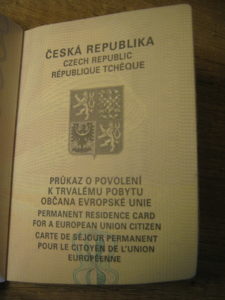
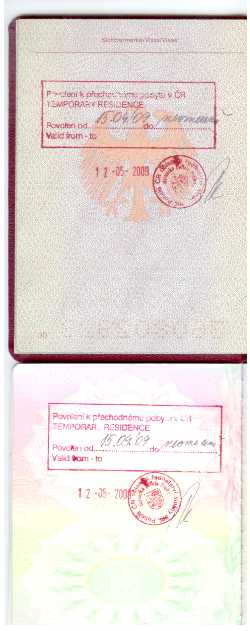
After our experience described in that post, we had various ideas as to how we might challenge our being treated as second-class citizens simply because we were deemed only to have ‘Temporary Residence’ in the Czech Republic. These ranged from getting the British Ambassador involved or taking our friend, an English-speaking Czech lawyer, along with us. Eventually, we decided to try the slightly less heavy-handed approach of asking a Czech-speaking member of the St. Clement’s congregation to telephone the stray dog and re-homing centre, to see if the impasse could be explained & overcome.

The person we got to help us was Karen, one of numerous ladies of that name either in my congregation or commenting on this blog! This Karen has both Czech and Australian nationality and speaks several languages fluently, including Czech and English. Having managed to speak on the phone to the man in charge of the dog centre, Karen was assured that, if she came in person with us to the centre and explained the situation, we would be allowed to adopt a dog. So on the morning of Wednesday 20th April, we met Karen outside the dog centre to see if the promise made on the phone would be fulfilled.

Unfortunately, the same very difficult and officious lady that we had met on our previous visit, was on the front desk. She gave Karen exactly the same story as we got the first time we were there – we were foreigners with ‘Temporary Residence’ and therefore not eligible to adopt a dog. Karen demanded to speak to the man in charge of centre saying that he had assured her that we could adopt. The gentleman duly came and a long discussion in Czech ensued.  Eventually, a solution was arrived at which is once more best described as Kafka-esque.

Officially, Karen has adopted the dog because she is a Czech citizen and therefore has ‘Permanent Residency’ here. However, the authorities have noted on their records that the dog will actually be living with us and not with Karen! Hence my description earlier of us being only ‘surrogate parents’ to Sam. This is all because they think that we, as foreigners, will run away out of the country with the dog. The reality is that Karen, together with her Australian husband and family, are planning to return to live in Australia in two to three years time, whereas we hope to be living here for at least the next six years.

The reason that we, together with Karen, are only ‘foster parents’ until early October is much more straightforward and something we were fully aware of before embarking on this exercise. If a stray dog is found by the police, wandering in the streets anywhere in the Czech Republic, the original owner has six months in which to reclaim his or her dog, measured from the date the dog was found. After the expiration of that period of time, the foster parents can register the dog as their own.

Therefore, in early October, providing the original owner doesn’t come forward, we can return with Karen to the dog centre and transfer Sam’s registration into our names. Apparently at that point, the fact that we are foreigners with ‘Temporary Residence’ doesn’t matter!

Oscar and Sam © Ricky Yates

You may be wondering how Sam the dog is getting on with the existing third member of our family – Oscar the cat. As most people know, cats consider themselves to be superior to humans and certainly far superior to dogs. I believe the picture on the left illustrates this reality very clearly!

The railway station in the village of Babylon © Ricky Yates

We spent the final long weekend of our October holiday in the far west of Bohemia, close to the German border, staying in the little village with the somewhat surprising name of Babylon. To get there from Slavonice, we spent a good part of Friday 8th October driving, firstly through parts of northern Austria before passing back into the Czech Republic. Our journey then took us through Šumava, a highly attractive area of mountains, forests and lakes, parallel to the German border. Having now driven through Šumava, this area has been added to my ‘must re-visit and explore more’ list of places in the Czech Republic.

Babylon is where Jack, an Irish member of our St. Clement’s congregation, has a house that dates from the first decade of the twentieth century, which he has spent the last few years, restoring to its former glory. We have visited and stayed with Jack in Babylon on a couple of previous occasions and enjoyed his hospitality. On this occasion, he gave us a wonderful meal on our arrival on the Friday evening but then set out for Prague by train on Saturday morning, leaving us alone to enjoy the peace and tranquillity of his house and the beautiful rolling hills and woods of the surrounding countryside.

The village of Pasecnice with the Church spire (top left) and the lake (bottom right). © Ricky Yates

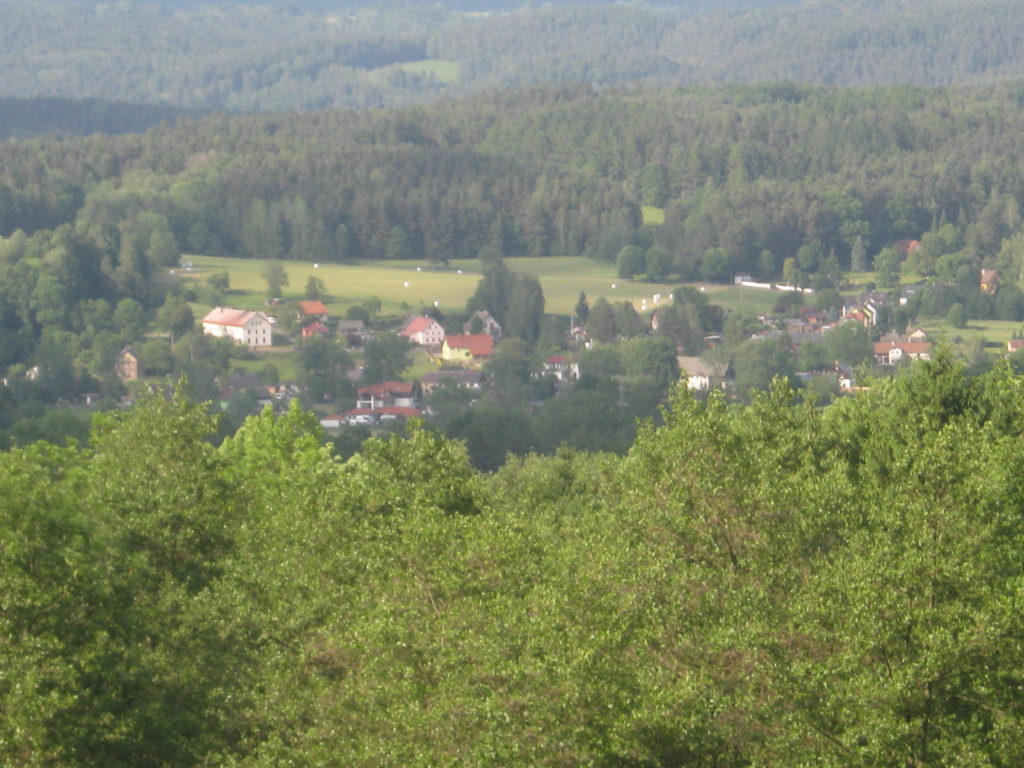
Just after Jack left, we decided we should make the most of the fine, sunny autumnal weather and set out to walk, through the woods beyond the railway station, to the neighbouring village of Pasecnice. The village has a very picturesque setting with a small lake in the centre. On the hillside beyond the lake is the village Church which we were delighted to find open as an older man and two older ladies were busy sweeping the Church forecourt and arranging flowers.

The Church of St. Francis of Assisi, Pasecnice © Ricky Yates

The Church is quite new having only been consecrated in 2003. It is dedicated to St. Francis of Assisi whose feast day is 4th October, the previous Monday. Our Czech was sufficient to be able to read the notice on the door saying that on the following day, Sunday 10th October at 11am, there would be a mass to celebrate their patronal festival. This was the obvious reason for all the cleaning and flower arranging that was going on.

The gentleman had a little German and was very pleased to show us the interior of the Church. It was decorated in typical Roman Catholic fashion with various pictures and statues of saints. As well as a statue of St. Francis, there was also one of St. James or ‘Santiago’ as the gentleman said as he pointed it out. We both then told him that we had made the pilgrimage to Santiago de Compostela and he proudly told us that he had done so too, beginning his journey at Leon.

On Sunday morning, we once more walked through the woods from Babylon to Pasecnice, in order to attend the mass and see how the village celebrated its patronal festival. We were not disappointed! The Church was already nearly full when we arrived about twenty minutes before the service was to begin. We stood at the back of the Church which continued to fill up so that by 11am, there were also many people standing outside on the Church forecourt. Fortunately, the day was fine and sunny so the Church doors could be left open.

Chod people in traditional dress. The lady on the the left is the one who gave us the cake © Ricky Yates

This border area of the Czech Republic is known as the Chodsko Region and the local people, the Chods, have customs and traditions which are a blend of Bavarian and Bohemian. For this special occasion, many of the women, both old and young, wore their traditional costume with brightly coloured floral dresses and orangey-red stockings. Two of the men, including the one we had met the previous day, were also dressed in their traditional costume which includes yellow breeches and long white socks.

Father Antonio (left) & the Parish Priest (right). The man in traditional costume behind Father Antonio is the one who showed us around the Church the previous day © Ricky Yates

The parish priest, who is based in the nearby town of Domažlice, introduced the Spanish visiting preacher and celebrant for the mass, Father Antonio. As Father Antonio was a foreigner who has learned to speak Czech, he spoke Czech much more clearly and distinctly than many a native Czech speaker. As a result, Sybille and I understood far more of what he was saying than we normally do listening a native Czech speaker going at full speed!

Chod dudy (bagpipes) being played © Ricky Yates

After the mass was over, the whole congregation processed to the neighbouring nursery school which had recently been renovated and extended, for the building to be dedicated. These proceedings were accompanied by a man, dressed in traditional costume, playing the Chod dudy (bagpipes). His daughter, realising we were not native Czechs, asked if we spoke English or German to which of course we replied ‘both’! She told us that her father had been to Scotland a few years previously, to attend a festival of bagpipers which he had very much enjoyed.

Sybille also managed to speak in Spanish with Father Antonio, (much to his surprise!), to find out what a Spanish priest was doing in the West Bohemian countryside. The answer was that he is a member of the Augustinian order based in central Prague at Sv. Tomáš, where along with his colleague Father Juan, they celebrate mass in Spanish. Another of their colleagues is the American Father William Faix who celebrates mass in English and whom I know well.  The Augustinians own a Church and monastery in Domažlice but no longer have a community living there. However, they maintain their connection with the parish by coming to help out in the various Churches a few times each year.

The amazing cake which was given to us, together with 4 small cakes © Ricky Yates

Our amazing morning had one final instalment. One of the two ladies we had met the previous day, insisted that we walk back with her to a house just the other side of the Church. There she proceeded to present us with a large cake, together four little cakes, all in a box to enable us to carry it safely back to Babylon. What we had done to deserve this gift we did not know. But her broad smile seemed to say that she just wanted to thank two foreigners who had effectively gatecrashed their village celebration!

Chod young lady in traditional costume © Ricky Yates

There are many people who will tell you that Czech people are not welcoming or hospitable. This has never really been our experience and the warmth of the welcome given to us by the villagers of Pasecnice on Sunday 10th October 2010 will remain long in our memories.

Tree with fascinating colours between Babylon & Pasecnice © Ricky Yates