A long weekend of anniversaries and celebrations

Double-flagged tram for Czechoslovak Independence Day © Ricky Yates

Friday 28th October 2016 – was a public holiday here in the Czech Republic, celebrating the ninety-eighth anniversary of the declaration of independence of a country that no longer exists 🙂 In the dying days of World War One, the new nation of Czechoslovakia was declared independent of the Austro-Hungarian Empire on 28th October 1918, by Tomáš Garrigue Masaryk, who then served as President of the ‘First Republic’, until 1935.

Although the state of Czechoslovakia ceased to exist on 1st January 1993, following the ‘Velvet Divorce’, the public holiday remains! Interestingly, it is no longer kept as a public holiday in Slovakia. Instead, they have double celebrations on 1st January each year, both to mark the New Year and to celebrate the establishment of the separate Slovak state, on 1st January 1993.

Inevitably, with the public holiday this year falling on a Friday, it made the perfect excuse for many Czechs, to leave the city and spend a long weekend at the chata or chalupa, out in ‘the nature’. But it was also marked by two other significant things.

As well as the official celebration of Czechoslovak Independence Day at Prague Castle, overseen by President Miloš Zeman, which was boycotted by quite a number of the ‘great and the good’ because of the recent behaviour of the President, there was a very well-attended rival unofficial celebration in Staromestské námestí/Old Town Square. And following recent new legislation, shops with a floor area in excess of 200 sq. metres, were required to be closed for the day, much to the annoyance of many retailers, who are threatening to challenge the law in the courts.

Anticipating Reformation Day 31st October 2017 © Ricky Yates

Today, Monday 31st October – is Reformation Day / Reformationstag, marking the occasion on 31st October 1517, when Martin Luther sent a letter to the Archbishop of Mainz and Magdeberg, protesting about the sale of indulgences and enclosing a document setting out his disputation with Roman Catholic teaching and practice of that time, which has become known as ‘The 95 Theses’. According to tradition – though now disputed by some scholars, he also pinned these ’95 Theses’ to the door of the Schlosskirche /Castle Church in Wittenberg, Germany.

As I explained in a blog post written four years ago, in several more Protestant German Bundesländer, each year, 31st October is kept as a public holiday. The Church of England also remembers today, ‘Martin Luther – Church Reformer’, as part of its calendar.

This year, many more people have become aware of the significance of Reformation Day, because of Pope Francis visiting Sweden, to share in two ecumenical services with members of the Lutheran World Federation, seeking to bring about reconciliation between two major strands of Christianity, after four hundred and ninety-nine years of division.

Certainly, as far as I am concerned, I am much happier celebrating the life and teaching of Martin Luther today, rather than participating in any of the stupidities that both children and adults involve themselves with marking Halloween in the USA and the UK. I am pleased to say that, despite the efforts of commercial interests and some American and British expats, Halloween is not really seen by most Czech people as part of their culture. Long my this continue!

Tomorrow, Tuesday 1st November – is All Saints’ Day, the designation now most commonly used for what was once known as All Hallows’ Day, from which the word ‘Halloween’ is derived – the eve of All Hallows’ Day. I suspect the vast majority of people dressing up in stupid costumes and encouraging children to go around frightening people, haven’t a clue as to where the name ‘Halloween’ actually comes from 🙁

In many countries, tomorrow is a public holiday, including Austria, Slovakia, Poland, and the Bundesländ of Freistaat Bayern/Bavaria, which together surround the irreligious Czech Republic, where it in NOT a public holiday. But the day is a wonderful opportunity to both remember and give thanks, for all the saints who have gone before us, and to seek to learn from and follow their examples.

In between these significant days came yesterday, Sunday 30th October. What were we to mark and celebrate at St Clement’s? Well, as St Paul bids us to do, we prayed for ‘those in authority’, in our situation, particularly for those in authority in the Czech Republic. The children and young people, in their time together, learned about Martin Luther and Reformation Day. And we gave great voice to the hymn ‘For all the saints’, to the wonderful tune, Sine nomine, by Ralph Vaughan-Williams.

But in all of this, I was also very aware of another significant date. With it being Sunday 30th October 2016, it was exactly six months until the end of my time as Chaplain of St. Clement’s, Prague, as I’ve now written to bishops and various others, stating that I will retire on Sunday 30th April 2017.

A problem with the appointment process in the Church of England

A view across Prague © Ricky Yates

‘How did you end up in Prague?’, is a question I have quite frequently been asked over the past eight years. My simple answer is always, ‘Because I applied for the job’. I chose to come here – I wasn’t sent.

For the past twenty years or more, nearly every vacant position in the Church of England has been advertised in the Church press. If you wish to apply, you complete a now fairly standard application form and submit it by the closing date. In due course, a short list of candidates is drawn up and those selected are invited for interview. An appointment is then made.

Putting it in simple terms, the Church of England has adopted the normal secular method of filling a vacancy. A change of position or advancement within the Church is now by competitive interview, rather than based on who you know. One can always cite instances where this still isn’t quite the case, but normally it is.

As part of this process, the vacant parish/benefice/chaplaincy has to draw up a profile, describing what they are like – the situation in which the new appointee will have to minister. They also have to write a person specification, saying what kind of individual they would like as their next Rector/Vicar/Priest/Chaplain. I must say that the expectations expressed in some person specifications that I have read, have left me feeling that only the Archangel Gabriel need apply, and even if he did, there would be no guarantee that he would be appointed 🙂

Whilst overall, the process does seem fair and right, I do have one major problem with it in relation to those of us called to ordained ministry within the Church. One question on the application form asks, ‘Please specify how you meet each of the selection criteria?’ In other words, how do you fulfil all the expectations contained in the person specification?

Answering this question in the manner expected, requires you to say what a wonderful, gifted Christian minister you are – basically that you are the best thing since sliced bread! You have to sell yourself and I find that being at complete odds with my calling.

I have expressed this view verbally, many times in the past, particularly quoting the words of St Paul; ‘For by the grace given to me I say to everyone among you not to think of yourself more highly than you ought to think, but to think with sober judgement, each according to the measure of faith that God has assigned.’ Romans 12. 3. Yet to be appointed to a new position, you are required to do the exact opposite – to think very highly of yourself.

As a result, there are inevitably some people who have gained new positions and advancement within the Church, in part because of being very good at selling themselves. And others who should have gained preferment, but haven’t, because of having the sober judgement that St. Paul recommends.

One person I knew, who was junior to me in the sales and marketing department of the publishing company I worked for before ordination, trained for ministry shortly after me and is now the Dean of a Cathedral. He was very good at self-promotion when in secular employment and I’m sure that has contributed to him being where he is now. Interestingly, in the process, he has gone from being a Charismatic Evangelical to being a Liberal Catholic 🙂

I am not saying that one shouldn’t be self-aware. As an ordained priest, I should know what are my strengths and what are my weaknesses. But when people ask me how a service has gone, especially a wedding or a funeral, I usually say in response, ‘Ask those who were there; those who were on the receiving end of my ministry’.

I have been promising to write a blog post on this very matter for a few years. But I have finally been prompted into doing so by a series of verses from the Gospel of Luke which have occurred within the Gospel readings set for recent Sundays by the Revised Common Lectionary that we, and so many other Churches, follow.

In Luke 14. 10-11, Jesus says that, ‘when you are invited (to a wedding banquet), go and sit down at the lowest place, so that when your host comes, he may say to you, “Friend, move up higher”; then you will be honoured in the presence of all who sit at the table with you. For all who exalt themselves will be humbled, and those who humble themselves will be exalted.’ That last sentence recurs again at the end of the Gospel passage I shall be preaching about tomorrow – the parable of the Pharisee and the Tax Collector, as recorded in Luke 18. 9-14.

Jesus is also recorded, speaking to his disciples, saying, ‘So you also, when you have done all that you were ordered to do, say, “We are worthless slaves; we have done only what we ought to have done!” ’ Luke 17. 10. In other words, don’t go around saying how wonderful we are in all that we do.

Basically, my premise is that the Church should be encouraging and admiring humility amongst its ordained clergy. Self-awareness, yes – but not self-aggrandisement. Having this week, written and sent my formal letter of resignation as Chaplain of St Clement’s, Prague from 30th April 2017 when I will retire from full-time ministry, all I can say is that I’m very pleased that I will not once again have to sell myself, in order to gain a new post.

Warsaw

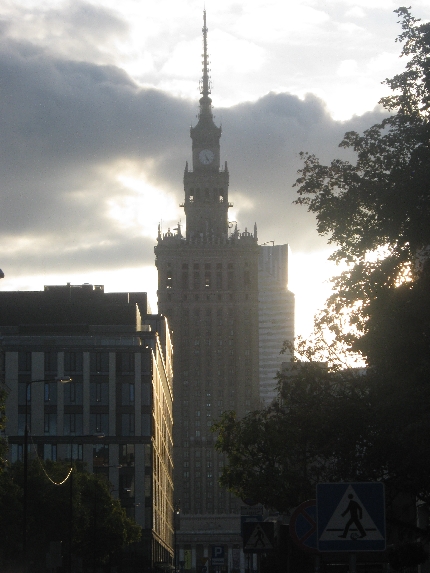
Palace of Culture and Science, Warsaw © Ricky Yates

Following lunch on Sunday 25th September, which marked the official end of the 2016 Eastern Archdeaconry Synod, quite a number of the Synod members stayed on for an afternoon walking tour through the centre of Warsaw. It was good to have the opportunity to see something of the Polish capital before returning to Prague the following day.

The first building that caught my eye after the taxi dropped me off in the city centre, was the tower of the Palace of Culture and Science. This building is a classical example of Stalinist-Baroque architecture and bears a striking resemblance to Hotel International here in Prague, located just a few hundred metres from the Chaplaincy Flat. Both are based on the design of Moscow State University.

The Palace of Culture and Science in Warsaw, built between 1952-55, was a ‘gift to the citizens of the city from the nations of the USSR’ 😉 During the communist era, it was seen as a symbol of Soviet domination and, as my Polish guidebook says, ‘still provokes extreme reactions, from admiration to demands for its demolition’.

Ministry of Finance building, Warsaw © Ricky Yates

Other examples of post-WW2 architecture are not so ostentatious such as this building which houses the Polish Ministry of Finance.

Our walk took us the length of Nowy Swiat, one of the historic thoroughfares of Warsaw, which later becomes Krakowskie Przedmiescie. Both streets are lined by a series of attractive buildings, but knowing how much is original, as against that which has been rebuilt since the destruction of World War Two, is difficult to tell.

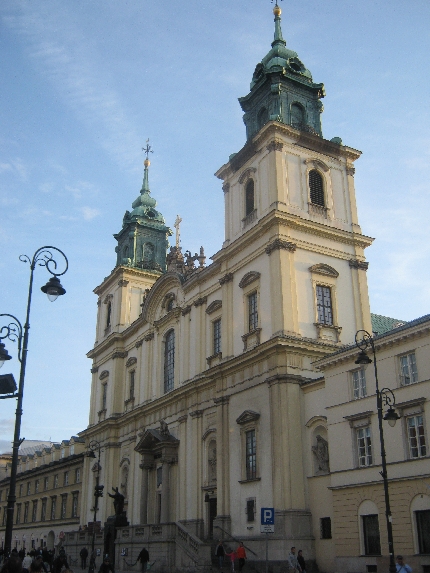
The Church of the Holy Cross, Warsaw © Ricky Yates

This is the baroque fronted Church of the Holy Cross whose main claim to fame is being the burial place of the heart of the composer Frederic Chopin.

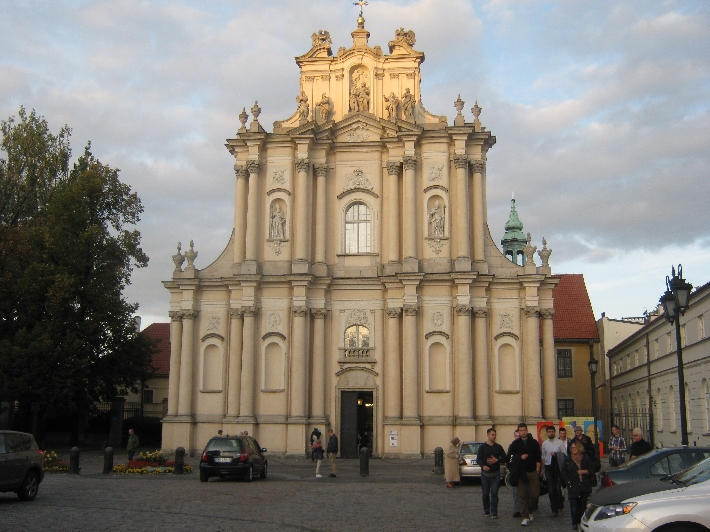
Church of the Visitation, Warsaw © Ricky Yates

Two other Churches along this ‘Royal Route’ as it is known, are the Church of the Visitation……

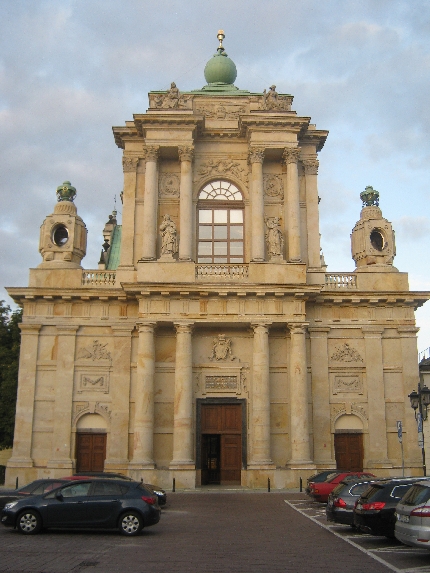
Carmelite Church of the Assumption of the BVM, Warsaw © Ricky Yates

…and the Carmelite Church, dedicated to the Assumption of the BVM.

Presidential Palace, Warsaw © Ricky Yates

In between is this grand palace which, since 1994, has been the official residence of the President of Poland.

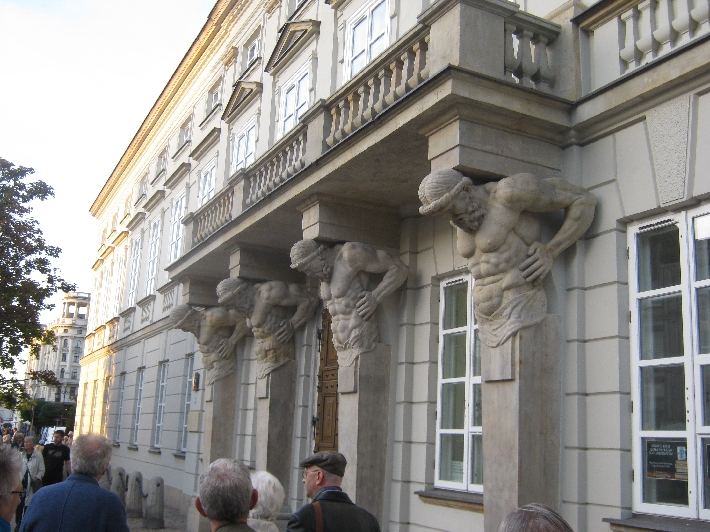
Balcony © Ricky Yates

Here, a balcony is being supported by four male figures, an architectural feature which can also be regularly observed in Prague, except that in Prague, the figures are more commonly female 🙂

The Royal Palace, Warsaw © Ricky Yates

The Royal Route ends in plac Zamkowy/Castle Square, which is actually more triangular than square 🙂 The original castle was built between 1598 – 1619. Sadly, this was utterly destroyed by the Nazis during World War Two and the current impressive building is a complete reconstruction undertaken between 1971 – 1988.

From the square, there is the view below, across the Vistula River, to a very recent addition to the Warsaw skyline – the National Football Stadium, completed in early 2012 in advance of Poland and Ukraine, hosting the European Football Championship.

National Football Stadium, Warsaw © Ricky Yates