In the early afternoon of Wednesday 14th October 2009, we drove into the town of Ürgüp, located in the central Anatolian region usually known by its ancient name of Cappadocia. Here the landscape in places looks more lunar than earthly! This is the result of eruptions from two or three nearby, now extinct volcanoes, which covered the surrounding area with volcanic lava and ash. The resultant landforms are quite spectacular and attract many visitors.
Driving into Ürgüp, we spotted the Melis Hotel and went to enquire about the cost and availability of rooms. The hotel attracted me for two reasons. One was that it was a well preserved old building, very much in keeping with the surrounding landscape. Subsequently, I discovered that it is a 300 year old Greek House which has been very sympathetically renovated and extended. The other attraction was that it had an outdoor swimming pool which still had water in it. Despite the daytime temperature being between 25 – 30 degrees Celsius, various other hotels we had seen in Ürgüp and elsewhere, had already emptied their pools for the forthcoming winter.
The Rev’d John Skinner, with whom we stayed at Selcuk the previous Sunday night, had wisely advised us never to pay the advertised price for a hotel room whilst in Turkey. Having been shown various rooms and been told what the ‘normal price’ for each of these was, I successfully negotiated a ‘special price’ for us staying for three nights and paying in cash with Euro notes. I got a reduction of 16.66%!!!! Something we had discovered in Croatia in July and now in Turkey, is that the role the US dollar used to have for travellers 20 – 30 years ago, has now been replaced by the Euro. Carrying and paying cash in Euro gave us better deals on numerous occasions during our trip.
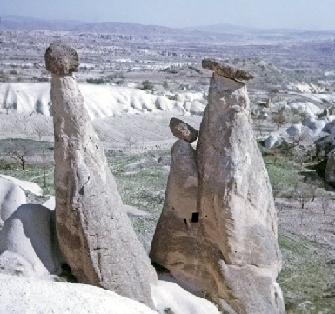
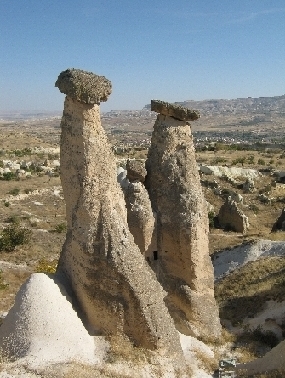
The outstanding feature of the Cappadocian landscape is one that I have already featured in my previously post. Whilst the most of the lava rock surface is hard, fissures in the rock have allowed water to penetrate and erode the much softer rock beneath. Once exposed, this softer rock has then been further eroded by wind-blown sand grains. This has created in numerous parts of Cappadocia, a series of landforms usually known as ‘fairy chimneys’. They are quite extraordinary as I hope you will see from the accompanying photographs.
The hard caps on top of the ‘chimneys’ protect the softer rock beneath. However, the soft rock does still slowly erode, eventually causing the collapse of the chimney. The different colour and texture of the various rock layers is evident in these photos.
I have mentioned a few times in describing my recent travels through Turkey, that I have once previously travelled through the country nearly 35 years ago in April 1975. Recognising that the only people likely to be reading this blog who knew me 35 years ago are my two older sisters, I thought a blog post of explanation was called for. If there is anyone else visiting my blog who also knew me in or before 1975, then please leave a comment & get in touch!
Although born and brought up in the UK, from July 1970 until mid-February 1975, I lived and worked in Australia. I then left Australia, flying from Sydney, via Singapore, Bombay and New Delhi, to Kathmandu in Nepal. There, on 25th February 1975, I joined a coach party run by a company called Penn Overland Tours and travelled all the way to London, where I arrived two and a half months later, on 7th May 1975.
I travelled what was then known as the ‘Hippie Trail’, except that I did it in reverse! It was in the era when the Shah was still in charge in Iran and the Soviet Union was yet to invade Afghanistan. Both these events happened some four years later, thus putting an end to such trips by Western visitors.
My journey across Turkey was therefore from east to west, entering the country from Iran and staying our first night in Erzurum. From there, we travelled via Sivas, Urgup in Cappadocia, Konya, Pamukkale, (see my previous post), Izmir – visiting Ephesus en-route, Canakkale, before crossing the Dardanelles and heading on to Istanbul. If I ever discover how to put a map into a blog post then I’ll put one in to help readers visualise the journey.
Therefore, my recent journey that I have described so far in this blog – crossing the Dardanelles, driving along the Aegean coast to Izmir and then travelling on via Ephesus to Pamukkale took me along the same route I had had travelled almost 35 years previously, but in reverse. On Tuesday 13th October, I continued that journey in reverse, driving first to Konya, where we stayed overnight, before driving onto Urgup the following day. We then stayed in Urgup for three nights, in order to explore some of the amazing sights of the Cappadocia region about which I shall write in my next blog posts.
The main record I have of my 1975 trip is a series of nearly 400 colour slides taken with a Kodak Instamatic Camera. Such is the manner in which technology has advanced since then, it is now impossible to purchase films for such a camera even though I still possess it. However, courtesy of present day technology, Sybille has successfully scanned a number of my old slides onto a memory stick which will allow me to post them on this blog.
The first of these is on the left at the top of this blog post, alongside a picture I took on my recent trip. Whilst taken from slightly different angles, they show the same three fairy chimneys in Cappadocia, but nearly thirty five years apart. I hope my readers will find comparing the two photos as fascinating as I do.
Following the visit to Ephesus, the synod members were wonderfully entertained to a barbeque supper at the nearby home of Rev’d John and Mrs Linda Skinner. John and Linda were founder members of the Northumbria Community in the North-East of England. In more recent years, they have run a small guest and retreat house just outside of the city of Selcuk and live a lifestyle that they describe as ‘New Monasticism.’ They very kindly allowed Sybille and I to stay overnight in their home when the rest of the synod members returned to Izmir later on the Sunday evening, ready for their respective flights home the next day.
We had breakfast in the sunshine on their terrace the next morning, in the company, (much to Sybille’s pleasure), of a menagerie of animals including three dogs, two cats and a horse. We then bid farewell to the Skinners and set out on the holiday part of journey, initially travelling inland to the small town of Pamukkale, in order to explore the amazing geological phenomenon that lies immediately above the settlement.
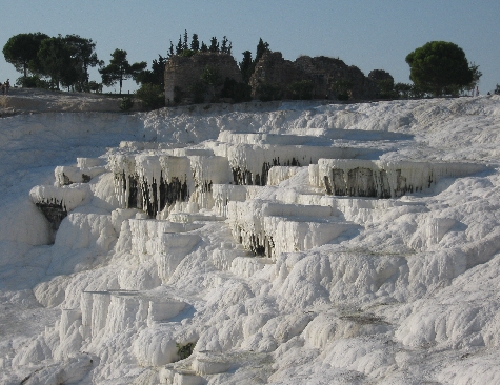
The name Pamukkale means ‘Cotton Castle’, an apt description of the hillside above the town. For thousands of years, several hot springs have released water, saturated with calcium carbonate, which has then run down the hillside, leaving snow-white deposits of a rock known as travertine. When one first views the hillside, it appears as though it is covered in slowly melting ice cream.
These hot springs have been used as a spa since the second century BC with the Greco-Roman town of Hierapolis being built on the top of the hillside. People came for the supposed curative powers of the spring water, the golden age of the city being during the first three centuries AD when it was visited by more than one Roman Emperor. With the collapse of the empire and with also suffering earthquake damage, it fell into ruin.
In the second half of the twentieth century, this whole area was rediscovered by travellers. Hotels were built, partly on top of the ancient remains of Hierapolis, and some of the hot spring water diverted into hotel swimming pools for guests to swim in. When I visited in 1975, I stayed in one of these hotels and swam in the swimming pool, not ever realising that my hotel was sitting on top of an ancient Greco-Roman city! It was also possible then, to freely walk across all parts of the white hillside with the warm spring water running across it.
In 1988, Hierapolis-Pamukkale was declared a UNESCO World Heritage Site and the Turkish government was forced to take action to conserve and preserve it. The hotels on top of the hill, which had almost certainly been built illegally, were demolished and visitors, who wish to stay overnight now, have to (as we did), use hotels within the town of Pamukkale itself. Both the hillside and the remains of Hierapolis have been fenced off and an entrance fee is now charged. Non-Turkish visitors are charged an entrance fee which is twice that charged to native Turks. If Turkey ever succeeds in its declared goal of becoming an EU member, that is one thing that will have to change!
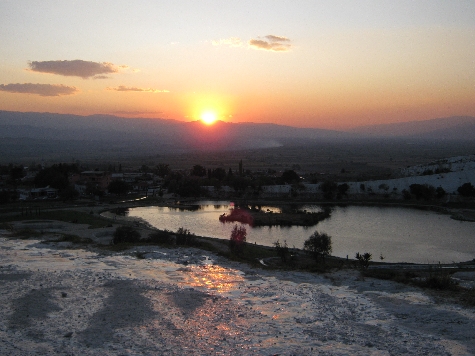
It is still possible to walk across the snow-white hillside and paddle in the shallow pools of warm spring water. But the whole area is now closely supervised and there are restrictions on the areas you may walk upon. All this must also be done in bare feet as shoes are completely banned. Hopefully these actions will help preserve this amazing phenomenon so it may be enjoyed by future generations as much as we enjoyed it on our visit on the afternoon and early evening of Monday 12th October 2009.
Although the Eastern Archdeaconry Synod meeting officially ended with the Eucharist and Ordination Service on the morning of Sunday 11th October, most synod members stayed on for a Sunday afternoon outing and guided tour to the Greco-Roman remains of the city of Ephesus some 50 miles/80 km south of Izmir. Although we had originally booked to go on the coach with everyone else, as we didn’t wish to return to Izmir late on Sunday evening, we instead followed the coach in our car.
I had previously visited Ephesus nearly 35 years ago in April 1975 and wondered how different it would be from how I remembered it. The most obvious contrast was the weather. My first visit took place on a cool day, under dark cloudy skies and with a light drizzle falling. As a result, the only photographic record I have is a series of bought slides. On the afternoon of Sunday 11th October 2009, we had clear blue skies, very bright sunshine and temperatures hovering around 30 degrees Celsius.
The other contrast was the number of visitors. Back in 1975, the party I travelled with were virtually the only people visiting the site. As I mentioned in an earlier post, tourism in Turkey was then in its infancy. This time, our coach party was one of many, with a variety of groups being taken around the site, thus making it difficult to take pictures that didn’t contain images of hoards of other tourists!
Rather than trying to describe all that is contained within this amazing site, I hope these accompanying photographs will do the talking for me.
One part of the site that was completely new to me was a series of six terraced houses, built into the hillside on one side of the main street. Apparently, their existence was known in 1975 but no archaeological digging had yet commenced. Having since been unearthed, they have now been covered with protective roofing to preserve the frescos and mosaics contained within them. I hope this picture gives some indication of how the wealthy of Ephesus lived in the last century BC and the first few centuries AD.
Ephesus has many New Testament associations. Acts 19 describes how St. Paul preached, taught and discussed with the people of the city during a period of over two years, bringing many to Christian faith. His time in the city came to an end following a riot initiated by the city’s silversmiths and other skilled workers. This took place in the city’s amphitheatre which is one of many outstanding structures that still remain. Our synod party sat on the terraced seats of the amphitheatre whilst Rev’d Jady Koch, the curate of Christ Church, Vienna, read the biblical passage describing those self-same events.
At the height of its importance as a city, the population of Ephesus may well have exceeded 200,000 people. Its size and economic success was very much based on it being a major port. However, slowly over the early centuries AD, the port silted up. The road on this picture used to lead to the port itself. Now the sea lies 4-5 km away! The city also suffered from a major earthquake in 262 AD and was further damaged by a series of lesser earthquakes during the following years. Therefore, although Ephesus hosted the Fourth Ecumenical Council in 431, its importance declined so that, over the next few centuries, it was slowly abandoned. Fortunately, despite the ravages of time, much of its former glory can still be seen today.
The 2009 meeting of the Eastern Archdeaconry Synod of the Diocese in Europe took place in the Kaya Prestige Hotel, Izmir, between 17.00 on Thursday 8th October until mid-afternoon on Saturday 10th October. We met in a large conference room on the second floor of the hotel and were able to set up the furniture so that one part was suitable for worship whilst the other could be used for listening to our speakers and for round-table discussion. However, like so many hotel conference rooms, there were no windows through which daylight might appear so it was good to be able to get out and walk around the city on the Friday afternoon during a two-hour break in proceedings.
In our Eucharist on Friday morning, we remembered Polycarp, Bishop of Smyrna who was martyred for his faith c155 AD, not so far from where we were meeting – Smyrna being the ancient name for what is now known as Izmir. We were reminded that Polycarp, when asked to forswear his faith and curse Christ famously declared, “I have served him for eighty-six years and he has done me no wrong; how can I blaspheme my King and my Saviour.” He was burned alive!
Our main speaker was Dr Colin Podmore, a Church Historian who has worked for the General Synod of the Church of England in various capacities since 1998. He gave three talks entitled ‘Aspects of Anglican Identity’. Not surprisingly, he has also written a book of the same title! Whilst one might not agree with everything he had to say on the topic, he certainly was a lucid a thought provoking speaker to listen to.
We also heard from David Healey, Communications Manager and General Manager of the Intercontinental Church Society (ICS), an Anglican mission society who support Christian work among English-speakers in countries where English is not the first language. ICS financially enabled the appointment in 2000, of John Philpott my predecessor as Prague Chaplain, and currently continue to meet about 10% of the Chaplaincy’s running costs as well of supporting us 100% prayerfully. Within the Eastern Archdeaconry, they also support the work of the Chaplaincies in Corfu and Kiev.
As well as speaking about the work of ICS, David also gave an illustrated talk about the impact of consumer culture upon belief and unbelief from a mission perspective. This was a revised version of a talk I’d heard him give last April at the ICS Chaplains and Families Conference. Part of his theme is one I have referred to more than once in this blog – that as Jesus said, “Life does not consist in an abundance of possessions” Luke 12 v15b.
A very important part of synod proceedings are the reports from each of the Chaplaincies. Many have financial struggles; those in St. Petersburg and Moscow have ever increasing difficulties regarding visas for chaplains and congregational members alike. Others have problems regarding their legal and tax status.
But there were also many positive things in several reports, particularly in the area of ecumenical cooperation. There are also possibilities of new Chaplaincies being established, notably in areas where increasing numbers of English-speakers are settling. One of these is on the west coast of Turkey. Members an expat group of Christians based at Didim attended the synod in an observer capacity and there is another similar group based around Bodrum. I understand that both these groups would like come under the ‘Anglican umbrella’. Our Archdeacon Patrick Curran, together with our Suffragan Bishop David Hamid, were staying on in Turkey after the synod, for a meeting with these groups to explore possibilities.
Although the synod had its serious moments, it was also a time for fellowship and fun. For the clergy, who in England would normally meet up with their near neighbours about once a month for a chapter meeting, it is rare opportunity to get together and mutually support one another. All of us in the Eastern Archdeaconry work in quite isolated situations. Geographically, my nearest colleague is my Archdeacon Patrick Curran who as well as being Archdeacon, is also Chaplain in Vienna. Vienna is about four hours from Prague either by car or train!
One of the slightly unnerving aspects of our meeting was security presence that surrounded us most of the time. There were always police in and around the hotel and often a private security man was hovering outside our meeting room. When on Saturday afternoon at the end of synod business, we set off to walk as a group to St. John’s Church, led by the Izmir Chaplain, Rev’d Ron Evans, we were followed by several police officers.
So far as one could ascertain, all this was organised by the hotel. There have in recent years been terrorist attacks in a number of tourist areas in Turkey which have usually been attributed to either the Kurdish PKK or Islamic extremists. The Turkish government is very keen to maintain and increase the number of tourists visiting the country as tourism makes a major contribution to the economy. Therefore they clearly want to deter and prevent anything that might damage the image of the country abroad. Later in our Turkish travels, we visited various tourist sites and an armed police presence was always very visible.
The final part of the synod meeting was our Sunday morning Eucharist, held in the Church of St. John the Evangelist, at which Bishop David presided. During the service, he ordained Tony Lane deacon, to serve the congregation of the Church of St. Thomas the Apostle, Kefalas, Crete. This congregation, which is now about 50 strong, was started by Tony a few years ago as half a dozen people meeting around his kitchen table. Since then he has personally built the chapel where the congregation now meet which was dedicated by Bishop Geoffrey in 2008.
Due to previous theological study, Tony was already a licensed Reader and this past year, he has undergone further training and been mentored by Canon Mike Peters, a recently retired priest from Somerset, who has spent the last six months in Crete, leading the congregation. Canon Mike was the preacher at the ordination service. The Crete congregation come under the umbrella of the Greater Athens Chaplaincy led by Canon Malcolm Bradshaw.
The Eucharist and Ordination Service were a wonderful way to conclude our synod meeting. It was followed by refreshments laid on by the Izmir congregation which we were able to enjoy in warm sunshine in the grounds of St. John’s Church.