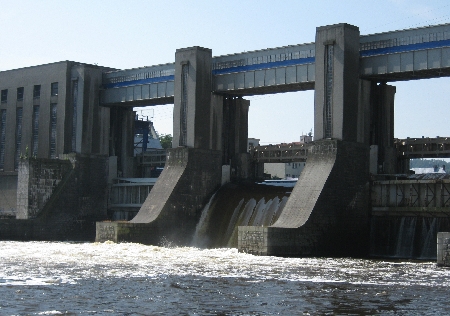
As most people who know me will already be aware, I have had a lifelong interest in canals and inland waterways. I was therefore delighted to discover that the Vltava, the river on which Prague is situated, is navigable. Engineering works, begun in the nineteenth century, have provided locks, navigable cuts and a sufficient depth of water to allow quite sizeable craft to reach the city.
The Vltava (or Moldau in German) leaves the Labe (Elbe in German) at Melnik, about 50 km north of Prague. From Melnik, it is possible to travel downstream along the Labe/Elbe all the way to the North Sea at Hamburg as well as connecting with canals and rivers that lead to Berlin and other German cities. Upstream of Melnik, the Labe is also navigable as far as the Czech city of Pardubice.
Not only is the Vltava navigable, it still carries quite a considerable amount of commercial traffic as far as Prague. From my observations, this mainly consists of bulky materials such as sand and gravel. The use of river transport in this way saves the surrounding roads from a large number of additional truck journeys which would otherwise be required to shift these goods.
In the centre of Prague, the Vltava is populated by many passenger vessels offering tourists trips along the river to view the city sights or to enjoy a meal in a floating restaurant. Most of these vessels rarely pass a lock, confining themselves to the section of the river between Hlávkuv most (just east of St. Clement’s Church) and to just south of Karluv most (Charles Bridge). However, a few months ago, I was delighted to discover that one company does offer a far longer trip upstream on the Vltava, all the way to the head of navigation at Slapy, nearly 40 km south of Prague city centre.
Pražská Paroplavební Spolecnost only run this trip on Saturdays and Sundays between early May and mid September. As Sundays are out because of my profession, if I was going to make the trip this summer, it was going to have to be on a Saturday. And having my sister Jenny staying with us for ten days recently gave me the perfect excuse. Here was a day out that we would both enjoy! So having for once, completed the Sunday sermon on Friday, on Saturday 15th August we set out early from the flat, travelled by bus and metro to Palackého námestí, bought our tickets from the office on the quayside, all ready for our departure upstream at 9am.
The boat was smaller than I was expecting and was quite packed with standing room only. However, so far as I was aware, Jenny and I were the only non-Czechs on board. This trip clearly appeals to Czech people who want to head out of Prague into the surrounding countryside but clearly doesn’t normally appear on the agenda of visiting foreign tourists.
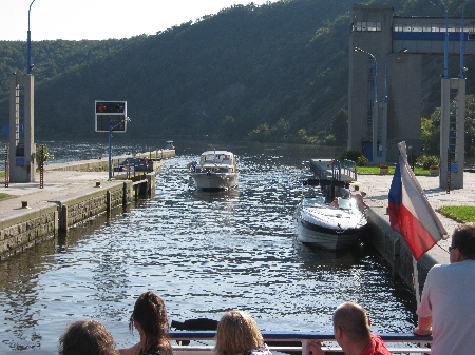
The initial part of the journey out of Prague goes past the Staropramen Brewery on one side of the river and the twin spires of the Church of St. Peter & St.Paul at Vyšehrad on the other. Then follows the southern suburbs of the city, together with passing our first lock at Modrany. Soon afterwards comes the confluence of the River Berounka and then the Vltava enters an ever increasingly beautiful wooded valley at Zbraslav.
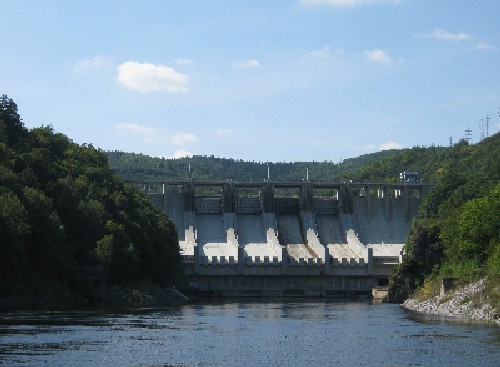
About 5 km further on lies the next lock at Vrané. This is situated at one side of a fairly substantial dam built across the river to generate hydro-electric power. Beyond this dam and lock, the river is wider because it is effectively a ribbon lake.
 |
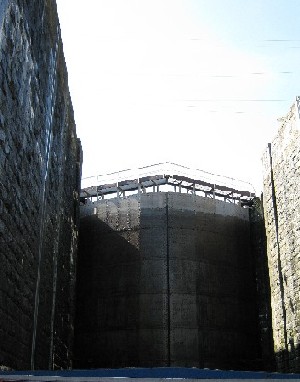 |
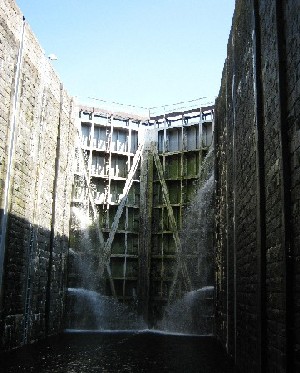
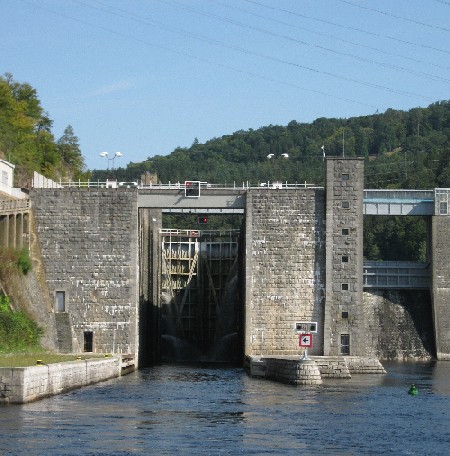
After cruising for over three hours and nearly 30 km, we arrived at the town of Štechovice. Here passengers both got off and on before we set out on the final leg of the journey. Ahead lay a much higher dam, also generating hydro-electricity, and therefore with a far deeper lock alongside. In fact the lock is monstrous – certainly the deepest lock I’ve ever passed through. The mind boggles as to how much water it takes to fill it! But eventually, our boat rose out of the bowels of the lock for a further forty minutes of cruising past beautiful wooded hills until we reached journeys end, the quay at Nové Trebenice, immediately below the very impressive Slapy Dam.
The Slapy Dam was built during the Communist era between 1949 – 1955. Like the earlier smaller dams we passed, it also enables the generation of hydro-electricity as well as helping to control the river flow, hopefully helping to prevent flooding further downstream during times of heavy rainfall. But for unknown reasons, no lock or boat lift was provided when it was built and the dam therefore prevents through navigation. The lake behind the dam is extremely popular with small yachts and pleasure boats. But none of them can cruise down the river to Prague because the Slapy Dam blocks the way.
After a quick lunch at a bar-restaurant in Nové Trebenice and a walk out on top of the dam, it was back to the boat for the return journey. This was fortunately less crowded as a number of people only did the journey one-way and got the bus back to Prague. It thus enabled me to more easily take the photographs that accompany this post. We arrived back at the quay alongside Palackého námestí at 6.30pm somewhat tired and a little sunburnt but having had a most enjoyable day.