Celebrating the Royal Wedding in the Czech Republic

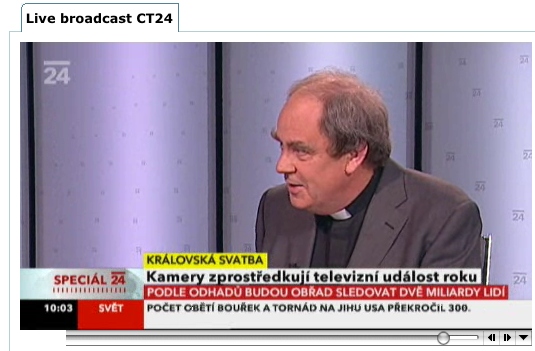
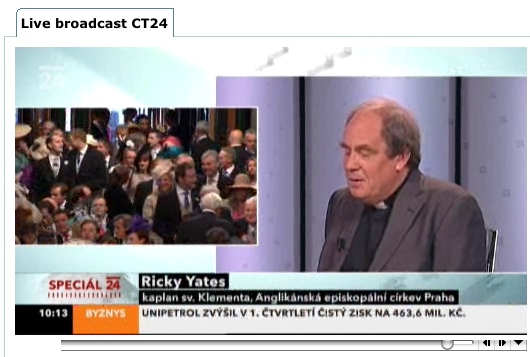
Being interviewed on Czech TV ©
Being interviewed on Czech TV © - with my correct title on the screen in Czech

One of the things I have begun to learn as part of being the Anglican Chaplain in Prague is to expect the unexpected. So when on the afternoon of the Wednesday of Holy Week, whilst walking along Jugoslávských partyzánu, my mobile phone rang with a call from a number unknown to me, I answered it with my friendly “Ricky Yates speaking”, unsure what the response would be.

“This is Czech TV”, said a female voice in English. “We would like you to take part in our special programme next Friday covering the Royal Wedding”. Therefore, following an email exchange with Veronika Linková of channel ct24, yesterday morning at 08.30, a taxi arrived outside the Chaplaincy flat, to whisk me away to the studios of Czech TV in the southern suburbs of Prague.

Upon arrival, it was first into the ‘make-up room’ to make sure my face looked its best under the glare of the lights. Then it was downstairs to the lounge where I was able to avail myself of several glasses of water to lubricate an increasingly dry throat. Here I met Martin who was to translate for me. I was also able to see and hear the live broadcast coming from the neighbouring studio.

Next it was the technician who ‘wired me for sound’ with a clip on microphone on my lapel and the battery pack clipped to my back trouser pocket. I was also fitted with an ear piece through which I would hear what I was being asked in Czech, translated into English. Then finally came the call to go into the studio to be interviewed live on Czech TV.
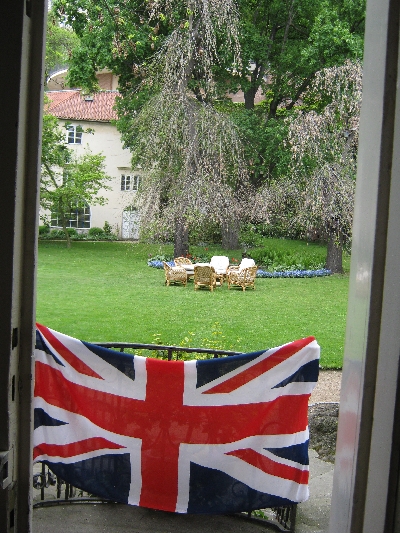
The balustrade overlooking the British Embassy garden suitably decorated for the Royal Wedding © Ricky Yates

I had been told in advance that I would be asked about the Anglican Church and the Marriage Service but I had no forewarning as to what the exact questions would be. Some were what I expected such as the relationship between the Royal Family and the Church of England and what impact I thought the televised wedding would have on people’s attitude to the Church.

As the Roman Catholic Church is the majority Church in the Czech Republic, I was also expecting a question regarding differences between an Anglican and a Roman Catholic ceremony. But what I wasn’t expecting was the surprise expressed by one of the two joint presenters Hana Scharffová, that a wedding should take place on a Friday because she claimed, that would never be allowed in the Roman Catholic Church as Fridays are meant to be days of abstinence.
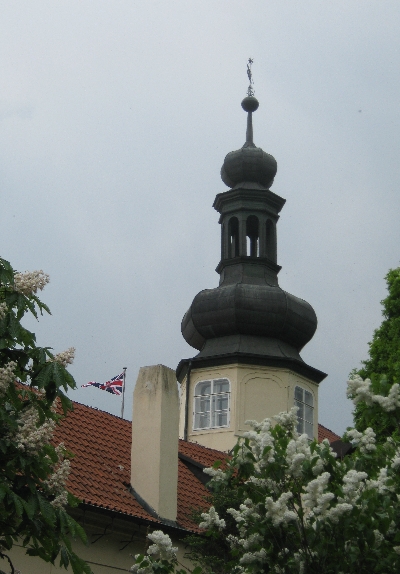
The tower of the British Embassy with the Union Flag flying © Ricky Yates

The question I certainly wasn’t expecting came from the other joint presenter Tomáš Šponar. He asked me about the level of support for the Royal Family within the Anglican Church in view of the outburst by Bishop Pete Broadbent on Facebook at the time of the announcement of the Royal engagement in November 2010. This was one piece of news that I didn’t realise had trickled down to the studios of Czech TV!

Unfortunately during the first part of my interview, the English translation into my ear piece was intermittent due to a loose connection somewhere. Fortunately, a combination of my limited understanding of Czech and both presenters occasionally re-phrasing their questions in English, allowed me to answer reasonably successfully. During a brief break, the technician who had wired me up, came back into the studio and sorted out the problem.

My questioning over, courtesy of Czech TV, I travelled back once more by taxi, but only as far as Mala Strana. There I was meeting up with Sybille as we had previously accepted an invitation to an event to celebrate the Royal Wedding that was not being televised! We were formally invited by the British Ambassador and her husband, to a Champagne Lunch at the British Embassy and more informally invited by ‘Sian and Richard’, to watch the Royal Wedding on TV beforehand. As we do not have a television ourselves, we were very pleased to have opportunity of watching it at the embassy.

The Embassy was suitably decorated to mark this special occasion as can be seen in the two accompanying photographs. As a memento of the day’s events, each guest was presented with a beautifully decorated gingerbread heart which can be seen below, laid out on a table, along with the visitors’ book.
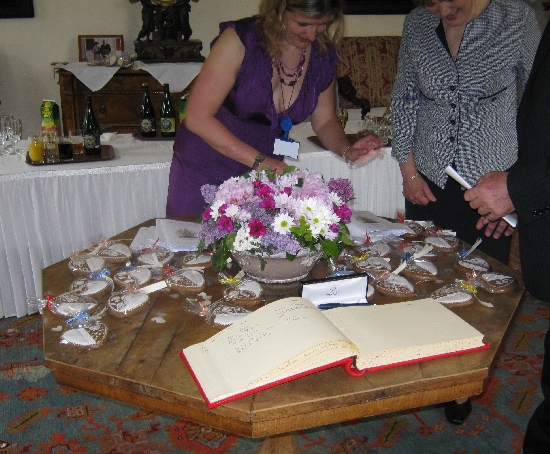
Decorated gingerbread hearts to celebrate the Royal Wedding © Ricky Yates

Jan Hus – Leader of the Bohemian Reformation and Czech Hero

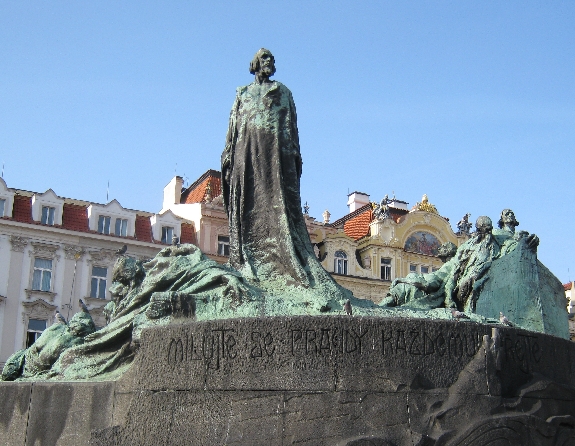
Statue of Jan Hus in Staromestské námestí/Old Town Square, Prague. © Ricky Yates

The photograph above is of the imposing statue of Jan Hus, located in Staromestské námestí/Old Town Square, in the centre of Prague. It is the work of the Czech sculptor Ladislav Jan Šaloun and was unveiled in 1915 to mark the five-hundredth anniversary of the death of Hus who was burnt at the stake on 6th July 1415.

Jan Hus was born around 1369 in the village of Husinec in South Bohemia. At a young age he moved to Prague, becoming a student at Charles University. He gained his Bachelor of Arts degree in 1393, his Master degree in 1396 and was ordained as a Roman Catholic priest in 1400.

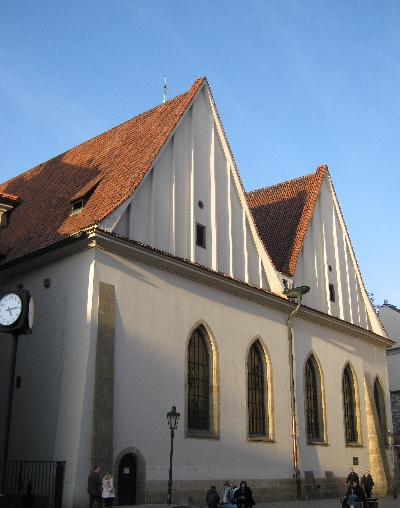
Bethlehem Chapel © Ricky Yates

The building in Prague most associated with Hus is the Bethlehem Chapel. The original Chapel, completed in 1394, was built for the express purpose of the service of preaching rather than for the celebration of mass. In 1402, Hus was appointed Rector of the Bethlehem Chapel and took up residence in rooms immediately adjoining the Chapel

Over the following ten years, the preaching of Jan Hus drew large crowds to the Bethlehem Chapel. He was very much influenced by the teaching and writings of the early English Church Reformer John Wycliffe, and in his preaching, called for reform within the Roman Catholic Church. He was particularly outraged by the selling of papal indulgences to collect funds for military purposes.

However, there are two significant things which Hus did or advocated which are reflected in the way he is now remembered by most Czech people. Firstly, he preached and wrote in Czech rather than Latin as he wanted his hearers and readers to fully understand what he was saying. Secondly, he wanted worshippers to be able to receive communion in both kinds – both bread and wine – and for lay people not to be forbidden to receive the chalice.

After a papal edict of September 1412, prevented Hus from preaching in Prague, he withdrew to the South Bohemian countryside where he continued to preach under the open skies and where he also completed most of his writings. In October 1414, having been assured of safe passage, he travelled to Konstanz to attend a Church Council which had been called to resolve a variety divisive issues within the Church at that time including the existence of three different individuals each claiming to be Pope! However, as part of the proceedings of the Council of Konstanz, Jan Hus was tried, found guilty of heresy and condemned to death. He was burnt at the stake in Konstanz on 6th July 1415.

The supporters of Hus were outraged and the Hussite movement flourished following his death, bringing about the Bohemian Reformation. Sadly, there were divisions between those who desired moderate reform and those who wanted far more radical change within the Church. Eventually in 1620, at the Battle of White Mountain/Bilá hora on the outskirts of Prague, the army of the Holy Roman Emperor Ferdinand II defeated the forces of the Bohemian Estates and as a result, unreformed Roman Catholicism was reimposed upon Czech lands.

The Czech National Revival, which began in the late eighteenth century, regarded Hus as a Czech hero, not primarily for religious reasons but rather for political and cultural ones. His opposition to church control by the Vatican gave strength to those who opposed control of Czech lands by the Hapsburgs in the form of the Austro-Hungarian Empire. He preached and wrote in the Czech language and therefore was a focus for opposition to the Germanisation of government, education and culture in Bohemia and Moravia. Therefore the statue of Hus located in Staromestské námestí/Old Town Square, in the centre of Prague, is surrounded by figures of victorious Hussite warriors and the figure of a young mother symbolizing national rebirth.

The Bethlehem Chapel fell into a dilapidated state and was partially demolished in 1786. Three original walls remained standing within which a sizable apartment building was constructed in the 1830s. Following the establishment of an independent Czechoslovakia in 1918, there were moves by the new government to purchase the apartment complex and restore the Chapel. But nothing concrete ever materialised before the outbreak of World War Two.

At the end of the war in 1945, the apartment building was confiscated from its German owners and, between 1950 – 1954, the Bethlehem Chapel was restored with considerable care to its original form. Ironically this took place under the guidance of a Communist run Ministry of Culture. But even the Communists used the legacy of Jan Hus for their own purposes by portraying him as a proto-communist!

Inscription and painting on the interior wall of the Bethlehem Chapel © Ricky Yates

Inside the chapel, the earlier inscriptions on the walls have been restored on the basis of known texts with associated illustrations, as in this photograph. However, this second wall painting was not in the original chapel as it shows Hus being burnt at the stake!

Painting on the inside wall of the Bethlehem Chapel showing Jan Hus being burnt at the stake © Ricky Yates

All Czech Protestants also remember and celebrate Jan Hus and the symbol they use to do this is the chalice. This is because of Hus insisting that all Christian believers should receive communion in both kinds.

Evangelical Church of Czech Brethren Church in Žižkov, Prague © Ricky Yates

The picture on the left is of an Evangelical Church of Czech Brethren Church building in the Prague suburb of Žižkov. It too is called the Bethlehem Chapel/Betlémská kaple and was constructed in the cubist architectural style. On the left of the front façade is a bust of Jan Hus whilst on the right is a bust of John Calvin. But as can be seen in close-up detail below, above the front façade are a Bible and, on top of the Bible, a large gold chalice.

Bible & Chalice © Ricky Yates
Plaque commemorating Jan Hus on the exterior of St. Clement’s Church, Prague © Ricky Yates

The photograph above is of a plaque on the outside of St. Clement’s Church which also belongs to the Evangelical Church of Czech Brethren. Like to statue in Old Town Square, this plaque was also erected on the 500th anniversary of the death of Jan Hus. With his picture, together with a chalice, thanks are given for ‘Svaté pameti otce Ceské Reformace – the holy memory of the Father of the Czech Reformation’.