Posts tagged ‘Adrian of Nepomuk’

Town Hall, Klatovy. The two plaques referred to below are either side of the bottom left window. © Ricky Yates

When I moved to live and work in the Czech Republic in September 2008, I believed I had a pretty good grasp of European History. I had studied the subject for many years at school and it was one of the three subjects I read, along with Geography and Theology, during my first year as an undergraduate student at university. However, during these past 16 months, my historical knowledge and understanding has been greatly increased as I’ve sought to understand the Czech people and this country which has become my current adopted home.

Good students of history do not just learn dates and places when and where certain events took place, such as knowing that the Battle of White Mountain occurred in 1620 on a hill just to the west of Prague. Rather they will want to understand the causes that led to the battle taking place and the consequences that followed from the victory of the Catholic League over the supporters of the Bohemian Estates. But a student still needs to know the dates and events before s/he can do any historical analysis.

During the last hundred years, the Czech and Slovak people have suffered much. Until 1918, they were a subjugated people incorporated into the Austro-Hungarian Empire. Then, having enjoyed twenty years as an independent democratic nation, their country was partly carved up without any consultation, by Neville Chamberlain and others at Munich. Six months later, the whole of Czechoslovakia was under Nazi occupation. Then, two and a half years after being liberated from the Nazis, the country was subjected to nearly forty-two years of Soviet inspired communist rule.

Under communist rule, many Czech and Slovak people suffered greatly. But it was not just people who suffered, another victim was historical truth.

Czechoslovakia has the distinction of being the country that endured the longest period of Nazi occupation. It was already fully occupied by March 1939 and was not liberated until the last days of World War Two in early May 1945. Liberation came from two different directions. Slovakia and Moravia and eventually Prague in Central Bohemia, were liberated from the east by the Soviet Red Army. But the whole of Western Bohemia, including the major city of Plzen, was liberated from the west by the Third US Army under General G.S. Patton.

After the Communist seizure of power at the beginning of 1948, there was a systematic campaign to suppress all acknowledgement of the U.S. Army’s role in liberating Western Bohemia. This effort continued until December 1989 when the Communists were removed from power. History textbooks declared that the whole of Czechoslovakia was freed from Nazi oppression by the valiant efforts of the Soviet Red Army. Schoolteachers were obliged to perpetuate the myth – to suggest otherwise would mean the loss of your job.

Last month, we drove out to Western Bohemia in order to visit our friend, Adrian Blank of Nepomuk, so he could carry out a couple of minor repairs to my car. But we combined the trip with a pastoral visit to one of our congregation who lives in a village very near to the German border but who regularly comes to Prague at weekends in order to worship at St. Clements.

Driving from Nepomuk towards the German border, we arrived in the attractive town of Klatovy where we stopped for lunch. We parked in the large square in the centre of the town which is surrounded by many architecturally interesting buildings including the Town Hall, pictured above. As we explored the square we saw two plaques, either side of a window on the outside of the Town Hall.

Soviet Communism's version of history, Klatovy © Ricky Yates

The first is only in Czech and reads in translation;

9th May 1945 the Soviet Army liberated Czechoslovakia

Unveiled as part of the celebrations of the 700th Anniversary of founding of the town of Klatovy

Klatovy was founded in 1260 so the plaque was presumably unveiled in 1960, twelve years into Communist rule.

Not only does the wording on the plaque perpetuate the myth that it was the Soviet Red Army that liberated the whole of Czechoslovakia, it also includes another little Soviet quirk. The German surrender that brought World War Two to an end in Europe came into effect late on 8th May 1945. This became known as VE Day (Victory in Europe Day) and is a public holiday in many Western European countries such as France. But because it was late on 8th May in France and Germany, it was already past midnight in Moscow. Therefore as far as the Soviet communists were concerned, VE Day was 9th May 1945! Since the Velvet Revolution, the VE Day public holiday is now marked on 8th May each year in the Czech Republic, not 9th May.

On the other side of the window is a second plaque, pictured below, with text in both Czech and English. Although not dated, it has clearly been put up since 1989.

Post-1989 correction of history, Klatovy © Ricky Yates

With this second plaque, the facts of Czech history have been corrected. Klatovy was liberated on 5th May 1945 by the US Third Army under General Patton. The following day, they moved on and liberated Plzen.

What I was most struck by was the fact that the Town Council had obviously decided not to take down and destroy the first incorrect plaque. They clearly felt that it was important to preserve it as a historical record of the Communist era. But the truth has eventually triumphed and is now clearly displayed for all to read. Much as many people would like to, especially Communist dictatorships, you cannot re-write history.

British car © Sybille Yates

British car © Sybille Yates

Change is coming! © Sybille Yates

Change is coming! © Sybille Yates

This morning, I walked out of the offices of ‘Praha Hlavní Mesto’ in the centre of Prague with an incredible sense of satisfaction. I had achieved what I had been told so many times, by a whole variety of people, was impossible to achieve. In my rucksack were Czech number plates and a Czech registration document for my previously British registered right-hand drive (RHD) car. Today my red Renault Megane Scenic has legally become a Czech car!

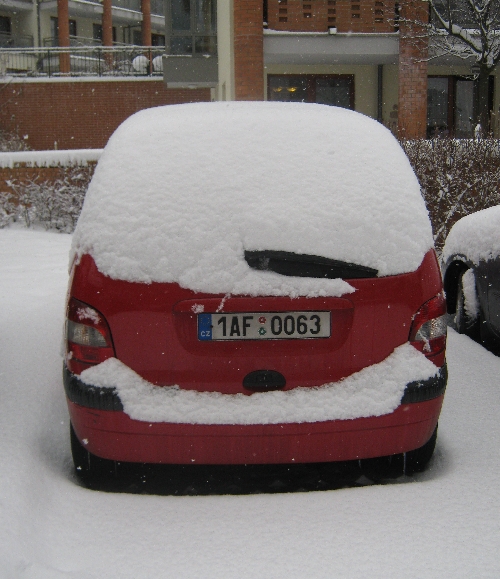
Czech car © Sybille Yates

Czech car © Sybille Yates

It should really be what we have achieved as I would never have managed to do this without the help and support of Sybille, the knowledge of the whole variety of procedures to obtain the appropriate protocols which came from Adrian Blank of Nepomuk, together with being accompanied through the final stages by Gerry Turner speaking in Czech on my behalf.

In my previous post entitled “Driving on the ‘right’ side of the road”; I explained how Gerry & I had gone to the imposing offices of the Czech Ministry of Transport on Wednesday 3rd June, to submit my application and accompanying papers for a ‘Certificate of Exemption’ for my RHD car. Adrian of Nepomuk had said that I should receive the certificate a week to ten days after submitting the application. When after two weeks, I had neither heard nor received anything; Gerry made a phone call asking what was happening. “Oh it will be in our system and we can take up to four weeks to process it” was the somewhat unhelpful answer given to Gerry. However, on Monday 22nd June, a registered letter arrived at our flat containing the certificate of exemption. The fact that the certificate was dated 17th June 2009, the date of Gerry’s phone call, does seem a little more than coincidence!

On the afternoon of Monday 22nd, I duly delivered the certificate to the Magistrát office in Vysorany, Prague 9 where all my other papers were already lodged. I had to return to the office on Tuesday to put two signatures onto the completed paperwork. Then it was a third visit in three days to collect the completed file on Wednesday. On this third occasion, Gerry accompanied me to ensure I discovered correctly what to do next.

We were told to go to the offices of ‘Praha Hlavní Mesto’ in the centre of Prague, pay 3000 Kc (about £100) environmental fee as my emissions are only ‘Euro 2 standard’, and there I would finally be issued with a Czech registration document and Czech number plates. We hopped on the tram, changed onto the Metro and arrived at the correct office. Through the good offices of Gerry, we explained to the lady on the information desk, what I had come to do. She checked through all the papers giving her approval to everything I had until she asked, “Do you have your insurance certificate with you?” What was the one thing I had not got with me????

So it was that Gerry and I reconvened at the offices of ‘Praha Hlavní Mesto’ at 9.30am this morning. We took our numbered ticket and waited for our number to come up on the electronic board to tell us which kiosk to attend. After about a half hour wait we were summoned.

The lady at kiosk 35 was perfectly friendly. We presented all my papers, including my insurance certificate. “Did I have my passport and residency document with me, not just the photocopies in the file?” Fortunately I had anticipated that one! “Had I personally imported the car?” This question reflects the concern of the Czech authorities of a glut of cheap second-hand British RHD cars being brought into the Czech Republic by unscrupulous dealers. “Did I have 3000 Kc to pay the environmental charge?” I went off to the cash desk, handed over the cash and returned with a receipt.

Then the magic moment came. Number plates were produced from a drawer. Stickers were attached, marked to show the end date of the validity of my mechanical and emissions protocols. A registration document in two parts, showing my new car registration number and my full name and address, came out of the computer printer. All these were presented to me. As a parting gesture, the lady then said to me in Czech, “May God bless you”. Gerry replied by telling her in Czech, how appropriate her words were as she had just said them to the English-speaking Anglican Priest in Prague. The poor lady nearly fell off her chair both with shock and with laughter!

This afternoon, the car underwent it’s transformation from being a British car to being a Czech car. Off came the British number plates and the ‘GB’ sticker. Using the British plates as a template, I successfully drilled two holes in each of the Czech plates and then proudly screwed them onto the car before, of course, posing for the photograph!

Right-hand drive vintage car in Prague © John Millar

Right-hand drive vintage car in Prague © John Millar

Continental Europeans, together with Americans & Canadians, are quick to tell British people that they drive on the ‘wrong’ side of the road. To them, driving on the right is ‘right’! Some British people can be just as bad in reverse, complaining that if they take their car across the English Channel, they have to drive on what to them is also the ‘wrong’ side of the road.

Like many British people, I have regularly taken my British registered right-hand drive (RHD) car to continental Europe both for holidays as well as for shopping trips to Calais. I personally have no real problem with driving a RHD car on the right (as in the opposite of left) side of the road. In the past few years I’ve twice driven from the UK to Galicia in the far north-west of Spain, as well as to southern Bavaria, to Switzerland and in June 2008 to Savona in northern Italy & then by ferry to Corsica.

Once you have driven well away from the French Channel ports and the popular coastal holiday areas of France, a British registered RHD car can attract considerable interest and attention. Last year, we drove slowly through a Corsican mountain village, the car windows wide open because of the heat. We passed the village bar with several men sitting outside enjoying a lunchtime drink. Spotting the RHD and the GB sticker, they stared at us in utter amazement until one of them called out rather slowly, “Do you speak English?” Sybille and I just descended into fits of laughter on hearing him. It was almost as though we had arrived from outer space!

Exactly a year ago, immediately before our holiday in Corsica, I accepted the invitation to be the next Anglican Chaplain in Prague. One of the many decisions that we then had to make was what to do with my car. Should I sell it and buy a left-hand drive (LHD) model in the Czech Republic. Or should I take it with me even though it would have the steering wheel on the ‘wrong’ side.

I soon decided that I would take it with me and that when we moved, we would drive all the way to Prague. My reasons were numerous

  • Selling my car for cash in the UK would never produce sufficient funds to buy the equivalent or similar model in the Czech Republic. I’ve since discovered that second hand cars here are considerably more expensive than in the UK.
  • I bought my current car, a Renault Scenic, from my local garage in Oxfordshire in January 2004. They have looked after and serviced it ever since and I was on first name terms with the owner and his staff. Buying a car in Prague without being able to speak Czech and with no way of knowing a vehicle’s history was a risk I was not prepared to take.
  • Driving in the car from Oxfordshire to Prague, enabled us to bring many things with us which we could not have put on a plane nor sent with the rest of our belongings which were transported here as a part container load. Chief amongst these was Oscar the cat, along with various plants, including a bay tree and an olive tree. We were also able to bring a computer and monitor and numerous other things that enabled us to live fairly normally before being reunited with the rest of our belongings some four weeks later.

As the Czech Republic is now part of the EU, I assumed that I would not have too many problems registering the car here. After all, there are an increasing number of LHD cars being driven around the UK with British number plates. These have either been brought into the UK by citizens of other EU countries now resident in Britain or by Brits themselves who have returned from living in continental Europe and have brought their LHD cars with them. That was, of course, before knowing what I now know about Czech bureaucracy!

My initial enquiries were all met with the same negative response. Yes, you can import a car but it must be LHD. There is no way to get a RHD car registered in the Czech Republic I was told. It was then that we first discovered the value of the website expats.cz. Searching the forum soon brought us to several threads dealing with cars. And with regard to getting a RHD car registered, the answer each time was, ‘Talk to Adrian of Nepomuk‘.

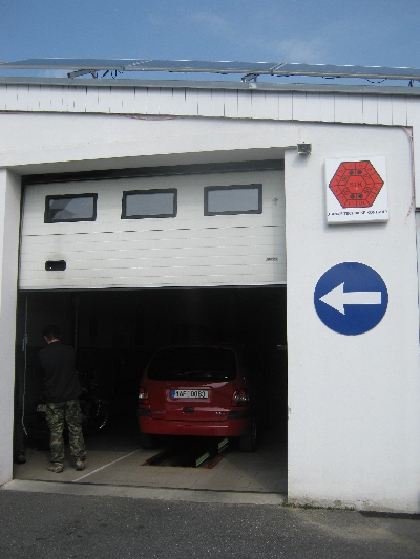
Adrian is a Brit married to a Czech and now works for his ‘in-laws’ truck and car servicing business in Nepomuk, south of Plzen. Early one Monday morning last December, after various phone & email exchanges, we made the one and a half hour journey out to Nepomuk. The main alteration necessary to the car was the headlights being changed so that they dip in the correct direction for driving on the right. Temporary stickers on the headlights are fine for short term holidays but not acceptable if the car is to be registered here. Fortunately, no other changes were necessary as my Renault Scenic already has functioning rear fog lights on both sides and a speedometer that is calibrated in kph as well as mph.

After that, we set off with Adrian to nearby Horazdovice where before and after lunch, the car was tested both mechanically and for it emissions, very much along the lines of the annual British MOT test. The tests were successfully passed and produced two protocols for me to take away. Adrian also arranged for us to go to another test centre in Prague some ten days later, in order to have the car mirrors checked to prove that the driver’s rear vision is not impeded by virtue of the car being RHD. This duly produced protocol number three.

Armed with these protocols, I successfully found a firm of English-speaking insurance brokers who kindly arranged third party insurance for the car, essential as my British insurer would only cover me for the first 90 days after leaving the UK. But jumping through the final hoops and getting the car registered with Czech number plates, had to wait until we had being granted our residency permits proving where we live. My previous blog entries entitled ‘A 21st century defenestration of Prague’ and ‘Dealing with Czech bureaucracy’ will explain that long drawn out procedure.

However, yesterday morning, accompanied by the ever-faithful Czech-speaking Gerry, I went to visit the imposing offices of the Czech Ministry of Transport alongside the Vltava River in the centre of Prague. Gerry took great delight in informing me that, prior to 1989, the building had been the headquarters of the Communist Party! There I presented all my numerous protocols, a copy of my UK car registration document, my passport and my Czech residency document and a signed statement in Czech and English declaring that my Renault Scenic is only for my own personal use and that I will not sell it on to anyone else in the Czech Republic. I also completed and submitted an application for a special exemption for my RHD car. Once I have my certificate of exemption, I can submit it with all the self same papers to another office in Prague and finally get a Czech registration document and Czech number plates. I’ve already paid the necessary fees.

What is so funny is the reason why in Czech law, it is possible to get an exemption for a RHD car. The explanation is that until 1939, the Czechs drove on the left side of the road using RHD vehicles! The rules of the road were changed overnight by decree when Hitler and his Nazi forces marched in. Therefore all cars made in and for driving in Czechoslovakia prior to 1939, are RHD. It was for these vintage cars that the original exemption provision was incorporated into Czech law.

The evidence of history is very easy to see in the historic centre of Prague today as in the photo above. Numerous individuals and companies offer visiting tourists guided drives around the main sites in vintage cars and nearly all of them are RHD because they date from the 1920s & 1930s. The odd one that is LHD is an import from Germany. My red Renault Scenic may not be a vintage car, (though it is now 9 years old), but it very soon will be a legally registered right-hand drive car in the Czech Republic.