Posts tagged ‘Renault Scenic’

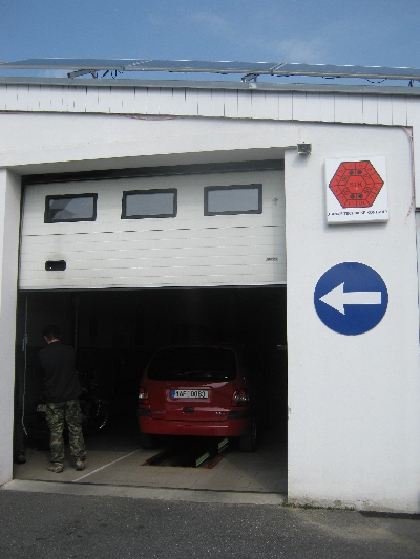
The 'Carly' at Nepomuk having a new crankshaft sensor fitted © Ricky Yates

In order to legally keep a car on the road in the United Kingdom, it has to have an MOT certificate. This shows that it has passed its MOT test, proving that it is mechanically sound and its exhaust emissions are within the accepted limits. The abbreviation MOT comes from ‘Ministry of Transport’, the then government department which first introduced the test in 1960.

In the Czech Republic, the equivalent of an MOT test is also known by a set of initials – STK. These stand for Stanice technické kontroly / Technical Inspection Station. Whilst in the UK, once a car is three years old, it has to pass an MOT test annually, in the Czech Republic the STK test only has to be undertaken once every two years.

As I wrote in my June 2009 post entitled “Driving on the ‘right’ side of the road”, my RHD Renault Scenic underwent its first STK test in December 2008, as part of the complicated procedure of obtaining a Czech registration document and Czech number plates for it. But as I explained in a subsequent post entitled ‘Check this Czech car out!’, I didn’t successfully achieve this until 25th June 2009.

Knowing that any vehicle has to have an STK test once every two years, I had assumed that the ‘Carly’, as it is affectionately known, would need to be tested again in December 2010. But when I asked my good friend Adrian Blank of Nepomuk, who helped me negotiate the minefield to get the car registered here in the Czech Republic in the first place, he assured me that the date the authorities would use would be two years from the date of registration, meaning that it did not need to be tested again before 25th June 2011.

Theoretically, I could have taken the ‘Carly’ to any STK centre in Prague for its test. But being aware of both my limited Czech and recurrent expression by many Czech people of their belief that you cannot register a RHD car here, I decided that it would be wise to once more work through Adrian, even though it would mean a journey out into the south-western Bohemian countryside. Therefore last Thursday, two days before the second anniversary of the ‘Carly’ becoming Czech, I set off.

Adrian suggested that, rather than travelling via Nepomuk, I should drive directly to the test centre at Horažd’ovice and he would meet me there. Fortunately, this worked out perfectly as we arrived at the centre within thirty seconds of each other. There is no system of booking a test at Horažd’ovice – you just turn up and wait your turn. Adrian discovered that there were two other cars in front of us so, having paid the test fee and handed over the car’s paperwork and keys, we went off and enjoyed coffee and cake together in a nearby outdoor coffee shop.

Stickers on the rear number plate of the 'Carly' showing the validity of its STK tests © Ricky Yates

Upon our return to the test centre, I was pleased to discover that the car had duly passed both its emissions and mechanical tests and my papers had been dated and stamped for a further two years. But, much more importantly, I had two new little hexagonal stickers on my rear number plate – one green for emissions and the other red for the mechanical test.

As in many continental European countries, the way the police can easily check as to whether a car has a current STK test certificate, is to look at these two stickers as illustrated in this photograph. On the outer rim of each sticker, is a hole between ‘5’ & ‘7’ indicating June, the sixth month. Then on the inner part of the sticker, there is a hole in the same box as ‘13’. My STK certificates are now valid until June 2013.

Adrian had also kindly ordered a new sensor for the crankshaft to try and resolve the occasional recent problem of the ‘Carly’ not wanting to start, despite the starter motor turning over. So after the STK test, I drove across to Nepomuk where it only took one of Adrian’s mechanics half an hour to fit before I was able to drive on back home to Prague.

Riverside Primary School in the snow © Ricky Yates

This winter will be the third one we have spent in Prague. In both 2008 and 2009, we had a dusting of snow before Christmas which soon rapidly melted. In both years, the really serious snow which settled and remained unmelted on the ground, didn’t arrive until January. However, this year, the snow has come early and hasn’t gone away since!

This winter, the first snow started falling during the night Sunday 28th – Monday 29th November. On the morning of Monday 29th November, I was booked to conduct assembly for Riverside Primary School which fortunately is located not far from the Chaplaincy flat. Normally, I hop in the car and drive there. Seeing the snow, I decided that discretion was the better part of valour and took the bus instead. Unlike in Britain, public transport in Prague doesn’t grind to a halt as soon as snow falls!

As it was the day after Advent Sunday, I spoke to the children about the Advent season and how we can use it to prepare ourselves for the coming of Christ. I also explained why Advent had begun the previous day and not on Wednesday 1st December when every commercial Advent calendar producer thinks it does! Here are the school children enjoying their break time out in the snowy playground immediately following my assembly. I’m sorry that the picture is a bit grey and grainy – it was still snowing when I took it!

My Renault Scenic in the snow © Ricky Yates

The snow continued to fall leaving large accumulations. The photo above shows the front of my car twenty-four hours later.

Overhanging snow & loose downpipe © Ricky Yates

Last week, we did have a couple of days when the temperature rose above 0 degrees and some of the snow began to melt. Besides causing some lying snow to turn to slush underfoot, a far more serious problem was accumulations of snow suddenly sliding off roofs and landing on unsuspecting individuals below.

I took this photo from our office in the Chaplaincy flat, looking across to the neighbouring block of flats which has recently been completed as part of the fourth and final stage of the Podbaba development. As you can see, a serious amount of snow is about to come off the roof! The sheer amount of snow also dislodged a piece of downpipe which has since crashed to the ground, along with the snow.

Then, just as I thought that all of the snow would melt, the temperature dropped below freezing again and earlier this week, yet more snow fell. The accumulation of snow hasn’t quite reached the proportions experienced in January this year, but it is rapidly heading in that direction.

In the midst of all this snow, life continues quite normally. Up the hill, behind the Podbaba flats complex, is a sports stadium. It is the home of Dukla Praha football team who currently are top of the Czech second division. Sensibly in view of the weather, they are currently on an extended mid-winter break and, having last played on Sunday 7th November, they are not due to play again until early in March 2011.

The football pitch is surrounded by a running track together with a variety of all-weather pitches and facilities. The stadium is also used for other events. Quite what event was being staged there last Tuesday evening I do not know? But what ever it was, it ended with a spectacular firework display. The Czechs seem to need little excuse for having a firework display and clearly, a serious amount of lying snow wasn’t going to stop them!

Firework display at the Dukla Praha Stadium © Ricky Yates

The Dardanelles - Europe on the right, Asia on the left © Ricky Yates

The Dardanelles - Europe on the right, Asia on the left © Ricky Yates

It is a month and a day since I’ve published a blog post and I’m sure some of my regular visitors will be beginning to think that I’ve disappeared off the planet. Rest assured – I haven’t! However, I have been absent from Prague for 23 of those 31 days only returning to the Chaplaincy Flat on the afternoon of Tuesday 27th October having left on the afternoon of Monday 5th October. Over the next few weeks I’m going to write about what I’ve been up to, hopefully making up for the lack of news during most of October.

As the title of this post says, Sybille and I have travelled to Asia and back and we’ve done the whole journey by car! I’ve driven 4,500 miles/7,200 kilometres and we’ve visited twelve countries in total. The trip has been part work and part pleasure – let me explain.

St. Clement’s Anglican Episcopal Church, Prague is part of the Church of England’s forty fourth diocese, the Diocese of Gibraltar in Europe. As with the other 43 dioceses that make up the Church of England, the Diocese in Europe is divided into Archdeaconries. My previous group of parishes were part of the Archdeaconry of Oxford, one of the three Archdeaconries that together form the Diocese of Oxford.

The Diocese in Europe is divided into seven Archdeaconries. Even the smallest of these, the Archdeaconry of Switzerland, covers the whole of one country. And Prague belongs to the largest of the seven, the Eastern Archdeaconry, which consists of everything eastwards from Poland, Czech Republic and Austria, including all of the former Yugoslavia, Greece, Turkey and all the former Soviet Union except for the Baltic States.

Once a year, each Archdeaconry has an Archdeaconry Synod where the clergy, together with elected lay representatives, meet to discuss and report on issues facing our scattered congregations, to pray and to study, as well as to make decisions regarding the common life of our chaplaincies. Because of the distances involved, the synod meetings have to be residentiary. This year, the synod meeting for the Eastern Archdeaconry took place between the afternoon of Thursday 8th and lunchtime on Sunday 11th October and was hosted by the Izmir Chaplaincy in Turkey. In their wisdom, this year’s Annual Meeting of the Prague Chaplaincy elected Sybille as one of their two lay synod representatives. So we decided that it would make good sense to combine our attendance at the Synod with my remaining annual leave.

Once we had decided to do this, I was very pleased to be able to arrange for Rev’d John Dinnen from Northern Ireland, accompanied by his wife Jane, to come and take up residence in our flat and for John to be locum chaplain for the three Sundays I would be away from Prague. John had been the first locum chaplain in April-May 2008 after the retirement of my predecessor John Philpott. What is more, Jane likes cats so they needed no persuasion to agree to also look after Oscar.

Because we would be on holiday once the synod meeting finished, rather than flying to Izmir, I thought, why not drive there? Instead of two airfares, there would only be the cost of petrol and overnight accommodation and we would have the car to explore Turkey and various chosen places on the way back. So it was that, at 2pm on Monday 5th October, we set out to drive from Prague in Central Europe to Izmir on the Asiatic west coast of Turkey.

Monday 5th October 2009

That afternoon, we headed south east out of Prague on the motorway towards Brno. Just before reaching Brno, we turned south and entered Slovakia, passing around the capital, Bratislava. Then it was into Hungary by which time it was beginning to get dark. So we ended our first day’s travel at Györ, an interesting historic city about an hour’s drive short of Budapest.

Tuesday 6th October 2009

The following day, we drove towards Budapest before heading south across the Hungarian plain to the border with Serbia, near the Hungarian town of Szeged. Here we left both the EU and the Schengen area. Entering Serbia, we had our passports stamped to show our date and place of entry and were also asked to produce our insurance green card for the car.

The British Foreign and Commonwealth Office website offers the following advice about driving in Serbia.

“You should also be aware that some parts of the motorway between Novi Sad and Belgrade have two-lanes with a hard shoulder on only one side.  Some drivers use the ‘middle’ lane to overtake, thus forcing the ongoing traffic onto the hard shoulder. We advise you to take additional care when driving on these stretches”

In fact, it is mainly the section from the Hungarian border to Novi Sad that has these characteristics. Frequent memorials at the side of road were a constant reminder of those who had previously failed to heed the wise advice of the FCO! Serbian police lurking under bridges were also an effective visual aid!

We crossed the Danube for the third time on our journey near Novi Sad, (having previously crossed it in Bratislava and just south of Budapest), and drove on to Belgrade. From Belgrade, there is a good dual carriageway/four-lane highway motorway passing through ever increasingly attractive scenery, all the way to the southern Serbian city of Niš where we spent the second night of our journey.

Wednesday 7th October 2009

That morning, we headed east from Niš, now on an ordinary single carriageway road, eventually reaching the border with Bulgaria just over an hour later. Here the Serbian border police stamped our passports, this time to show when we had left the country. They also took the cards, dated and stamped by the hotel where we slept in Niš, which proved where we had stayed during our time in Serbia. Apparently, the Serbian authorities can be difficult if you don’t have the proper evidence to show where you’ve been in their country! Entering Bulgaria, we re-entered the EU (but not Schengen!) and headed further east on a good road until we reached the outskirts of Sofia.

It was here that we experienced the worst section of road during the whole of our journey – the Sofia ring-road. Clearly dating from the Communist era, it is single carriageway nearly all the way around the city. Each crossing with a road heading out of Sofia is controlled by traffic lights with no roundabouts or flyovers. Because of the impact of heavy trucks, the road surface is severely rutted in many places. Unfortunately, we followed a large slow moving truck for the whole of our journey around it. Eventually, the last little section suddenly became three lanes each way and then joined the motorway enabling us to head east towards Turkey.

Waitresses at a Happy Bar & Grill © Andreas Welch http://www.flickr.com/people/awelch/

Waitresses at a Happy Bar and Grill © Andreas Welch http://www.flickr.com/people/awelch/

We had lunch at a motorway service/rest area in an establishment called ‘Happy Bar & Grill’. The food and service were good and reasonably priced and with our complete inability to speak Bulgarian, it was most helpful to have a waitress who could speak English. But the abiding memory we both have of our visit, is of the outfits worn by our waitress and all her colleagues which featured the shortest miniskirts you are ever likely to see!!! Some internet research since reveals that ‘Happy Bar & Grill’ are the largest and most successful restaurant chain in Bulgaria. I wonder why??!!!

After an enforced detour around a section of motorway still under construction, we eventually reached the border with Turkey. Leaving Bulgaria was easy but successfully entering Turkey was another matter. At the first of numerous check points, we had our usual problem of explaining why a Czech registered vehicle had right-hand drive whilst the two occupants produced German and British passports! The Turkish passport officers were all smiles once we’d explained everything but they then forgot to stamp our passports or tell me where to go to pay €15 for an entry visa.

When we got to the next check point, this time for the car, I duly produced my Czech registration document and green insurance card, together with my passport, in order that a record could be made of the car being brought into Turkey.  It was then that the failure to obtain my visa and have both passports stamped came to light. We had to park the car, go to the cash office, buy the visa, go back to passport control, get both passports stamped and then return to vehicle control!

There I got a lecture about why I must not try and sell my car whilst in Turkey but instead, export it again when I left the country. Why anyone in Turkey would actually want to buy a nine year old right-hand drive Czech registered car is beyond my comprehension!!! However, a record of my car was duly entered in my passport and woe betide if I dared try to leave the country without it.

We returned to the car in order to reverse back to baggage control when the car, for reasons known only to itself, refused to start! Eventually we had to ask someone from baggage control to come to us and then get a nearby coach passenger to help push the car in order to bump start it. Next it was customs and another check of documentation before finally, over an hour after we had arrived at the border, we were actually allowed to drive into Turkey.

The absence of part of the Bulgarian motorway, together with the Turkish border delays, meant we were somewhat behind my anticipated schedule. However, Turkey then produced the first of several surprises. I had expected the first section of motorway from the border to, & then around the city of Edirne, to be good. But when we left the motorway to head south towards the Gallipoli peninsular, I discovered that what I had expected to be a single carriageway road, was in fact a dual carriageway/four lane highway or well on the way to becoming one. Throughout our time in Turkey, time and again we were to be impressed by the standard and quality of the roads we drove on.

Eventually, after experiencing a wonderful sunset across the nearby Aegean Sea and driving for another hour and a half in the dark, we reached the town of Eceabat on the Dardanelles. As we drove slowly into the town, we saw a hotel sign and at the same time, two men sitting outside the building almost jumped out in front of us to flag us down. Seeing our foreign number plate, they suspected we were looking for somewhere to stay and were very keen to find more paying customers for their hotel. So it was that we booked into the somewhat eccentric but very pleasant Aqua Hotel in Eceabat.

After putting our overnight bags in our room, we went back downstairs to the restaurant. We were told that the menu was on the far side of the restaurant. When we got there, it was not a printed menu nor written on a blackboard on the wall as one might have expected. Rather, it was a glass fronted refrigerated unit! Within it was a selection of fresh fish, no doubt caught in the waters immediately outside the hotel, a variety of meat including kebabs, together with a selection of side dishes from which to choose. Basically we pointed to what we wanted and it was taken out, cooked and delivered to our table.

We chose a large fish to be cut in two & shared between us, together with some side dishes and a salad. All this we washed down with our first Turkish Efes beer. The meal and the liquid refreshment were most welcome after two and a half long days of driving.

Ferry Port at Kilitbahir © Ricky Yates

Ferry Port at Kilitbahir © Ricky Yates

Thursday 8th October 2009

After breakfast on the terrace by the sea, we drove about 3 km further along the road to the little port of Kilitbahir. Here we boarded the ferry that would take us on a short journey across the Dardanelles but also one that would take us from Europe to Asia. As you can see from the photograph, we were the first car on the ferry & therefore needed to be the first one to drive off on the other side in Canakkale. Fortunately on this occasion, the car started first time!

Our red Renault Scenic on the Dardanelles Ferry © Ricky Yates

Our red Renault Scenic on the Dardanelles Ferry © Ricky Yates

The journey from Canakkale to Izmir along the Turkish Aegean coast is one that I had made in reverse as part of a coach party, nearly 35 years previously in April 1975. For Sybille, it was her first time in Turkey or anywhere in Asia for that matter. Whilst the views and scenery were as beautiful as I remembered them, what I couldn’t help but notice was the scale of development of hotels and apartments all along the coast to support a tourist industry which was only in its infancy when I last passed along this self-same road. Also, as noted previously, there was a considerable improvement to the road itself.

So finally, after three days and nights, 1300 miles/2080 km of driving, just after 2pm, we arrived in the city of Izmir. There then followed a rather interesting 45 minutes or so whilst we tried desperately to find our way to the Kaya Prestige Hotel, the venue for our synod meeting. No, we don’t have a GPS/Satellite navigation system and guess who forgot to print out a Google map? However, assisted by the proprietor of another hotel who answered our crie de coeur by hopping in the front seat of the car to direct us around the one-way system, we finally arrived, two hours before the synod meeting was scheduled to begin.

Dalmatian islands seen from the coast road between Senj and Zadar © Ricky Yates

Dalmatian islands seen from the coast road between Senj and Zadar © Ricky Yates

On Monday 6th July, we drove right across Austria via Linz in the north to Klagenfurt in the south. As we did so, the rain got heavier and heavier so that, as we headed towards the steep mountain pass that would take us into Slovenia, it was positively tipping it down. The weather was no better on the Slovenian side of the border. However, as we joined the motorway to head south towards Ljubljana, (having purchased an expensive vignette to travel relatively few km of motorway), the rain slowly started to ease. And having bypassed Ljubljana and travelled on to Postojna where we left the motorway for the somewhat windy road that leads to the Croatian border, the sun came out as though to welcome us to our holiday destination.

At the Slovenian – Croatian border we had our passports checked for the first time on our journey. I couldn’t help but reflect on the irony of the situation and how the political geography of Europe has changed in the last twenty years. We had crossed from the Czech Republic to Austria and from Austria to Slovenia where, in both cases, border controls are now non-existent because all three countries are EU members and also part of the Schengen agreement. Yet now we were having our passports checked at a border that used not to exist until the beginning of the 1990s with the break-up of Yugoslavia.

It was also as we had our passports checked on the Croatian side of the border, that questions about our somewhat complex identity first raised their head as we tried to explain why a Brit and a German were travelling in a car with Czech number plates! This was the prelude to two cases of mistaken identity that occurred the following day.

We spent Monday night in the small Croatian coastal town of Senj. On Tuesday morning, after the secession of an early morning thunderstorm, we set out along the winding coastal road towards Zadar with wonderful views across to nearby islands. As we drove, we passed three motorcycles parked at the side of the road. Their riders & pillion passengers who were having a mid-morning break, waved to us in a very friendly fashion. We waved back and soon realised that the reason they were waving was because they were Czech and thought they were waving to fellow Czechs. Suddenly their friendly smiles turned to very quizzical looks when they noticed that my steering wheel was on the ‘wrong’ side!

Later in the day as we approached Zadar, we used a short section of motorway. As we turned off the motorway to drive into Zadar, we had to present our ticket and pay a small toll. Sybille wound down the car window and gave our ticket to the young man in the toll booth. ‘Pet’ he said, which is the word for ‘five’ in Czech. (There should be a hacek over the ‘e’ to lengthen the sound but most computer browsers won’t cope with it if I put one in and will instead render it as a ‘?’)! He seeing the Czech number plates was trying to be helpful and tell us in Czech, that we needed to pay five kuna, bearing in mind that both Czech and Croatian are Slavic languages with similar vocabularies. He couldn’t understand our blank looks until he saw where my steering wheel was located. ‘Five kuna’ he then said, and we paid!

British car © Sybille Yates

British car © Sybille Yates

Change is coming! © Sybille Yates

Change is coming! © Sybille Yates

This morning, I walked out of the offices of ‘Praha Hlavní Mesto’ in the centre of Prague with an incredible sense of satisfaction. I had achieved what I had been told so many times, by a whole variety of people, was impossible to achieve. In my rucksack were Czech number plates and a Czech registration document for my previously British registered right-hand drive (RHD) car. Today my red Renault Megane Scenic has legally become a Czech car!

Czech car © Sybille Yates

Czech car © Sybille Yates

It should really be what we have achieved as I would never have managed to do this without the help and support of Sybille, the knowledge of the whole variety of procedures to obtain the appropriate protocols which came from Adrian Blank of Nepomuk, together with being accompanied through the final stages by Gerry Turner speaking in Czech on my behalf.

In my previous post entitled “Driving on the ‘right’ side of the road”; I explained how Gerry & I had gone to the imposing offices of the Czech Ministry of Transport on Wednesday 3rd June, to submit my application and accompanying papers for a ‘Certificate of Exemption’ for my RHD car. Adrian of Nepomuk had said that I should receive the certificate a week to ten days after submitting the application. When after two weeks, I had neither heard nor received anything; Gerry made a phone call asking what was happening. “Oh it will be in our system and we can take up to four weeks to process it” was the somewhat unhelpful answer given to Gerry. However, on Monday 22nd June, a registered letter arrived at our flat containing the certificate of exemption. The fact that the certificate was dated 17th June 2009, the date of Gerry’s phone call, does seem a little more than coincidence!

On the afternoon of Monday 22nd, I duly delivered the certificate to the Magistrát office in Vysorany, Prague 9 where all my other papers were already lodged. I had to return to the office on Tuesday to put two signatures onto the completed paperwork. Then it was a third visit in three days to collect the completed file on Wednesday. On this third occasion, Gerry accompanied me to ensure I discovered correctly what to do next.

We were told to go to the offices of ‘Praha Hlavní Mesto’ in the centre of Prague, pay 3000 Kc (about £100) environmental fee as my emissions are only ‘Euro 2 standard’, and there I would finally be issued with a Czech registration document and Czech number plates. We hopped on the tram, changed onto the Metro and arrived at the correct office. Through the good offices of Gerry, we explained to the lady on the information desk, what I had come to do. She checked through all the papers giving her approval to everything I had until she asked, “Do you have your insurance certificate with you?” What was the one thing I had not got with me????

So it was that Gerry and I reconvened at the offices of ‘Praha Hlavní Mesto’ at 9.30am this morning. We took our numbered ticket and waited for our number to come up on the electronic board to tell us which kiosk to attend. After about a half hour wait we were summoned.

The lady at kiosk 35 was perfectly friendly. We presented all my papers, including my insurance certificate. “Did I have my passport and residency document with me, not just the photocopies in the file?” Fortunately I had anticipated that one! “Had I personally imported the car?” This question reflects the concern of the Czech authorities of a glut of cheap second-hand British RHD cars being brought into the Czech Republic by unscrupulous dealers. “Did I have 3000 Kc to pay the environmental charge?” I went off to the cash desk, handed over the cash and returned with a receipt.

Then the magic moment came. Number plates were produced from a drawer. Stickers were attached, marked to show the end date of the validity of my mechanical and emissions protocols. A registration document in two parts, showing my new car registration number and my full name and address, came out of the computer printer. All these were presented to me. As a parting gesture, the lady then said to me in Czech, “May God bless you”. Gerry replied by telling her in Czech, how appropriate her words were as she had just said them to the English-speaking Anglican Priest in Prague. The poor lady nearly fell off her chair both with shock and with laughter!

This afternoon, the car underwent it’s transformation from being a British car to being a Czech car. Off came the British number plates and the ‘GB’ sticker. Using the British plates as a template, I successfully drilled two holes in each of the Czech plates and then proudly screwed them onto the car before, of course, posing for the photograph!