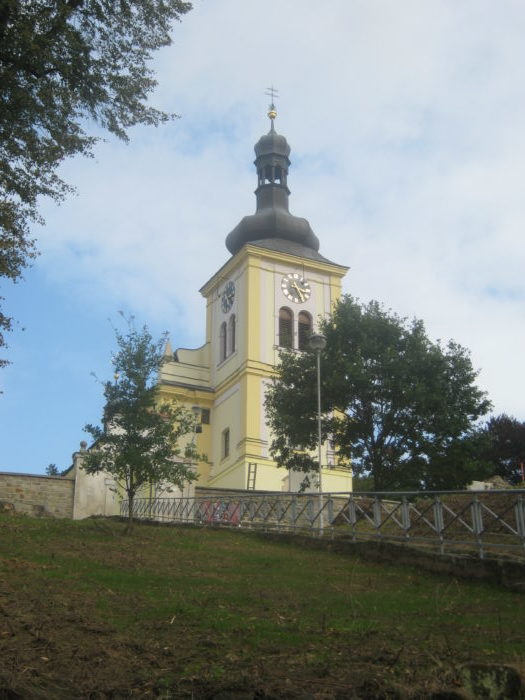
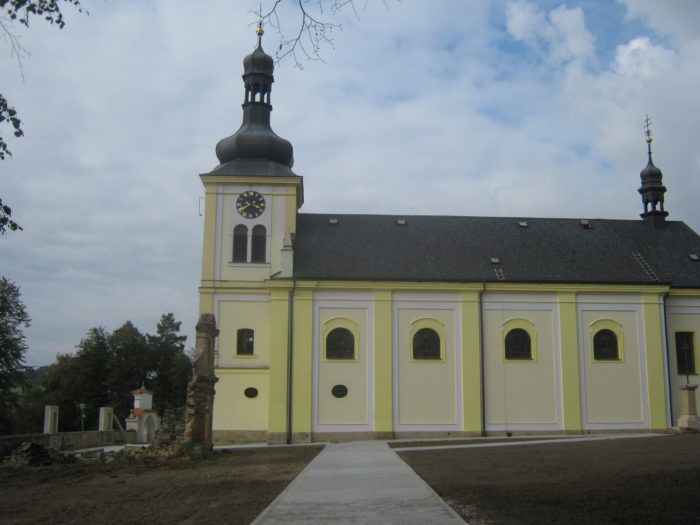
Today saw the reconsecration of Kostel sv Martina/St Martin’s Church in the nearby village of Markvartice. For the somewhat irreligious Czech Republic, renovating an abandoned Church building and bringing it back into liturgical use, is quite an event.
Whilst there has been a Church on the current site since the thirteenth century, the building in its present baroque appearance, dates from a rebuilding between 1701-04. It started falling into disrepair following the end of the Second World War, a result of the expulsion of the majority Sudetendeutsche population in 1945-6 and the communist takeover of power in Czechoslovakia, shortly afterwards.
The Church was last used for liturgical worship in 1966. By the late 1980s, all that was left standing were the perimeter walls – all of the roof had collapsed. Apparently, in 1989, the communist authorities issued an order for the demolition of the building, but fortunately, the Velvet Revolution took place before the order could be carried out.
Work to restore the Church began fifteen years ago, in 2002. Whilst funds to carry out the restoration have been raised locally, considerable finance has come from various German Roman Catholic dioceses. There has also been financial support from the regional government and from the Czech Ministry of Culture. This governmental support whilst welcome, is more about preserving what is seen as the country’s cultural and architectural heritage, rather than directly supporting the Roman Catholic Church.
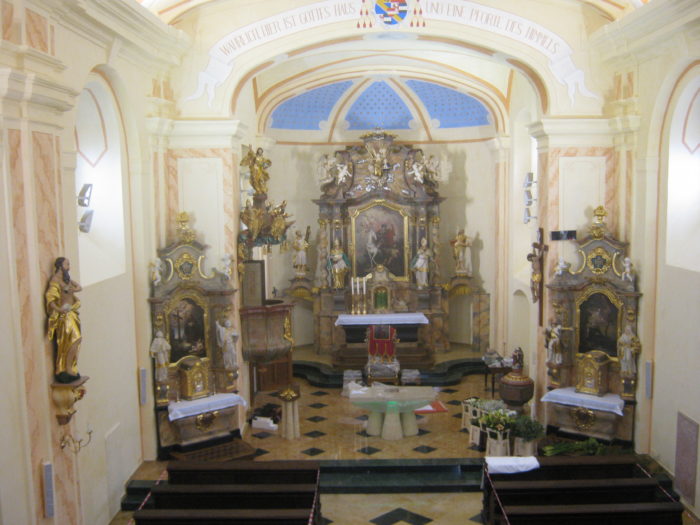
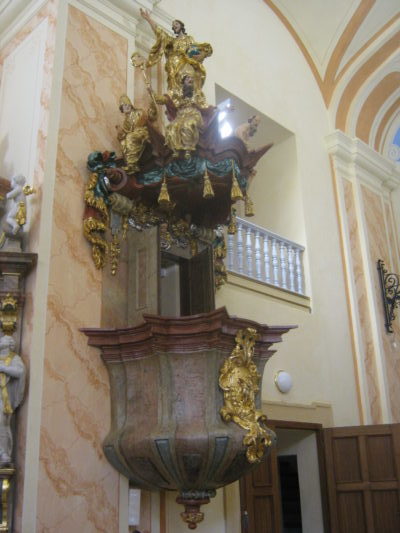
Markvartice is about eight kilometres by road from Stará Oleška. Earlier this week, after I first read about today’s reconsecration, I drove across there to visit the Church. Last minute work to get everything ready for today’s celebrations, was taking place, but I was able to explore and take the photographs that follow.
As you can see, the very baroque interior has been completely restored to a very high standard and a modern forward altar and lectern installed. One rather ‘interesting’ feature is the coloured light under the front of the new altar. It changes between the different liturgical colours, avoiding the need for different coloured altar frontals 🙂
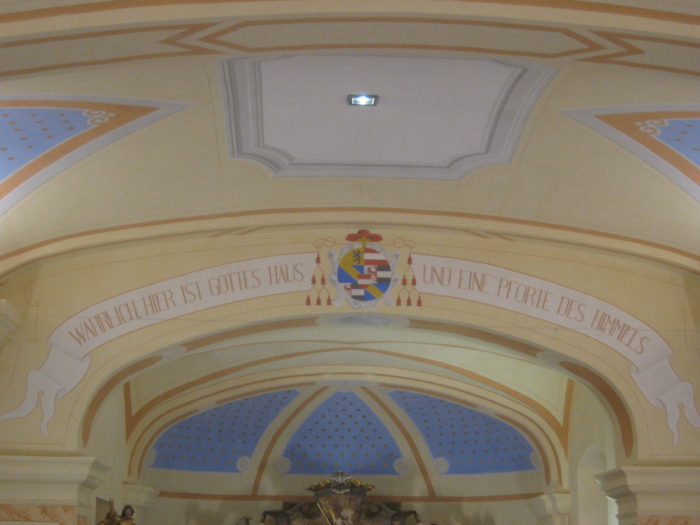
The inscription above the chancel arch clearly reflects the fact that German was the language of the majority population at the beginning of the eighteenth century until 1945.
The churchyard on the north side of the Church, has been almost completely cleared with the damaged remains of memorials, moved and placed alongside the boundary wall.
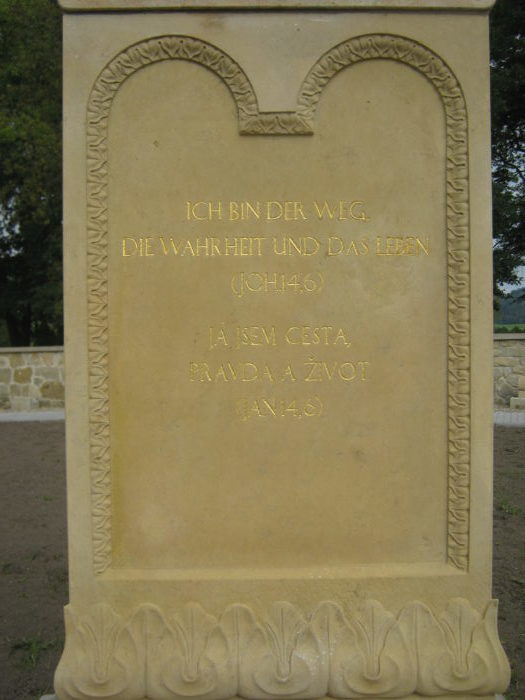
However, this memorial, with its bilingual inscription underneath a large cross, has been renovated and preserved. It is also an example of how much longer it takes to say something in German than in most other languages 🙂
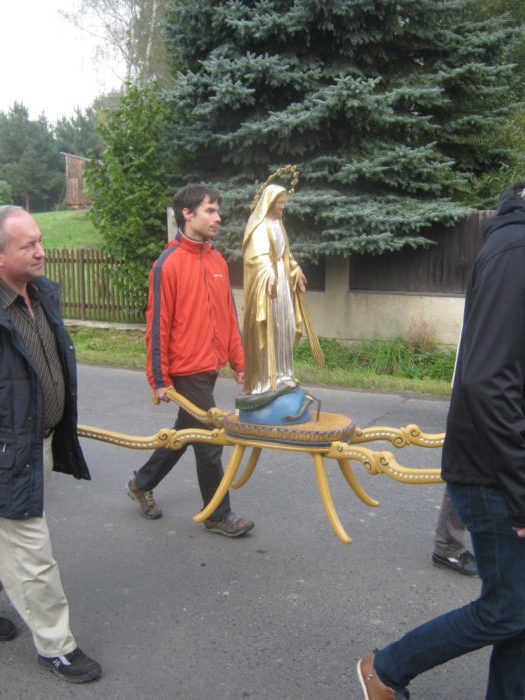
Today’s celebrations began with this statue of the Virgin Mary being carried in procession through the village. The procession started at the railway station, located at the southern end of the village, and proceeded to the Church, located at the northern end.
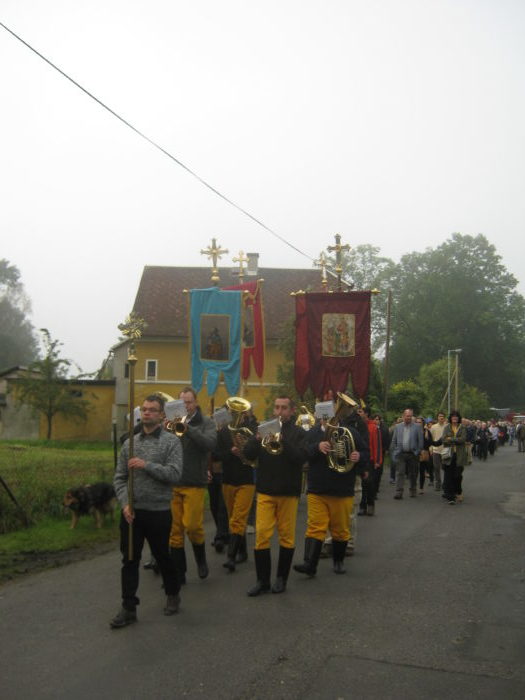
At the head of the procession, along with a processional cross and four banners, was a small brass band who I’m almost certain had travelled from Germany. There was quite a German presence with many German registered cars parked in the various temporary car parks that had been set up.
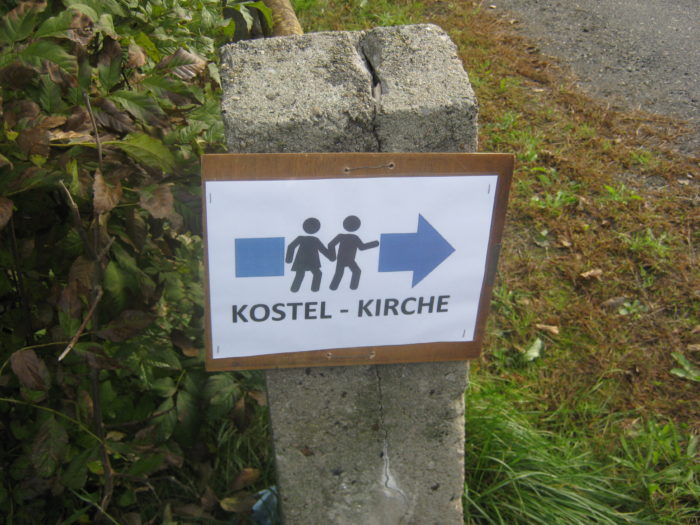
Hence this bilingual sign! There were also coaches which had brought people from elsewhere in the Czech Republic, particularly from Moravia which is the more Roman Catholic end of the country. Therefore whilst the Church was packed for the 11.00 mass of reconsecration, I do wonder how well attended it will be by local people, Sunday by Sunday, once all the visitors have left.
Back on the last Sunday of January 2016, we were joined at St. Clement’s for worship by Alex and Kathleen, a Czech-British couple, together with about fifteen of their family and friends. Alex and Kathleen live in the UK and are regular worshippers at their local parish church. But they also maintain a flat in Prague and, whenever they spend time here, they always join us for worship at St. Clements.
Alex was celebrating his ninetieth birthday, hence his family and friends had travelled from various parts of the world, to be in Prague to mark this special occasion. And attending our Church service that morning, was seen as an integral part of the weekend of celebrations.
A few months previously, Kathleen had asked me if they could invite a young Czech soloist called Jan, to sing during the service that morning. Jan is a personal friend of Alex’s and had studied music under our regular organist, Professor Michal Novenko. I assured her that this would be a wonderful addition to our worship and Michal was very pleased to cooperate and accompany Jan from the organ.
Therefore on that Sunday morning, Jan sang three different arias from Handel’s ‘Messiah’ – one after the sermon, before we said the Nicene Creed, and two during the administration of communion. He did so, standing on the balcony at the west end of the Church, where the organ is also located. From that vantage point, he watched and followed all of the service.
During the colder months of the year, following worship, we have Coffee Hour in the hall across the road from the Church in Klimentská 18. It is an opportunity both to share fellowship and to warm up after spending around eighty minutes in a Church with limited heating 😉 That morning, we also all got to share in a special birthday cake that Kathleen had provided.
At Coffee Hour, Jan sought me out in order to speak with me. He firstly thanked me for giving him the opportunity to sing during the service. But he then said to me, ‘ I want to bring a whole series of Roman Catholic priests to your services, to show them how to be warm and welcoming to everyone who comes to worship’. He then went on to say how he appreciated that everyone had a complete Order of Service containing all of our liturgy. How I explained when to stand, when to sit, when to join in, etc. For me, this is what I normally do. To him, it was a revelation!
As always, it is nice to be complimented and appreciated for what I do. But I was also deeply saddened to once more hear of the lack of warmth and welcome experienced by those who have attended Czech Churches, in Jan’s case, Czech Roman Catholic Churches.
Four and a half years ago, I wrote here on this blog, about the conversations I had with Czechs in their twenties, thirties and forties, at the reception following the wedding of Petr and Kristin. That they found the way I led that wedding service both warm and welcoming and in total contrast to their past experience of attending occasional Czech Church services. As I wrote then:
‘It is not the primary purpose of my being here in the Czech Republic, to minister to the spiritual needs of Czech people, but rather to the spiritual needs of native English-speakers. But I increasingly feel that the main reason that the Czech Republic is as atheistic or agnostic as it appears to be, is not because of a deliberate rejection of Christian faith by its population, but rather as a result of the failure of the Czech Christian Churches to be an attractive advert for the Christian faith.’
In recent months, I’ve tried to understand the reasons for this lack of welcome to newcomers or occasional worshippers in Czech Churches. So far, I’ve come up with two possibilities which I will now outline. I would welcome feedback, especially from native Czechs, as to whether I’m correct.
One reason is that it is a hangover from Communism. During the nearly forty-two years of communist rule in Czechoslovakia, those who attended Church worship; those who were Church members, all suffered. They were restricted in the area of employment, often being forced to only do menial tasks. Their children were limited regarding educational opportunities. Therefore Church congregations turned inward, seeking to mutually support each other. They didn’t welcome any outsider who wanted to join them, suspecting such individuals to be informers.
The second reason is not unique to the Czech Republic – I’ve come across it many times in England. It is the attitude that those who decide to come to Church, should already ‘know what to do’. They shouldn’t need any explanation – they should know!
Both of these attitudes have got to change! It is nearly twenty-seven years since the fall of Communism. The outsider is to be welcomed and not feared. And there is now an almost completely un-churched generation who cannot be expected to know what ‘we do in Church’.
Sadly, the answer to my question in the title of this post is that many Czech Churches are not welcoming. If they do want to grow and not die, habits need to change – rapidly!
Before 2015 comes to an end, I want to try and write, at least briefly, about all those things that happened in the second half of this year, but which never got the blog post they deserved – a combination of my own ill health and the excessive heat we experienced during the summer months. It will take two posts, so here is the first. And the second has now been written and published.
Monday 6th July marked the 600th anniversary of Jan Hus, the early Czech Church reformer, being burnt at the stake in Konstanz on 6th July 1415. As I have previously explained, during the past two hundred years, Czech people have tended to celebrate Hus as a political and cultural hero. His opposition to church control by the Vatican gave strength to those who opposed control of Czech lands by the Austro-Hungarian Empire. He preached and wrote in the Czech – language is the main factor in Czech national identity. Even the Communist regime tried to claim Hus as a proto-communist!
Therefore it was pleasing to see the main non-Roman Catholic Churches take the lead in organising events in Prague over a long weekend 4th – 6th July, to mark the 600th anniversary of Hus’s martyrdom. They took place on two stages erected either side of the newly renovated statue of Hus in Old Town Square, culminating in an open air Ecumenical service celebrating the life and teaching of Hus and broadcast live on Czech radio. It was good to see and hear Hus being commemorated for who he really was, with his spiritual legacy being reclaimed and proclaimed.
The other pleasing aspect were the efforts made by the Roman Catholic Church, to finally acknowledge their own history and responsibility for the death of Hus. Cardinal Vlk, the now retired, but still active, former RC Archbishop of Prague, spoke at the service, bringing a personal message from Papa František/ Pope Francis. At the end of his address there was applause, showing appreciation for the conciliatory nature of the message.
On the morning of Friday 10th July, I attended, along with Lea Williams, the last part of the Fifth Conference of representatives of the Cross of Nails Community in Central and Eastern Europe which was being held in Prague that week. The conference ended with a Festive Service at which the Dean of Coventry Cathedral, Very Rev’d John Witcombe, gave a address on the theme, ’75 Years of Peace Efforts by Coventry Cathedral – Turning enemies into friends’. Following the service, we were all invited to lunch at the Roman Catholic Archbishop of Prague’s dining hall where this photograph was taken.
On the morning of Sunday 26th July, we had the pleasure of the Choir of Little St. Mary’s, Cambridge, UK, enhancing our worship at our Sung Eucharist. Like previous visiting choirs, they very much enjoyed the excellent acoustics of the Church building, as well as the splendid organ. During their visit to Prague, they had a group photograph taken in each of the places where they sang. Therefore following worship, the choir posed on the chancel step, along with their travelling supporters, and insisted that I be in the middle of the photograph 🙂
August
The first half of August was dominated by my hospitalisation with a pulmonary embolism, about which I did manage a blog post of explanation. However, I was very pleased to eventually be given clearance by my GP, to spend Tuesday 18th – Monday 24th August, walking with Sybille in Germany, from Görlitz to Kamenz, along the first part of Der Ökumenische Pilgerweg. That week has to have its own blog post or posts, even if it isn’t written and published until early 2016.
As I explained in the post about my hospitalisation, one consequence is that I have had to retire from playing cricket. I have therefore donated all of my cricket kit – batting pads and gloves, wicket-keeping pads, gloves & inners, along with my box 🙂 , to the Prague Barbarians Cricket Club, for whom it has been my privilege to play for the past six summers. In turn, Terry the club captain, kindly organised a dinner in my honour to mark my retirement, attended by a number of my playing colleagues.
September
On each of the first two Saturdays of September, I conducted a wedding. In both cases it was British male marrying Czech female.
On Saturday 5th September, I conducted the wedding of Paul and Michaela, the couple who own and run Sansho, the dégustation restaurant where Sybille and I celebrated our joint birthdays earlier this year. Their wedding took place in the grounds of Trojanuv mlyn, Tiche udoli, a peaceful rural location just within the Prague city boundary. Unlike in England and Wales, outdoor weddings are permissible under Czech marriage law.
Using the liturgical texts that I gave her, Michaela had an attractive Order of Service produced, the cover matching their wedding invitations. Michaela’s brother Aleš, kindly helped me with the liturgy, enabling Michaela to make her vows in Czech whilst I helped Paul make his in English. Meanwhile, the very supportive congregation, sat on straw bales, surrounded by trees to witness the ceremony. It does have be said that I heard numerous, ‘It’s about time too’ comments, from friends and family, very pleased that Paul and Michaela had finally tied the knot 🙂
On Saturday 12th September, I conducted the wedding of Charles and Radka, a couple who I first met at the beginning of 2015, when they started worshipping at St. Clements, having just got engaged. Whilst Charles is a baptised and confirmed Anglican, it was a wonderful to hear Radka profess Christian faith and to baptise her as an adult, during our Easter Day Eucharist earlier this year.
Their wedding took place in Kaple Nalezeni sv Križe, Malé Cicovice, adjacent to the Penzion where they held the reception following their marriage service. Malé Cicovice lies north-west of Prague, not far from Kladno. On this occasion, Renata and Eva, two friends of Radka, helped her make her vows in Czech, whilst I did likewise for Charles in English.
Whilst we didn’t sing any hymns, I drove Larry Leifeste and his wife Celieta, from Prague to the wedding venue, so Larry could play the ancient chapel organ to provide music before the service, for the entrance of the bride, and for the happy couple leaving at the end of the service. It did make for a most enjoyable occasion, helped by some warm and sunny weather.
Between Thursday 24th – Sunday 27th September, I attended the 2015 meeting of the Eastern Archdeaconry Synod, which this year took place in a Roman Catholic conference centre, just outside Zagreb in Croatia. In past years, each Archdeaconry Synod meeting has had its own blog post, but in 2015……
Three highlights from this year’s meeting were:
1) Our long-standing and long-suffering Archdeacon Patrick Curran, formally stepped down as Archdeacon of the East and thus ceased to be ‘venerable’ 🙂 I’ve never seen Patrick so relaxed – he was very much demob happy 🙂 Patrick was presented with an icon of St Cyril & St Methodius by the Chaplaincies of the Archdeaconry, and with a framed map of Europe, together with an ‘interesting’ bottle, by Bishop Robert.
In his place, we formally welcomed our new ‘free-standing’ Archdeacon, Colin Williams. Colin is now half time Archdeacon of the East, and half time Archdeacon of Germany and Northern Europe. But unlike Patrick, who remains Chaplain of Christ Church, Vienna and oversees the daughter congregations in Klagenfurt, Ljubljana, Zagreb and Yerevan, Colin has no responsibility for a particular chaplaincy, hence he is deemed ‘free-standing’.
2) During our Sunday morning Eucharist, Janet Berkovic, who brilliantly organised the Zagreb Synod meeting, was licensed as a Reader by Bishop Robert. Janet has led the small Zagreb Anglican congregation for many years, under the long distance guidance of Patrick from Vienna.
Three years ago at our Synod meeting in Athens, Jack Noonan was licensed as a Reader to serve the Prague Chaplaincy. It was during that licensing service that the Holy Spirit spoke to Janet saying she should also offer herself to train as a Reader, something Patrick had been suggesting to her for several years. So she is now licensed as ‘Reader-in-charge of Zagreb’, but still under Patrick’s jurisdiction. An additional highlight under the Berkovic heading, is that Janet’s Croatian husband Danijel, a Hebrew scholar, gave us three brilliant expositions of the Psalms, particularly bringing out things that are so easily ‘lost in translation’.
3) On the afternoon of Sunday 27th September, after a tour of central Zagreb, we were invited to coffee and refreshments at the new headquarters building of the Croatian Roman Catholic Bishops Conference. Here we met the chairman of their ‘Ecumenical Committee’, together with one of their bishops. Whilst our Zagreb Anglican congregation use Roman Catholic premises for their services, the Anglican congregation is not recognised as a ‘Church’ in Croatia – they function as a ‘voluntary organisation’.
Therefore having Bishop Robert with us made quite an impact, most notably when he spoke, with Danijel Berkovic translating. I still remember the look of total surprise on the face of the RC bishop, when Bishop Robert said he was responsible for just over three hundred Anglican congregations scattered across Europe. With only seeing one little congregation of English-speaking Anglicans in Zagreb, they had no idea of the size of the Church of England in continental Europe, let alone the wider Anglican Communion.
‘Did you enjoy your holiday in Poland?’, is a question we’ve been asked several times since our return to Prague just over six weeks ago, on Wednesday 21st October. My reply is always a very positive ‘Yes’, with the notable exception of the problem we had with the ‘Carly’ when the immobilizer malfunctioned. I hope that some of our enjoyment comes through in my previous eleven blog posts 🙂
A number of people questioned in advance of our visit, whether we were wise to travel around Poland in mid-October, thinking we would experience bad weather. However, in the whole of the fifteen days we were away, we were only affected by rain twice – in the late afternoon and evening when we drove from Frombork to Malbork, and the bulk of the day when we sought to explore Wroclaw on foot.
During the first few days of our trip, when we enjoyed blue skies and bright sunshine during the day, it was inevitably quite cold overnight, with a touch of frost on occasions. But it was never severe and temperatures soon rose, once the sun came up.
There were two major pluses arising from visiting Poland in October. One was the wonderful array of autumn colours we saw as we travelled, which became more pronounced each successive day. The other was the cost of our hire boat on the Masurian Lakes, which was half what it would have been, had we hired it in July or August. But also, because we hired in the late-season, we then had the lakes virtually to ourselves.
The Masurian Lakes more than lived up to my expectations. What really impressed me was the excellent balance that the authorities seem to have achieved, between protecting the wonderful unspoilt environment with its variety of wild animals and birds, and allowing visitors to enjoy and explore the area. I would love to visit again in summer, but it would inevitably be far busier with many more visitors.
Although we travelled from the south of Poland, to the far north, and back again, we were still limited in the number of places that we had time to stop in and explore. And even in the places where we did stop, I often felt that we only scratched the surface of what there was to see and discover.
Speaking of the places in which we did spend some time, my own preference was for Wroclaw rather than Kraców, despite the rain that impinged on our enjoyment of the former. As Wroclaw is no more than five hours drive from Prague, it is certainly somewhere to which I would like to return, hopefully in better weather.
The inevitable question that has been asked is why didn’t we visit the capital, Warsaw. There is a very simple answer – I have to go there next year in late September, as the Warsaw Anglican congregation are kindly hosting the 2016 Eastern Archdeaconry Synod. I hope to encourage Sybille to come with me and we might then add on a few more days of annual leave, and discover a little more of Poland.
‘Did anything come as a surprise?’, is something I’ve also been asked. Probably the biggest surprise was discovering how widely English is spoken, with the exception of when we most needed it to be, when the ‘Carly’ broke down 🙁 Also, when we offered either English or German, English was nearly always preferred, with the notable exception of the marina at Mikolajki.
The only other surprise, though as a geographer by first degree I should have known, was discovering in reality, how big Poland actually is. Except when travelling on motorways, of which there are currently relatively few, it did take a lot longer than I originally anticipated, to get from A to B.
Of all the eleven blog posts that I’ve written about Poland, the one that has attracted the greatest number of comments has been the first one, regarding contrasts between the Czech Republic and Poland. I’m most grateful to everyone who did comment and it has been very reassuring to receive several affirmations within those comments, concurring with what I wrote.
Firstly, my thanks to Cynthia, an American expat living and working in the Czech Republic and who writes an excellent blog herself 🙂 , saying that she had exactly the same response from Czech people as we had, questioning why on earth she would want to spend time visiting Poland.
Secondly, I appreciated the various explanations, by both expats and native Czechs, as to why Czech people rarely visit Poland. That Czechs prefer the warm Adriatic sea to the cool Baltic sea. That they think it will be the same as the Czech Republic, therefore why would they want to see more of the same? That they have experienced poor Polish food imported into the Czech Republic and presume therefore that all Polish food is poor. That agnostic Czechs feel threatened by the power and influence of the Polish Roman Catholic Church!
My original observations were written and posted after only being in Poland for five days. But what we observed in the following days, only further confirmed what I originally wrote. I mentioned the high level of adherence and practice by Polish Roman Catholics, in contrast to to the Czech Republic. Both Sybille and I were amazed at the number of masses being celebrated at almost any urban Roman Catholic Church. The photograph on the left was one Sybille spotted in Wroclaw.
I also wrote that virtually the only area where I had observed any similarities between Poles and Czechs, was in their fashion sense. As in the Czech Republic, throughout our travels, we continued to see many men having long hair and tying it back in a pony tail. And it certainly seemed almost de rigueur, in virtually every bar-restaurant we patronised, for young female waitresses to wear short stretchy black miniskirts or mini-dresses 🙂
I finished that post by saying that since passing through the border area just north of Ostrava, we hadn’t seen a single Czech registered car! That continued to be true until three days before the end of our trip, when we were passed by a Czech registered car, just north of Wroclaw. But we didn’t see another until a few kilometres before the Polish-Czech border near the ski resort of Harrachov, on our drive back to Prague.
One major attraction that I omitted from my post about Wroclaw, were the dwarfs that can be found throughout the city. Apparently, there are now over three hundred of them! Our favourite of the ones we spotted, was the dwarf using the ATM, at the beginning of this post. Below is another.
Ever since moving to Prague just over seven years ago, Sybille and I have adopted the view that we should take full advantage of being based in Central Europe, to explore both the Czech Republic beyond Prague, together with neighbouring countries. So earlier this year, we decided that we would spend two weeks of my 2015 annual leave, visiting the Czech Republic’s immediate northern neighbour, Poland.
Our Polish odyssey began last Wednesday 7th October, when we set out to drive from Prague to Kraków. Ironically, although Kraków lies north-east of Prague, the quickest way to get there was to drive south-east on the D1 motorway to the outskirts of Brno before then heading north-east, passing around Ostrava and over the border into Poland.
For the first time in our travels, we used airbnb to find appropriate accommodation. Using their website, Sybille found us a studio apartment within walking distance of the historic centre of Kraków which also had secure parking for the ‘Carly’. We spent two nights staying in the apartment and the intervening day exploring the city.
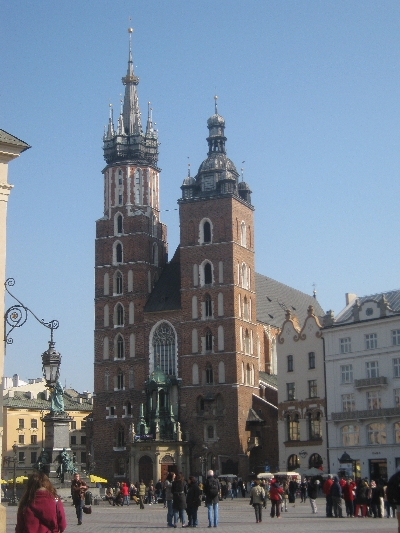
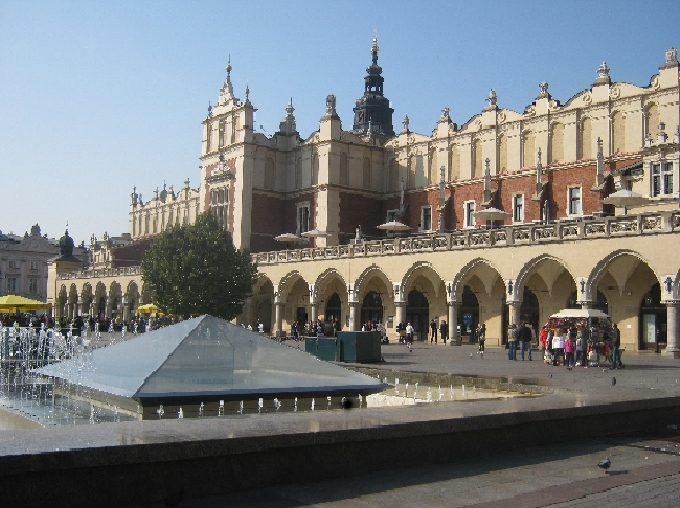
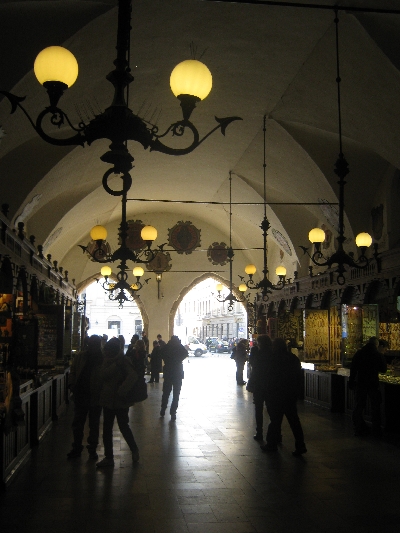
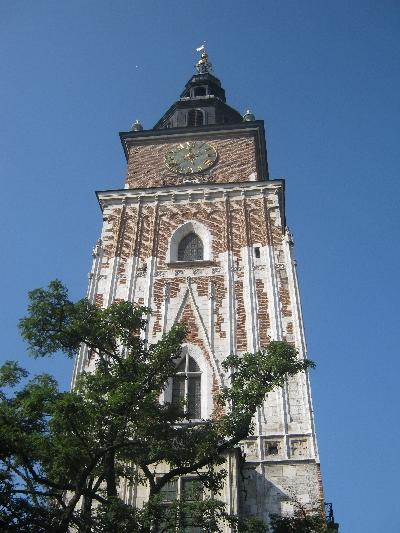
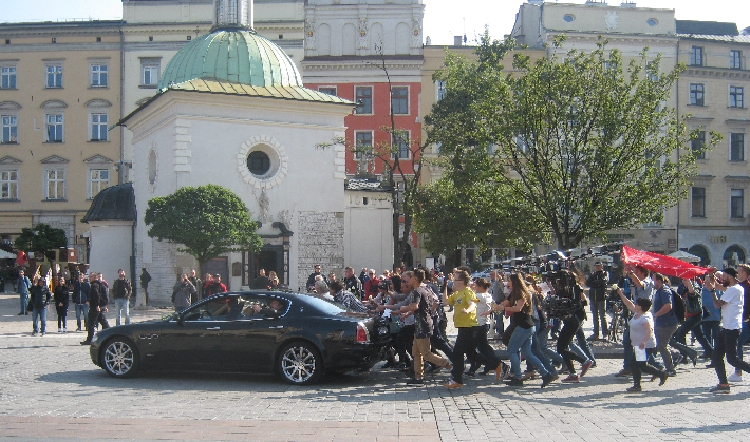
First we visited Rynek Glówny, the main market square, where the title photograph and the following three photographs were taken.
Whilst in the square, we witnessed the filming of part of a TV series featuring my namesake, Ricky Gervais, with a drone being used to take pictures, and several ‘heavies’ to keep the crowds at bay!
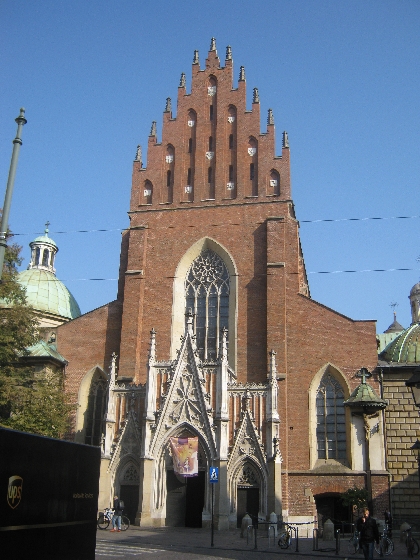
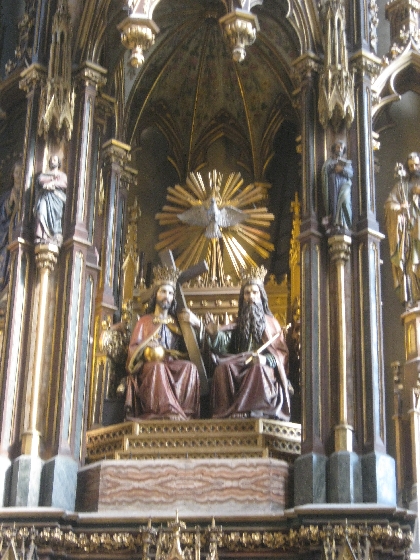
We also visited Churches belonging to two different Roman Catholic Orders – the Dominicans and the Franciscans. This is the Dominican Church, dedicated to the Holy Trinity. Below is a photograph of part of the reredos within the Church, seeking to illustrate the Trinity, with God the Father portrayed as an old man with a long beard 🙂
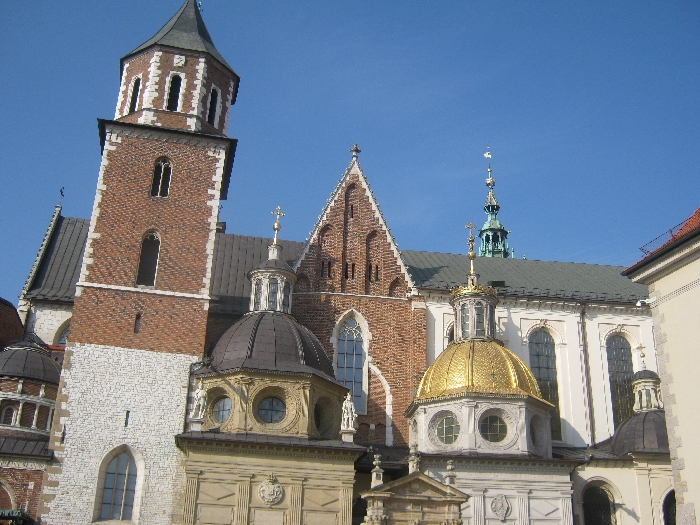
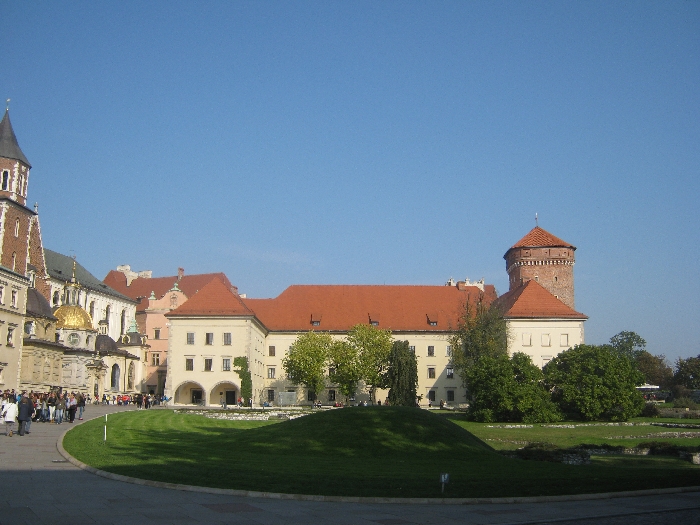
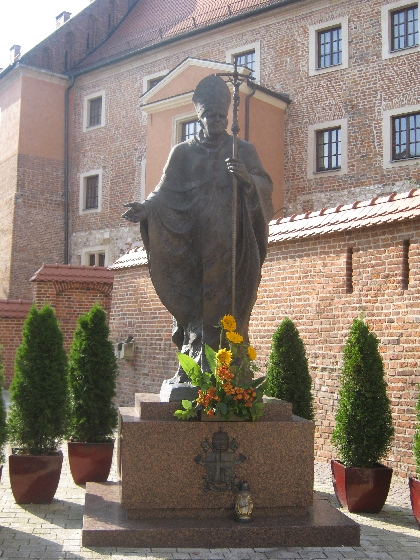
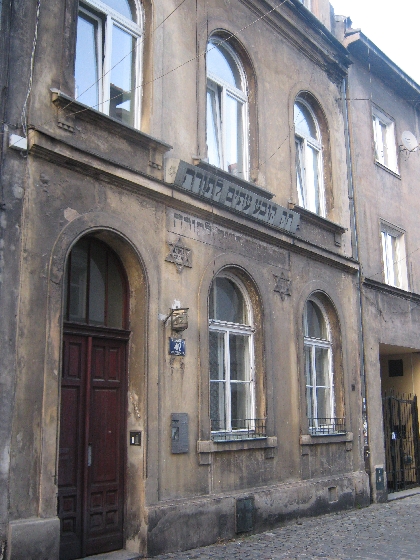
We spent the last part of our day in Kraków, exploring the Kamimierz district, the former Jewish quarter. This area is far less ‘spruced up’ than the other central parts of the city and remains a poignant reminder that around 65,000 Jews from the city of Kraków and the surrounding districts, were murdered by the Nazis during the Second World War.