Winter has arrived

The view from my front door on Tuesday 12th January © Ricky Yates


As I explained in this post, the winter of 2019-2020 was remarkably mild. However, the winter we are currently experiencing is bearing a much greater similarity to my first two winters living here in Stará Oleška and a week ago, winter arrived with a vengeance.


Before Christmas, we had a dusting of snow on a few occasions, but it soon melted. On 26th December, Boxing Day, we had a further light snowfall but which again, mostly melted in the following twenty-four hours. But overnight Friday 8th – Saturday 9th January, snow fell once again and didn’t melt. And since then, snow has fallen, snow on snow!


The view from my front door on Saturday 9th January © Ricky Yates

This was the scene that greeted me when I got up on the morning of Saturday 9th January.

Olešský rybník on Saturday 9th January © Ricky Yates

Later that day, I went for a walk to Olešský rybník, the lake at the other end of the village. As you can see it was almost totally frozen at the surface with snow lying on top of the ice.

Stará Oleška 44 © Ricky Yates

The photo at the beginning of this post was the view from my front door on Tuesday 12th January, before I cleared my front path. And above is a view of my house from outside of my front gates, taken the same day.

My back garden © Ricky Yates

The new path across my back garden, from the rear steps to the woodshed, has very much proved its worth during the current weather. You can just about make it out in this photo, taken before I cleared it of snow. But being smooth and even, it is relatively easy to scrape snow off it.

A few days ago, my Czech friend Kát’a, who has helped me with language issues in recent months, saw one of my snowy photos and said she would like to make a snowman. She lives in Decín, which although being only 11km from my home, is 135m above sea level, whereas Stará Oleška is nearly 300m above sea level. Therefore what falls as snow here, often only falls as rain in Decín.

Snowman & snow woman © Kát’a Burešová

Therefore yesterday, ironically when Decín did get some snow, I picked her up and brought her to my house and together, we made a snowman and a snow woman 🙂 The snow woman was Kát’a’s idea and her creation 🙂

My back garden, Friday 15th January © Ricky Yates

Today we have had yet more snow. Once more, I cleared the path to the woodshed, past the snow people 😉 ,  in order to split some more logs and bring them into the house and keep the wood-burning stove going. But as you can see, within an hour it was once more being covered in snow.
Winter has arrived

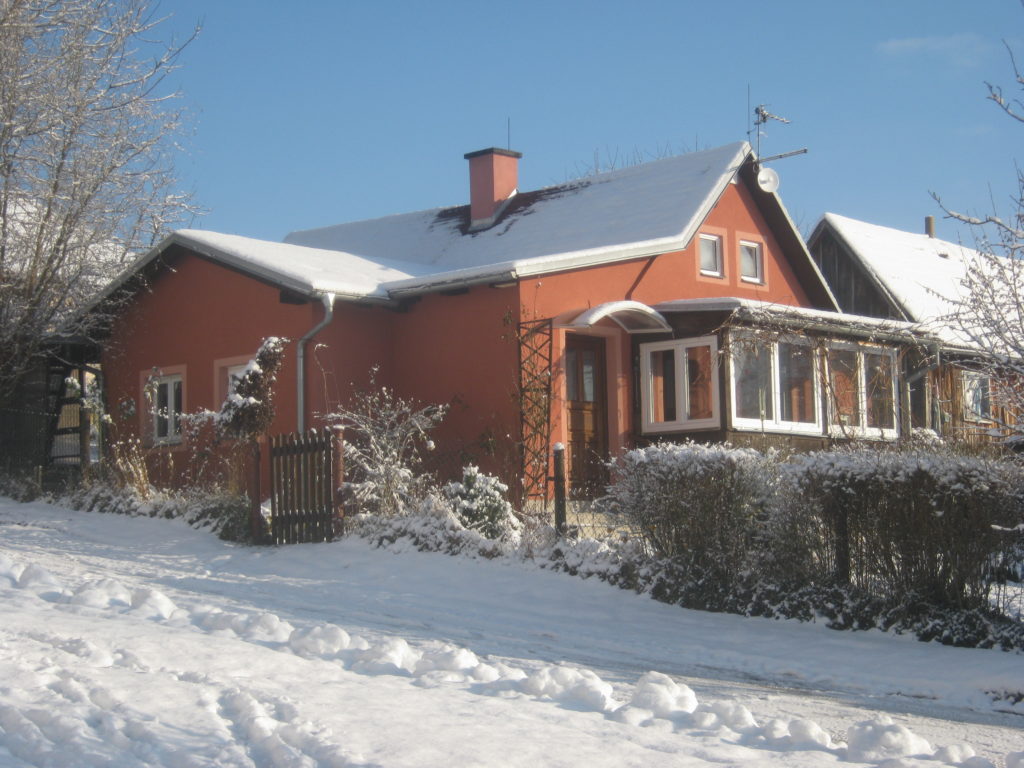
Stará Oleška 44 in the snow © Ricky Yates

This past weekend, winter has well and truly arrived in Stará Oleška. Whilst since the beginning of the month, snow fell on three or four occasions, it never amounted to much and rapidly melted. But the morning of Friday 15th December brought a more serious snowfall, and it has snowed again on several occasions since then and it is doing so once more, even as I write this blog post.

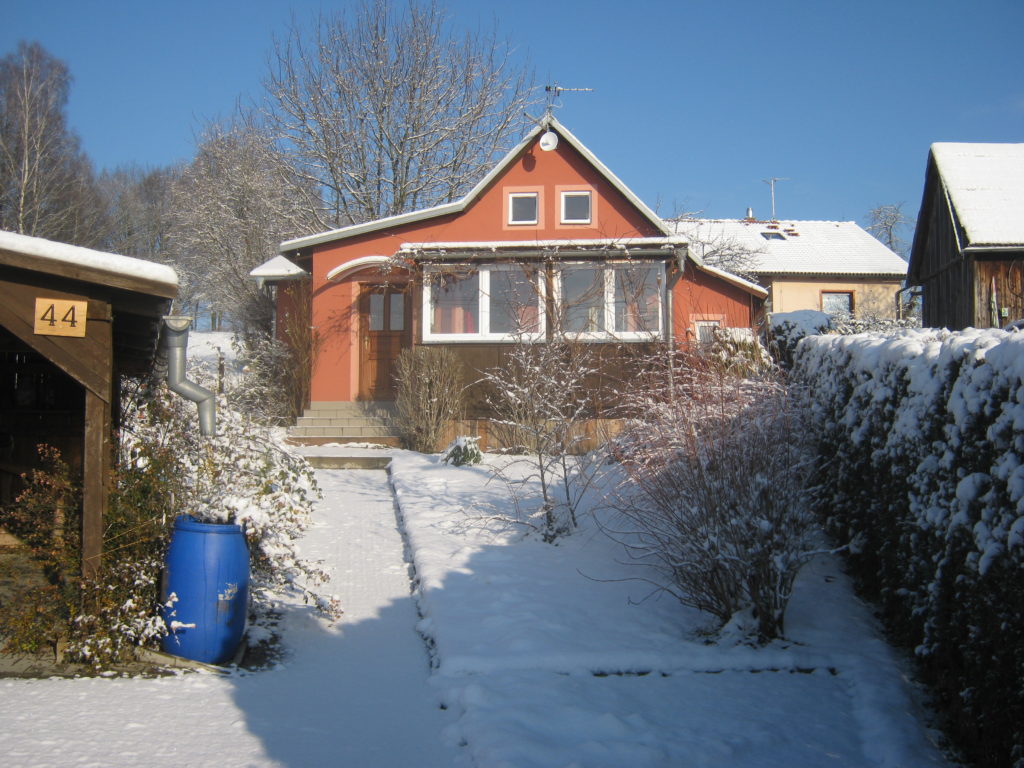
Stará Oleška 44 in the snow © Ricky Yates

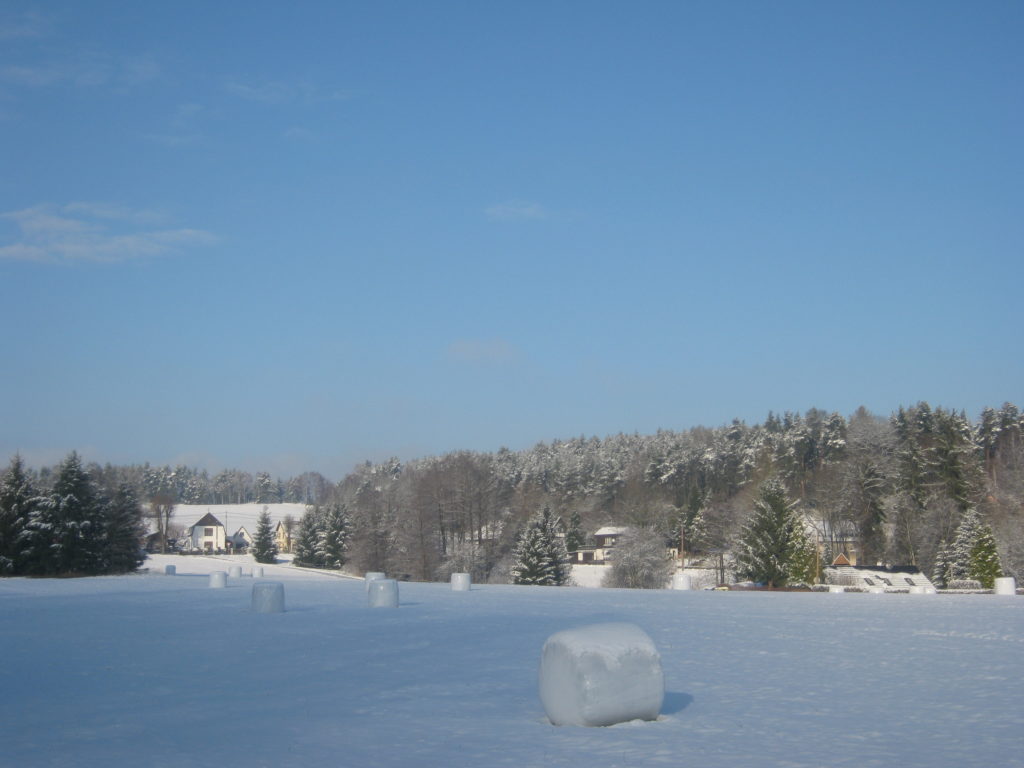
However, on the morning of Monday 18th, the snow stopped for several hours and the sun came out, enabling me to take the photographs accompanying this post. And to take the photograph on the left, I did go out through the side gate, to avoid having footprints in the snow on the path 🙂

View across the village © Ricky Yates

Above is the view across the village from the road in front of my house, looking out towards Huntírov. In case anybody is interested, the yellow house in the centre of the photograph is currently for sale. The details can be found by following this link.

Northern edge of the village © Ricky Yates

This is a view of the northern edge of the village, taken from the road leading to the large lake, Olešský rybnik.

Olešský rybnik with snow-covered Popovicský vrch in the distance © Ricky Yates

Olešský rybnik with snow-covered Popovicský vrch in the distance.

Autokemp Aljaška © Ricky Yates

It has always amused me that one of the three camp sites located around the lake is entitled, in Anglicized form, ‘Autocamp Alaska’ – hardly the name I would choose for a summer camp site. But here it is, living up to its name 🙂

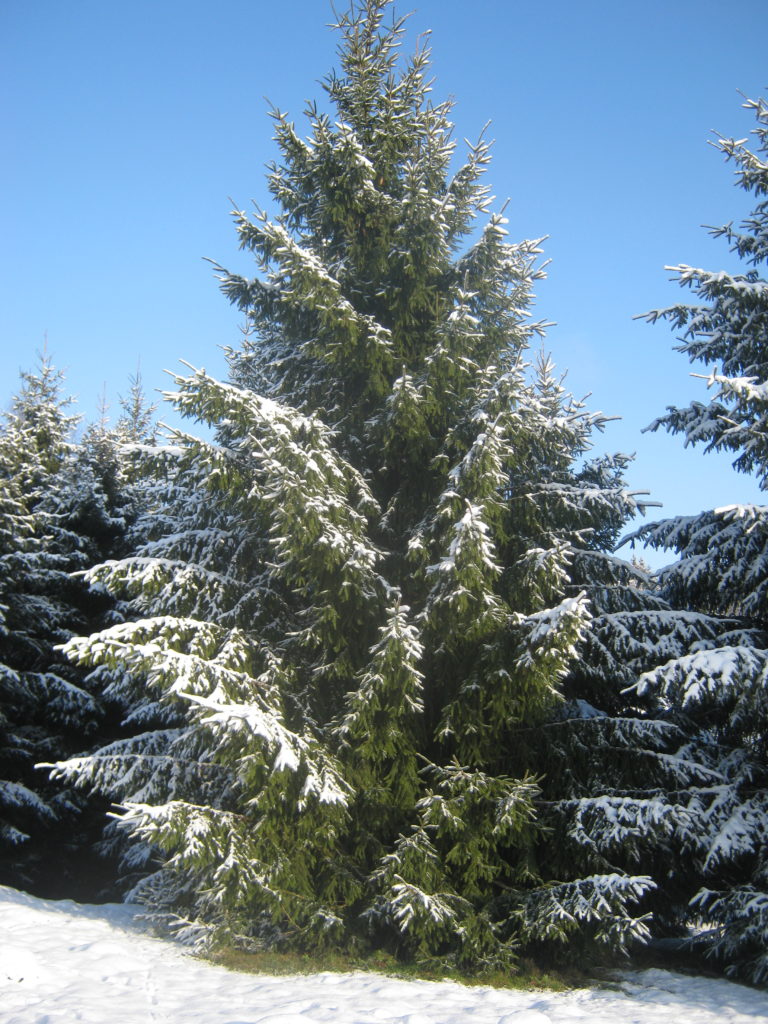
Finally for this post, a couple of beautiful snowy trees.

Snowy tree © Ricky Yates
Snowy Christmas Tree © Ricky Yates


Happy eighth birthday to my blog

Kostel sv. Mikuláse in Malá Strana © Ricky Yates

Tomorrow, Saturday 4th February 2017, marks a significant anniversary – it is exactly eight years since I wrote and posted my first-ever blog post here on ‘Ricky Yates – an Anglican in Prague’. Yes – eight years on, I’m still blogging 🙂

Believe it or not, this is post number 375. But I have to confess that in the past year, I’ve only managed to add 33 posts since celebrating the blog’s seventh birthday, a year ago. Therefore it sadly ranks as my least productive year 🙁 However, I am proud that if you scroll down the right-hand side bar to ‘Archives’, you will see that in each of the 96 months since I started writing, I have managed at least one post in every single one of them!

However, in its forthcoming ninth year, my blog will have to change its name as, very soon after Sunday 30th April, Ricky Yates will cease to be ‘an Anglican in Prague’. Suggestions for a new title are welcome. Likewise, I will need a new header photo to replace the skyline of the city that has been my home for the past eight & a half years.

As I write this post, we are experiencing one of the coldest and snowiest winters that we have had for a number of years. Here in Prague, there hasn’t been as much snow as there was back in January 2010, when the authorities were using JCBs to tip excess snow into the Vltava. But the temperature has been below freezing point for about two weeks and, whilst it has risen today to -1°C 🙂 , after a brief thaw, we are are promised sub-zero temperatures again from next Tuesday.

This year’s severe weather has certainly been positive for one part of the Czech economy. As this news article explains, the Czech ski resorts are having a bumper season. Two years ago, when we experienced the mildest of all our nine winters here, they suffered considerably because of warm temperatures and a lack of snow.

I am still trying to get my head around the fact that twelve weeks on Sunday, I will retire. There is still so much to do as part of the day job, not least divesting myself of things that I normally do, to members of the laity. That is before starting to sort out papers and belongings, ready to move.

But I do promise to try and continue adding regular posts here over the coming weeks. And as I’m taking the week of annual leave owing to me in 2017, from Monday 13th – Monday 20th February inclusive, I may even finally complete the text of my long-promised book, ‘How to be Czech’. Watch this space!

The ‘Carly’ in the snow 🙂 © Ricky Yates

11th November in the Czech Republic

First World War memorial in Zbraslav © Ricky Yates

Today is Armistice Day, marking the signing of the armistice, ninety-eight years ago, which brought an end to the First World War at the eleventh hour of the eleventh day of the eleventh month. In the USA, it is known as Veterans Day and is kept as a public holiday.

During the First World War, what is now the Czech Republic was still part of the Austro-Hungarian Empire which, together with Germany and the Ottoman Empire, formed the eventually defeated Central Powers. The Czechs were a subjugated people, increasingly seeking much greater autonomy or self-rule. As I explained in my previous post, two weeks before the official end of WW1, the independent new nation state of Czechoslovakia was proclaimed.

Yet despite the rise of Czech nationalism, many Czech people fought and died for an Empire that they didn’t really believe in. In many towns and cities across the country, there are memorials such as this one in Zbraslav, to those who gave their lives in the First World War.

Today is also St Martin’s Day, the Feast Day of St. Martin of Tours. As a fourth century Roman soldier, Martin is said to have cut his military cloak in two and given one half to a scantily clad beggar outside the city of Amiens, to protect him from the freezing weather. Later, after leaving the army, Martin became a monk and hermit, before being made Bishop of Tours in 371.

Here in the Czech Republic, there are numerous traditions associated with St Martin’s Day. There is a Czech saying, ‘Martin prijíždí na bílém koni‘ – ‘Martin is coming on a white horse’, indicating that today is when the first snowfall can be expected. This year in the Czech Republic, Martin came quite early with the first snowfall on the higher mountains some two weeks ago. Even here in Prague, we had our first dusting of snow, twenty-four hours before St. Martin’s Eve.

St Martin = wine & goose :-) © Ricky Yates
St Martin = wine & goose 🙂 © Ricky Yates

Many restaurants offer a St Martin’s special menu which always features roast goose. According to tradition, the association of a goose with St Martin is because he was so reluctant to be ordained a bishop, that he hid in a goose pen, only for his hiding place to be given away, by the cackling of the geese.

The appropriate accompaniment to St Martin’s goose is Svatomartinské vino, a young wine from the recent harvest. This is produced in the vineyards of South Moravia and always becomes available for the first time on 11th November each year. In more recent times it has been marketed in a big way in a similar manner to Beaujolais nouveau.

All that I describe here are examples of the keeping of traditions which are Christian in origin by a now rather irreligious Czech population. The Epiphany door-marking illustrated at the end of this post and referred to in following comments falls into the same category.

Mariánské Lázne

The larger colonnade in Mariánské Lázne © Ricky Yates

Mariánské Lázne is a spa town in West Bohemia, located not far from the German border. Better known by its German name of Marienbad, in the nineteenth century, it developed as one of the top European spas, popular with notable figures and rulers who often returned there on numerous occasions.

To meet the needs of these international visitors, a whole series of hotels, colonnades and other buildings were constructed. These included Churches of different denominations, all located in relatively close proximity to each other.

Kostel Svatého Vladimíra © Ricky Yates

This is Kostel Svatého Vladimíra, the Russian Orthodox Church. It is still in use, though the number of Russian visitors has dropped considerably in recent times, because of the serious fall in value of the rouble.

Kostel Nanebevzetí Panny Marie © Ricky Yates

Here is Kostel Nanebevzetí Panny Marie, the Roman Catholic Church, dedicated to the Assumption of the Blessed Virgin Mary. It was constructed between 1844-1848 in the ‘new Byzantine style’, according to my research.

Evangelický kostel / Protestant Church © Ricky Yates

Squeezed between two taller and grander buildings, is the Evangelický kostel / Protestant Church. It was built to meet the needs of Protestant guests, in the years 1853-1857, from the public subscriptions of German Lutherans. In 1907, stained glass windows were added, donated by Kaiser Wilhelm II. It continues to be used for worship by the Ceskobratská Církev Evangelická, the main Czech Protestant Church.

The Anglican Church © Ricky Yates

And yes – there is also an Anglican Church. It is a classic example of a red brick Victorian Church building and was consecrated by the Bishop of Bath and Wells in 1879. My understanding is that it fell into disuse, some time in the late 1920s–early 1930s, when a combination of the Stock Market crash of 1929, and the subsequent rise to power of Adolf Hitler, meant that British citizens no longer came to take the waters.

Former Anglican Church in Mariánské Lázne © Sybille Yates

Sybille and I had twice previously visited Mariánské Lázne during the early part of our time in the Czech Republic, but on both occasions it was in winter and the Anglican Church building was snowbound and locked. So I was very pleased that when I was there again last Saturday, that it was open and I was able to go inside.

Noticeboard © Ricky Yates

Since the early 1990s, the building has belonged to the Mariánské Lázne Town Council, who use it as an Exhibition and Concert Venue. But the reason I found it open was because it was being made ready for a wedding that was to take place there later that afternoon. No doubt this would have been a civil ceremony, conducted by the local registrar. The main reason that I was visiting Mariánské Lázne was to conduct a religious wedding, following the liturgy of the Church of England, but at a different venue. Somewhat ironic to say the least!

Plaque commemorating King Edward VII worshipping in the Anglican Church © Ricky Yates

Of the original interior, the only remaining features are the pulpit and this marble memorial plaque from 1911, commemorating the frequent visits of King Edward VII, both as Prince of Wales and later, as King. I knew that this plaque existed and was very pleased to be finally able to see it, and get a photographic record.

The smaller colonnade being made ready for the wedding © Ricky Yates

Finally for this post, here is the smaller of the two colonnades in Mariánské Lázne, being made ready for the wedding I was there to conduct. The larger colonnade is featured in the first photograph of this post. The happy couple were Bismark and Hannah. Bismark comes from Ghana whilst Hannah was born in Norway, but of Ghanaian parents. They met whilst both studying medicine in Hradec Králové and are now working as doctors in Norway.

They originally asked if I would conduct a service of blessing for them, following a civil marriage. But once I explained that I could legally marry them, they gladly agreed. We did have a few problems, convincing the local registrar that I could conduct a legal marriage ceremony for them. However, we did eventually succeed. Below are the happy couple, following their marriage.

Bismark & Hannah following their wedding © Ricky Yates