Posts tagged ‘Velvet Revolution’

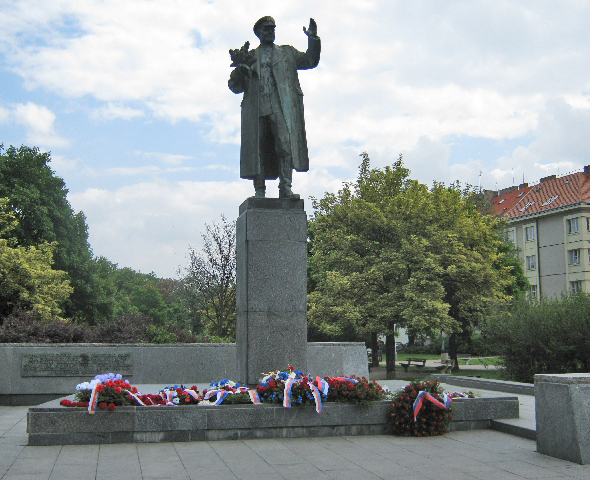
Statue of Soviet Marshall Ivan Konev with floral tributes © Ricky Yates

Inscription alongside the statue © Ricky Yates

Today is a public holiday here in the Czech Republic, as it is in several other European countries. The public holiday marks the ending of World War Two, sixty-seven years ago, on 8th May 1945.

I took the photograph on the left today. It is of a statue that stands in Námestí Interbrigády, a large square on one side of Jugoslávských partyzánu, the main thoroughfare leading from our nearest Metro station at Dejvická, to Podbaba where we live. And the person it portrays is Marshall Ivan Stepanovich Konev of the Soviet Red Army, who led the troops that liberated Prague from Nazi occupation, finally entering the city early on 9th May 1945, just a few hours after the unconditional surrender of all Nazi troops across Europe, had come into force.

As I wrote in an earlier post on this same topic two years ago, this statue is a rare sight today, anywhere in the Czech Republic or Slovakia, as it features a leading figure of the Soviet Army which, during nearly forty-two years of communism, was regarded as an army of occupation by the people of Czechoslovakia. Nearly all public monuments featuring or seeking to celebrate, ‘Soviet friendship and brotherhood’ have, since the Velvet Revolution of 1989, been quietly removed. But, because it commemorates an event that took place before the communist coup in 1948, it remains standing.

As you can see, a large number of floral tributes have been placed at the foot of the statue in recent days. Some are official, such as the ones from the Czech Military and from the Defence Office of the Czech President. Others are simple bunches of flowers, left by private individuals. Although there is a considerable dislike of Russia and Russians amongst the Czech people today, (see some of the comments on my previous post), there is a recognition that it was the Soviet Army that was responsible for liberating Prague and two thirds of what is now the Czech Republic, early in May 1945.

Floral tribute with Cyrillic writing © Ricky Yates

However, I was intrigued by one large floral tribute pictured here, whose ribbons have an inscription written in a language using the Cyrillic alphabet, presumably Russian. If anyone can tell me what it says or which organisation might be responsible for it, I would love to know.

Inscription behind the statue which refers to the Czechoslovak Socialist Republic © Ricky Yates

And I was also intrigued by this inscription on the low wall behind the statue, which refers to the country as the Czechoslovak Socialist Republic, the name used only during the years of communist rule. Whereas elsewhere in the Czech Republic, specific communist logos and references have been removed from war memorials such as in Tábor, here communist nomenclature remains.

Whilst the liberation of the country from Nazi occupation is still marked each year here in the Czech Republic, what has changed since the Velvet Revolution, is the attitude of Czech people towards Germany and the German people. Most Czechs are now freely able to distinguish between Nazi Fascist ideology as exemplified by Hitler’s Third Reich, and present-day democratic Germany, still very much aware of it’s relatively recent past history.

Therefore these days, Germany is the Czech Republic’s biggest trading partner. Germans also travel here in considerable numbers to enjoy the delights of what this country has to offer and in doing so, make a major contribution to the Czech Republic’s tourist income.

On the other hand, although the part played Russia and the Soviet Red Army to liberate the country from Nazi occupation is still acknowledged each year, those who liberated, in turn became an army of occupation. And although all Russian troops had left Czech soil by June 1991, there remains a strong feeling that Russia still wants to control its former republics and satellite states using its economic power, particularly with regard to the supply and distribution of natural gas.

Besídka Restaurant & Hotel, Slavonice © Ricky Yates

Less than 30 km south of Telc lies the little town of Slavonice. On the morning of Thursday 7th October, we drove from Telc to Slavonice, stopping off to briefly explore the intervening town of Decice en-route.

Slavonice has some of the best examples of buildings with sgraffito decoration in the whole of the Czech Republic. The reason that so many of these architectural gems have survived is because of the town’s somewhat unfortunate history. A prosperous town in the latter part of the sixteenth century from which period, many of the town’s historic buildings date, it lost much of its prosperity during the Thirty Years War (1618-1648) and suffered a further economic downturn when the main road between Prague and Vienna was re-routed in the eighteenth century.

In the twentieth century, two further events had a dramatic effect on Slavonice. At the end of the Second World War in 1945, most of the minority German-speaking population of Czechoslovakia, the Sudeten Deutsche, were expelled. This included the majority of the population of Slavonice. Less than three years later, following the coup that brought the Communist Party to power in February 1948, because the town lies less than 2 km from the Austrian border, it was made part of a restricted zone which was off limits for most of the Czechoslovak population, for fear that they might try to escape from their Communist ‘paradise’.

It is ironic that, a combination of economic degradation followed by a period of social isolation, has maintained so much of Slavonice’s architectural heritage. Fortunately, since the Velvet Revolution of 1989, a considerable effort has been made to both restore and preserve it.

One of the many restored buildings with sgraffito decoration is now the Bar-Restaurant Besídka. We ate lunch here soon after our arrival and enjoyed the English version of the menu which has several humorous items on it and a total absence of Czenglish. Clearly it had been translated by someone who had a very good understanding of the English language rather than using ‘Google translate’.  The food was very good too! The interior walls are used to display a fascinating collection of pictures and other artwork and it is worth stepping inside Besídka just to see these.

Sgraffito decorated buildings in Slavonice. Ubytování Eva Giordanová is the building on the far right of the picture © Ricky Yates

A few doors along from Besídka, we saw a sign on the large wooden doors of Ubytování Eva Giordanová declaring Zimmer frei. So we went in, climbed the stairs to the first floor office and enquired about their rooms. We were shown a very attractive room with simple kitchen facilities adjacent, all for a very reasonable price. I was also able to move the car from the main square and park it securely in the yard at the rear of the building.

Not only does Ubytování Eva Giordanová have accommodation, it also houses a museum of old agricultural and household machines and implements. And on the first floor, adjacent to our room, is a former Lutheran prayer room, with the walls decorated with sixteenth century frescoes, illustrating scenes from the Book of Revelation. They date from the time when there was a strong Protestant community in Slavonice before the re-imposition of Roman Catholicism at the end of the Thirty Years War. I was not allowed to take any photos of the frescoes but there are pictures of them on their website, together with some very interesting Czenglish descriptions!

Gateway into Slavonice © Ricky Yates


Gateway into Slavonice © Ricky Yates

Here are two of the gateways that lead into the historic centre of Slavonice, one of which also features sgraffito decoration.

More sgraffito decorated buildings in Slavonice. The one on the left features scenes from the Old Testament © Ricky Yates

Sgraffito illustration of the story of 'Jacob's ladder' © Ricky Yates

One building that particularly fascinated me was the one on the left in the picture above. It is covered with scenes from stories recorded in the Old Testament, together with the associated biblical reference.

It was still fairly grey and cloudy when we walked around the town in the afternoon which meant the light was not so good for taking detailed pictures of the individual illustrations. However, I was pleased with this one on the left, which illustrates the story of Jacob’s dream at Bethel, recorded in Genesis chapter 28, where he saw a ladder or stairway between earth and heaven with angels ascending and descending.

Slavonice was a place that Sybille & I very much enjoyed. Whilst is has visitors, it is a little more off the tourist track than Telc. Being so close to the Austrian border, German is often spoken and understood – a great help with our relatively limited Czech! However, it doesn’t suffer from the blight that affects so many towns and villages in the Czech Republic that border Austria or Germany – a proliferation of casinos and gambling places together with associated prostitution that I have described previously in this blog. There is just one Herna Bar, (bar with slot machines), and even that wasn’t open all the time.

The surrounding countryside consists of rolling wooded hills with many waymarked walking routes and cycleways. Certainly a place we plan to re-visit at some future date.

Sgraffito decorated house in Slavonice © Ricky Yates

Sgraffito decorated house in Slavonice © Ricky Yates

Statue of Marshall Konev in Námestí Interbrigády, Prague 6 © Ricky Yates

The statue pictured on the left here, is an extremely rare sight in the present-day Czech Republic. It stands in Námestí Interbrigády, a large square on one side of Jugoslávských partyzánu, the main thoroughfare leading from our nearest Metro station at Dejvická to Podbaba where we live. The reason that it is such a rare sight is because it portrays a Marshall of the Soviet Red Army, Ivan Stepanovich Konev.

As you can probably imagine, following the Velvet Revolution at the end of 1989, steps were rapidly taken to rid Czechoslovakia, (since 1st January 1993, the Czech Republic and Slovakia), of anything that celebrated the preceding nearly 42 years of Soviet imposed communist rule. Anything that was part of the so called ‘normalisation’ that followed the crushing of the Prague Spring of 1968 by the Soviet Red Army was particularly detested.

Therefore, not many weeks after the Velvet Revolution, 14 Metro stations which bore names to supposedly celebrate Soviet-Czech friendship, were re-named. Thus Moskevská (Moscow Station) became Andel (Angel) and Leninova became Dejvická. Most poignantly, Red Army Square in the centre of Prague was re-named Jan Palach Square to commemorate the self-immolator whose death became such a focus for those who opposed communist oppression.

However, the statue of Marshall Konev remains, simply because he just pre-dates the Communist coup of 1948. For it was he who led the troops of the Soviet Red Army that liberated Prague from Nazi oppression, entering the city on 9th May 1945, a few hours after the German unconditional surrender across Europe had come into force. The sixty-fifth anniversary of these events occurred just over two weeks ago, hence the floral tributes lying at the foot of the statue when I took the picture a few days later.

Memorial plaque to victims of May 1945 Prague uprising © Ricky Yates

All around Prague there are quite a number of memorials on buildings similar to these ones illustrated here. On 5th May 1945, there began an uprising by Prague citizens against the Nazi occupying forces. Those involved in the uprising expected that the US Third Army under General Patton, which was advancing from the west, would soon come to their aid. What they did not know was that a previous agreement between the US and Soviet governments, only allowed for American troops to advance as far as a line linking Karlovy Vary – Plzen – Ceske Budejovice.

The Soviet government insisted that this agreement be honoured. Thus, many Prague citizens commemorated on these plaques lost their lives because the Soviet Red Army advancing from the east took 24-48 hours longer to reach Prague than US troops from the west would have done if they had been allowed to do so. Eventually, the Nazi forces withdrew westwards, keen to surrender to the American rather than the Soviet authorities. They knew who would treat them better! And because of their withdrawal, relatively little damage was done to physical structure of Prague itself, leaving it with the multiplicity of architectural gems that continue today to delight the eye of resident and visitor alike.

Memorial plaque to another victim of the 1945 Prague uprising © Ricky Yates

Charcoal roasted ham being cooked on Old Town Square © Ricky Yates

Charcoal roasted ham being cooked on Old Town Square © Ricky Yates

Yesterday, Tuesday 17th November 2009, marked the twentieth anniversary of the start of the events that led to the ‘Sametová Revoluce’, the Velvet Revolution, which saw the demise of the Communist government that had ruled Czechoslovakia for previous forty one years. As I mentioned in my recent blog post about Holidays and Celebrations in the Czech Republic, 17th November is now kept as a public holiday entitled ‘Struggle for Freedom and Democracy Day’.

Although not a Czech and having only lived here for 14 months, I was still interested to see how the momentous events of twenty years ago would be celebrated. So early yesterday afternoon, Sybille and I set out from our flat and travelled by bus and Metro to the centre of Prague, in order to soak up the atmosphere.

One thing the Czechs have become very good at is attaching a midweek public holiday to the nearest weekend and thus creating a long weekend. Therefore most schools and university faculties were also closed on Monday 16th as students and staff were granted a Headteachers/Deans holiday. As one Czech parent said to me, “If it wasn’t granted as a holiday, most people would take it as one anyway!”

However, in contrast to those enjoying a four-day weekend, most retail outlets were open on Tuesday. Our local Billa Supermarket had a notice declaring that on 17th November they would be open ‘normal Tuesday hours’. In Prague city centre, most shops, not just those aimed at tourists, were also open as normal for business. Twenty years on from the fall of communism, the capitalist free-market has well and truly established itself in the Czech Republic!

Display Board explaing the events of 1989 © Ricky Yates

Display Board explaining the events of 1989 © Ricky Yates

We went first to Staromestské námestí/Old Town Square where we understood various attractions had been laid on. We stupidly arrived two minutes too late and missed out on the thirty minute period when beer was being sold at the communist era price of just under 3 Kc for 0.5l. In UK terms that is about 10p a pint! However, we did enjoy some ham that had been freshly charcoal roasted over an open fire, accompanied by a cold beer. But for that privilege, we had to pay nearer the 2009 tourist price.

We then walked across to Václavské námestí/Wenceslas Square. At the Muzeum end of the square, were a series of display boards explaining in Czech and English, the events of 1989 that culminated in the capitulation of the Communist government and the election of the dissident playwright Václav Havel, as President on 29th December that year. The first of these events were students gathering in Wenceslas Square to mark the twentieth anniversary of the self-immolation of Jan Palach on 19th January. This and subsequent gatherings in what has become known as ‘Palach Week’, were forcibly dispersed by the National Security Corps officers using batons and water cannons.

Candles and flowers at the memorial to Jan Palach & Jan Zajic © Ricky Yates

Candles and flowers at the memorial to Jan Palach & Jan Zajic © Ricky Yates

Between the site of the display boards and the towering statue of Sv. Václav/St. Wenceslas on his horse, there is a small memorial to Jan Palach and another self-immolator Jan Zajic. In front of the memorial, many people had laid flowers or lit votive candles and several more people came to light candles as we stood in silence in front of the memorial. It had just gone dark and the flickering light of the candles made for a quiet evocative atmosphere.

We then set off back down Wenceslas Square and turned left into Národní where the main action of the day was due to culminate. On 17th November 1989, a large group of students who were trying to march from Albertov to Wenceslas Square, were attacked and severely beaten by riot police in Národní, the main thoroughfare from the banks of the River Vltava leading to the square. The reaction of the wider public to this violent action by the Communist authorities against their own people, was the catalyst for a series of daily demonstrations of an ever increasing size, which eventually brought about the end of the oppressive regime.

Yesterday, that march was re-enacted by several thousand people. Whilst also ending in Národní, instead of violence, more candles were lit at the site of the 1989 event, speeches were made and the national anthems of both the Czech Republic and Slovakia were sung. Suddenly, with very loud bangs and plumes of smoke, a ‘curtain’ of fireworks exploded symbolising the collapse of the Iron Curtain. Then, a street concert began, beamed and broadcast onto large screens erected at various points in the street, as well as live on Czech television.

Re-enactment of the 1989 demonstration in Národní © Ricky Yates; Note the somewhat less welcome post-communism arrival of 'Thai Massage' and the 'Admiral Casino'!

Re-enactment of the 1989 demonstration in Národní © Ricky Yates; Note the somewhat less welcome post-communism arrivals of 'Thai Massage' and the 'Crystal Palace Casino'!

One of the very good things about yesterday’s re-enactment was the number of young people who took part in it, as well as those who were re-tracing the steps that they themselves had walked twenty years before. I have often heard the complaint from numerous older Czech people who lived and suffered under the Communist regime, that the young people of today do not appreciate the freedom they have – the freedom to travel, to express their own views, to be educated rather than indoctrinated. Yesterday, at least some Czech twenty-somethings, did think it important to go out and commemorate such a significant event in the history of their country.

One rather ironic observation I noted was the role of the police. There was a sizeable police presence in central Prague overseeing yesterday’s events. They too all seemed rather young. Sybille wondered whether older officers, who might have been around twenty years ago, had been shipped off to the countryside for a few days! But instead of attacking the crowds, they were seeking to protect them, directing traffic away from streets pedestrianised for the day and ensuring that no one got hurt in the crush.

CNN News Crew in Wenceslas Square © Ricky Yates

CNN News Crew in Wenceslas Square © Ricky Yates

The ultimate irony was in relation to the news media. On Wenceslas Square, we came across the mobile base for a CNN News crew. Under the awning attached to their van, they had a laptop computer set up which was showing clips of the events twenty years previously. The short bit I watched included a clip where a riot policeman deliberately comes across to the TV camera and puts his hat over the lens to try to prevent filming of the violence directed at the student protesters. Yesterday, one of the main police tasks was protecting TV vans and outside broadcasting facilities so that pictures of the events could reach the whole of the Czech Republic and the wider world!

Former Dissidents being interviewed for TV on Národní © Ricky Yates; If anyone can identify either of them, please let me know!

Former Dissidents being interviewed for TV on Národní © Ricky Yates; If anyone can identify either of them, please let me know!

world-map-logo-final-200pxKnowing the dates of public holidays when you move to or visit a country of which you are not a native, is quite important as my wife and I found out only on Monday of this past week. We were returning from our trip to Turkey about which I’ve just started blogging, when we drove from Italy into Austria on the penultimate leg of our journey home to Prague. We were driving along the Austrian autobahn when my wife said, “Rather than stop at a service station for lunch, why don’t we drive into a nearby town and find a nice restaurant instead?”

So it was that we drove into Spittal an der Drau and parked in the centre of the town. It was only when the parking ticket machine refused to accept my euro coins I tried to feed it, did it begin to dawn on me that the town was rather quiet. Then I noticed that all the shops and banks were also closed. We did eventually find a pleasant bar-restaurant that was open where I enjoyed a fine Wiener Schnitzel. Whilst there, we quietly enquired of the proprietor whether the day was by any chance a public holiday. “Of course”, came the reply. “It is the Austrian National Day.” Therefore beware if you ever have cause to be in Austria on 26th October. Most shops and businesses will be geschlossen!!

There are five public holidays annually which are peculiar to the Czech Republic. Each celebrates individuals or events that helped form the Czech nation.

5th July celebrates St. Cyril and St. Methodius, two brothers who lived in the ninth century and were responsible, both for bringing the Christian faith to the Czech and other Slavic peoples, but also for inventing an alphabet that allowed the Slavic language of the day, usually now known as ‘Old Church Slavonic’, to be written down for the first time. Whilst the Czech Republic is now seen as one of the most atheistic countries in Europe, these two Christian saints are still celebrated for being responsible for the origin of Czech culture.

28th September celebrates the patron saint of the Czech people, St. Wenceslas. He is believed to have been martyred on this day in 935. He is well known to English speakers because of the Christmas Carol ‘Good King Wenceslas’. The day is also known as ‘Czech Statehood Day’, no doubt because Wenceslas (Václav in Czech) is seen as an embodiment of the Czech state.

6th July is celebrated as Jan Hus Day. Hus was an early Church reformer calling for Church teaching and practices to be in line with what appeared in the Bible, for the Czech language to be used in liturgy and preaching and for the people to be able to receive Holy Communion in both kinds. He was excommunicated from the Roman Catholic Church in 1412 for insubordination and burnt at the stake on 6th July 1415. Once again, it is his desire for the use of the Czech language that has caused him to be celebrated more as a Czech cultural hero rather than as a Church reformer. The Communist government of 1948 – 1989 even tried to make him out to be a Czech proto-communist!

28th October marks Czechoslovak Independence Day. It celebrates the declaration of independence from the Austro-Hungarian Empire on 28th October 1918 by Czechs and Slovaks in the dying days of World War 1 and the establishment of what is now referred to as the ‘First Republic’ under the presidency of Tomáš Garrigue Masaryk. Although the state of Czechoslovakia ceased to exist on 1st January 1993 following the ‘Velvet Divorce’, the public holiday remains!

17th November is the most recent addition to the Czech calendar of public holidays and is officially known as ‘Struggle for Freedom and Democracy Day’. It marks the day in 1989 when students began demonstrations that led to the fall of the Communist regime and the successful ‘Velvet Revolution’. This year it will be especially celebrated being the twentieth anniversary of those remarkable events.

Tram with two flags © Ricky Yates

Tram with two flags © Ricky Yates

On all Czech public holidays, the Prague integrated transport system runs a Sunday timetable and trams and buses display two Czech flags at the front. Why two flags you may ask? The answer lies in the years of Communist rule. The Communists loved flags and insisted they were displayed on public holidays, not just on trams and buses but on a variety of buildings too. But the Czech flag could never be displayed on its own; it always had to be accompanied by the flag of the Soviet Union. Now this is no longer required, they just display two Czech flags instead!

This was my contribution to WBSD and I’m asked to link next to an expat blogger I know rather well, Hospitalera who blogs about ‘Christmas in Prague‘.

We are also being ‘Twittered’ by Karen and I’m asked to include the following about her. Karen is an American expat blogger last seen in Prague. The Wall Street Journal said, “Her blog makes a fun read for anyone looking for reassurance that change can be a wonderful thing–and also for anyone interested in visiting the Czech Republic.”