Electing a new Old Catholic Bishop for the Czech Republic

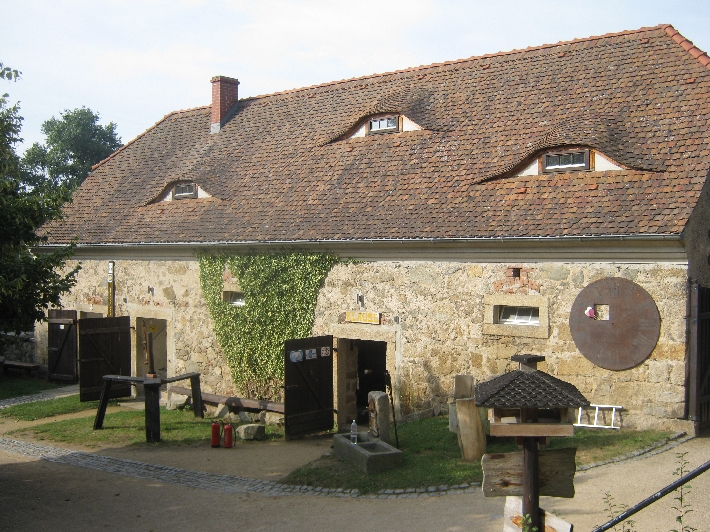
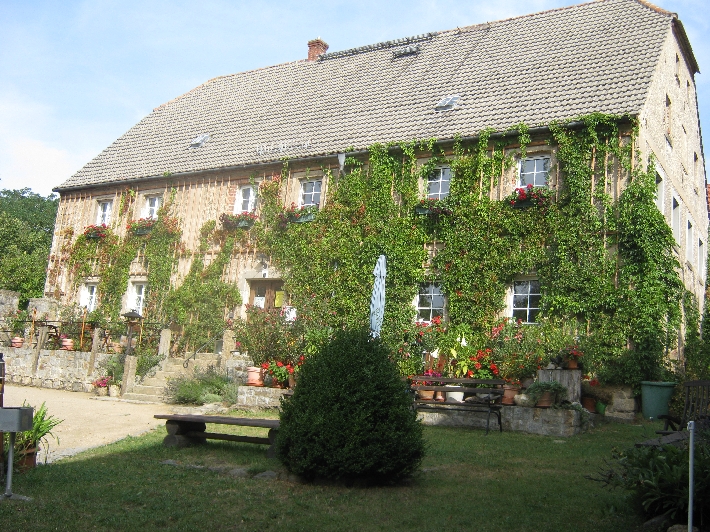
Želiv Monastery © Ricky Yates

As I have explained previously in this blog, the Prague Anglican congregation legally functions as the English-speaking parish of the Old Catholic Church in the Czech Republic or Farní obec Starokatolické církve pro vericí anglického jazyka v Praze. This came about as the result of a covenant signed in September 2000 by Bishop John Hind, the then Anglican Bishop of the Diocese in Europe, and Bishop Dušan Hejbal of the Old Catholic Church in the Czech Republic.

Under the covenant, we are treated both as a Chaplaincy in the Anglican Diocese in Europe, and as a constituent parish of the Czech Old Catholic Church. One consequence of this is that I am expected, along with one lay person from my congregation, to attend any meeting of the Synod of the Old Catholic Church in the Czech Republic when they take place. Fortunately, this is normally only once every three years as the meetings, which usually take place over a couple of days, are conducted entirely in Czech 🙁

Back in October 2010, Sybille I broke into our holiday to attend a Synod meeting held in Moravia, as mentioned in this post, whilst three years later in 2013, I attended the next Synod meeting, along with a lay representative, which was conveniently held in Prague. But last year, Bishop Dušan called an extra Synod meeting, in order to gain approval for his proposal to stay on as Bishop for a further three years beyond his sixty-fifth birthday in July 2016, exercising a provision within the Church’s constitution. Unfortunately, the date of that Synod meeting fell in the middle of our previously booked holiday in Poland, so I was unable to attend, nor could we find a lay representative to go either.

At that meeting in October 2015, the Synod decided not to accept Bishop Dušan’s proposal. Thus was set in motion, a procedure that had not happened for over twenty years – a further Synod meeting was called to take place in April 2016, to elect a new Old Catholic Bishop. As I have said numerous times, I do realise that ‘a new Old Catholic Bishop’, does sound like a contradiction in terms 🙂

This Synod meeting took place between the evening of Thursday 7th and the morning of Saturday 9th April at Želiv Monastery, located in the Vysocina/Highlands, about 100km south-east of Prague. I was accompanied by one of my Churchwardens, Stephen Weeks, who the Church Council had previously elected to be their lay representative. After an opening Eucharist, followed by our evening meal, the Synod meeting began.

Fortunately, whilst having supper, Stephen and I were overheard speaking to each other in English, by a lay member of the Synod called Vlad’ka. Like many of the Old Catholic laity, she had no idea of our existence as an English-speaking parish in the Czech Old Catholic Church and asked us in English, who we were and what we were doing there. Once we had explained, she kindly offered to interpret for us as she is a teacher of English to vocational students in Brno. She sat between us, interpreting all that was being said, enabling Stephen and I to follow the proceedings.

The evening session began with the two candidates to be the new Bishop, each making a presentation as to their understanding of the role and what they hoped to achieve if elected. There was then a short break, during which time written questions could be submitted to the moderator for the candidates to answer in the following session. Stephen and I compiled a couple of questions which we wanted to ask, which Vlad’ka kindly translated into Czech for us to submit.

The question and answer session went on until it was 22.00 which had previously been agreed as the finishing time for that evening. But it resumed again after breakfast, the following morning. Issues raised included the candidates attitude to same-sex blessings, what was the first things they would do upon becoming bishop and the question of the ordination of women as priests. Currently, the Czech Old Catholic Church only ordain women deacon, unlike their fellow Old Catholics in the Netherlands, Germany, Austria and Switzerland who do ordain women as priest.

We raised the specific question of their attitude to us being able to advertise for a successor to me, being open to ordained Anglican priests of either gender. My Church Council are unanimous that this should be the case, and fortunately we now have an Archdeacon and Bishop who are committed to supporting us in this. We did not get as clear an answer as we would like from the candidates, but we certainly did not get an outright rejection on the issue.

By the middle of Friday morning, there were no further questions. So we moved to a coffee break, to be followed by the election of the new Bishop. However, before the election could take place, a technical issue was raised. There were meant to be fifty-six Synod delegates but only fifty-five were present. The constitution provides that to be elected, a candidate needs a three fifths majority. Was it to be three fifths of fifty-five or fifty-six? After some debate, we voted that it should be three fifths of fifty-six 🙂

It took three rounds of voting before a conclusive result was achieved. The Synod elected Pavel Stránský, currently the Old Catholic priest in Zlín, to be their new Bishop. He was given a standing ovation and presented with a chain and crucifix, showing him to be the Bishop-elect. He then made a formal declaration, signed various papers and both he and Bishop Dušan were presented with flowers.

After lunch, the Synod meeting elected a new Synodal Council, who with the new bishop, will run the Church for the next three years. Various other committees were also elected and then, with no further business to conduct, the meeting ended with the singing of the Te Deum.

Exactly when Bishop-elect Pavel will be consecrated has yet to be decided but I’ve been told informally that it will probably be sometime in September or October.

Yours Truly with the Bishop-elect, Pavel Stránský © Ricky Yates

Walking Der Ökumenische Pilgerweg – Gröditz to Kamenz

On the morning of Friday 21st August 2015, Sybille and I set out from the Pilgerherberge at Gröditz, to walk 20km to the large town of Bautzen. As you can see from the photographs, we were blessed with fine sunny weather.

Our route took us along a series of tracks and minor roads across undulating countryside.

The Pilgerweg approaching Drehsa © Ricky Yates

Here is the way approaching the village of Drehsa.

Flying pigs in Drehsa © Ricky Yates

Within Drehsa, there was this fun mural of a flying pig and piglet 🙂

Pilgerweg with shade © Ricky Yates

In view of the sunny weather, we both appreciated the shade provided by trees along parts of the route.

As on many pilgrim routes that I’ve walked, the approach to larger towns and cities is often not that pleasant for walkers. The last few kilometres into Bautzen involved walking uphill, alongside a busy main road. But we eventually made it, obtained the key to the pilgrim accommodation provided by the Lutheran Church, where we were able to shower, change and leave most of our belongings securely.

The Rathaus in Bautzen © Ricky Yates

In the early evening, we enjoyed a drink, sitting outside in the main square, opposite the Rathaus.

St Peter's Cathedral, Bautzen © Ricky Yates
St Peter’s Cathedral, Bautzen © Ricky Yates

Nearby is St. Peter’s Cathedral, an example of a simultaneum or Simultankirche. Here Lutherans and Roman Catholics have shared the same Church building since 1530! After exploring more of the historic town centre, Sybille took me a very nice Sorbian restaurant which she had discovered during her pilgrimage earlier in April.

The Milleniumsdenkmal featuring St Cyril and St Methodius, Apostles to the Slavs © Ricky Yates

Fortunately, the route out of Bautzen the following morning, was along a series of quite quiet roads, though we did have to pass under the busy Autobahn 4. After 8.5km of walking, we reached the top of Roter Berg, a low hill on which has been erected the Milleniumsdenkmal featuring St Cyril and St Methodius, Apostles to the Slavs. Methodius was made a bishop therefore he is the one wearing a mitre 🙂

Yellow arrow © Ricky Yates

That afternoon, we walked on a further 8.5km, to the town of Crostwitz. Just outside the town, the correct way was indicated by a yellow arrow, painted on the road!

Croswitz Pilgerherberge © Ricky Yates
Roman Catholic Church in Crostwitz © Ricky Yates

In Crostwitz, we stayed overnight in this Pilgerherberge owned and run by a lady called Monika. She is a native speaker of Sorbian, the West Slavic language I mentioned in my previous post. In Crostwitz, the secondary/high school, teaches through the medium of Sorbian, with German only being taught as a second language.

Monika explained that when this area was part of the Soviet satellite state of East Germany, the communist authorities actively encouraged the use and preservation of the Sorbian language. This was because of it being a Slavic language and so much of what happened was orchestrated by the Russians in Moscow, their ‘fellow Slavs’ 😉 It is ironic that now, one place where the language continues in active use, is within the Church. On the evening of Saturday 22nd August 2015, Sybille and I went to a very well-attended mass in the Roman Catholic Parish Church, conducted only in Sorbian.

Street name in German & Upper Sorbian with waymark for the Pilgerweg © Ricky Yates

Believe it or not, despite only being spoken by about 50,000 people, there are two different versions of Sorbian! About 40,000 people speak Upper Sorbian and live in the Bundesland of Freistaat Sachsen, the area we were walking through. Immediately north, in the Bundesland of Brandenburg, there are a further 10,000 speakers of Lower Sorbian. Upper Sorbian relates more to Czech; Lower Sorbian to Polish.

Our final day on this first part of the Ökumenische Pilgerweg was Sunday 23rd August 2015, when we walked 16.5km from Crostwitz to Kamenz. Once more it was fine and sunny and my main recollection of that day, was finding nowhere that was open to serve us a cool drink! Fortunately, when we reached the eastern outskirts of Kamenz, we had to walk right through where a travelling fair was set up for a week and we finally were able to purchase a couple of beers.

Kamenz Rathaus © Ricky Yates
Beer with wasp cover! © Ricky Yates

We then walked on to the town centre to the tourist information centre, where we collected the key to the Pilgerherberge. Following that, we treated ourselves to a further beer, sitting outside a hotel on the town square, opposite the Rathaus. One problem we encountered throughout our week on the Ökumenische Pilgerweg, were an abundance of wasps, who tended to take a great interest in any beer we were drinking. This was a novel way of preventing them doing so 🙂

My other recollection of the whole week was the almost total absence of anyone who spoke English. My normal experience of trying to use my limited German when in Germany, is being spoken back to in word-perfect English! But the first time this happened to me during our five days on the Ökumenische Pilgerweg, was in Kamenz, ordering this beer and a different one for Sybille, who had gone off to use the toilet facilities in the hotel. I presume the reason for the lack of English was being in the former East Germany and being places not normally frequented that much by non-German tourists.

Brass plaque outside the Kamenz Pilgerherberge © Ricky Yates

Suitably refreshed, we then walked on a further kilometre uphill 🙁 , to the Kamenz Pilgerherberge.

Rucksacks, walking poles & hats © Ricky Yates
My Pilgerausweis, duly stamped.


Walking Der Ökumenische Pilgerweg – Görlitz to Gröditz

Peregrinus Herberge, Görlitz © Ricky Yates


As explained in the opening two paragraphs of my previous post, back on Tuesday 18th August 2015, Sybille and I drove from Prague to Görlitz, in order to spend the following week walking the first part of Der Ökumenische Pilgerweg. We stayed overnight in the Peregrinus Herberge, where we were also able to leave the ‘Carly’ securely parked, before setting out along the Pilgerweg the next morning.


With Görlitz being located in the valley of the Neiße river, it was inevitable that initially walking westwards to leave the town, involved walking uphill! However, we were soon out into open countryside and having covered 5km……


Ebersbach © Ricky Yates

……reached the attractive village of Ebersbach.

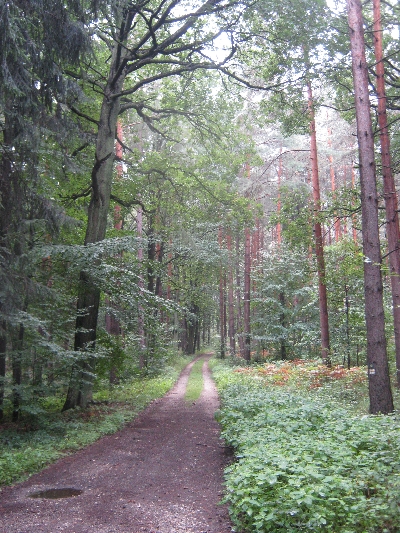
Path through the forests near Hochstein © Ricky Yates

From Ebersbach, there was then a gentle further climb along a minor road to the small village of Liebstein. The way then heads into a large and hilly forested area, following a series of gravelled tracks. 15km after leaving Görlitz, we finally arrived at Hochstein, at 406m above sea level, the highest point on the Pilgerweg east of Leipzig. Fortunately, it is also the location of the Hochsteinbaude where we were able to enjoy a drink and a late lunch. We were glad that we hadn’t arrived the previous day as Dienstag ist Ruhetag!

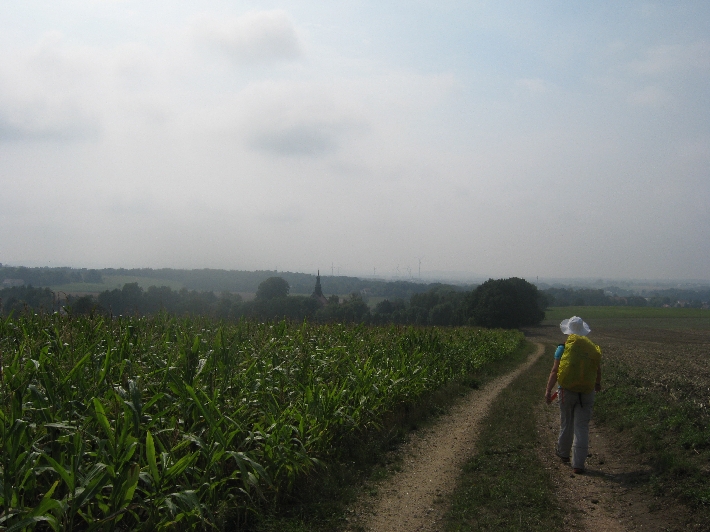
Sybille walking towards Arnsdorf © Ricky Yates

Suitably refreshed, we then continued to walk a further 5.5km, eventually leaving the forest and gently descending to the village of Arnsdorf.

Pilgerherberge at Arnsdorf © Ricky Yates

In Arnsdorf, we stayed in this delightful Pilgerherberge which has been created in the outbuildings of the Protestant Pastor’s home.

Protestant Pastor's home in Arnsdorf © Ricky Yates
Protestant Pastor’s home in Arnsdorf © Ricky Yates
Pilgerweg © Ricky Yates

The next day, our route took us along paths like this…..

Pilgerweg © Ricky Yates

…and this,

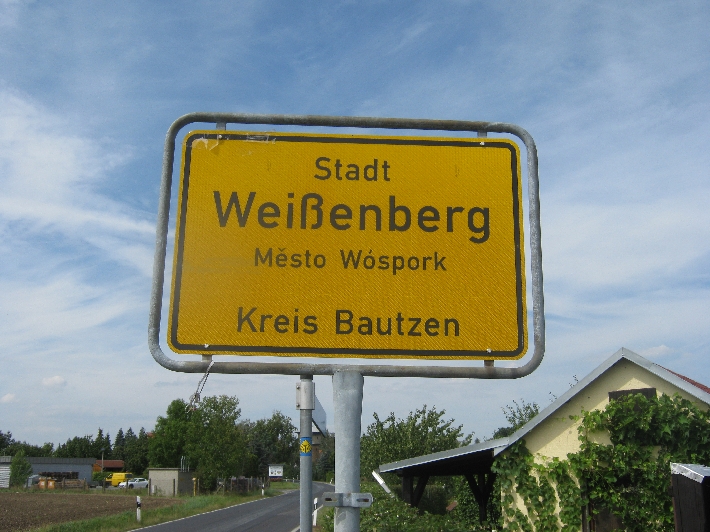
Weissenberg or Wóspork © Ricky Yates
Weissenberg or Wóspork. Also note the waymark on the pole © Ricky Yates

sometimes following minor roads, until we reached the small town of Weissenberg. Weissenberg marks the beginning of this part of south-eastern Germany where Sorbian is spoken, which is a legally recognised minority language, hence the town’s alternative name Wóspork. Sorbian is a West Slavic language, closely related to Czech and Polish – more in my next blog post.

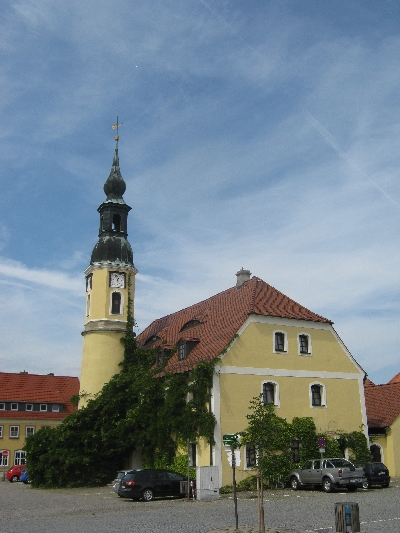
Weissenberg Rathaus © Ricky Yates

After lunch at an outdoor table of a restaurant situated on the main square, opposite the Weissenberg Rathaus, we walked on, heading for the village of Gröditz.

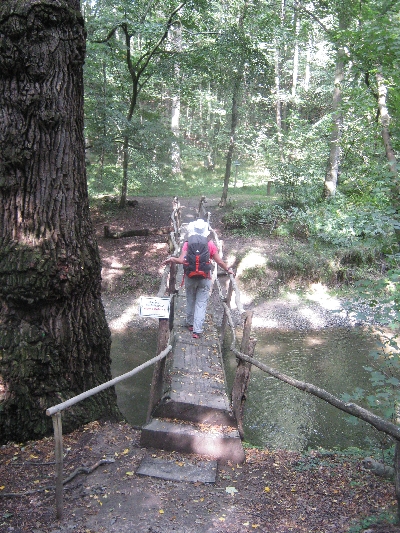
Sybille nervously crossing the rickety bridge © Ricky Yates

Our route took us along the Gröditzer Skala, an attractive deep valley. But it also involved crossing a river on this somewhat rickety footbridge!

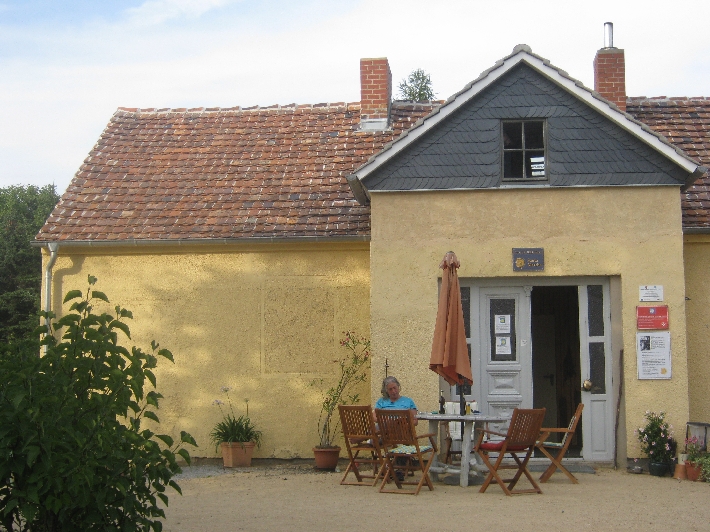
A weary pilgrim resting outside the Gröditz Pilgerherberge © Ricky Yates

We eventually climbed out of the valley to arrive directly before the door of the Gröditz Pilgerherberge. For those interested in distances, Arnsdorf – Gröditz is about 15.5km.

Görlitz

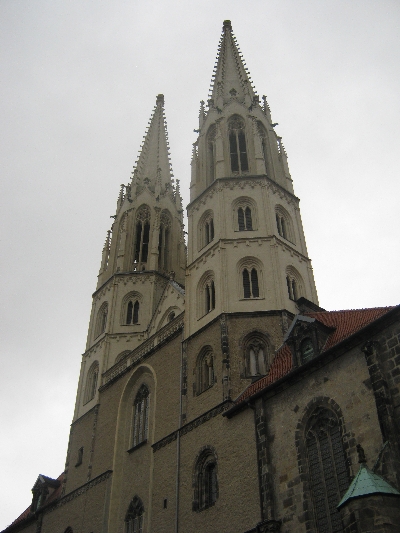
The twin spires of St Peter & St Paul's Church, Görlitz © Ricky Yates
The twin spires of St Peter & St Paul’s Church, Görlitz © Ricky Yates


The town of Görlitz is located in the far south-eastern corner of Germany and is about two-and-a-half hours drive directly north from Prague. Back on Tuesday 18th August 2015, Sybille and I drove to Görlitz, in order to spend the following week walking the first part of Der Ökumenische Pilgerweg. This is the first of three long-promised posts about that week mentioned in my summary post entitled ‘All those things in the second half of 2015 that got missed‘.


Having securely parked the ‘Carly’ in the gated backyard of the Peregrinus Herberge, we spent the rest of Tuesday 18th August, exploring Görlitz, before setting out walking along our pilgrimage route the following morning. On Monday 24th August, we returned to Görlitz by train, from Kamenz, which we had reached on foot the previous evening, and decided to further explore Görlitz, before driving back to Prague the next day. On Tuesday 18th it was grey and cloudy, whilst on Monday 24th it was fine and sunny with blue skies. Therefore it is fairly easy to tell on which day the photographs illustrating this post were taken 🙂


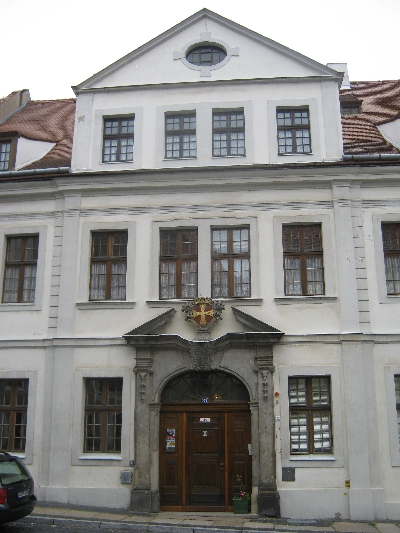
Beautiful exterior decoration on a Görlitz building © Ricky Yates
The Church of St Peter & St Paul, Görlitz, overlooking the Neiße river © Ricky Yates


Görlitz fortunately suffered relatively little physical damage during the Second World War. Post 1945, whilst part of the communist state of East Germany, it was rather grey and colourless. Since German reunification, many buildings have been redecorated and restored. It is now a very attractive place to visit and is beginning to realise its tourist potential.


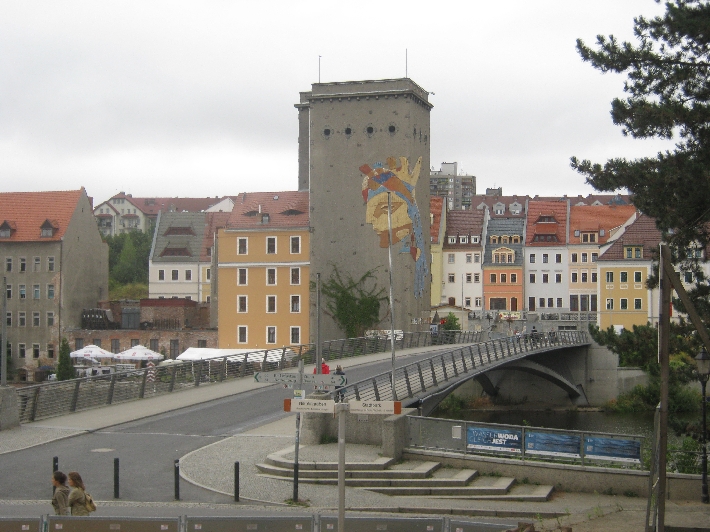
The most prominent landmark in Görlitz, is the Protestant Church dedicated to St Peter and St Paul, with its intricate twin spires. It stands overlooking the Neiße river which now forms the border between Germany and Poland. Under the 1945 Potsdam Agreement, following the end of the Second World War, the border of Poland was moved westwards to the Oder-Neiße line. As a result, what used to be the eastern half of German Görlitz, is now the Polish town of Zgorzelec.


Looking across the Neiße river from Germany to Poland © Ricky Yates

This relatively recently reconstructed bridge links the two towns.

Waymarking of the pilgrimage routes © Ricky Yates

The Ökumenische Pilgerweg, following the ancient Via Regia, begins on the bridge and links back to the ‘camino’ coming from Wroclaw in Poland.

The Untermarkt,  © Ricky Yates
The Untermarkt, Görlitz © Ricky Yates

This is the Untermarkt in the centre of Görlitz.

A side street & ancient tower in Görlitz © Ricky Yates

A side street with an ancient tower.

Weihnachtshaus, Görlitz © Ricky Yates

We discovered a couple of interesting businesses in Görlitz. This shop sells everything imaginable in relation to Christmas but is open all year round.

Jesus' Bakery © Ricky Yates
Jesus’ Bakery © Ricky Yates

And if you have to feed the five thousand, this is where you clearly need to come 🙂

Liquid refreshment © Ricky Yates

On sunny Monday 24th August, Sybille and I enjoyed some liquid refreshment on a terrace overlooking the bridge and the Neiße river. The young ladies serving us spoke German and we ordered auf Deutsch. But afterwards Sybille told me that they were Polish as she could tell by their accent 🙂

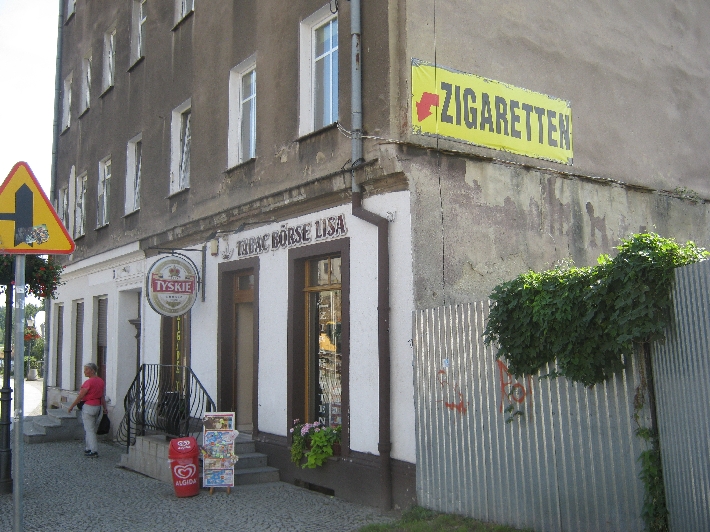
Buy your cheaper cigarettes here © Ricky Yates

Suitably refreshed, we walked over the bridge into Poland. Clearly there is less tax on cigarettes in Poland than in Germany, hence the advertisement in German for cigarettes, on the side of a Polish shop 😉

Sybille examoining the border marker as we walked back into Germany © Ricky Yates
Sybille examining the border marker as we walked back into Germany © Ricky Yates

We then walked south through part of Zgorzelec, parallel to the Neiße, before crossing another bridge to return to Germany, Freistaat Sachsen and Görlitz. With both Poland and Germany being EU members and part of the Schengen agreement, there were no border controls at all.

Obermarkt, Görlitz © Ricky Yates

When I’m Sixty-Four

Yours Truly on 11th March 1956, aged 4

Tomorrow will be my sixty-fourth birthday. Yes – on 26th February 1952, in the upstairs bedroom of a semi-detached house in Allesley, Coventry, UK, Yours Truly made his entry into the world. Of course, if I had arrived three days later, then it would only be my sixteenth birthday as 1952 was a leap year 🙂 , just like 2016.

The reason I was born at home and not in hospital, was because my two older sisters had been born in hospital. My mother had had no problem with either delivery so was told that baby number three could be born at home. My mother was under the care of her district midwife, a situation which is now much more widely understood by the younger generation, because of the TV series ‘Call the Midwife’. However, I chose to enter the world on my mother’s district midwife’s day-off, meaning that a colleague covering for her, had to assist with my delivery.

Unlike 25th February 2015, when Sybille and I celebrated our joint birthdays with a delightful meal at Sansho, I cannot celebrate with her today, as she is currently in Spain, walking the Via de la Plata from Seville to Santiago de Compostela. So instead, I sent greetings to her by Skype yesterday, wishing her both ‘Happy Birthday’ and ‘Alles gute zum Geburtstag!‘ I’m sure she will return the compliment to me tomorrow. And I have been invited out to lunch tomorrow, in honour of my birthday.

Whilst my birthday tomorrow is not a landmark one with a zero at the end, it still has great significance. Why? Because it means that in exactly one year’s time, both the Church of England and the state, will allow me to retire if I choose to do so. Whilst because of increased human longevity, retirement ages are being raised for younger people, it doesn’t really affect me, because of my age.

I probably will not retire in exactly a year’s time. However, my current Bishop’s Licence as Chaplain of St. Clement’s, Prague, only goes to the end of April 2017. Therefore sometime between my sixty-fifth birthday on 26th February 2017 and the expiry of my Bishop’s Licence on 30th April 2017, I will retire – the exact date to be decided in the next few months.

The other major decision to be made is where to retire to. That is a big issue to be resolved sometime this summer. In the mean time, I end this post with a song that I’ve been whistling and singing the past few weeks in anticipation of tomorrow. Rather than the original from The Beatles, here’s a fun version by a male voice choir.