The 2013 Eastern Archdeaconry Synod

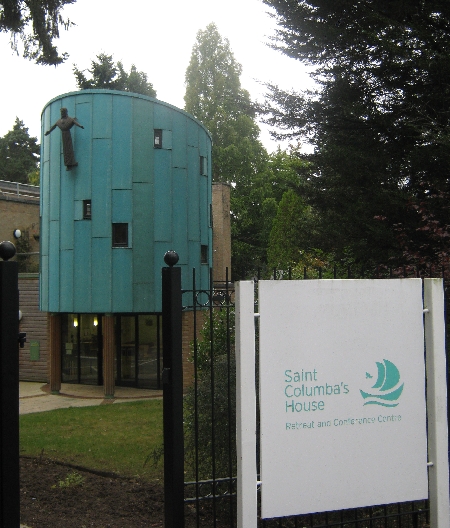
St. Columba's House, Woking © Ricky Yates
St. Columba’s House, Woking © Ricky Yates

As I wrote in my previous post, rather than being hosted by one of the Chaplaincies within the Eastern Archdeaconry, our 2013 Synod meeting, took place at St. Columba’s House, a Conference and Retreat Centre in Woking, Surrey, England, between Thursday 19th – Sunday 22nd September. Here is the post about the Synod meeting itself, as promised at the end of my previous rant about the profusion of unnecessary notices.

From my point of view, having the Synod meeting at Woking did mean it was relatively easy to travel to. I flew Prague – London Gatwick and return, using that well-known low cost airline one of my Church Council members has christened ‘SqueezyJet’, leaving Prague at lunchtime on Thursday and arriving back home in the middle of Sunday evening. The flights both ways, departed right on time, and the onward train journey from Gatwick to Woking, was relatively quick and simple.

As I frequently explain, the Diocese in Europe, of which the Eastern Archdeaconry is part, is the forty-fourth diocese of the Church of England, but no part of it is in England! Strictly speaking, that statement is not quite true as the Diocesan Office is in London and the Bishop’s residence and office, is at Worth, near Crawley, ten minutes drive from London Gatwick Airport. Therefore, the idea of holding our Synod meeting in Woking was so that we might meet with and hear from members of the Diocesan and Bishop’s staff, who are normally only names on the end of emails.

During our Synod meeting, we heard from our soon to retire Diocesan Bishop, Rt Rev’d Dr Geoffrey Rowell, who sought to answer the question, ‘What is a Diocese and what is its purpose?’ Other speakers were the Chair of the Diocesan Board of Finance (DBF), the Diocesan Appointments Secretary, the Diocesan Director of Ordinands (DDO), and the Diocesan Communications Officer. The last of these is also a member of the Diocesan Safeguarding Committee so he also spoke about the very important issue of the safeguarding of children & vulnerable adults.

The Chair of the DBF, obviously spoke about the finances of the diocese – where the money comes from, (mainly the annual contributions of each of the Chaplaincies, together with the income from historic grants and investments), and what it is spent on. The Appointments Secretary spoke about all the procedures involved in appointing a new Chaplain, when there is a vacancy. This was of great help to lay members of the Synod who may face this situation in the near future; for example St Andrew’s, Moscow, where Canon Simon Stephens is due to retire in June next year.

Following the talk by the Diocesan Appointments Secretary, there was quite an interesting discussion around the issue of the legal status of the Anglican Church in each of the over forty countries across which our diocese is spread, and regarding complying with employment law within each of them. This is becoming an ever increasing problem for several Chaplaincies within the Eastern Archdeaconry. Much of this arises out of the historical origin of many of our Chaplaincies.

Particularly in capital cities, many European Anglican Chaplaincies were established with the support of the British government, in conjunction and with the British Embassy in each country. This is reflected in the geographical location of several of them. For example, Christ Church, Vienna is directly opposite the British Embassy in the Austrian capital. St. Nicholas, Ankara, is within the grounds of the British Embassy in the Turkish capital. In the past, Chaplains were often deemed to be Chaplain to the Ambassador and thus had diplomatic status. Despite the Church of England still officially being the Established Church in England, (though not in Wales, Scotland or Northern Ireland), these days there is an ever-increasing distance between Church and state.

At one level, I’m very pleased that there is this distancing as many people still think that somehow we are the spiritual arm of the Foreign and Commonwealth Office and financed by the British government. Just to be clear, we are not! But this change has also created problems. For example, the Athens Chaplaincy, despite being in existence since the middle of the nineteenth century, recently had its bank account frozen because it was deemed not to be a legal entity and was therefore accused of tax fraud! Their problem is in the process of being resolved, but not without a few difficulties on the way.

As well as our speakers, the Synod meeting also provided various opportunities for corporate worship in the Conference Centre Chapel, led by ordained members of the Synod and by licensed Readers. Both Jack Noonan and I, led services of Morning Prayer. We also enjoyed two Bible Studies led by Canon Meurig Williams, Chaplain to our Diocesan Bishop and currently also Acting Archdeacon of NW Europe.

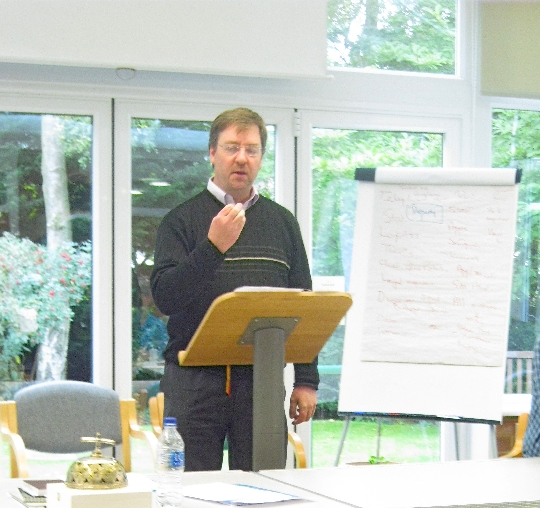
Canon Meurig Williams leading a Bible Study © Ricky Yates

As I have written several times previously, one of the most valuable parts of our annual Archdeaconry Synod meetings, is the opportunity for fellowship and mutual support for those of us who work in very isolated situations. In many respects, it is an annual meeting of old friends as well as meeting one or two new ones too.

Finally, in 2014, I will not need to travel at all to attend the meeting of the Eastern Archdeaconry Synod as the Prague Chaplaincy have agreed to be the hosts. Between now and Thursday 25th September 2014, I and my Prague Church Council, have a lot of planning and organising to do. As I often write – watch this space!


A profusion of unnecessary notices

What a surprise - the kettle might be hot! © Ricky Yates
What a surprise – the kettle might be hot! © Ricky Yates

I am just back from attending our annual Eastern Archdeaconry Synod meeting. Unusually this year, instead of being hosted by one of the Chaplaincies in our Archdeaconry, it was held in St. Columba’s Retreat and Conference Centre in Woking, Surrey, England. And whilst the Conference Centre was an excellent venue, it did feature one aspect of British life that I find irritating and absurd – an increasing profusion of unnecessary notices.

This first photograph illustrates what is probably the best, or worst 🙁 , example of what I am talking about. Yes – there is a kettle or electric jug for boiling water, to allow guests to make themselves a hot drink, either first thing in the morning or late in the evening. As it is there to provide hot water, do we really need to be told that it just might be hot? Do the management of the centre really believe that every guest they have, is as thick as two short planks?

It's a door - what's the danger? © Ricky Yates
It’s a door – what’s the danger? © Ricky Yates

The second example is hardly any better. Yes – it is a door. But I open and shut many doors, virtually every day of my life, as I suspect all other guests do to. Why do we all need to be told to ‘take care’?

As the passage leads from the first to the ground floor, stairs might be necessary :-) © Ricky Yates
As the passage leads from the first to the ground floor, stairs might be necessary 🙂 © Ricky Yates

This third example might have a little more justification, were the stairs to begin immediately beyond the door. But they don’t! They begin at least three paces later. And bearing in mind that this door obviously leads to the way from the first to the ground floor, most people with a few grams of common sense, would realise that to do so, there would be stairs.

There is a reason for the proliferation of all these totally unnecessary notices. It is the growth of a culture that actively encourages each and every person to believe that there must be someone to blame for anything adverse that ever happens in your life. No longer is even the slightest misfortune, just ‘one of those things that happens’, let alone actually being your own mistake. No – somebody else, human or corporate, is to blame!

Parallel to the growth of this culture of blame, has arisen a whole group of lawyers who offer to sue on your behalf, anyone or anything that can be remotely held responsible for even the most minor accident or injury, on a ‘no-win, no-fee’ basis. It is a case of ‘chicken and egg’ as to which came first – the culture or the lawyers. But both are now firmly embedded in British society, as they have been for far longer, in the USA.

To cover the risk of being sued for negligence, insurance is available. But because of the rise of spurious claims for damages, such as being burnt by a kettle because the complainant did not realise it was hot, insurance premiums have risen rapidly, with the cost being passed on to the consumer – in my example, the person like me, staying in the conference centre. These totally unnecessary notices, are insurance companies trying to cover themselves against future spurious claims.

I would hope that a Retreat and Conference Centre, run by a Christian charitable organisation, would be immune from the possibility of being sued for negligence by guests, past, present or future. But clearly, the management and their insurers, think otherwise. Hence all these unnecessary, and frankly absurd, notices.

Whilst here in the Czech Republic, there could be greater attention paid to certain aspects of health and safety, overall I am very glad that there is the presumption that citizens will use their God-given common sense. That if there is a hole in the pavement, people will just walk around it – not sue the local authority for failing to put up a two metre high fence to prevent someone falling in! Long may the ‘blame culture’ of the UK and USA, with the associated proliferation of silly notices, stay clear of the Czech Republic.

PS   A post about the 2013 Eastern Archdeaconry Synod itself, will appear here in the next couple of days!


A Wedding and a Baptism

The interior of St. Clement's Church, set up for the wedding © Ricky Yates
The interior of St. Clement’s Church, set up for the wedding © Ricky Yates

Last weekend, I had the privilege of officiating at two ‘occasional offices’, to use the term by which baptisms, weddings and funerals, are collectively known within the Anglican Church. On the afternoon of Saturday 7th September in Prague, I conducted my second wedding of 2013, whilst on the evening of Sunday 8th September, I conducted my first-ever baptism in Brno.

Unlike my earlier wedding this year, this second wedding took place in our worshipping home in Prague – Kostel sv Kliment/St. Clement’s Church. This has several major advantages from my point of view, not the least being that getting there was far less problematic than travelling to Bouzov Castle 🙂

As I have frequently written and said previously, the geography of a building, does impact on the way a wedding is conducted. As this wedding was the sixth wedding that I have conducted in St. Clement’s Church, I was thankfully far more at ease than normal. My only real concern as always, was being sure I had everything I needed either with me, or already in the Church, before setting out from the Chaplaincy Flat.

I got to Church more than an hour before the marriage service was due to begin, mainly to allow Larry the organist, plenty of time to practice all the music he was to play, well before the arrival of any of the guests. But it also allowed me to get the Church ready without any undue haste, and then to take the picture above.

Protokol, pen and stamp © Ricky Yates

Here is a close up of the table that I set up in the chancel apse where the necessary paperwork is completed. Rather than signing two marriage registers, as would be the case under the law of England and Wales, instead a four page marriage protokol has to be signed. But just like in England and Wales, the protokol has to be signed by the couple, as well as by two adult witnesses, and by me as the officiant. However, it being the Czech Republic, it also most importantly, needs to be stamped!

As you can see, I have pen, protokol and stamp in place, together with an Osvedcení, saying that the couple have fulfilled all the legal requirements allowing a religious marriage to take place, and an annotated protokol, to remind me as to who needs to sign where, to ensure I do not foul up anything!

Maria & David with me, following their wedding © Ricky Yates

The happy couple were David, an Englishman, and Maria, an American citizen from Puerto Rico. Both have lived in Prague for a number of years and for both, it was their second marriage. The supportive congregation was made up of family members, some of whom had specially flown in from the USA and the UK for the occasion, together with their friends, a mixture of expats and English-speaking Czechs. I could tell that there were a large number of expats present, by the laughter that followed my usual quip of saying, “This is the most important part of a Czech wedding ceremony”, followed by very firmly stamping the protokol 🙂

Sunday evening in Brno was a very special occasion, when I baptised Amelie Gabriela, the daughter and first child of Philip and Lenka Read, whose wedding I conducted in September 2010. This was the first-ever baptism for the Brno congregation since I started conducting regular monthly services there in January 2012. As I wrote in my earlier post in April, Phil and Lenka are having a house built just south of Brno, with a view of moving there permanently from England, later this year. Phil had two job interviews lined up for this week and I’m hoping to hear of a successful outcome, very soon.

Phil, Lenka & Amelie with me. the words in Czech on the wall behind us say 'God is love' © Ricky Yates
Phil, Lenka & Amelie with me. The words in Czech on the wall behind us say ‘God is love’ © Ricky Yates

Just like the wedding the previous day, my greatest fear was not having with me in Brno, everything I needed for the baptism service. When you are more than 200 km from home, it isn’t possible to pop back and pick up something you forgot! I also had the logistical problem of the Czechoslovak Hussite Church that we use for our Brno services, not having a font! I overcame this problem, by having a glass bowl on the altar, which can be seen on the right of this photograph.

Amelie's amazing baptism cake © Ricky Yates
Amelie’s amazing baptism cake © Ricky Yates

After worship in Brno, we always share fellowship over refreshments. Last Sunday, our refreshments included large helpings of this amazing cake, made especially to celebrate Amelie’s baptism. Supporters of the Intercontinental Church Society (ICS), will also notice that I was busy distributing copies of ICS News and Prayer Diary and the recent Prayer Diary supplement. The financial and prayerful support of ICS has been a major factor in the establishment of the Brno congregation.


The Soviet invasion of 1968 and its aftermath

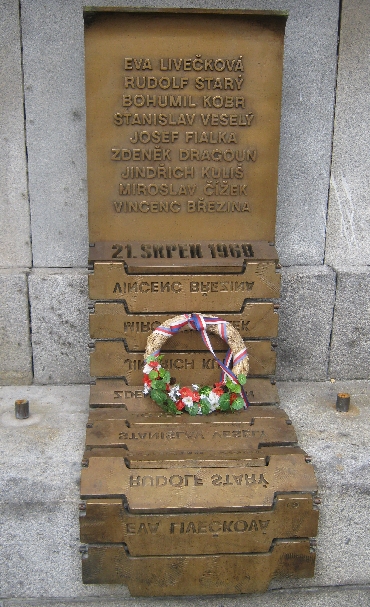
Memorial to the victims of the Soviet invasion of August 1968 © Ricky Yates

This past week saw the forty-fifth anniversary of the invasion of Czechoslovakia by the Soviet Red Army, which brought to an abrupt end, the short period of liberalisation known as the ‘Prague Spring’. On the night of 20th – 21st August 1968, around 200,000 Soviet troops poured over the borders from surrounding Warsaw Pact countries, supported by airborne troops, equipped with artillery and light tanks, who were flown in via Prague Airport. Along with the Soviet forces, there were also contingents of troops from Poland, Hungary, Bulgaria and East Germany.

Whilst Alexander Dubcek, the Czechoslovak leader who had sought to introduce, ‘socialism with a human face’, called on his people not to resist, many ignored his advice and over one hundred citizens were killed and many more injured. This memorial commemorates those who died in the city of Liberec in northern Bohemia. Many more employed passive resistance, such as painting out or completely removing road signs, so the invading troops would not know where they were. The only signs left standing, were those pointing the way back to Moscow!

The forty-fifth anniversary of the Soviet invasion has been marked this past week by a number of official events across the country. This report, from Czech Radio’s English service, tells of a commemoration held outside their own Headquarters, where several people died trying to defend those inside the building, who were broadcasting details of the invasion and calling for help from the West.

On social media such as Facebook, many Czechs have been posting black and white photographs, taken on the day of the invasion or shortly afterwards. It is interesting to note that some of those posting were not even alive at the time of the invasion!

Forty-five years on, it is also interesting to reflect upon the various consequences of the brutal implementation of what became known as the ‘Brezhnev Doctrine’ – no challenge to Soviet hegemony over all of the communist satellite states of Central and Eastern Europe.

One immediate consequence was the departure of around 300,000 people from Czechoslovakia, predominantly skilled and educated individuals that the country could ill afford to lose. In my time of living in the Czech Republic, it has been fascinating to meet several of them and hear their stories – some who have chosen to return post 1989, and others just visiting from the countries where they have now settled.

Both before and after the Soviet invasion in 1968, the one foreign language that Czech people were taught and required to learn, was Russian. Since 1989, Russian has very much become the language you don’t use within the Czech Republic. Most Czechs aged over thirty-five, who once were were able to speak Russian, seem to have since done their utmost to forget what they were taught 🙂

For as I have discovered, the people Czechs most dislike, are Russians. This is partly historical – the Russian Federation is seen as little different to the former Soviet Union who invaded in 1968 and exercised de-facto control here, until 1989. There is a strong feeling that Russia still wants to have a strong influence, but is now seeking to do so via economic means such as the supply and price of natural gas.

The other reason for a dislike of Russians is that those Russians who do live here, are seen as arrogant, wealthy, and in control of some of the less attractive aspects of life – twenty-four hour Herna (gambling) bars, prostitution, and associated people trafficking. As always, stereotypes don’t apply to everyone. There are Russians living in Prague, doing perfectly legal business and wanting only to steer well clear of Putin. But nearly all Russians living in the Czech Republic tend to get tarred with the same brush, at least part of which is the legacy of the events of forty-five years ago.

Senior Cat Oscar

Oscar enjoying the sunshine by the balcony door © Ricky Yates

It is three and a half years since I wrote a blog post about the third member of our family – Oscar the cat. Other than an occasional passing mention, he hasn’t since really featured here very much. So I thought it was time he once more deserved his own post.

These days, we refer to Oscar as our ‘senior cat’ as he is now nearly sixteen and a half years old. This is a very good age for a cat and in many respects, it is quite remarkable that he is still with us.

Whilst Oscar has never been a large cat, we began noticing earlier this year, that he seemed to be getting thinner. We tried feeding him cream and other goodies, in an effort to fatten him up. He also was failing to groom himself as he did in the past, with Sybille resorting to catching him and brushing him herself, to try and keep his fur in order. And increasingly, his breath smelt somewhat unpleasant.

All of this we put down to Oscar getting old. However, whilst I was in the UK for a few days in early July, Sybille managed, without losing blood 🙂 , to get a closer look at Oscar’s mouth and realised that there was a major build up of tartar on his teeth which needed attention and was clearly the source of his increasingly bad breath. So on my return to Prague, I made contact with the vet, who fortunately speaks fluent English and German as well as Czech, to ask whether he would be willing to treat Oscar’s teeth – treatment which would certainly involve giving him a general anaesthetic, bearing in mind his advanced age.

In his reply, the vet said that they would first want to carry out a complete geriatric profile, to assess Oscar for treatment. But if that was satisfactory, they would then carry out the necessary dental work. All this could be done the same day, meaning only one journey to the vet’s surgery, bearing in mind how much Oscar dislikes car travel. So Oscar was booked in for his profile and possible treatment, on Thursday 25th July.

The geriatric profile was comprehensive, involving a clinical examination, the taking of blood for a series of tests, an abdominal ultrasound and a thoracic X-ray. The X-ray revealed abnormalities in the shape of Oscar’s sternum which the vet thinks are due to old fractures. We can only think that these might have occurred when he went walkabout for two months in the summer of 2007. Fortunately, there was nothing revealed to prevent the administration of a general anaesthetic, so one was duly given and five rotten teeth were then extracted.

However, what the blood tests did reveal, is that Oscar is suffering from an over-active thyroid – in fact a very over-active thyroid! This is the explanation as to why he had become so thin. Therefore three weeks ago, he started taking a prescribed methimazole tablet twice a day, to help bring his ‘T4 values’ back to more normal levels. The results have been phenomenal, so much so, we now have a very healthy ‘fat cat’ as you can see in the photo I took of him yesterday, sitting on the mat by the door to the main balcony, enjoying the sunshine.

Anyone who knows Oscar, despite him mellowing in recent years, will realise that getting him to swallow a tablet, it no easy task. But Sybille has discovered the foolproof method – wrap it in a small piece of ham! It then goes down a treat 🙂 Bearing in mind that he will need this medication for the rest of his life, we are clearly going to also need a constant supply of ham. And judging by the healthy cat we now have, who is also once more grooming himself far better than before, it looks like Oscar is going to be with us for a few more years yet.