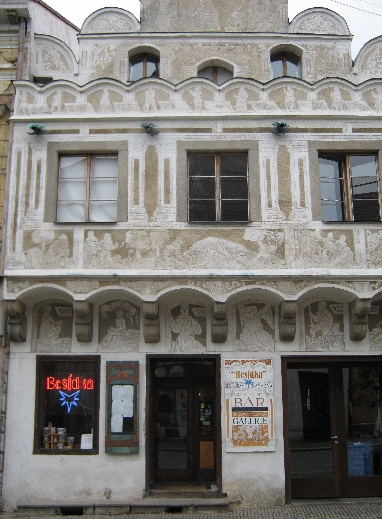
Telc

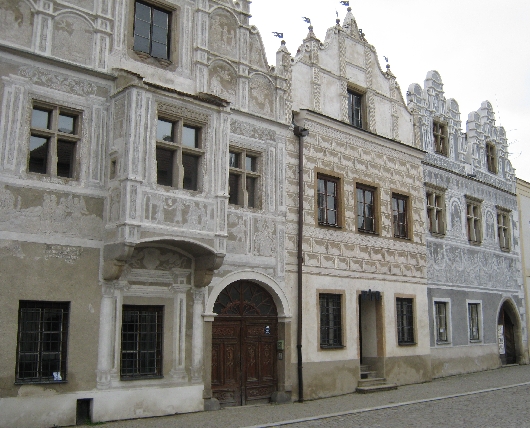
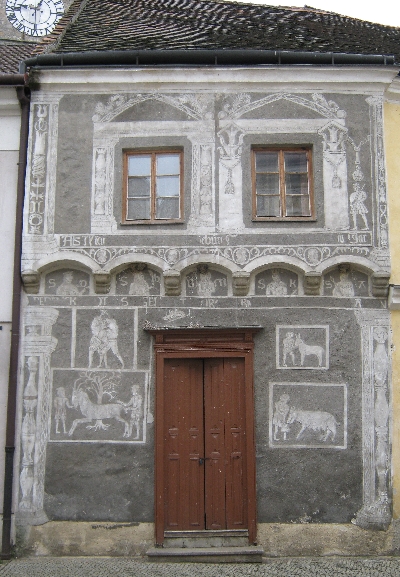
Arcaded building with sgraffito decoration in Telc © Ricky Yates

Leaving behind the Bata Canal and the valley of the Morava River, we drove westwards some 200 km to the little town of Telc, situated around 500 metres above sea level in the rolling hills of the far south-west of Moravia. Telc had been on my list of places to visit ever since I first read about it soon after arriving in the Czech Republic in September 2008.

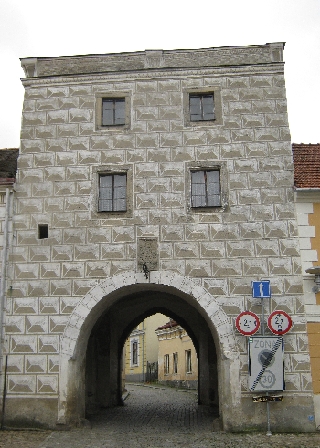
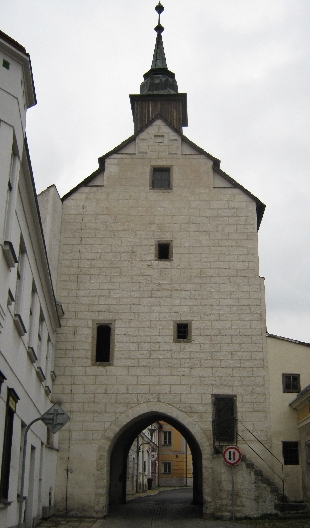
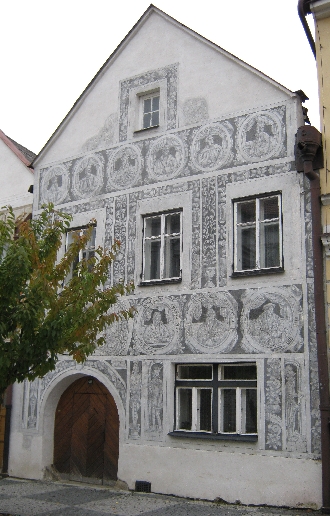
The historic centre of Telc is surrounded on three sides by medieval fish ponds and access to it is via a narrow bridge and/or a gateway through the town wall. Inside the wall is the cobbled town square námestí Zachariáše z Hradce, which is surrounded by arcaded houses with beautifully decorated facades. These all date from the 16th century when the town was rebuilt by Italian masons in the Renaissance style, following a disastrous fire in 1530. There has been little alteration or additions since then.

Late in the afternoon of Tuesday 5th October, we parked the car near the narrow bridge across the fishponds, walked over the bridge, through the gateway and into the square. The view that greeted us did not disappoint, despite the poor light and the drizzle that was falling.

Cobbled town square - námestí Zachariáše z Hradce, in Telc © Ricky Yates

Walking around the square, we found Penzion a hospada U zeleného Žížaly on the southern side and enquired about accommodation. The proprietor had no English but did speak German, not surprising as the Austrian border is less than 30 km away to the south. She showed us a very pleasant room on the first floor, with access to a well equipped kitchen, which was within our price range. We gladly accepted the offer, especially as we were promptly given a parking permit for the car, allowing us to park in the historic square, directly outside the Penzion. Then, deciding that there was plenty to see the next day, we booked in for two nights.

At one end of the town square is Telc’s Renaissance Water Chateau. Originally belonging to a branch of the Liechtenstein family, it is now in the care of the Czech government. The following morning, we took a tour of the interior of the chateau. There were only four of us for the tour which was given entirely in Czech, though we were given laminated cards with quite a bit of information in English, which helped us understand more of what we were looking at. Some of the decorated ceilings were quite incredible but, as is often the case these days, no interior photography was allowed.

From l. to r: Spire of the Church of St. James the Apostle, former Jesuit monastery and the twin spires of the Church of the Holy Name of Jesus, Telc © Ricky Yates

Adjacent to the chateau are two Churches, one dedicated to St. James the Apostle and one to the Holy Name of Jesus. And in between, a former Jesuit monastery which is now used as a branch of Masaryk University in Brno. Here they can all be seen from the far side of one of the fishponds.

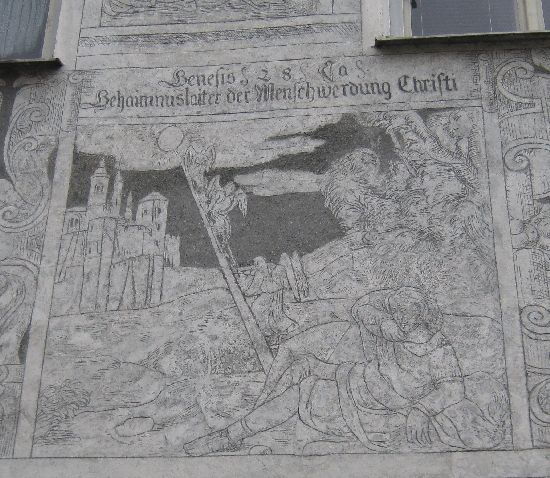
Decorated building in Telc © Ricky Yates

Visiting Telc in early October, well out of the main tourist season, had both its advantages and disadvantages. The main disadvantage was that we could not gain access to the interiors of any of the Churches. In particular, we both would have loved to have seen inside the Church of St. James. But that is only open regularly between the beginning of June and the end of August. Otherwise you can only get inside when mass is being celebrated and mass times didn’t coincide with our time in Telc.

The main advantage was the absence of other tourists, especially during the two evenings we were there. During the day, there was the occasional group of tourists, particularly Japanese or Koreans. It would appear that some coach tours of Central Europe stop off at Telc for an hour or so, to break the journey between Vienna and Prague. But by late afternoon, all of these had departed and we could walk around the town square with only a few local residents for company.

Writing this post has once again highlighted my constant problem of most web browsers being unable to cope with diacritics which are an essential part of writing Czech correctly. There should be a hácek, (a little hook) above the ‘c’ at the end of Telc. But if I were to put one in, most readers of this blog would see ‘Tel?’ There should also be a hácek above the ‘c’ in ‘hácek’, but if I put one in, that would likewise appear as ‘há?ek’!!!!

Arcaded houses in Telc © Ricky Yates
The town square - námestí Zachariáše z Hradce, Telc © Ricky Yates

Uherské Hradište and the Bata Canal

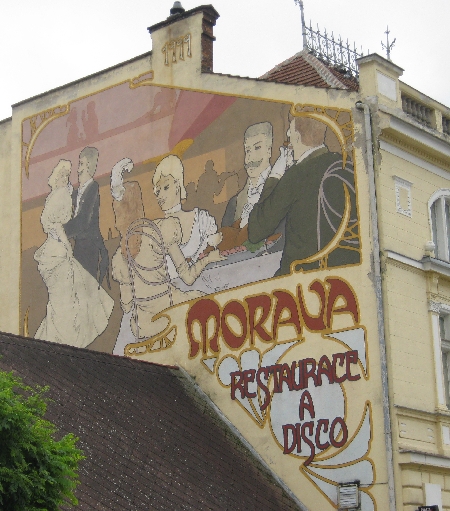
Advert in the style of Alphonse Mucha for the Morava Restaurace a Disco in Uherský Ostroh © Ricky Yates

After the disappointment of the Wallachian Open-Air Museum being closed on Mondays, we left Rožnov pod Radhoštem and headed south, having lunch in and spending a couple of hours walking around the streets of the small spa town of Luhacovice, before arriving in the late afternoon, in the town of Uherské Hradište. Struggling continually trying to pronounce ‘Uherské Hradište’ correctly, we soon resorted to referring to it as ‘U.H.’!

As Professor Michal Novenko, our St. Clement’s Church organist had told me a few months previously, ‘Uherské Hradište’ means ‘the fortified place of the Hungarians’ – ‘Hrad’ being the Czech word for ‘castle’. The name is a reminder of past history when borders and peoples were not as they are now. I’m not sure how many Hungarians are left living in Uherské Hradište but in nearby neighbouring Slovakia, about 10% of the population are Hungarian and their treatment has again recently been a source of tension between the Slovak and Hungarian governments.

After various fruitless accommodation enquiries which were all beyond our budget, we spotted the newly built Penzion Na Stavidle, adjacent to the main railway station. This offered a very spacious double room with en-suite facilities, together with access to kitchen facilities, for a very reasonable 800 Kc for the night. The kitchen had coffee and tea available, together with the equipment to make breakfast or cook a bigger meal should that be desired.

Unfortunately, by the time we got our accommodation sorted, the light had gone so I have no photos. But we enjoyed exploring the two large cobbled squares, surrounded by numerous attractive historic buildings, that make up the centre of Uherské Hradište.

Restored Chateau/Zámek at Uherský Ostroh © Ricky Yates

As I have blogged previously, those who have known me for a long time will know that I have a life-long interest in canals and inland waterways. I was therefore very keen to explore parts of the nearby Bata Canal the following day.

The Bata Canal was built between 1934-1938, in order to transport lignite (brown coal) from a mine near Rohatec, to a power plant at Otrokovice, a distance of over 50 km. Both the mine and the power plant were owned by the Bata family of Bata Shoes fame. They paid for most of the construction costs together with some government support, as the canal also helped with flood control in the valley of the Morava River. The canal is part artificial channel, and part, a making navigable of sections of the Morava River.

The canal infrastructure was damaged during World War Two but was partially restored in 1949. By the 1960s, it ceased to be used for commercial traffic and was officially abandoned in the early 1970s. In the past 15 years, with the recognition of the tourist potential of a restored waterway based on the growth of pleasure boat traffic on the British and French Canals, the waterway has been restored. As well as being extended further south along the Morava River to Hodonín, there are plans to also extend it to Skalica just over the border into Slovakia, and northwards along the Morava River, from Otrokovice to Kromeríž.

We drove first to the small town of Uherský Ostroh, (note once more the Hungarian prefix), several km south of Uherské Hradište, where the helpful lady in the tourist office could speak English but could not provide me with a leaflet about the canal in either English or German, but only in Czech! This was one of several occasions when I really began to wonder whether the Czech authorities actually want foreign tourists!

The above two photos were taken in Uherský Ostroh. The first is of a painting, completed in 1999, (you can just make out the date on the chimney), in the style of the early twentieth century Czech artist, Alphonse Mucha, It advertises the Morava Restaurace a Disco which is located on the ground floor of the same building. Whilst exceedingly attractive, it did also strike me as somewhat incongruous. No twenty-first century couple is going to be going to the restaurant, let alone the disco, wearing that sort of gear!

The second photo is of the nearby chateau or zámek, (to use the correct Czech term), recently restored and an example of the sort of architectural delight that can be found in almost every town and village in this part of the world.

Boats moored at the wharf in Strážnice © Ricky Yates
Canal bridge at Strážnice © Ricky Yates

Further south, in the town of Strážnice, we found this wharf and bridge. According to a small map in my Czech leaflet, there were two locks a short way from the wharf and bridge, so we set out to walk along the towpath to find them.

Flood locks on the Bata Canal at Strážnice © Ricky Yates

Flood locks on the Bata Canal at Strážnice. The Velicka River flows at right-angles across the canal from left to right, between the two locks © Ricky Yates

Here they are! But they are not locks that allow boats to move from one level of the canal to another – they are what are known as flood locks. The two locks are located on either side of the Velicka River as the canal crosses it at right-angles but on the same level. Whilst the water level in the Velicka River is the same as that in the canal, both sets of lock gates can be left open as was the case when we visited. Only if there is heavy rain, causing the river level to rise considerably, are the lock gates closed in order to prevent the canal from overflowing.

Our visit has wetted my appetite for discovering more about this fascinating waterway. Who knows? During the next few years, I may even hire a boat and cruise the full length of the Bata Canal.

More Czenglish and Museums don’t open on Mondays

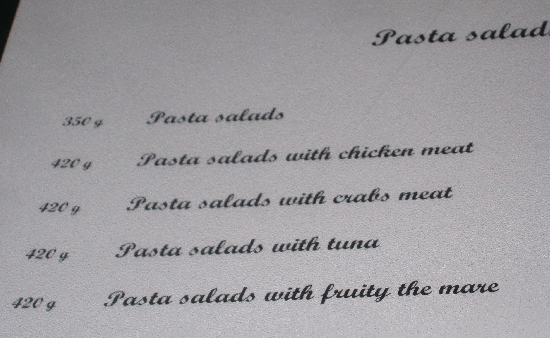
Do you fancy a pasta salad with a horse called 'Fruity' galloping through it? © Ricky Yates

In a valley between wooded Moravian hills, lies the small town of Rožnov pod Radhoštem which is where we drove to after leaving Ceský Tešín. Rožnov had been recommended to us as a place to visit by several people as it is the home of the Wallachian Open-Air Museum where an amazing variety of historic wooden Moravian buildings have been preserved since the founding of the museum 85 years ago in 1925.

We arrived just before dusk and eventually found a place to stay within our price range in Penzion Becva, which didn’t appear in our guidebook, but which I fortunately spotted as we were about to leave the town to look elsewhere. Having been so well-fed at lunchtime, we then went out that evening looking only for a place to have a drink and a snack.

Not far from the hotel, we found the very pleasant Restaurace U Janíku. We ordered two beers and asked to also see the menu and the waitress gave us their ‘English version’. A few minutes later we were both killing ourselves with laughter upon seeing the description of the last item on the page photographed above. Each of us had visions of a female horse called ‘Fruity’, galloping through 420 grams of Pasta Salad!

It is yet another example of that wonderful language called Czenglish of which I have cited many examples in previous blog posts. Maybe I should actually call this example Czfrenglish. What the menu is trying to say is on offer is ‘Pasta Salad with seafood’. But the compiler of the ‘English Menu’ has instead sought to adapt the French for seafood, fruits de mer, literally ‘fruit of the sea’. He has tried to make the word ‘fruit’ plural but has done it in the Czech manner by the addition of the letter ‘y’. He has then put in the definite article, which doesn’t exist in Czech. Finally for reasons known only to himself, he has converted ‘mer’ to ‘mare’.

After breakfast the next morning, we drove the short distance to the edge of Rožnov, to the ticket office and car park for the Wallachian Open-Air Museum. There were no cars in the car park and the ticket office was shut. Then it dawned on us – like so many art galleries and museums in Prague and elsewhere in the Czech Republic, the Wallachian Open-Air Museum does not open on Mondays! So, despite all the positive recommendations, we didn’t get to make our planned visit and it must wait until we visit Moravia once again sometime in the future.

Two Moravian Churches and a brief visit to Poland

Wooden Church in Bílá, Moravia © Ricky Yates

The modern-day state of the Czech Republic is made up of what was historically known as Bohemia and Moravia, together with a small part of Silesia. Bohemia forms the western part of the country with Prague at its centre, whilst Moravia forms the eastern part where the country’s second city Brno, is located. The bulk of Silesia now lies in Poland with only a very small part being contained within the borders of the Czech Republic, in the far north-eastern corner of the country.

On the afternoon of Thursday 30th September, we drove from Litomyšl, which is in East Bohemia, further eastwards into South Moravia, to the little town of Vizovice. The main claim to fame of Vizovice is that the very best variety of Slivovice (Czech plum brandy) is distilled within the town, a fact that we were told every time we ever mentioned that we were going there!

We spent from that Thursday evening, through to lunchtime on Saturday 2nd October, in a simple but pleasant ‘glorified youth hostel’, located in the beautiful wooded hills above Vizovice, attending the synod of the Old Catholic Church in the Czech Republic. We were given the synod dates after we had booked our holiday dates so decided to incorporate our synodical attendance into our travel plans. As the discussions were all in Czech and mainly about a new Church constitution which was finally adopted early on the Friday evening, I won’t write anything more about it here in this blog post other than saying that we were very well looked after and enjoyed the fellowship.

Following the end of the synod, we left Vizovice and set off to drive through the beautiful wooded hills of the far east of Moravia. Our journey took us through numerous small towns and villages, many of which welcome walkers and cyclists in summer and skiers in winter. Our scenic journey briefly took us across the border into Slovakia before, a few km later, we returned to the Czech Republic. Soon afterwards, we passed through the village of Bílá and spotted this beautiful wooden Church. Apparently, there are only a few of these in Moravia but are more commonly found in Slovakia.

We ended the day in the somewhat industrial town of Ceský Tešín which is located in the Czech part of Silesia. In many respects, Ceský Tešín is only half a town – the other half lies across the Olše River in Poland and is called Cieszyn. As part of the settlement that followed the end of the First World War, in July 1920 the town was divided between the newly formed nation of Czechoslovakia and Poland, using the natural divide of the Olše River.

Having found a very pleasant and reasonably priced room in the Central Hotel in Ceský Tešín, we decided to take the advice of our guidebook which declared that the most interesting and historic parts of the town were on the other side of the river. So we set out on a short walk and crossed Hlavní Most, one of the two bridges across the Olše, and entered Poland, the first time I had ever set foot in the country and only the second time that Sybille had.

Unfortunately, it was just getting dark as we walked up a cobbled street into the main square of Cieszyn so I don’t have any pictures though we were able to enjoy the architecture as some buildings were floodlit. And after Sybille had withdrawn some Zloty from a Polish ATM, we enjoyed a pleasant drink and meal in a bar-restaurant on the main square before returning across the river to our bed in the Czech Republic.

Chapel dedicated to the late Brother Roger of Taize, Ceský Tešín © Ricky Yates

The next day being Sunday, we joined the congregation who worship in this rather unusual Church. It is located behind a supermarket and the building was formerly a flower shop and a shoe repair shop! Now it is the Chapel dedicated to the late Brother Roger of Taize where a small Old Catholic congregation worship, led by Dr Cezary Mizia. Cezary is Polish and was originally a Roman Catholic priest. He conducted the service, partly in Czech and partly in Polish. He preached in Czech and English for our benefit!

Interior of Chapel dedicated to the late Brother Roger of Taize, Ceský Tešín © Ricky Yates
The Olše River & Hlavní Most - Poland on the left & the Czech Republic on the right © Ricky Yates

After the service, we walked with Cezary’s wife Alice and their little baby Jeremias, back over the border into Poland where I took this photo from the castle mound looking down on Hlavní Most and the Olše River. We did this whilst Cezary was busy back in their apartment, preparing lunch for us all. Lunch was a little like French Sunday lunch with innumerable courses! However, it did have a Polish flavour as Sybille & Cezary both downed at least three shots of Polish vodka which had to accompany certain courses! Alice and I were fortunately able to avoid the vodka as we both had the excuse of needing to drive later in the day.

It was late afternoon on Sunday 3rd October before we finally bid farewell to Cezary, Alice & Jeremias and set out once again to explore more of the Czech Republic. Before doing so, I helped with feeding Jeremias his lunch as you can see below!

Me feeding Jeremias © Sybille Yates

Litomyšl

Town Hall in Litomyšl © Ricky Yates

Yet again, I have to start a blog post by apologising for not posting anything here for the past three weeks. My chief excuse is that Sybille & I have been on away on holiday for two of those weeks only returning to Prague last Tuesday (12th) in the afternoon. We’ve spent our time exploring various parts of the Czech Republic with little forays into each of the country’s neighbours – Slovakia, Poland, Austria & Germany. Over the next couple of weeks, I hope to write a series of posts about our travels & introduce readers to the delights of the Czech Republic that lie outside of Prague.

On the evening of Tuesday 28th September, we met my former colleague Rev’d Kathy Ferguson, at Prague airport and brought her to the Chaplaincy flat. Then on the Wednesday morning, I took her on a quick tour of St. Clement’s Church & the Old Catholic’s Communio Centre so she was familiar with both places as she was to spend the next two weeks as my locum priest as well as taking care of Oscar!

Sybille & I left Prague on the afternoon of Wednesday 29th September and initially drove to the small town of Litomyšl which is about 180 km east of Prague. Here we stayed overnight with Steve & Paula, an American couple who had couchsurfed with us in Prague in late July this year & who Sybille also knew through Shutterstock where both she & Steve sell their photographs. Steve had created a wonderful homemade soup as well as a pear cobbler and we feasted on both as part of our evening meal.

Smetanovo námestí in Litomyšl © Ricky Yates


The next morning, we set off to explore the architectural and other delights of Litomyšl. The historic centre is made up of a cobbled ‘square’, (effectively two isosceles triangles whose acute angles meet in the middle), which is surrounded by a series of arcaded buildings. One of the oldest, which dates from the 1640s, is known as ‘The Knight’s House’ and is an excellent preserved example of renaissance burgher housing.

The Knight's House, Litomyšl © Ricky Yates
Statue of Bedrich Smetana, Litomyšl © Ricky Yates


As well as its architecture, Litomyšl’s other claim to fame is being the birthplace of the composer Bedrich Smetana. His statue stands at the far end of the ‘square’ which in turn is named Smetanovo námestí after him.

Sgraffito in Litomyšl © Ricky Yates

Nearby is a high school building which is decorated with sgraffito, a form of decoration we were to see on many more buildings during our travels.

Chateau at Litomyšl © Ricky Yates

Also nearby is a 16th century chateau, to which additional baroque features have been added, again with sgraffito decoration . Since 1999 it has been part of Unesco’s World Heritage List and it is very easy to see why!

Detail of the sgraffito decoration on Litomyšl Chateau © Ricky Yates
Diving female figure by Olbram Zoubek © Ricky Yates

In the grounds of the chateau and in the nearby monastery garden are various figures, the work of the Czech sculptor Olbram Zoubek. The sculpture pictured here is one of four ladies surrounding a pool into which they are all about to dive.

A wonderful combination of friendly welcoming hosts, a delightful little town, together with pleasant sunny weather made this an excellent beginning to our October holiday in the Czech Republic.