Journey home through the interior

Sign warning of landmines by the road side between Šibenik & Knin © Ricky Yates

After spending the nights of Saturday 18th and Sunday 19th July in Primošten and exploring Šibenik, we set out on the morning of Monday 20th July on the long journey back to Prague. Having driven down into Croatia on the coast road, we decided to return through the interior. Therefore, once we had reached the outskirts of Šibenik, we headed inland on the road leading to Knin.

From background reading, I knew that we would be travelling through an area that was fought over during the conflict that took place between 1991 and 1995. So I was expecting that we would almost certainly see some remaining war damage. However, what we did observe still did come as quite a shock.

Within 20 km of the coast we saw the first few damaged buildings. Shortly afterwards we began to see signs like that in the adjacent photograph, warning people not to stray from the road onto the adjoining land because of the danger of the presence of unexploded landmines. Again, I’d read the advice on the Foreign and Commonwealth website warning British visitors to Croatia of this danger but it was still quite disturbing to see the signs in person.

In one sense I should not have been so surprised to see all this so near to the Dalmatian coast bearing in mind what I have written previously in this blog about Zadar being under siege for three months at the height of the war. Likewise, the guide I purchased to Šibenik Cathedral stated that the dome of the Cathedral had suffered war damage which has thankfully since been repaired.

War damaged bar-restaurant © Ricky Yates
Shrapnel and bullet damage © Ricky Yates

One particular building seemed to encapsulate what happened during the conflict and the situation that exists now. We saw this building as we drove by and stopped to investigate. It would appear to have been a bar-restaurant with accommodation for the owner on the upper floor. But it was completely burnt out with shrapnel and bullet damage still clearly visible.

This area around Knin is known as Krajina and, before the conflicts of the 1990s, it had a majority Serb population although lying within the boundaries of Croatia. When the nationalist government of Franjo Tudman declared Croatian independence in June 1991, the Serbian enclave of Krajina proclaimed its own independence from Croatia with the idea that it would become part of a ‘Greater Serbia’. Ethnic cleansing followed with the Croatian minority resident in the area being reduced from 44,000 to 900 in the following months.

However, when the Croatian army retook the area in 1995, driving out the Serb militia forces, up to 150,000 members of the Serb population also fled with the militia. The looting and burning that followed was no doubt designed to discourage their return.

The Dayton Accords signed in December 1995, which brought an end to the conflicts in the former Yugoslavia, recognised the traditional borders of Croatia but provided for the return of Serbian refugees and the restitution of their property. Whilst good in theory, the reality on the ground is very different. I suspect this property belongs to a Serb who has decided not to return. Hence it is ‘Na prodaju/For sale’ with a mobile telephone number. The owner is either fearful to return and/or can see no future for his former business in an independent Croatia.

War damaged house near Knin © Ricky Yates

Here is another photograph of a burnt out house. Whilst now peaceful, this area is littered with damaged buildings similar to these. Clearly the total population is now only half what it was before 1991.

I’ve deliberately referred to what happened between 1991 and 1995 as ‘the war’ or ‘the conflict’, trying to adopt the role of the neutral observer. But I couldn’t help but notice the language used in tourist material and published guides.  Much tourist material makes no mention of ‘the war’ at all. After all, they don’t want to put off visitors! But when reference is made, it is called ‘the patriotic war’ (guide to Šibenik Cathedral) or ‘the homeland war’ (tourist literature about Karlovac – see my next post). Once I saw it referred to in slightly less jingoistic terms as ‘the Croatian War of Independence’. But all of these descriptions inevitably imply that the Croats were the ‘goodies’ and the Serbs were the ‘baddies’. The reality, as I’ve briefly described, is that atrocities were carried out on both sides and that much still needs to be done in the coming years to try and make some amends, resettle people and allow those that want to, to return to their former properties.

Moutainous scenery west of Knin © Ricky Yates

On reaching Knin, we headed northwest on a good road that runs through a wild and beautiful mountainous area roughly parallel to the Croatia/Bosnia border. I hope this picture on the left gives some indication of the attractiveness of the landscape. Eventually we reached the small town of Gracac where we managed to procure a late lunch in a pizza restaurant.
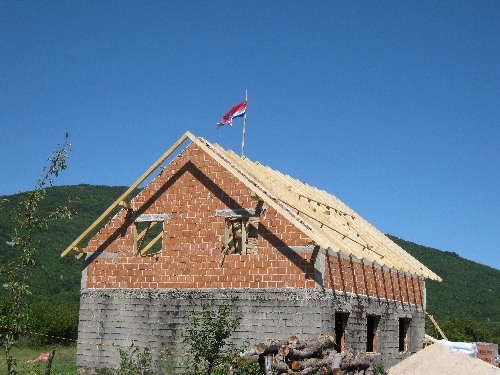
House being re-built in Gracac with prominent Croatian flag © Ricky Yates

Sitting on the balcony on the first floor of the restaurant building, we could see across the road to a small group of houses of which two or three were being repaired/re-built. Out of the roof of one of them was a flag pole with a large Croatian flag attached. Clearly the owner of this property wanted to make a very public statement as to his ethnicity. Whatever the nationality of any past owner, he was a Croat repairing/re-building his house within the independent Republic of Croatia!

Šibenik and Primošten

As Karen felt that the last view of the sea was …breathtaking (see the first comment on the previous post) – here is another one! This is the commercial port of Šibenik viewed from the fortress/citadel above the old part of the city. The Cathedral is just off to the right of this picture.

Šibenik habour and commercial port seen from the citidel © Ricky Yates
Šibenik habour and commercial port as seen from the citidel © Ricky Yates


And here is Primošten, an ancient village but now a popular holiday resort some 25 km further along the coast from Šibenik, where we stayed for two nights before beginning our return journey to Prague.

Primošten just before sunset © Ricky Yates


The Cathedral of St. James, Šibenik

After ten very enjoyable and relaxing days on Dugi Otok, we returned by ferry to Zadar and headed slightly further down the coast to Šibenik. The ancient city centre of Šibenik has a network of steep pedestrianized streets which are fascinating to explore and in the midst of which is the Cathedral Church dedicated to St. James.

The west front of Šibenik Cathedral © Ricky Yates

The Cathedral was constructed during a period of just over 100 years between 1431 and 1536. It is built entirely of stone quarried from nearby islands without any brick or wooden supports. Large stone blocks or slabs were brought together in such a way that the edge of one slab entered into the groove of the second slab. It is reputed to be the world’s largest Church built in this manner.

On the outside of the Cathedral are many fascinating carvings including 71 different heads with a variety of facial expressions.

Carved heads on the exterior of Šibenik Cathedral © Ricky Yates
On the north wall, either side of one of the entrances, Adam and Eve are portrayed, both holding onto their fig leaves and looking somewhat embarrassed!
Adam looking somewhat embarrassed © Ricky Yates
Eve looking somewhat embarrassed © Ricky Yates
As Sybille and I have, at different times, both made the pilgrimage to Santiago de Compostela, the reputed burial place of St. James, we were interested to see how he was portrayed. We discovered that he appears not once, but twice in carvings on the Cathedral exterior. At the pinnacle of the chancel roof, he is portrayed as St. James the Teacher with book in hand. However, on the north wall, immediately above Adam, he is portrayed in his more usual role as St James the Pilgrim. Unfortunately, his pilgrim staff is in need of some repair.
St. James as Teacher © Ricky Yates
St. James as Pilgrim © Ricky Yates
By steadily climbing up through the ancient narrow streets of Šibenik, it is possible to visit the citadel fortress that overlooks the city. The effort is more than worthwhile for the magnificent views back down on the Cathedral and across to the nearby islands.
Šibenik Cathedral from the Citadel © Ricky Yates

More about Dugi Otok

Until recently, I’ve usually been rather wordy with my blog posts but in the last few posts, I’ve tried to let the pictures tell more of the story. And I’m going to do the same again by posting some more photos of Dugi Otok to try and give an indication of why I fell in love with the place.

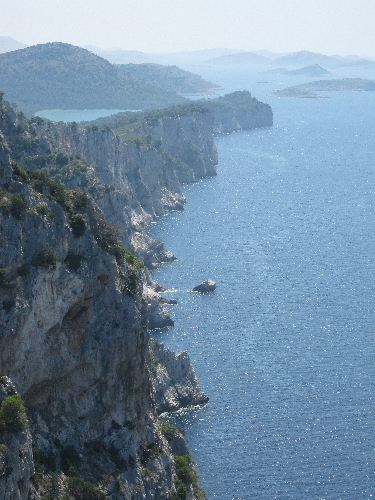
Limestone Cliffs on the west coast of Dugi Otok © Ricky Yates

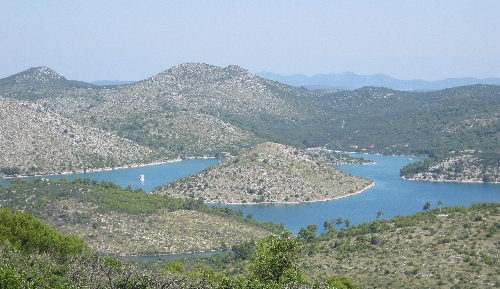
The southern end of the island, immediately to the south and west of Sali where we were staying, is designated as the Telašcica National Park. It is an area of amazing beauty with its karst topography, limestone cliffs and the long Telašcica Bay which is dotted with islands. The best way to really appreciate the area is no doubt by boat, something we didn’t manage to do. But it is possible to drive part way into the park & then walk further and see some stunning views of which I hope these two pictures are indicative.

Telaš?ica Bay © Ricky Yates
Telašcica Bay © Ricky Yates
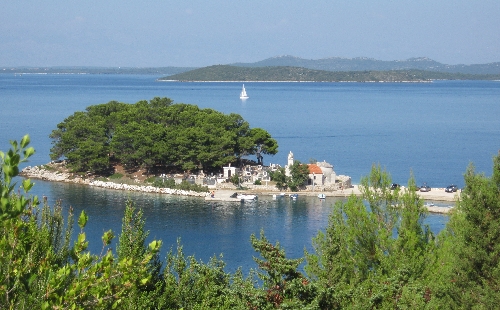
Savar and the Church of St, Pelegrin © Ricky Yates
Savar and the Church of St. Pelegrin © Ricky Yates

Further north on the island, just below the ferry port of Brbinj, lies the village of Savar. Here, on a wooded peninsular jutting out into the sea, is the pre-Romanic Church of St Pelegrin. The chancel dates from the seventh century and most of the rest of the tiny Church from the ninth. Its setting is idyllic as you can see and my only regret was being unable to see inside the building as it was locked with no indication as to where one could obtain the key.

Sali Harbour in the evening © Ricky Yates

And to finish, before I write about our experiences back on the Croatian mainland, here is picture of the inner part of Sali harbour taken one evening with the setting sun lighting up some the nearby buildings. Here the locals moor their boats whilst in the outer harbour, visiting yachts and motor cruisers would tie up each evening. Walking around the harbour in the evening was always an interesting and enjoyable experience with a mix of boating visitors, holiday makers like ourselves, together with local islanders both old and young.