‘The Beach’

Sali 'Beach' and sunbathing pier © Ricky Yates

As elsewhere in Croatia, what is called ‘the beach’ on Dugi Otok isn’t what one normally would think of as a beach. There are no long stretches of sand gently sloping down into the sea. Instead, in each of the island’s coastal settlements, there are man-made places where it is possible to enter the sea and swim and sunbathe on the shore.

Sali 'Beach' © Ricky Yates

The two pictures on the left are of our nearest ‘beach’ in Sali, about ten minutes walk from the apartment.  They illustrate what I mean by ‘the beach’ being man-made. The handrails do make entering the sea that bit easier and the sea itself was very pleasantly warm. However, there is no chance to gently wade in as the sea-bottom drops away quite steeply. This part of ‘the beach’ is quite shaded but the pier provides plenty of space for sun worshippers.

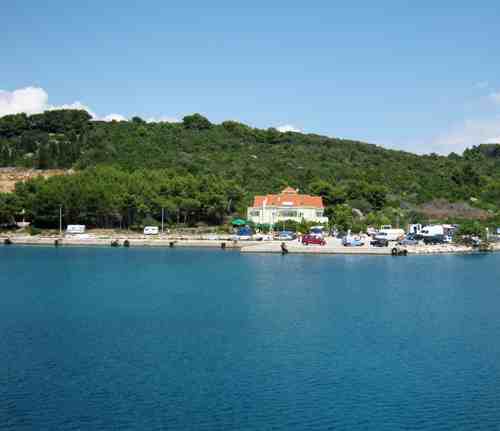
Similar ‘beaches’ to this can be found in all the island settlements along the sheltered east coast of Dugi Otok. There are no settlements at all on the more exposed west coast. But in a couple of places, a steep minor road leaves the main north-south road and descends to the shore. One leads to a place called Mala Voda which literally translates as ‘little water’. I say ‘place’ but there are no buildings other than a wooden shack – just an area for car parking together with a tiny harbour where small boats can be launched.

Boats at Mala Voda © Ricky Yates

It is then possible to walk 300-400 metres north from the car park, either along the pebbly shoreline or on a parallel path through the ‘maquis’ and reach a place that more resembles what I understand as a beach! Whilst the area above sea level is made up entirely of pebbles, as soon as one enters the sea there is sand under foot. And here it is possible to gently wade some way into the sea before being out of one’s depth.
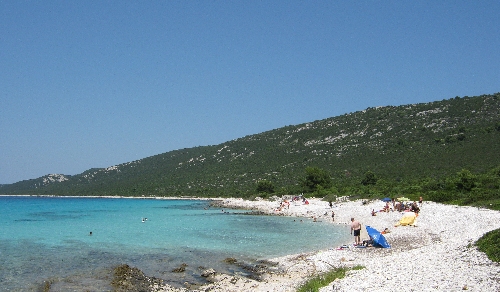
The beach at Mala Voda © Ricky Yates

Mala Voda became our favourite beach during our ten days on Dugi Otok. It was never crowded, no doubt because it takes a little more effort to reach it, and always felt very relaxed. In many respects it is the perfect beach for children as access to the sea is so much easier than on the man-made ‘beaches’. But we saw very few children almost certainly because of the greater effort needed to reach the beach. It has no shade so we always took our beach umbrella and often went in the late afternoon when the angle of the sun was lower.

If we return to Dugi Otok sometime in the future, which I hope we will, one thing I shall certainly look forward to doing is swimming in the sea again from the beach at Mala Voda.

Looking down on Mala Voda © Ricky Yates

The interesting effects of Croatian bureaucracy

A 24 year old German!!!

Officially, if you stay overnight somewhere in Croatia, your presence needs to be registered with the authorities. Therefore we had to give our passports to Darinka, the owner of the apartment, so she could take them back down to the Tourist Office and register the fact that we would be temporarily resident in her apartment for the next ten days.

When our passports were returned, inside each of them was an official slip of paper. Both slips were entitled in ‘Crenglish’, (a language very similar to ‘Czenglish’), ‘Temporary of Permanent Residence’!! But apart from that, the one issued for Sybille was completely accurate.  However, when we examined my ‘Temporary of Permanent Residence’, we descended into howls of laughter. Whilst they had got the day & month of my birth correct, they had put my year of birth down as 1985 thus making me only 24 years old! Overnight, Croatian bureaucracy had taken 33 years off my age and given me back my youth.

But whilst I was pleased with being made many years younger, I did not appreciate what else they had done. My country of birth was stated as ‘Njemacka’, the Croatian name for Germany. Croatian bureaucracy had turned me into a German!!!!!!

Eventually we decided that it wasn’t worth the hassle to go down to the Tourist Office ourselves and point out their error. Instead, Sybille just enjoyed being married to a young 24 year old fellow-countryman for the following ten days!

Dugi Otok

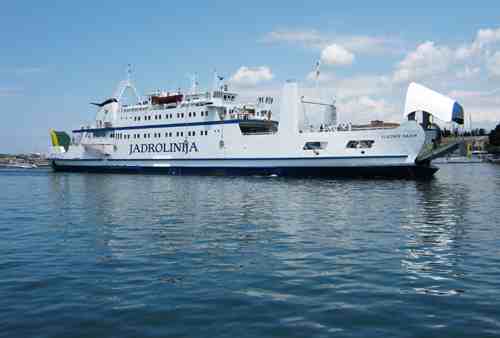
Jadrolinija Ferry arriving at Zadar © Ricky Yates
Jadrolinija Ferry for Dugi Otok arriving at Zadar © Ricky Yates

Having arrived in Zadar on the afternoon of Tuesday 7th July, we decided that now was the time to head for an offshore island for the time of relaxation that we had promised ourselves. We found the booking office of Jadrolinija Ferries on the Zadar quayside and enquired about booking a ferry crossing for ourselves and the car for the following day to the island of Dugi Otok.

There are more than a thousand islands along the Croatian coast of which more than one hundred are inhabited. Some are so close to the mainland that they are connected by a bridge, whilst others are so small and isolated you would have to take everything needed for your stay with you. We opted for the island of Dugi Otok because it fell into neither of these categories. It takes a one and a half hour ferry journey to reach the island from Zadar but has a resident population of 1800 people and therefore has most basic shops and facilities.

The name ‘Dugi Otok’ means ‘Long Island’, which is most appropriate as it is around 43km long but only 4km wide. When driving along the one main road that links Veli Rat and Bozava in the north to Sali in the south, there are places where you can view the sea on both sides at the same time. On the west coast is the full expanse of the Adriatic Sea stretching all the way to Italy. From the east coast, the Croatian mainland is visible, with several parallel smaller islands in between.

Just before midday on Wednesday 8th, we joined the line of cars on the designated section of the quayside, ready to board the ferry. We waited for and then watched its arrival as the bow section rose and the access ramp was lowered. Once the cars and passengers travelling from the island to the mainland had disembarked, we were then summoned forward to carefully drive onto the car deck. Then the ramp was raised, the bow lowered and we headed off out of the harbour, bound for Dugi Otok.

Ferry Port at Brbinj, Dugi Otok © Ricky Yates

The ferry port on Dugi Otok is at Brbinj, just over halfway up the east coast of the island. From there it took us about thirty minutes to drive south to Sali, the administrative centre and by far the largest settlement on Dugi Otok. We parked on the quayside of the picturesque harbour and walked along to find the tourist office to see if they could help find a one bedroomed apartment for us to rent for the next ten days. The young lady in the tourist office assured us that she could and, after a brief phone conversation in Croatian, told us that an owner would be with us in less than ten minutes to show us one. It was within my price range, had the basic requirements we were after, as well as a splendid view from the balcony across the harbour. We took it!

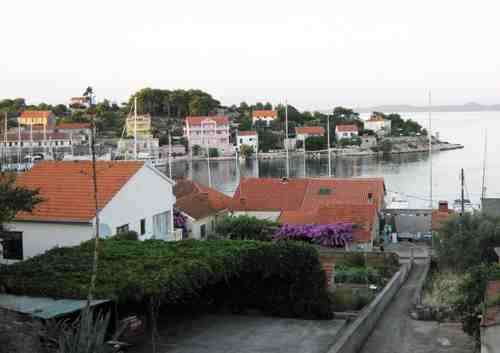
The harbour at Sali from our balcony © Ricky Yates

One of the reasons we took the risk of setting out on holiday with no accommodation booked in advance, was because we expected the current economic downturn would reduce the number of tourists meaning that, even in July, places would hopefully, not be fully booked. And so it has proved to be. Our apartment is in a building consisting of four separate apartments. When we arrived, none of the other three were let. Likewise, the ferry car deck was only two thirds occupied. Whilst Sali is busy, especially in the evenings, clearly the tourist industry here in Croatia has also been affected by economic events elsewhere in the world.

Zadar

St. Donat's Church, Zadar with Roman remains in front © Ricky Yates

Zadar is the largest city on the north Dalmatian coast with a population of around 70,000. Its historic centre lies on a peninsular only 500m wide with a Roman street pattern containing marble paved traffic-free streets and a wealth of Roman remains and historic buildings. Chief amongst these is St. Donat’s Church, an amazing circular building which dates from the beginning of the ninth century.

Although located in Western (Roman Catholic) Europe, the Church is of early Byzantine (Eastern Orthodox) style. What makes it even more fascinating is that it was built over part of the Roman forum that dates from the 1st century BC to the 3rd century AD. Therefore, incorporated into the Church are two complete Roman pillars, together with other stonework containing Latin inscriptions. It is possible to climb a stone stairway to a first floor arcade and walk completely around in a circle looking down on the ground floor.

Outside of the Church, there are many more Roman remains including another pillar that was used as a ‘shame post’ during mediaeval times. It is ironic that some of these Roman remains were only discovered as a result of allied bombing during World War II which destroyed the more recent properties which had been built on top of them.

Walking around this fascinating city on a sunny Tuesday afternoon and Wednesday morning in July 2009, it was hard to believe that less than 18 years previously, it had once more been part of a war zone, under siege for three months from Serb gunners during the Croat – Serb war that resulted from the break-up of the former Yugoslavia. Now it is a bustling city, welcoming the visiting tourist and resident citizen alike and displaying a wealth of history stretching back more than 2000 years.

Mistaken Identity

Dalmatian islands seen from the coast road between Senj and Zadar © Ricky Yates

On Monday 6th July, we drove right across Austria via Linz in the north to Klagenfurt in the south. As we did so, the rain got heavier and heavier so that, as we headed towards the steep mountain pass that would take us into Slovenia, it was positively tipping it down. The weather was no better on the Slovenian side of the border. However, as we joined the motorway to head south towards Ljubljana, (having purchased an expensive vignette to travel relatively few km of motorway), the rain slowly started to ease. And having bypassed Ljubljana and travelled on to Postojna where we left the motorway for the somewhat windy road that leads to the Croatian border, the sun came out as though to welcome us to our holiday destination.

At the Slovenian – Croatian border we had our passports checked for the first time on our journey. I couldn’t help but reflect on the irony of the situation and how the political geography of Europe has changed in the last twenty years. We had crossed from the Czech Republic to Austria and from Austria to Slovenia where, in both cases, border controls are now non-existent because all three countries are EU members and also part of the Schengen agreement. Yet now we were having our passports checked at a border that used not to exist until the beginning of the 1990s with the break-up of Yugoslavia.

It was also as we had our passports checked on the Croatian side of the border, that questions about our somewhat complex identity first raised their head as we tried to explain why a Brit and a German were travelling in a car with Czech number plates! This was the prelude to two cases of mistaken identity that occurred the following day.

We spent Monday night in the small Croatian coastal town of Senj. On Tuesday morning, after the secession of an early morning thunderstorm, we set out along the winding coastal road towards Zadar with wonderful views across to nearby islands. As we drove, we passed three motorcycles parked at the side of the road. Their riders & pillion passengers who were having a mid-morning break, waved to us in a very friendly fashion. We waved back and soon realised that the reason they were waving was because they were Czech and thought they were waving to fellow Czechs. Suddenly their friendly smiles turned to very quizzical looks when they noticed that my steering wheel was on the ‘wrong’ side!

Later in the day as we approached Zadar, we used a short section of motorway. As we turned off the motorway to drive into Zadar, we had to present our ticket and pay a small toll. Sybille wound down the car window and gave our ticket to the young man in the toll booth. ‘Pet’ he said, which is the word for ‘five’ in Czech. (There should be a hacek over the ‘e’ to lengthen the sound but most computer browsers won’t cope with it if I put one in and will instead render it as a ‘?’)! He seeing the Czech number plates was trying to be helpful and tell us in Czech, that we needed to pay five kuna, bearing in mind that both Czech and Croatian are Slavic languages with similar vocabularies. He couldn’t understand our blank looks until he saw where my steering wheel was located. ‘Five kuna’ he then said, and we paid!