With arrival of the New Year has also arrived some serious winter weather. We have had snow – plenty of it, and it is still snowing this evening as I write. The last time we saw snow like this was three years ago in early 2013.
Since the winter 2012-2013, we have had two very mild ones. The winter of 2013-2014 was particularly mild with many Czech ski resorts suffering because a lack of snow and warm temperatures. Last winter was a few degrees colder, but here in Prague, we really only had some snow showers and any snow that did settle, soon melted. But the weather of the past few days has been much more reminiscent of our first five winters in Prague, since moving here in September 2008.
The first snow started falling during the last hour of 2015. It was quite magical to be standing outside with some dog owning neighbours that we have got to know, drinking Bohemia Sekt, celebrating the arrival of the New Year, with fireworks going off and snowflakes falling.
That first snowfall soon melted the next day. But over weekend that followed, temperatures rapidly dropped. Driving into Church for our Eucharist on the morning of Sunday 3rd January, the thermometer in my car gave the temperature as being -4°C. For the first time this winter, I wore my fleece under my cassock-alb, whilst officiating at St. Clement’s 🙂 Then when driving over the Vysocina to Brno in the afternoon, the temperature registered as being -8°C and there was some lying snow on the eastern side of the highlands, and in Brno itself.
The serious snow we now have in Prague, started falling around lunchtime on Monday 4th January. From time-to-time it has stopped snowing for a few hours, but then resumed. And whilst it isn’t now as cold as on Sunday night, the temperature is yet to really get above 0°C.
The weather forecast is that it will finally stop snowing later this evening with the promise of temperatures rising to just above freezing point in the next few days. So for how long we will have lying snow now, is debatable. But it does seem that for the first time in three years, we are going to have a proper Central European winter.
We set out from Kraków on the morning of Friday 9th October, to drive to the small town of Mikolajki in the far north-eastern corner of Poland, aiming to arrive there around lunchtime on Saturday 10th. The centrepiece of our Polish adventure has been to spend a week, cruising the Masurian Lakes, on a hire boat from Marina Miko in Mikolajki. Handover of the boat was to be between 15.00 -18.00 on Saturday afternoon.
I was well aware that we would not accomplish the journey from Kraków to Mikolajki in a single day, which is why I had allowed nearly two days in our travel timetable. In retrospect, I’m very glad that I did. As it turned out, it could have very easily taken us a whole lot longer!
On Friday 9th October, I made a number of significant discoveries, or I was reminded of things I really should have already known 😉 Firstly, driving out of any big city takes time – driving out of Kraków certainly did! Secondly, driving along ordinary Polish main roads, also takes time – lots of it! Whilst the motorway from the Czech-Polish border near Ostrava, to the outskirts of Kraków, had allowed for very speedy progress, route 79 from Kraków to Sandomierz, did not. Lots of small towns and villages with speed limits and plenty of relatively slow moving trucks.
Travelling that day, also really brought home to me, just how big Poland actually is. What looks like a short hop on the road atlas, in reality, takes far longer than anticipated.
When we did finally reach Sandomierz, we then headed for Lublin, finally crossing the Wisla/Vistula river, whose valley we had been following from Kraków. Unfortunately, a section of bypass around Lublin, which is shown as being ‘under construction’ in our road atlas, was still under construction. Thus we battled our way into and out of Lublin during the Friday afternoon rush hour. Progress northwards after that, was a little quicker.
Once it got dark, we decided to head for the next major centre and find somewhere to stay. So when we reached the outskirts of Siedlce, we made for the town centre and spotted a sign for a hotel. The receptionist spoke excellent English and the price for a pleasant double room for the night with breakfast, was very reasonable. As the hotel restaurant seemed all but empty, we instead found a much busier one nearby where we had a most enjoyable evening meal.
The next morning dawned cold, but fine and sunny. Being Saturday, there were relatively few trucks on the road so we made quite rapid progress northwards. After about two hours of driving, we reached the town of Zambrów and decided to take a short break. We parked in a small square opposite a flower shop where a wedding car was being decorated as you can see in the photograph above.
But when we got back into our car to continue our journey, disaster struck. The ‘Carly’ refused to start! It turned over perfectly, so there was clearly plenty of life in the battery. But the engine refused to fire. We tried rolling it down the road to bump start it, but still to no avail.
First we rang the number for the National Emergency Roadside Service as given in our Poland guidebook, but it didn’t work. So we then rang 112 and a most helpful operator who spoke English, gave us the phone number of a local Zambrów breakdown service. He of course, didn’t speak English but somehow Sybille conveyed to him over the phone, where we were and correctly understood him say in reply, that he would be with us shortly. Twenty minutes later, a breakdown truck arrived.
The breakdown truck driver had previously worked in Germany for a short while and therefore spoke some German which aided communication. He rang his mechanic friend to say that he would be bringing a Czech-registered right-hand drive Renault Scenic to him shortly, and then duly took the ‘Carly’ and both of us, to the mechanic’s workshop.Cost 150 zloty/960 Czech crowns.
After about an hour of trying various things, the mechanic and his son conveyed to us that the problem was with the immobilizer. It was an electronic problem rather than a mechanical one. Despite phone conversations with his electronics friend, the mechanic couldn’t fix it. We would have to wait until Monday. All this was conveyed without any of us having any language in common. The similarities between Czech and Polish were of considerable help in our somewhat interesting conversation.
We were able to explain where we were travelling to and why – pointing to the picture of our hire boat in a brochure helped. The mechanic called a taxi driver friend who quoted between 375-400 zloty/2555 Czech crowns to drive us the 125km from Zambrów to Mikolajki and cover the cost of his return journey. We bit the bullet!
Within twenty minutes, the taxi arrived and we then transferred all of our belongings out of the ‘Carly’, and into the taxi. The journey that followed might best be politely described as ‘interesting’. At times our taxi driver drove at speeds of up to 140kph on roads with a maximum speed limit of 90kph. At the end of the journey, Sybille declared that she was in serious need of a double Polish vodka!!!!! But we made it to the marina in Mikolajki arriving at 16.10, still all in one piece – just! – together with all our belongings.
Update – You can find out how we were eventually reunited with the ‘Carly’ here.
Observant readers of this blog may have noticed that my wife Sybille, has not had a mention in any of my recent posts. This is because on Maundy Thursday 2nd April, Sybille travelled by train from Prague to Görlitz, a town lying in the south-eastern corner of the former East Germany on the border with Poland. Then on Good Friday morning, she set out to walk from Görlitz, 470 km along Der Ökumenische Pilgerweg, to the small town of Vacha, which lies on the former Inner German Border.
Der Ökumenische Pilgerweg was established in 2002-3, almost solely by the efforts of one lady, Esther Zeiher. It follows the line of the ancient Via Regia passing through Leipzig, Erfurt and Eisenach. Simple pilgrim accommodation is available along the way at quite reasonable cost, provided by both the Roman Catholic and Protestant Churches.
Sybille’s original plan was to complete her pilgrimage and be back in Prague, before I left for the ICS Chaplains Conference in the Netherlands on Monday 27th April. But a slight problem with her knee just over two weeks into her journey, caused a delay in her anticipated schedule. Fortunately, ‘Aunty Karen’ agreed to have Šárek the cat whilst I was to be away, allowing Sybille to complete her pilgrimage, which she did by successfully, arriving in Vacha on Wednesday 29th April. She was then able to stay on in Vacha for another night, allowing me to pick her up on my return journey to Prague from the Netherlands, on Friday 1st May.
So after breakfast on Friday 1st May, I set off from the Mennorode Conference Centre, driving back into Germany and soon afterwards headed south towards Dortmund and then east towards Kassel, the city where Sybille was born. Then it was south again and around Bad Hersfeld, before leaving the autobahn for the final 20 km into Vacha. I had promised Sybille that I would reach her between 14.00 and 14.30, so I was pleased to drive into the town square of Vacha at 14.15, to be greeted by Sybille, seeking to attract my attention by waving my walking pole at me!
Vacha, pronounced by the locals ‘Facher‘ – native English-speakers beware 🙂 – lies within the former East Germany, adjacent to the Inner German Border with the former West Germany. These days, the Inner German Border is simply the boundary between the Bundesland of Thüringen and the Bundesland of Hessen. But there remains on the edge of the town, both evidence of recent past history, together with artwork celebrating the end, in November 1989, of the post-Second World War internal division of Germany.
Overlooking both the sub station and the dividing wall, was this watchtower, surrounded by scaffolding as it is undergoing restoration! I forgot to photograph it but fortunately, Sybille did!. But it does raise the question that I’ve written about previously on this blog, as to what structures and memorials from past unpleasant history do you preserve, and what do you demolish or destroy?
Deciding that I was too tired to drive all the way back to Prague that day, we headed eastwards and eventually turned off the autobahn to the town of Apolda where we stayed in a B and B overnight. In the centre of Apolda was a large red brick Protestant Church with an early reminder of the forthcoming five-hundredth anniversary of Martin Luther and the German Reformation to be marked and celebrated in two years time.
I spent Monday 27th April-Friday 1st May, attending the annual Intercontinental Church Society (ICS) Chaplains Conference, which this year took place at the Mennorode Conference Centre, Elspeet, in the Netherlands. As I mentioned in my first post of 2015, this has resulted in an addition to the number of countries I have visited, having never previously set foot in the Netherlands until two weeks ago today.
To get to the Conference Centre involved a drive from the Czech Republic, right across Germany, which eventually took ten hours – from 07.00 when I left Prague, until 17.00 when I finally got to Elspeet. This was somewhat longer than I had anticipated, almost entirely due to Baustellen/road works on the German Autobahn and associated Stau/traffic jams. Signs telling me whilst stuck in slow moving or stationary traffic that, ‘Wir bauen für Sie’, engendered the same frustration that I used to feel seeing signs for the ‘Cones hotline’, when stuck on British motorways in past years 🙁
My journey took me first through the former East Germany, passing around Dresden, Leipzig, Halle and Magdeburg. Heading westwards on Autobahn 2 towards Hannover, I crossed from the Bundesland of Sachsen Anhalt, into the Bundesland of Niedersachsen and in doing so, crossed into the former West Germany. Between 1st July 1945 and 30th June 1990, this was the location of Border Checkpoint Helmstedt-Marienborn, controlling traffic and goods passing between West Germany and West Berlin. It was also the busiest of the small number of crossing points on the former inner German border because it provided the shortest route across East Germany, (only 170 km), between West Germany and West Berlin.
These days, traffic passes at considerable speed where once vehicles could be held up for several hours. There is a sign that indicates that this is where the former inner German border used to be, together with a disused watchtower overlooking the site. But twenty-five years after German reunification, I could still notice visual differences as I passed from East to West.
I drove on around Hannover and Osnabruck, finally entering the Netherlands near the Dutch town of Hengelo. That evening, I told several of my fellow Chaplains that it was my first time in the country. ‘What were my first impressions?’ I was asked. ‘It’s rather flat’, was my reply. The other immediate observation I made is that Dutch petrol is more expensive than the German variety, something I made note of for my return journey at the end of the conference.
As in previous years, the conference struck a nice balance between prayer, worship and teaching with some free time each afternoon, to explore the immediate surrounding area. The highlight for me were three Bible expositions on the Jacob narrative from the Book of Genesis, led by my colleague, Rev’d Dr Paul Vrolijk, currently Chaplain in Aquitaine, France, but about to become Senior Chaplain in Brussels this coming summer. His talks were based on his doctoral thesis and gave great insight into the Hebrew literary structure of the narrative & the wider structure of Genesis. He also brought out some of the many plays on words in the Hebrew text, which are inevitably ‘lost in translation’.
As so often with conferences of this nature, some of the most valuable time was spent talking informally with colleagues over coffee or on occasions, something a little stronger 🙂 , such as the excellent but rather strong Belgian beer that was on tap at the Conference Centre bar. All of us work in somewhat isolated situations, I in a very isolated one, with rarely any opportunity to meet with each other except at this annual gathering.
Deciding on Thursday afternoon, that I did want to see a little more of the Netherlands than the inside of a very comfortable and well-equipped conference centre, I set off in the car, to visit the nearby historic Hanseatic city of Deventer. I hope the photographs that follow will give a flavour of what I saw during my all too-brief visit.
The Mountain Church dedicated to St Nicholas/Bergkerk Sint-Nicolaas. It is no doubt called the Mountain Church because it is situated at the top of a small hill, which is a mountain by Dutch standards 😉 Dating from around 1200, it is now used as a gallery and concert venue.
Originally Roman Catholic, it was taken over by the Calvinists in 1580 who completely eliminated the interior decoration. This is how the interior looks now.
Oh dear! April is gone and I haven’t written or posted anything here for nearly a month. So finally, an update, explaining what I’ve been up to.
Worship
The first few days of April were the latter days of Holy Week, leading to Easter Sunday. As I’ve previously written, Easter Day is the Sunday when we normally have the biggest congregation of the year. However, 2015 proved exceptional with a total attendance of 136, (121 adults and 15 children), the largest ever during my seven Easters in Prague.
The additional encouraging thing is that a higher level of numbers attending worship has been maintained post-Easter. Low Sunday, (the Sunday after Easter Day), was far from being ‘low’ and on the following Sunday 19th April, the congregation numbered 74, nearly 50% up on our Sunday average for the year, of around fifty.
Besides being thankful for this rise in numbers, I’ve obviously asked myself what has brought this about. I think the answer is that our core congregation has slightly increased in size and is putting in a higher regularity of attendance. This has combined with an increase in visitors to Prague, joining us for worship. Well over half of our Easter Day congregation were visitors. Nearly all of these find us via our Church website which I constantly seek to keep up-to-date. I recently read some research which indicates that having a Church website that is not up-to-date, is a sure way of discouraging people from attending your Church.
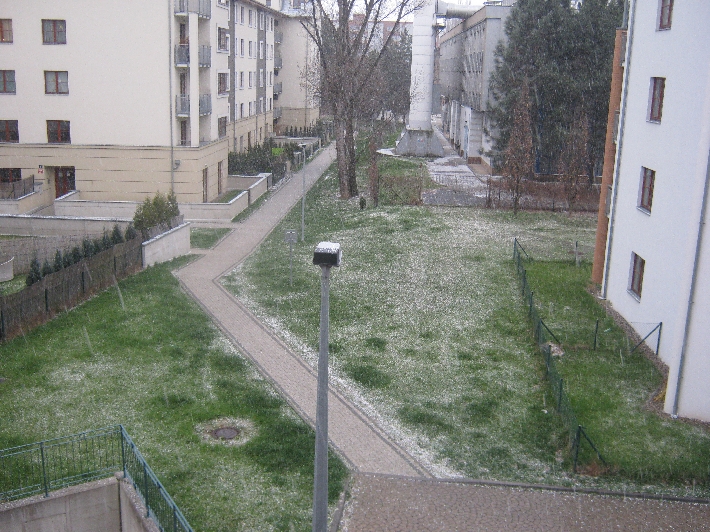
Despite writing in early March, that Spring seems to be arriving, winter has been somewhat reluctant to release its grip. There were several occasions during the last week of March and the first week of April, when Prague experienced heavy snow showers, most notably on Maundy Thursday when I took this picture from the balcony of the Chaplaincy Flat. Much to the amusement of the congregation, I did say at the beginning of our service that evening, in view of the weather I was tempted to change the opening hymn to ‘In the bleak midwinter’ 🙂
However, since the Easter weekend, the weather has been much improved. It was pleasantly fine for our mini-pilgrimage on Holy Saturday and positively warm when I went walking to further explore Ceský Ráj.
Dentist
Earlier this year, I was forced to visit the dentist for the first time for a few years, when one of my front teeth just fell out. Actually, it was a crown dating back nearly thirty years, which had come adrift because the tooth root to which it was attached, had died. A root canal filling and a new crown restored my good looks 😉
However, whilst fixing my front tooth, my dentist did point out that the rest of my mouth was a bit of a mess. So in late March, I decided to bite the bullet – please forgive the obvious pun – and get some further dental work done. Several visits later, on Friday 10th April, I had three new crowns fitted to the top left side of my mouth, into the large gap left by bits of tooth and filling falling out over previous years.
Whilst I’m very pleased with the end result, my three new crowns have inevitably cost me many Czech crowns – CZK13,500, (£400 at current exchange rates), to be precise 🙁 , making a serious hole in my bank account. My only consolation is knowing that having similar work done in the UK, would probably have cost twice as much!
Annual Church Meeting
At our Annual Church Meeting on Sunday 19th April, we did all the usual things such as receiving the 2014 accounts and electing the Churchwardens and Church Council for the next twelve months. But as well as looking back over the previous year, I took the opportunity to look forward.
I pointed out that in less than two years time, I would turn sixty-five, and that my current bishop’s licence as Anglican Chaplain in the Czech Republic, expires on 30th April 2017. Further to that, somewhere between my sixty-fifth birthday and the expiry date of my bishop’s licence, I intend to retire. Ahead lies an interesting two years as the Chaplaincy begins to prepare for finding my successor and as Sybille and I begin to sort out where we are going to retire to. Keep reading this blog if you want to know more!
As in many continental European countries, in the Czech Republic it is a requirement to have winter tyres fitted on cars, when driving in severe weather conditions. This realistically means between November and March each year. So on Friday 24th April, I drove to Nepomuk to visit my friend Adrian Blank, in order to change from winter back to summer tyres. Adrian’s in-laws truck and car servicing business, kindly store the set of tyres I’m not using at any given time.
As I’ve previously explained, once every two years in the Czech Republic, a car also has to pass STK, the equivalent of a British MOT test. Although my current STK is valid until 20th June 2015, I decided to take advantage of the opportunity of needing to be in Nepomuk for the tyre change, to also get the ‘Carly’ through STK slightly earlier than required.
As well as changing the tyres, I asked Adrian and his mechanic colleague, to check if anything else needed doing to ensure the ‘Carly’ would pass STK. Fortunately, the only thing wrong was that one light over the back number plate was not working, because the bulb was kaput.
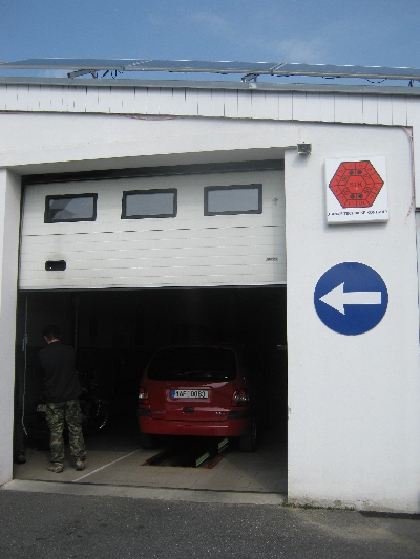
After this, Adrian and I set off to the nearby town of Horažd’ovice, where the STK testing station is located. Conveniently, Adrian had another car that had been left with him by the owner, in order to get it through STK, so he drove that car and I followed in mine. I am pleased to report that the ‘Carly’ passed with flying colours, costing me only CZK1125 for the test and CZK9 for a new light bulb 🙂 Afterwards, Adrian and I had lunch together which I did also pay for as a ‘thank you’ for his continued help in keeping the ‘Carly’ legally on Czech roads.