Walking with my pilgrim wife


Sybille taking a photograph alongside the Thunersee © Ricky Yates

My sincere apologies that it is exactly one month since I last posted anything here on my blog. Long-standing followers will know that this is an extremely rare occurrence. Over the next couple of weeks, I do hope to write several new blogposts to compensate.

As I explained in responding to my Liebster Blogger Awarder Emily, answering her Question 3, I’ve spent two weeks of August, walking with my pilgrim wife Sybille. During that time, I had virtually no access to the internet – hence the absence of blog posts. I only returned to Prague last Thursday evening and this afternoon and evening is the first real opportunity I’ve had to compile a new post.

When Sybille first planned her pilgrimage, walking from Prague to Santiago de Compostela, the idea that I would join and walk with her for two weeks of my annual leave in August, seemed perfectly simple. But as the time for doing so drew near, the practical reality, became somewhat more complicated.

Sybille is deliberately not walking to a set timetable. Therefore, exactly where she would be by the time I was set to join her, was always going to be a crucial issue. My original plan was to fly to a major centre and then use public transport. As the time of my planned departure approached, flying to Geneva looked like the best option. But then Sybille said, ‘Why not drive?’ I did the arithmetic and found that the cost of petrol, together with a Swiss motorway vignette, was actually no more than the cost of a return flight from Prague to Geneva. The only problem then, was finding a safe place where I could leave my car for two weeks.

The solution to my problem came in the form of Sarah, a priest in the Swiss Old Catholic Church / Christkatholische Kirche der Schweiz / Eglise catholique-chrétienne de Suissean, who is an online friend of Sybille. Sarah and her husband Michael, live in Langenthal, north of Bern. So on Thursday 7th August, I drove from Prague to Langenthal and parked my car, by prior arrangement organised by Sarah, in the private car park of the nearby Swiss Reformed Church called Zwinglihaus. Numerous jokes have since been cracked about how reformed the ‘Carly’ is now, having sat there for two weeks 🙂

Once I’d transferred my rucksack, together with a bag of various things Sybille had asked me to bring for her, from my car to Michael and Sarah’s car, they then drove me south to Merligen where Sybille was staying that night. Then they insisted on taking us both out to a nearby restaurant for a most enjoyable evening meal of fish from the adjacent Thunersee, washed down with a most quaffable locally produced white wine.


Our little cabin © Ricky Yates

Sybille and I spent that first night sleeping in this little cabin in the grounds of the guest house of the Christusträger Communität, a small group of Lutheran brothers. You can click on this link to find out more about what they do and use ‘Google translate’ if you cannot read German  🙂  


Christian guest house in Merligen © Ricky Yates

This is the main guest house where we had breakfast the following morning.

View across the Thunersee from Merligen © Ricky Yates

And this is the view that greeted us that morning.

After breakfast, we set off to walk together along the Jacobswege Schweiz, heading towards Thun. Our route followed the side of the Thunersee which meant it was basically flat, a great bonus for me on my first day of walking!

Thun © Ricky Yates
Thun © Ricky Yates

We reached Thun early in the afternoon. Below is a close up view of the beautifully decorated covered bridge which you can see in the foreground of the photograph above. The amount of water passing under the bridge is indicative of the very heavy rainfall that Switzerland had experienced in the previous few weeks and through which Sybille had been walking. We were therefore both thankful that our first day walking together was fine and sunny.


Covered bridge with floral decoration in Thun © Ricky Yates


Kirche Scherzligen, Thun © Ricky Yates

We walked on out of Thun, now on the opposite side of the lake, visiting this delightful Swiss Reformed Church on the way. One of the most pleasing aspects of our pilgrimage through Switzerland was that nearly every Church we passed was open and welcoming to visitors. In several of them, the lights were on sensors which came on when we walked in and presumably went off soon after we left!

However, that first day, we did struggle to find somewhere to stay overnight. The tourist office in Thun could only offer us a ridiculously expensive hotel room and the B & B in a village five km out of Thun, which would have been ideal, was already fully booked as Sybille discovered when she phoned earlier in the day.

Fortunately, Sybille then had the brilliant idea to phone another B & B in Einigen which appeared in her accommodation list because it lies on an alternative route that involves taking the ferry from Merligen across the Thunersee. The answer to Sybille’s enquiry was positive so, although it meant a three kilometre diversion from our route with the last section inevitably being uphill, the accommodation, host and view made it more than worthwhile.

Later that evening, a thunderstorm broke, followed by a rainbow which I just managed to capture in this photograph taken from our bedroom balcony.

Rainbow over the Thunersee © Ricky Yates


Route from Merligen to Einigen


My Liebster Blogger Award – part two

Liebster AwardAs promised in my first post eight days ago, here are my answers to the last six questions set by my Liebster Blogger Award nominator Emily, the owner of the blog Czechesotans.

6. What drives you crazy?

The addiction that so many people seem to have to their mobile/cell/smart phones. In particular, the number of people I see here in the Czech Republic, who talk on their mobile phones whilst driving, even though it is completely illegal to do so. What drives me even more crazy is that I’ve never yet seen the police stop someone doing so, even though here in Prague, there are always plenty of police around and they seem to stop people quite readily for relatively petty offences.

It is impossible to be in full control of a vehicle if someone is at the same time, using a hand-held mobile phone. Yet I regularly see mothers doing so, with children in their car; truck drivers who carry an even greater responsibility given the size and weight of their vehicles, also doing so; and when travelling along the D1 Prague-Brno motorway, vehicles passing me in breach of the maximum speed limit, with their drivers talking on their phones.

As I’ve previously highlighted on this blog, even when not driving, constantly talking on a mobile phone is highly anti-social. I continue to see, predominantly but not exclusively women, out walking with their children and/or their dogs, yet with their necks bent forty-five degrees whilst they talk away to some friend on the other end of their mobile phone. What message does that send to the children/dogs? Quality time with Mummy?

Just this morning, I saw another example of anti-social mobile phone use. A woman talking on her mobile whilst at the same time, passing her shopping through the supermarket checkout. If I had been the checkout operator, I would just have stopped serving the woman, until she got off her phone! Being a supermarket checkout operator is a mind-numbing enough without being treated to such rudeness by a customer.

Yes – mobile phones are useful but they shouldn’t control our lives and their use should never endanger the lives of others.

7. Where do you do most of your blogging?

This one is relatively easy to answer. Almost exclusively whilst sitting at my desk in my office in the Chaplaincy Flat. Since May 2012, I’ve had a laptop computer which has enabled me to compile text when I’m elsewhere. But in more than two years, I think I’ve only twice successfully compiled and posted a blog post from somewhere other than my office.

8. How do you spend your free time?

This question raises an interesting issue as I don’t have a job with set hours or even a job description. Officially, I hold an office – I am the Anglican Chaplain in the Czech Republic. As I’m subject to canon law, I do have certain responsibilities that I must fulfil, but how I use my time is very much at my discretion.

Therefore, what is work and what is pleasure is frequently blurred. And I often move from one to the other and back again, several times during the day. Whilst I do regularly have to work unsocial hours – evenings and weekends; unlike many others, I can take ‘time-off’ during the day on weekdays.

I am actively encouraged to take one full ‘day-off’ each week which is normally Monday. Today is Monday, and what am I doing? Writing this blog post! So maybe that answers the question 🙂 I do also like to get out and walk around and explore various parts of Prague, especially the parks. And frequently these walks end by finding somewhere to have ‘a cool glass of something’ 😉

9. What is something cool you’ve found?

As in my previous answer, I’m adept at quite regularly finding ‘a cool glass of something’. But I don’t think that’s what Emily my nominator, meant 😀 Quite honestly, as a British male who is now the wrong side of sixty, I don’t think I’m going find anything that’s ‘cool’, in the sense that my thirty-something American female nominator intended 🙁

10. If you could switch places with someone for a day, who would it be?

I have two responses to this question. The first is that I don’t really want to switch places with anyone, even for a day. I’m perfectly happy being who I am, where I am. My second reaction is that if I did switch places, I would want to do so for far longer than twenty-four hours, in order to institute radical and permanent change. For example, to take over from Putin and put Russia on a totally different political path, in contrast to the confrontational one that is currently being pursued. That would certainly need plenty more time.

11. What gets your creative juices flowing?

With regard to this blog, it has often been current events and the reaction of other people to them, that has suddenly got my fingers tapping rapidly on my keyboard. The resulting blog posts have also usually attracted plenty of comments. Three examples come to mind.

Back in November 2012, I just had to write about the reactions to the result of the American Presidential Election that I was reading on social media, by right-wing conservative friends back in the USA, of a few of my American friends living here in the Czech Republic. It resulted in my post entitled ‘Two days after President Obama’s re-election‘, in which I challenged some of the absurd things that I was reading.

Earlier this year, the Russian takeover of the Crimea peninsula prompted me to quite rapidly write about ‘The Ukraine crisis as seen from the Czech Republic‘. It is a post that has since received many appreciative comments and unfortunately, continues to remain highly apposite in view of the very sad events of the last few days.

The most recent example was at Easter this year, when over fifty ‘public figures’, (for which read, ‘people full of their own self-importance’), declared that David Cameron referring to the United Kingdom as a Christian country, ‘fosters alienation and division in our society’. In response, I immediately wrote the post entitled, ‘The militant atheists are at it again‘. I can tell you, militant atheists and their pronouncements, very quickly get my creative juices going 😉

And finally…..

Thank you Emily, for your nomination and making me answer all these questions. And can I add that your own nomination is also highly deserved.

My two-day drive from the Czech Republic to the United Kingdom

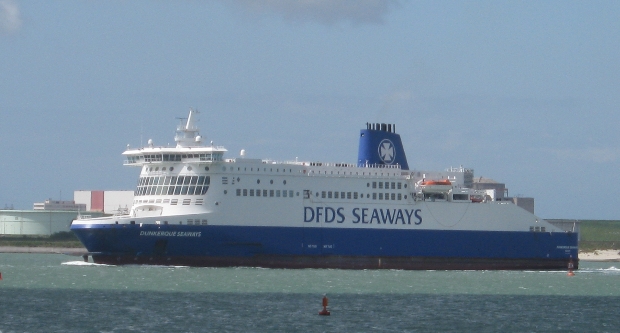
My DFDS Seaways cross-channel ferry © Ricky Yates

At the beginning of last week, I drove all the way from Prague to the East Midlands of England, in order to attend this year’s Intercontinental Church Society (ICS) Chaplains and Families Conference, followed by a week of annual leave visiting family and friends. Both before setting out from the Czech Republic and on arrival in the UK, I’ve had many expressions of surprise for undertaking the trip as well as numerous questions as to my route and what the journey entails. So here is a blogpost by way of explanation.

I should start by saying that it is a journey that I have undertaken once previously, albeit in the reverse direction. For when Sybille and I moved to the Czech Republic in September 2008, we drove all the way from our old home in North Oxfordshire, to our new home in Prague, along with Oscar the cat. But in the nearly six years since our arrival in the Czech Republic, the five return UK visits I’ve previously made, have always been by air.

I set out on my journey on Sunday 11th May, having first celebrated the Sunday Eucharist at 11.00, followed by a brief visit to post-Eucharistic Coffee Hour. I would have preferred to have driven from the Chaplaincy Flat to Church, rather than using public transport, so I could set off directly afterwards in the ‘Carly’. Unfortunately, that Sunday was the day of the annual Prague Marathon which results in many street closures. So instead, I packed the car first thing on Sunday morning, leaving it parked by the Chaplaincy Flat, and then travelled to Church and back again by tram, as we normally do.

It was therefore not until 13.25, that I set out on my journey. Fortunately, once I reached the Pražský okruh/Prague ring road on the western side of the city, the rest of the my journey to Dunkerque in France on the coast of the English Channel, was almost exclusively on motorway, or dálnice, Autobahn, autoroute, autobaan, depending on the language of the country through which my route passed.

From the Pražský okruh/Prague ring road, I took the D5 which heads westwards towards, and then around, Plzen, before heading for the German border. Most confusingly, nearly all the road signs tell you that, beyond Plzen, you are heading towards Rozvadov, rather than towards Germany or Nürnberg, the first major city over the border. Where or what is Rozvadov? It is a small village, just off the D5, the last one in the Czech Republic!

There are several interesting differences between a Czech dálnice and a German Autobahn. Czech motorway signs are green with white lettering whilst German ones are blue with white lettering. The Czechs use blue signs with white lettering for their ordinary roads! Czech motorway intersections are numbered according to how many kilometres they are from the beginning of that motorway, usually starting in Prague. German motorway intersections are just given consecutive numbers. Many Czech over bridges have advertisements on them which I find both unsightly and distracting whilst there is a total absence of such things in Germany.

One contrast I particularly noticed as I drove up into Ceský les, the hills that lie in the very west of the Czech Republic and form the border with Germany, is the almost total absence of human settlements – there are just forests and open fields. Yet once across the border and driving down through the Oberpfälzerwald, there are a succession of villages amongst the woods and fields. Of course, there is a reason for the contrast. The area on the Czech side is part of what was known as the Sudetenland from which the Sudetendeutsche population were expelled in 1945. Within a couple of years, the area had become a restricted zone which only those trusted by the regime, were allowed to enter for fear that all others might try to escape from their Communist paradise to capitalist West Germany.

Being aware that petrol is cheaper in the Czech Republic than in Germany, I filled up just before crossing the border. I was fairly sure that a full tank would take me right across Germany, all the way to Luxembourg, which it duly did. I also knew from many years of travelling in continental Europe, that petrol is cheaper in Luxembourg because of low taxation, hence I planned my route to pass through the duchy, in order to fill up once more.

It took me five hours to drive across Germany passing near Nürnberg, Heilbronn, Speyer, Kaiserslautern and Trier. Whilst Germany does have an excellent Autobahn network, parts of it are beginning to show their age with several bridges and viaducts that I crossed being under repair, including the one across the Rhine.

One thing that again brought a smile to my face whilst driving in Germany, was seeing every exit from the Autobahn being marked by a sign saying ‘Ausfarht’. It always reminds me of my first ever visit to Germany in 1975 when I was travelling with a coach party consisting mainly of Australians, most of whom had not previously been to Europe. After travelling for some time along the Autobahn, one of the party turned to me and said, “This place called Ausfarht must be really big as I’ve seen so many signs to it” 🙂

Passing around Trier, along one very small section of my route which was not motorway, I then entered Luxembourg and within about thirty minutes, had driven from one side of the country to the other! Just before the border with Belgium, I pulled into a service station at the side of the autoroute and took full advantage of the low price of fuel. Then it was over the border to the town of Arlon where I stopped for the night in a hotel located in a service area without a fuel station, as everyone buys cheap petrol over the border in Luxembourg 🙂 So by 20.45 that evening, I had driven through four countries and covered 760 km/473 miles.

Next morning after breakfast, I set off on the Belgian autoroute, heading towards Brussels. Of course, according to the road signs, I was heading towards Bruxelles, until suddenly the signs instead said Brussel. The reason for the change is crossing the boundary between a French-speaking province and a Flemish speaking one. Both French and Flemish-speaking Belgians do not believe in bilingual signs which can be most confusing when the name of a town or city differs considerably more than Bruxelles/Brussel.

From past experience, the one part of the journey I was a little concerned about was driving around the Brussels ring road where I have previously experienced congestion. However, apart from a short delay getting onto the slip road giving access to the ring road, the rest of my trip around the Belgian capital went smoothly. This was followed by an equally smooth journey on towards the coast near to Ostend and then just inland but parallel to the coast, over the French border to Dunkerque.

Courtesy of having such an easy journey, I arrived two hours in advance of the departure time of my ferry crossing. The Dunkerque-Dover crossing takes two hours, but with the change from Central European Summer Time(CEST), to British Summer Time(BST), I left Dunkerque at 14.00 CEST and arrived at Dover at 15.00 BST.

Once off the ferry, it took me a further three hours to drive from Dover to Hothorpe Hall near Market Harborough, along the M2, M25 and M1. En-route, I had the first of what were to be many experiences of discovering how expensive life in the UK has become. When I last used the Dartford Crossing east of London, the toll was £1.00. It came as quite a shock to discover the 100% increase to £2.00 🙁

So I arrived at Hothorpe Hall, safely but somewhat tired, at 18.20 on Monday 12th May having driven a further 688 km/430 miles. The evening meal was to be served ten minutes later and, in the meantime, one of my fellow ICS Chaplains bought me a much needed drink from the bar. Thank you Hazel!

Ordination in Vienna

Rev'd John Barker outside Christ Church, Vienna following his ordination as priest © Ricky Yates
Rev’d John Barker outside Christ Church, Vienna following his ordination as priest © Ricky Yates

On the evening of Sunday 30th March, I had the privilege of attending and participating in the ordination as priest, of my friend and ministerial colleague, John Barker. The ordination service took place at Christ Church, Vienna and meant that for the first time in my life, I was part of two services, on the same Sunday, in two different countries.

John was originally a licensed Reader in the Diocese of Durham and since his work for the European Commission brought him to continental Europe, he has helped in the Anglican Chaplaincies of Warsaw and Bucharest. I first met John in September 2008, at the Eastern Archdeaconry Synod meeting in Corfu which I attended, a week before moving from Oxfordshire to Prague. At that point, John had just moved from Bucharest to Skopje in Macedonia.

After establishing and leading the Anglican congregation in the Macedonian capital, last year John’s work took him to Yerevan, the capital of Armenia. At the same time, he successfully completed further studies and was ordained deacon in the summer of 2013. In Yerevan, John has re-established an Anglican congregation there after a gap of ten years. Officially, he is the assistant curate of his and my Archdeacon Patrick Curran, the Chaplain of Christ Church Vienna. Therefore when plans for his ordination as priest in Yerevan ran into technical difficulties, the service was quickly and appropriately, moved to Vienna.

I only heard that the ordination service was happening, a week before the event. The official announcement wasn’t issued until twenty-four hours later! But knowing John and the fact that it would be very difficult for many other ordained Anglican priests to be present, I thought the least I could do was to try and see if I could attend.

Therefore on Sunday 30th March, I celebrated our regular 11.00 Eucharist in Prague as normal. Surprisingly, despite being the annoying Sunday when the clocks go forward by one hour, we had the largest congregation so far in 2014. But after a quick post-Eucharistic cup of coffee, I jumped into the car in order to drive to Vienna.

According to my internet research, the journey from central Prague to central Vienna, should take around four hours, providing there are no hold-ups en-route. In fact, the only mishap I had on my journey was finding myself on my first stretch of Austrian autobahn without a vignette. A quick detour into the first service area corrected this error, before falling foul of the österreichische Polizei 🙂

Leaving central Prague at 13.15, I reached central Vienna at about 17.00. But that is where I failed to pull off the autobahn at the correct intersection. I therefore spent the next forty-five minutes, weaving my way back through suburban Vienna, to 17-19 Jaurèsgasse, where Christ Church is located. Fortunately, with the service beginning at 18.00, I still made it with fifteen minutes to spare.

The ordaining bishop was David Hamid, the Suffragan Bishop of the Diocese in Europe. However, one of the great joys when someone is ordained priest, is that fellow priests are also invited to join in laying hands on the candidate, along with the bishop. I’m fairly sure that this was only the third time I’ve been privileged to do this, since my own ordination as priest nearly twenty-four years ago.

A reception held in the nearby Church Centre followed the service giving me the opportunity to speak in person with both my Archdeacon and Suffragan Bishop. Given the far flung nature of the Diocese in Europe, this is something that rarely happens more than once or twice a year!

It was inevitably a long and tiring day but I’m very glad I made the effort to travel and get to Vienna for the ordination service. And in the not too distant future, I do also hope to make the far longer journey to visit Yerevan and see John in action.

John with his wife Ella & daughter Laura, following the ordination service © Ricky Yates

November – a time of change

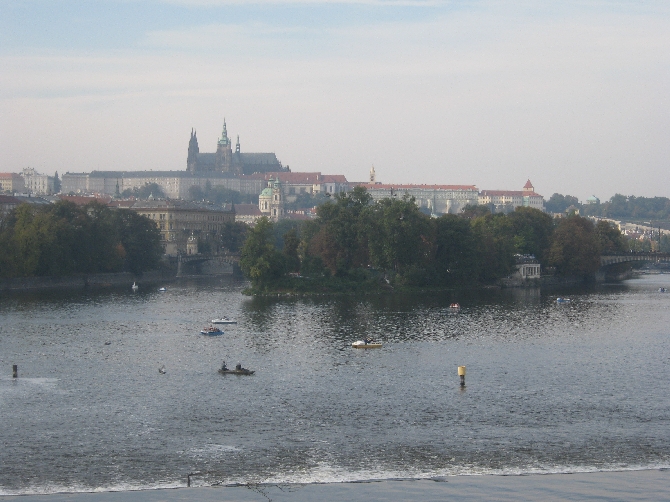
Prague Castle & the Vltava River © Ricky Yates

As October has become November, so many aspects of my life and the situations around me with which I interact, have changed. I’ve therefore decided that this provides an overarching theme for a new blog post 🙂

As all across Europe, overnight between Saturday 26th and Sunday 27th October, our clocks changed, going back one hour. I write this, partly for the benefit of my British son-in-law who some months ago, famously remarked, ‘I don’t suppose the clocks change where you are?’ Well yes – they do! At the same time as the United Kingdom was moving from British Summer Time (BST), back to Greenwich Mean Time (GMT), here in the Czech Republic, we changed from Central European Summer Time (CEST), back to Central European Time (CET). This means that we remain one hour ahead of the UK, and also the Republic of Ireland and Portugal. Whilst the clocks always change on a fixed date – the early hours of the morning of the last Sunday in October – there is never any guarantee that the seasons and the weather will change in a synchronised manner. However, last week we had our first overnight frost and most of the leaves have now fallen from the trees. Autumn is rapidly changing to winter.

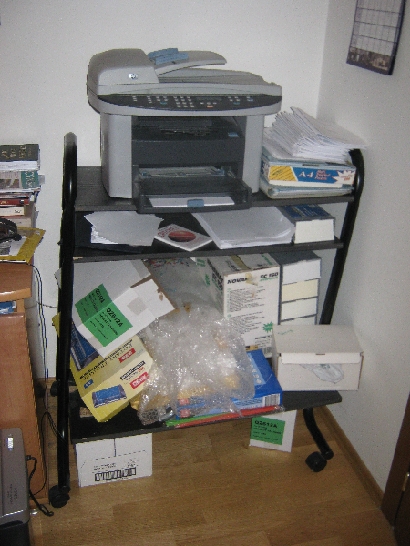
Collapsing office trolley © Ricky Yates

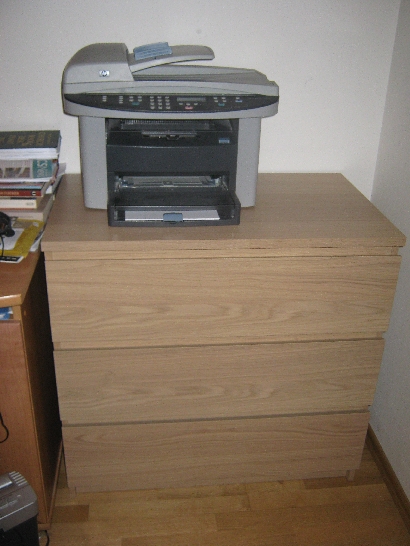
New IKEA chest of drawers © Ricky Yates

When Sybille and I moved to Prague more than five years ago, in September 2008, the third bedroom of the Chaplaincy Flat, was already furnished as an office, with a desk, bookshelves and a rather simple trolley on which was situated a printer/scanner/photocopier. Some time ago, the bottom shelf of the trolley collapsed when I put too much weight on it. More recently, the only reason it has remained reasonably upright, is because part of the metal trolley frame, was leaning against the wall! Before the printer/scanner/photocopier ended up in a heap on the floor, we decided that a change was required.

Late last week, we visited the IKEA store at Zlicín on the outskirts of Prague, in search of a replacement for the collapsing trolley. A three drawer chest that had the correct dimensions to fit into the corner where the trolley was located, seemed the best purchase. Thus I successfully put together a piece of flat-pack furniture for the first time in several years. The end result is very much a change for the better, as all the things that were on the trolley shelves, are now stored in the drawers of the new chest, where they cannot fall down or gather dust.

Last Tuesday, I met Her Excellency Jan Thompson, the new British Ambassador to the Czech Republic, for the first time. Jan arrived here in August and presented her credentials to President Zeman, at the beginning of September. She replaces H. E. Sian MacLeod with whom I had a very good working relationship, not least through hosting the Prince of Wales and the Duchess of Cornwall, during their visit to the Czech Republic in March 2010.

As part of a commendable and very understandable exercise of beginning to learn about and comprehend, the British expatriate community living here in the Czech Republic, Jan had invited Christian ministers working with British citizens, to afternoon tea at the British Embassy. Amongst those present were Rev’d Gareth Morris who is pastor to the International Baptist Church, together with his wife Elizabeth, and Major Mike and Major Ruth Stannett, who head up the the work of the Salvation Army throughout the Czech Republic.

The Ambassador was keen to both learn about our work, and to have our insights on life in the Czech Republic. Just like her predecessor, she has had over six months of individual language training and was able to present her credentials to the President, speaking in Czech, much to his surprise! After all that hard work, it does seem a shame that she is likely only to be here for four years before there is another Ambassador change.

There is another change that I have noticed at the British Embassy, over the time that I have lived here. With the exception of a relatively small number of senior positions that are held by British nationals, all the other staff are now Czech or Slovak. When I met my first British Ambassador, (I’m now on my third 🙂 ), the PA who set up my meeting, was a British young lady, who was on secondment for a few years from the Foreign and Commonwealth Office in London.

Now the Ambassador’s PA is a delightful Czech young lady, who first sought my help for names and contact details of those she ought to invite to afternoon tea with the Ambassador. Likewise, all the staff of the consular section, dealing with lost passports, Brits who run foul of the Czech police etc, are also Czech or Slovak. The reasoning behind this change is almost certainly one of cost. Czech staff are cheaper to employ and have no additional expense of being moved from, and eventually back to, the United Kingdom. But it does seem slightly strange as a British Citizen, to be mainly dealing with non-Brits at my own Embassy 🙂

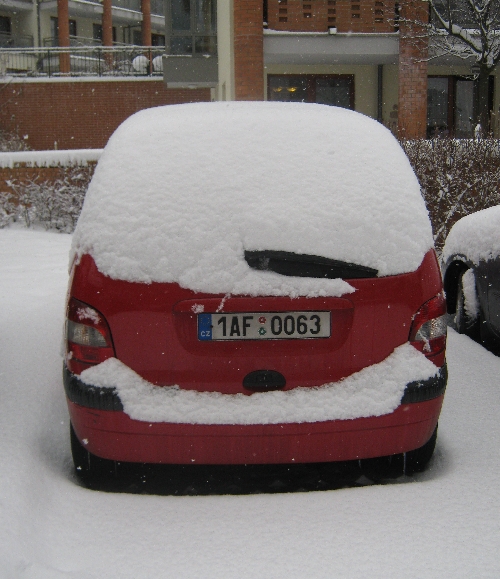
My car parked in the snow last winter © Ricky Yates

Last Wednesday, I paid a visit to my good friend Adrian Blank in Nepomuk, so that my car could experience an important change – from summer to winter tyres. This is the first winter that I’ve done this, as previously the car has been little used during the winter months. But after a couple of somewhat hairy return trips from Brno in falling snow last winter, this year I’ve purchased and had fitted, a completely new set of winter tyres. They certainly gave a very smooth return journey last Wednesday. And I shall be most interested to experience the promised improvement in grip and control they are meant to provide, once the snow and frost do arrive.

Finally for this post, there is one change that the Czech nation is still waiting for – a change of government. On the last weekend in October, the Czechs went to the polls to elect a new lower house of parliament, the Chamber of Deputies. The background to the election and its eventual outcome, would require a further post in its own right. But if a stable government is to be formed, it will need a three/four party coalition. Talks between the parties are under way, but lurking in the background is a President who has his own ideas of what should happen. Watch this space!

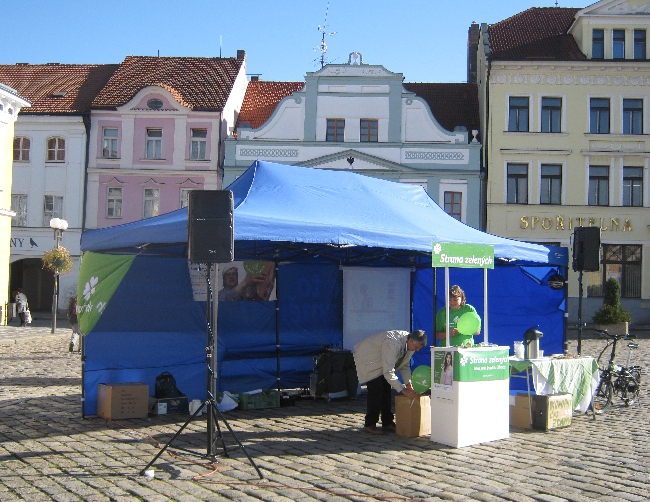
The Green Party campaigning in Pelhrimov © Ricky Yates