The Ökumenische Pilgerweg, Vacha and the Inner German Border

Here Germany & Europe were divided until 08.00, 12th November 1989 © Ricky Yates

Observant readers of this blog may have noticed that my wife Sybille, has not had a mention in any of my recent posts. This is because on Maundy Thursday 2nd April, Sybille travelled by train from Prague to Görlitz, a town lying in the south-eastern corner of the former East Germany on the border with Poland. Then on Good Friday morning, she set out to walk from Görlitz, 470 km along Der Ökumenische Pilgerweg, to the small town of Vacha, which lies on the former Inner German Border.

Der Ökumenische Pilgerweg was established in 2002-3, almost solely by the efforts of one lady, Esther Zeiher. It follows the line of the ancient Via Regia passing through Leipzig, Erfurt and Eisenach. Simple pilgrim accommodation is available along the way at quite reasonable cost, provided by both the Roman Catholic and Protestant Churches.

Sybille’s original plan was to complete her pilgrimage and be back in Prague, before I left for the ICS Chaplains Conference in the Netherlands on Monday 27th April. But a slight problem with her knee just over two weeks into her journey, caused a delay in her anticipated schedule. Fortunately, ‘Aunty Karen’ agreed to have Šárek the cat whilst I was to be away, allowing Sybille to complete her pilgrimage, which she did by successfully, arriving in Vacha on Wednesday 29th April. She was then able to stay on in Vacha for another night, allowing me to pick her up on my return journey to Prague from the Netherlands, on Friday 1st May.

So after breakfast on Friday 1st May, I set off from the Mennorode Conference Centre, driving back into Germany and soon afterwards headed south towards Dortmund and then east towards Kassel, the city where Sybille was born. Then it was south again and around Bad Hersfeld, before leaving the autobahn for the final 20 km into Vacha. I had promised Sybille that I would reach her between 14.00 and 14.30, so I was pleased to drive into the town square of Vacha at 14.15, to be greeted by Sybille, seeking to attract my attention by waving my walking pole at me!

Vacha, pronounced by the locals ‘Facher‘ – native English-speakers beware 🙂 – lies within the former East Germany, adjacent to the Inner German Border with the former West Germany. These days, the Inner German Border is simply the boundary between the Bundesland of Thüringen and the Bundesland of Hessen. But there remains on the edge of the town, both evidence of recent past history, together with artwork celebrating the end, in November 1989, of the post-Second World War internal division of Germany.

Remains of the former dividing wall outside Vacha © Ricky Yates

The remains of the dividing wall between East and West.

One people © Ricky Yates
Without walls © Ricky Yates
In freedom. Wall opening 12.11.1989 © Ricky Yates

Decoration of an electricity sub station, adjacent to the dividing wall.

East German watchtower under renovation! © Sybille Yates

Overlooking both the sub station and the dividing wall, was this watchtower, surrounded by scaffolding as it is undergoing restoration! I forgot to photograph it but fortunately, Sybille did!. But it does raise the question that I’ve written about previously on this blog, as to what structures and memorials from past unpleasant history do you preserve, and what do you demolish or destroy?

Deciding that I was too tired to drive all the way back to Prague that day, we headed eastwards and eventually turned off the autobahn to the town of Apolda where we stayed in a B and B overnight. In the centre of Apolda was a large red brick Protestant Church with an early reminder of the forthcoming five-hundredth anniversary of Martin Luther and the German Reformation to be marked and celebrated in two years time.

Poster on the tower of the Protestant Church in Apolda © Ricky Yates

ICS Chaplains Conference 2015

Mennorode Conference Centre © Ricky Yates

I spent Monday 27th April-Friday 1st May, attending the annual Intercontinental Church Society (ICS) Chaplains Conference, which this year took place at the Mennorode Conference Centre, Elspeet, in the Netherlands. As I mentioned in my first post of 2015, this has resulted in an addition to the number of countries I have visited, having never previously set foot in the Netherlands until two weeks ago today.

To get to the Conference Centre involved a drive from the Czech Republic, right across Germany, which eventually took ten hours – from 07.00 when I left Prague, until 17.00 when I finally got to Elspeet. This was somewhat longer than I had anticipated, almost entirely due to Baustellen/road works on the German Autobahn and associated Stau/traffic jams. Signs telling me whilst stuck in slow moving or stationary traffic that, ‘Wir bauen für Sie’, engendered the same frustration that I used to feel seeing signs for the ‘Cones hotline’, when stuck on British motorways in past years 🙁

My journey took me first through the former East Germany, passing around Dresden, Leipzig, Halle and Magdeburg. Heading westwards on Autobahn 2 towards Hannover, I crossed from the Bundesland of Sachsen Anhalt, into the Bundesland of Niedersachsen and in doing so, crossed into the former West Germany. Between 1st July 1945 and 30th June 1990, this was the location of Border Checkpoint Helmstedt-Marienborn, controlling traffic and goods passing between West Germany and West Berlin. It was also the busiest of the small number of crossing points on the former inner German border because it provided the shortest route across East Germany, (only 170 km), between West Germany and West Berlin.

These days, traffic passes at considerable speed where once vehicles could be held up for several hours. There is a sign that indicates that this is where the former inner German border used to be, together with a disused watchtower overlooking the site. But twenty-five years after German reunification, I could still notice visual differences as I passed from East to West.

I drove on around Hannover and Osnabruck, finally entering the Netherlands near the Dutch town of Hengelo. That evening, I told several of my fellow Chaplains that it was my first time in the country. ‘What were my first impressions?’ I was asked. ‘It’s rather flat’, was my reply. The other immediate observation I made is that Dutch petrol is more expensive than the German variety, something I made note of for my return journey at the end of the conference.

As in previous years, the conference struck a nice balance between prayer, worship and teaching with some free time each afternoon, to explore the immediate surrounding area. The highlight for me were three Bible expositions on the Jacob narrative from the Book of Genesis, led by my colleague, Rev’d Dr Paul Vrolijk, currently Chaplain in Aquitaine, France, but about to become Senior Chaplain in Brussels this coming summer. His talks were based on his doctoral thesis and gave great insight into the Hebrew literary structure of the narrative & the wider structure of Genesis. He also brought out some of the many plays on words in the Hebrew text, which are inevitably ‘lost in translation’.

As so often with conferences of this nature, some of the most valuable time was spent talking informally with colleagues over coffee or on occasions, something a little stronger 🙂 , such as the excellent but rather strong Belgian beer that was on tap at the Conference Centre bar. All of us work in somewhat isolated situations, I in a very isolated one, with rarely any opportunity to meet with each other except at this annual gathering.

Historic building in the centre of Deventer © Ricky Yates

Deciding on Thursday afternoon, that I did want to see a little more of the Netherlands than the inside of a very comfortable and well-equipped conference centre, I set off in the car, to visit the nearby historic Hanseatic city of Deventer. I hope the photographs that follow will give a flavour of what I saw during my all too-brief visit.

Bicycles © Ricky Yates

It being the Netherlands, there were inevitably bicycles everywhere!

The Mountain Church dedicated to St Nicholas/Bergkerk Sint-Nicolaas © Ricky Yates

The Mountain Church dedicated to St Nicholas/Bergkerk Sint-Nicolaas. It is no doubt called the Mountain Church because it is situated at the top of a small hill, which is a mountain by Dutch standards 😉 Dating from around 1200, it is now used as a gallery and concert venue.

Beautiful Dutch brick architecture © Ricky Yates

Beautiful Dutch brick architecture. The building next door was being completely renovated, hence the crane.

St Libuinus Church/Lebuïnuskerk © Ricky Yates

St Libuinus Church/Lebuïnuskerk is the most famous city landmark

Interior of St Libuinus Church/Lebuïnuskerk © Ricky Yates

Originally Roman Catholic, it was taken over by the Calvinists in 1580 who completely eliminated the interior decoration. This is how the interior looks now.

Fresco of Jesus carrying his cross © Ricky Yates

However, this fresco showing Jesus carrying his cross, has survived situated in the Church porch.

Looking ahead into 2015

Prague safe
Prague © Ricky Yates

Since the beginning of this new year, aided by the ‘Forward Planner’ in my new Church Book & Desk Diary 2015, I’ve been looking ahead at what is in store for me and what I want to achieve in the coming year. In the past, I’ve frequently not been the best at forward planning, so with the new year comes a determination to do better.

In particular, I’ve been trying to decide when I can and want to take my annual leave, allowing for Easter and Christmas when I have to be in Prague, weddings at which I have agreed to officiate, and the Eastern Archdeaconry Synod and the ICS Chaplains Conference, at which my attendance is expected. By the end of this week, I want to have something firmly booked and begin organising cover for the Sundays I’ll be away.

Apart from the obvious ongoing important task of leading, caring for, and seeking to grow, the Prague and Brno congregations, one goal I have set for myself, is completing writing my book, ‘How to be Czech’. This has been a work in progress for over a year, since I commenced working on the project in August 2013. One of my favourite mantras is, ‘If you aim at nothing, you’re certain to hit it’. Therefore I have set myself a deadline of the end of March, to complete the text.

Having written that and put it in the public domain, means I can be held to it. You read it here and therefore you can publicly rebuke me if I don’t hit my target!

I’m very much looking forward to this year’s ICS Chaplains Conference which will take place during the last week of April. This is for two reasons. The first is that, because I work in a very isolated situation, the opportunity of meeting with colleagues for fellowship and mutual support, combined with some theological input and teaching, is highly valuable.

The second is that the conference is being held at Elspeet, in the Netherlands. Despite being fairly well-travelled in Europe, surprisingly I’ve never previously visited the Netherlands. The added bonus is that to get there, will involve driving across some interesting parts of Germany that I’ve also never seen before.

Then at the end of September, the Eastern Archdeaconry Synod meeting will be held in Zagreb, capital of Croatia. As with the ICS Chaplains Conference, the Synod meeting is always a great opportunity for fellowship and mutual support. The theme of our time together this year, will be ‘Fresh Expressions of Church’ and how these might or might not work in our continental European context. That should certainly be stimulating.

Whilst I have previously been to Croatia in 2009, and also in 1975, when it was called Yugoslavia, I’ve never been to Zagreb, only along the Adriatic coast. So once more, some new sights and experiences await me.

For the first time in nearly seven years, at the beginning of June I will conduct a wedding according to the law of England and Wales. I’ve been invited by Adam, the long-standing best friend of my son Phillip, to officiate at his marriage to his fiancée Claire. The wedding is to take place in one of my former parishes in North Oxfordshire, where Adam’s parents still live. Guess who will be the best man? It should be quite an interesting as well as being an enjoyable experience 🙂

My grandson Finley & my daughter Christa © Ian Margieson

Being in the UK for Adam and Claire’s wedding, will be part of one week of my annual leave. I shall obviously be able to spend time with my son Phillip as part of the marital celebrations. But I will also take the opportunity to visit my daughter Christa, son-in-law Ian, together with my grandson Finley. I suspect the young man will have grown some more since this delightful photograph was taken three weeks ago.

With regard to weddings, I have one definite and two others awaiting confirmation, here in the Czech Republic. All are English-speaker marrying a Czech, and all are of the more common variety of English-speaking male marrying a Czech female 🙂 It is one of the great privileges of my vocation, to be part of people’s major life events, if you will forgive me using the language of sociologists 🙂

Taking all of these commitments into account, it looks as though the best time to take at least two weeks of my annual leave, will be in October, soon after I return from Zagreb. My intention whilst living in Prague, has always been that we should take advantage of our Central European location, to visit surrounding and nearby countries. High on my ‘bucket list’, (to use a very American expression 🙂 ), has been exploring Poland and the Baltic States. My plan this coming October, is to begin ticking those two off my ‘bucket list’.

Jan Hus © Ricky Yates

Finally for this post, 2015 will see two significant anniversaries – one historical and one personal. Monday 6th July will be the six-hundredth anniversary of the martyrdom of the early Czech Church reformer, Jan Hus. Major events are being planned which are promised to be ‘friendly to English and German-speaking participants’ according to a publicity leaflet. Unfortunately, this website , to which the leaflet refers, is currently only in Czech 🙁 , whilst the second, just has a couple of articles in English though there are a few more in German.

A few days earlier, Wednesday 1st July will be the twenty-fifth anniversary of my ordination as a priest by the Rt Rev’d John B. Taylor, in the Cathedral and Abbey Church of St Alban. I’m planning a little celebration for 28th June, which is the nearest Sunday to that significant date in my own personal journey of faith.


ICS Chaplains Conference at Hothorpe Hall

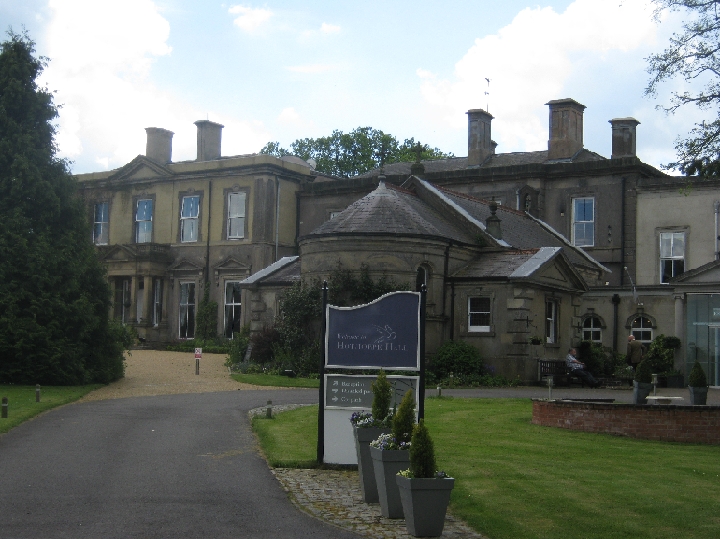
Hothorpe Hall Conference Centre © Ricky Yates

I spent the week (Monday 12th – Friday 16th May 2014), attending the annual Intercontinental Church Society (ICS) Chaplains and Families Conference at Hothorpe Hall, which lies adjacent to the Northamptonshire-Leicestershire border, a few miles outside Market Harborough. Attending the conference was one of the two reasons for my two-day drive from the Czech Republic to the United Kingdom, that I described in my earlier post.

As I explained in my post about the 2013 Conference, ICS is an international Church of England mission agency seeking to make known the good news of the Christian Gospel to people who speak English, who find themselves living, studying, working or holidaying away from home in countries where English is not the main language. ICS mainly works in continental Europe and other countries that surround the Mediterranean, and has financially and prayerfully supported the Prague Anglican Chaplaincy since August 2000.

The conference struck a nice balance between prayer, worship and teaching with some free time each afternoon, to explore the delightful surrounding countryside. As so often with conferences of this nature, some of the most valuable time was spent talking informally with colleagues over coffee or on occasions, something a little stronger 🙂 All of us work in somewhat isolated situations with rarely any opportunity to meet with each other except at this annual gathering.

Foxton Locks © Ricky Yates


The area around Hothorpe Hall was somewhere I had previously explored by foot or on my bicycle during my teenage years when living in Coventry. On the Wednesday afternoon, I made a circular walk of around 13 km to see the staircase flight of ten locks at Foxton on the Leicester section of the Grand Union Canal, a place I last visited about forty years ago


Top end of the remains of the Foxton inclined plane © Ricky Yates


Bottom end of the remains of the Foxton inclined plane © Ricky Yates

As well as the locks, a remarkable feat of engineering in their own right, I was fascinated to see the remains of the neighbouring inclined plane, built at the beginning of the twentieth century but abandoned in 1928 because of being too costly to maintain. The whole site, which used to be totally overgrown, has in recent years, been completely cleared and landscaped.

My  path through a field of flowering oil seed rape © Ricky Yates
My path through a field of flowering oil seed rape © Ricky Yates


I took a different and slightly longer route to return to Hothorpe Hall, one that avoided a section of busy main road and which took me through a field of flowering oil seed rape.


On the final evening of the conference, a celebration dinner was held. We were encouraged to dress up a little and several of the ladies wore dresses or skirts, rather than the usual jeans and I wore my suit, together with my favourite tie which features a series of white sheep with just one black sheep in the middle.

During the dinner, a tradition started at the 2013 conference was continued with a fun ‘awards ceremony’, known as the ICS Carrot Awards. Last year, little mementos were presented which were made of carrots – this year there were printed certificates featuring a smiling carrot logo. Clearly my suit and tie were impressive as was given the prestigious ICS Carrot Award in recognition of being the best dressed man during the conference 🙂

The Parish Church of St. Mary the Virgin, Wilby © Ricky Yates


Whilst the weekend following the conference, was meant to be the first part of my holiday, on the morning of Sunday 18th May, I undertook a deputation visit on behalf of ICS and was the preacher at two supporting parishes, St. Mary the Virgin, Wilby and St. Mary Magdalene, Ecton, two villages near Wellingborough in Northamptonshire. As well as preaching, I was also interviewed at both services by the Rector, Rev’d Chris Pearson, asking me to explain about my ministry in the Czech Republic and how ICS supports that work by finance and prayer. It was a most worthwhile morning, tinged by a little bit of déjà vu as I drove between services through the Northamptonshire countryside, echoes of my fifteen and a half years of rural multi-parish benefice ministry in the Oxfordshire countryside 🙂


My two-day drive from the Czech Republic to the United Kingdom

My DFDS Seaways cross-channel ferry © Ricky Yates

At the beginning of last week, I drove all the way from Prague to the East Midlands of England, in order to attend this year’s Intercontinental Church Society (ICS) Chaplains and Families Conference, followed by a week of annual leave visiting family and friends. Both before setting out from the Czech Republic and on arrival in the UK, I’ve had many expressions of surprise for undertaking the trip as well as numerous questions as to my route and what the journey entails. So here is a blogpost by way of explanation.

I should start by saying that it is a journey that I have undertaken once previously, albeit in the reverse direction. For when Sybille and I moved to the Czech Republic in September 2008, we drove all the way from our old home in North Oxfordshire, to our new home in Prague, along with Oscar the cat. But in the nearly six years since our arrival in the Czech Republic, the five return UK visits I’ve previously made, have always been by air.

I set out on my journey on Sunday 11th May, having first celebrated the Sunday Eucharist at 11.00, followed by a brief visit to post-Eucharistic Coffee Hour. I would have preferred to have driven from the Chaplaincy Flat to Church, rather than using public transport, so I could set off directly afterwards in the ‘Carly’. Unfortunately, that Sunday was the day of the annual Prague Marathon which results in many street closures. So instead, I packed the car first thing on Sunday morning, leaving it parked by the Chaplaincy Flat, and then travelled to Church and back again by tram, as we normally do.

It was therefore not until 13.25, that I set out on my journey. Fortunately, once I reached the Pražský okruh/Prague ring road on the western side of the city, the rest of the my journey to Dunkerque in France on the coast of the English Channel, was almost exclusively on motorway, or dálnice, Autobahn, autoroute, autobaan, depending on the language of the country through which my route passed.

From the Pražský okruh/Prague ring road, I took the D5 which heads westwards towards, and then around, Plzen, before heading for the German border. Most confusingly, nearly all the road signs tell you that, beyond Plzen, you are heading towards Rozvadov, rather than towards Germany or Nürnberg, the first major city over the border. Where or what is Rozvadov? It is a small village, just off the D5, the last one in the Czech Republic!

There are several interesting differences between a Czech dálnice and a German Autobahn. Czech motorway signs are green with white lettering whilst German ones are blue with white lettering. The Czechs use blue signs with white lettering for their ordinary roads! Czech motorway intersections are numbered according to how many kilometres they are from the beginning of that motorway, usually starting in Prague. German motorway intersections are just given consecutive numbers. Many Czech over bridges have advertisements on them which I find both unsightly and distracting whilst there is a total absence of such things in Germany.

One contrast I particularly noticed as I drove up into Ceský les, the hills that lie in the very west of the Czech Republic and form the border with Germany, is the almost total absence of human settlements – there are just forests and open fields. Yet once across the border and driving down through the Oberpfälzerwald, there are a succession of villages amongst the woods and fields. Of course, there is a reason for the contrast. The area on the Czech side is part of what was known as the Sudetenland from which the Sudetendeutsche population were expelled in 1945. Within a couple of years, the area had become a restricted zone which only those trusted by the regime, were allowed to enter for fear that all others might try to escape from their Communist paradise to capitalist West Germany.

Being aware that petrol is cheaper in the Czech Republic than in Germany, I filled up just before crossing the border. I was fairly sure that a full tank would take me right across Germany, all the way to Luxembourg, which it duly did. I also knew from many years of travelling in continental Europe, that petrol is cheaper in Luxembourg because of low taxation, hence I planned my route to pass through the duchy, in order to fill up once more.

It took me five hours to drive across Germany passing near Nürnberg, Heilbronn, Speyer, Kaiserslautern and Trier. Whilst Germany does have an excellent Autobahn network, parts of it are beginning to show their age with several bridges and viaducts that I crossed being under repair, including the one across the Rhine.

One thing that again brought a smile to my face whilst driving in Germany, was seeing every exit from the Autobahn being marked by a sign saying ‘Ausfarht’. It always reminds me of my first ever visit to Germany in 1975 when I was travelling with a coach party consisting mainly of Australians, most of whom had not previously been to Europe. After travelling for some time along the Autobahn, one of the party turned to me and said, “This place called Ausfarht must be really big as I’ve seen so many signs to it” 🙂

Passing around Trier, along one very small section of my route which was not motorway, I then entered Luxembourg and within about thirty minutes, had driven from one side of the country to the other! Just before the border with Belgium, I pulled into a service station at the side of the autoroute and took full advantage of the low price of fuel. Then it was over the border to the town of Arlon where I stopped for the night in a hotel located in a service area without a fuel station, as everyone buys cheap petrol over the border in Luxembourg 🙂 So by 20.45 that evening, I had driven through four countries and covered 760 km/473 miles.

Next morning after breakfast, I set off on the Belgian autoroute, heading towards Brussels. Of course, according to the road signs, I was heading towards Bruxelles, until suddenly the signs instead said Brussel. The reason for the change is crossing the boundary between a French-speaking province and a Flemish speaking one. Both French and Flemish-speaking Belgians do not believe in bilingual signs which can be most confusing when the name of a town or city differs considerably more than Bruxelles/Brussel.

From past experience, the one part of the journey I was a little concerned about was driving around the Brussels ring road where I have previously experienced congestion. However, apart from a short delay getting onto the slip road giving access to the ring road, the rest of my trip around the Belgian capital went smoothly. This was followed by an equally smooth journey on towards the coast near to Ostend and then just inland but parallel to the coast, over the French border to Dunkerque.

Courtesy of having such an easy journey, I arrived two hours in advance of the departure time of my ferry crossing. The Dunkerque-Dover crossing takes two hours, but with the change from Central European Summer Time(CEST), to British Summer Time(BST), I left Dunkerque at 14.00 CEST and arrived at Dover at 15.00 BST.

Once off the ferry, it took me a further three hours to drive from Dover to Hothorpe Hall near Market Harborough, along the M2, M25 and M1. En-route, I had the first of what were to be many experiences of discovering how expensive life in the UK has become. When I last used the Dartford Crossing east of London, the toll was £1.00. It came as quite a shock to discover the 100% increase to £2.00 🙁

So I arrived at Hothorpe Hall, safely but somewhat tired, at 18.20 on Monday 12th May having driven a further 688 km/430 miles. The evening meal was to be served ten minutes later and, in the meantime, one of my fellow ICS Chaplains bought me a much needed drink from the bar. Thank you Hazel!