Snowy Prague

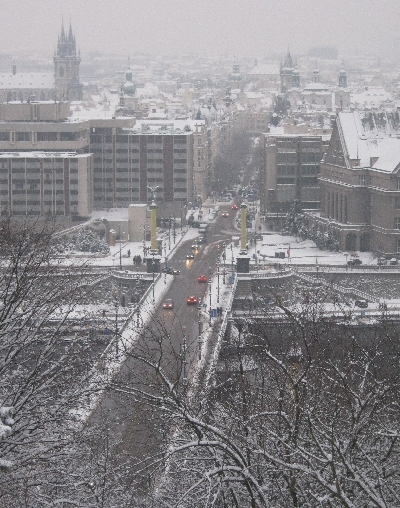
Chechuv Most, Prague; in the snow © Ricky Yates

Like much of Central and Northern Europe, the Czech Republic has recently experienced extremely heavy snowfall. Here in Prague, it started snowing just over a week ago on Friday 8th January and continued doing so, almost without interruption, until part way through Monday 11th January. According to the local media, around 40 centimetres of snow fell during this period, the heaviest snowfall here for 17 years.

Since it has stopped snowing, the weather has been overcast and grey with virtually no sunshine. Temperatures have risen slightly, but have rarely got above zero degrees Celsius, meaning that hardly any of the lying snow has melted. According to the weather forecast I have just looked at, it will start snowing once again tonight and ‘Heavy snow’ can be expected for the next two days!
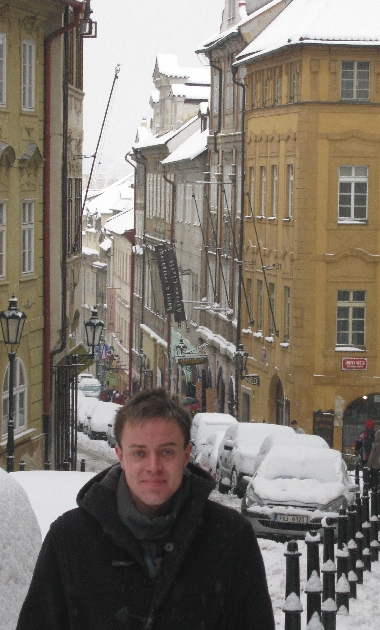
Phillip in the snow in Mala Strana © Ricky Yates

I was rather worried on Friday 8th January when it started snowing heavily, as my son Phillip was due to fly in that day from the UK to visit me over the weekend. Knowing that the UK had just experienced its worst snow for nearly thirty years, I had visions of his flight being cancelled, either because it couldn’t take off or because it couldn’t land. Fortunately, East Midlands Airport, which serves the city of Derby where Phillip lives, was less affected by snow than most other UK airports. Therefore his Friday afternoon flight was able to take off without any problems. And because the Czechs are used to dealing with snow, Prague Airport was still open and functioning, allowing his flight to land safely and on time.

I cannot help but contrast the way the UK deals with snow compared to the Czech Republic. As every British person knows, as soon as it snows in the UK, the country grinds to a halt. Last winter in London, snow falling caused the complete cessation of the capital’s bus services. Here in Prague last Sunday, despite two days of continuous falling snow, we travelled by tram from our flat in the north-western suburbs, to Church in the city centre, without any problems whatsoever. Likewise, the few flights to or from Prague Airport that were cancelled over last weekend, were almost all cancelled because of snow problems at other airports, particularly British ones, together with ones in northern Spain, not due to snow problems in Prague.

On Saturday 9th January, Sybille and I took Phillip on a walking tour of parts of Prague that he hadn’t had the opportunity of exploring on his three previous visits. We took the tram to Prague Castle and then walked down through Mala Strana, the ‘lesser town’ or ‘lower town’, that lies beneath the castle and is full of architectural delights. He was particularly keen to see the Lennon Wall and some of the artwork which lies outside the Kampa Museum alongside the Vltava River.

Phillip in front of the Lennon Wall © Ricky Yates
Father & Son in front of the Lennon Wall © Sybille Yates

I took this series of pictures during our walk last Saturday. I hope they help to convey the beauty and character of Mala Strana, together with Phillip’s enjoyment of his time with us.

Phillip outside the Kampa Museum © Ricky Yates

Phillip, Lion & Beer © Ricky Yates
The French Embassy in Mala Strana © Ricky Yates

Collecting stickers whilst driving across Europe

We bid farewell to our couchsurfing hosts in Istanbul on the morning of Monday 19th October and set out on a two day drive to reach Montenegro. Using the older of the two suspension bridges that span the Bosphorus, we crossed into European Turkey and headed out of the city on the motorway that leads to the border with Bulgaria.

Once out of the immediate urban confines of Istanbul, the motorway is subject to toll. On entering the section subject to toll, there is a barrier where you obtain a ticket that shows the date, time and location where you joined the motorway. When you leave the motorway or reach the end of the section subject to toll, you present your ticket at another barrier and pay the appropriate fee. Motorway tolls are collected in the same manner in Serbia and Croatia as they also are in France, Spain and Italy.

However, many other European countries that charge motorists for the use of their motorways do so by means of a ‘vignette’. A ‘vignette’ is a sticker, usually purchased from a roadside shop or garage, indicating that the appropriate road toll has been paid for a certain period of time which can range from a few days to one year. Cameras and random police checks are used to enforce compliance.

Whilst the system is good in principle, it does mean that if you drive in and through as many countries as we have in 2009, you end up with a windscreen full of vignette stickers! Different countries require vignettes to be displayed in different locations on car windscreens meaning that we now have stickers in three separate places!

Vignettes from Slovenia (top left), Switzerland (top right) and Austria (bottom right) © Ricky Yates
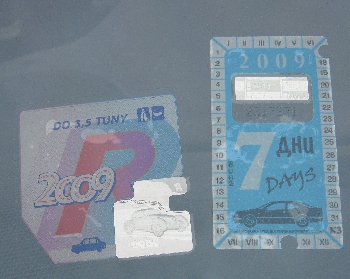
Vignettes from Slovakia (left) & Montenegro (right) © Ricky Yates. Although Montenegro has no motorways, a 10 Euro environmental charge has to be paid by all foreign vehicles entering the country.
Vignettes from Slovakia (left) & Montenegro (right) © Ricky Yates. Although Montenegro has no motorways, a 10 Euro 'environmental charge' has to be paid by all foreign vehicles entering the country.
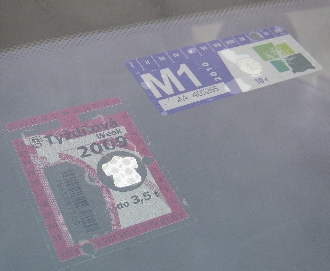
Vignette from Czech Republic (left) & Bulgaria (right) © Ricky Yates
Vignettes from Czech Republic (left) & Bulgaria (right) © Ricky Yates

On reaching the Turkish-Bulgarian border, we began retracing our steps, travelling the same route across Bulgaria as we had used for our outward journey but in the reverse direction. We continued along this same route in reverse as far as Niš in southern Serbia where we once more stayed overnight. The following day, we ventured into new territory, wending our way across southern Serbia towards Montenegro.

I deliberately chose a route through southern Serbia that avoided passing into Kosovo as the car is only insured to be driven in ‘those parts of Serbia under the control of the government of Serbia’. Our route therefore took us through the mountains of the Kopaonik National Park just north of the Serbia-Kosovo border.

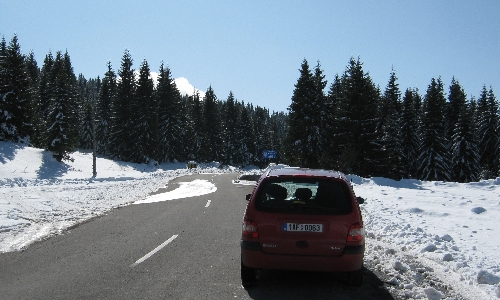
Only three days earlier, we had been experiencing daytime temperatures in excess of 25 degrees Celsius. It had become much cooler ever since passing through a series of thunderstorms as we drove into Istanbul. But as we climbed into the mountains of the Kopaonik National Park, through ever increasingly attractive scenery, the temperature dropped sharply and, much to our surprise, we found ourselves surrounded by the first snowfall of the winter. Fortunately, the road had been cleared which allowed us to cross the mountains, drop down the other side and make our way to the border with Montenegro.

Snow alongside the road through the Kopaonik National Park, Serbia © Ricky Yates