It is now four months since a little critter got me and over two months since I last wrote a blogpost. So I thought it was high time that I posted an update.
Firstly, I am very grateful to the many people who have been praying for me, sending me their best wishes for a full recovery and wanting to know my current state of health. This post is for all of you!
When I last saw my GP, on Friday 5th December, and he saw my leg 😉 , he was pleased with what he saw. Whilst the upper part of my left calf is still a bit swollen, it is vastly improved from three & a half months previously. So I have finally stopped taking anti-inflammatory tablets. The other good news is that my INR has finally settled down after being badly disturbed by taking antibiotics. On 5th December, it was 2.6 – almost perfect, as it is meant to be in the range 2.0-3.0.
As I said in reply to one of the welcome comments on my last post, my planned further hospitalisation on 7th October, to investigate the scabby lump on the bottom of my left leg, didn’t happen, as there wasn’t a spare bed for me. I am now re-booked to see the dermatologist on Tuesday 6th January 2026. In consultation with my GP, I will be slightly reducing my intake of Warfarin in the week before that appointment and then having my INR checked by my GP, the day before the appointment. Hopefully it will be around 2.00 and will allow an incision to be made, without the risk of me severely bleeding.
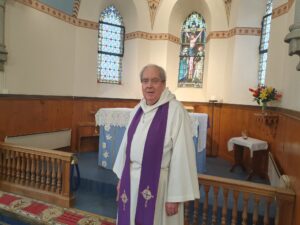
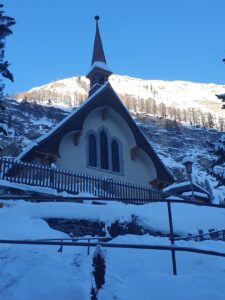
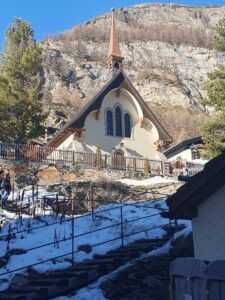
Last December, as I wrote in this post, I answered a cri de cœur and travelled to Zermatt, Switzerland, to provide Christmas services at St Peter’s Church, known locally as the ‘English Church’. Having enjoyed the uplifting but tiring experience, some months ago, I volunteered to return in December 2025, this time for a full two weeks including Sunday 21st December- Advent 4, and Sunday 28th December – Christmas 1.
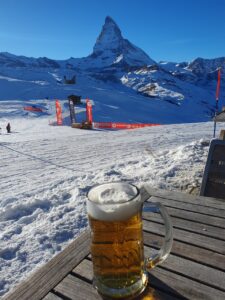
Because my two weeks mark the beginning of the Winter Season, the Chaplaincy flat has been vacant since the end of the Summer Season in September. Therefore I have been able to arrive a few days early, acclimatize myself and enjoy the mountains, before my Chaplaincy duty commences.
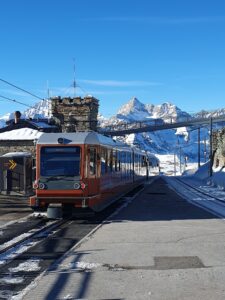
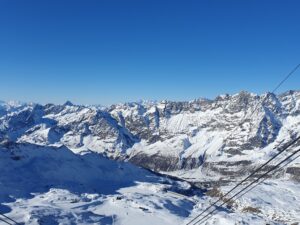
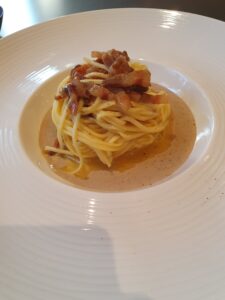
And I’ve travelled the Matterhorn Alpine Crossing from Switzerland to Italy and back, with further amazing views and a delightful Italian lunch in Breuil-Cervinia.
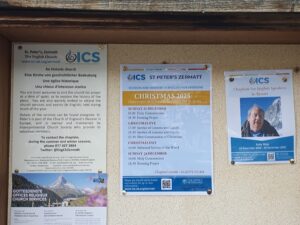
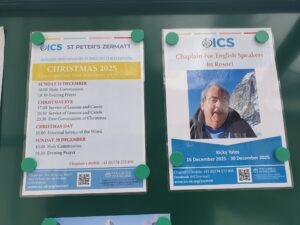
During my two week stint, I will be officiating and preaching at eight different services, as advertised now on the Church noticeboard and on the Church website. With my two earlier services at the Dresden Frauenkiche, that means ten services in December. So much for being retired!
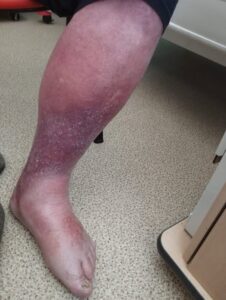
Between 02.00 and 11.00 on Saturday 16th August 2025, I seriously vomited five or six times. During that Saturday, the lower part of my left leg, together with my ankle and foot, became swollen, red and painful. At the time, I didn’t associate the two events.
I assumed the vomiting was because of something I’d eaten. And my left calf and foot are always slightly bigger than their opposite numbers on my right leg, ever since August 2015, when a deep vein thrombosis (DVT) escaped from there and became a pulmonary embolism in my lung, as described in this post.
After a day of resting and not sleeping very well that night, on Sunday morning I was still feeling quite unwell and also not very mobile. So I made the reluctant decision that I couldn’t officiate and preach at the Frauenkirche that evening, the first time I’ve ever had to cancel a service since I took up my Dresden responsibilities almost ten years ago. Thankfully, my friend and colleague Andrew Allen, stepped into the breech.
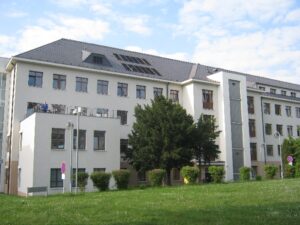
After another uncomfortable night and no improvement during Monday 18th, late that afternoon, I decided the time had come to go to my local hospital in Decín and seek medical help. Fortunately, I had a friend staying with me, my first guest in my renovated upstairs rooms. We were unable to get a taxi and so Libor, husband of Sona, the boss of Restaurace U Soni, kindly drove us to the hospital.
At the hospital, I was seen by a nurse and had some blood samples taken. Then I saw the duty doctor who told me that I needed to be admitted to hospital that evening, in order for the infection in my leg to be treated with antibiotics and pain killers, fed intravenously. The doctor fortunately, had some English and used Google translate on his phone when he became unstuck. My friend got back to my house by taxi and the following day came to the hospital by bus, bringing me clothes, pyjamas, toiletries etc.
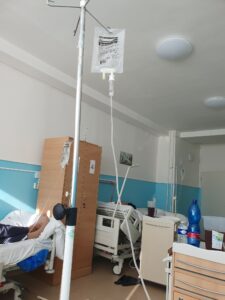
I took this photo from my bed whilst receiving antibiotics intravenously. It gives you an idea of the four-bedded ward where I spent three nights. Every morning, the doctor came around to see each of the patients. He only spoke to me in Czech, most of which I didn’t understand. He didn’t seem to have a word of English. Fortunately, a couple of the nurses spoke fluent English, the one who got me to fill out my consent forms was particularly helpful. Czech hospital food was as unappetising as I remember it being ten years previously in Vojenská nemocnice in Prague 🙁
On the morning of Thursday 21st August, the doctor told me that I was being discharged and could go home. That was one bit of his Czech that I did understand 😉 I was presented with four prescriptions, (two for further antibiotics, one for anti-inflammatory tablets and one for pain relief), and a two-page report about me and my time in hospital, obviously all in Czech. But from the report, I finally found out what I had been diagnosed with – Erysipelas.
Erysipelas, historically known as St Anthony’s Fire, is a bacterial infection of the skin and the lymphatic system. Its origin is the bacterium Streptococcus pyogenes, almost certainly caused by an insect bite. When I wrote this on Facebook, along with the photo of my leg at the beginning of this post, a friend commented that, ‘It’s amazing the damage a little critter can do’, a sentiment with which I completely agree and why I have chosen it as the title for this blog post. One of the symptoms of being infected with Streptococcus pyogenesis, is vomiting. The two events of the morning of Saturday 16th August were connected.
Whilst I’ve now lived in Stará Oleška for over eight years, I’ve remained registered with the GP practice, Young & Co, in Prague. This is for a number of reasons. They have looked after me brilliantly since my pulmonary embolism in August 2015. All the doctors have to be able to speak English. And going on a train trip to Prague once every six weeks to have my INR,(the level of thinness of my blood), checked, makes for a nice day out.
But having to travel there with a badly swollen leg, has been a little more difficult. So far I’ve been for five follow up visits, the first on Monday 25th August, the most recent on Thursday 25th September. Both my regular GP, Dr Josef Stonawski, and the boss of the practice, Dr Adriana Youngová, have been very helpful and supportive. Whilst the infection has been dealt with and I no longer have pain or numbness in my left leg, it is still swollen. Dr Youngová told me that I will probably have to take the anti-inflammatory tablets for up to three months which means I have another five weeks to go.
The other problem that has caused me to make frequent visits is that the antibiotics have totally upset my INR – a well-known problem. My INR is meant to be between 2.0 and 3.0. On 25th August it was 4.2. Having reduced my Warfarin intake, on 2nd September it was 1.6. on my last visit it was 2.9, just within range, but still rather high. And this has caused me further problems.
On my last visit to my GP practice, on the morning of Thursday 25th September, I had an appointment in the afternoon with my dermatologist, at Vojenská nemocnice. This was to investigate a scabby lump, near the bottom of my problematic left leg. Is it a Basel Cell Carcinoma to be treated with liquid nitrogen? Or is it a leg ulcer requiring different treatment? But to extract a small sample for testing would involve an incision in my leg and with my INR being 2.9, my dermatologist is afraid I will bleed too much.
As a result, tomorrow morning I am being admitted to Vojenská nemocnice for four or five days, whilst my INR is reduced and closely monitored and then appropriate treatment will follow. It will be a very early start to catch the 05.40 bus from the village, to then catch the 06.25 train from Decín to Prague, in order to reach the hospital by 09.00. So I’m off to bed as soon as I’ve successfully posted this text.
If in recent days, you have arrived on my blog for the first time, you won’t notice any difference. But if you are a regular visitor, maybe checking up as to whether I’ve actually written a new post, then you will have noticed that its appearance has changed. And having not written and posted here for over three months, this is the perfect reason for me to get blogging again.
Back in July, I received a message saying that my PHP needed updating. PHP is a general-purpose scripting language that powers my blog. Apparently, my PHP was 8.0.30 when it should now be 8.3. As things such as this are beyond my competence, I contacted my technical guru to ask whether she could help and she kindly updated me almost straight away.
A few weeks later, my technical guru wrote saying that, whilst updating my PHP, she had noticed that my WordPress theme, the way my blog appears, was no longer supported by the developers and was therefore a security risk. It was time for a change.
Amazingly, the last time I changed my WordPress theme was over thirteen years ago. This post describes what happened then. I have since altered the blog header from being an Anglican in Prague to being an Anglican in Bohemia & Saxony, but no other changes have been made to the appearance of my blog, until now.
My new theme has the slightly bland title of ‘Twenty Sixteen’. But it is clear and uncluttered and, most importantly, it is secure. I like it and I’d be interested for feedback from any of my regular visitors.
Inevitably, changing theme has slightly disrupted a few earlier posts. In particular, any text that is at the side of a photo at the beginning of a post, sometimes has large gap in it mid-sentence, before continuing under the photo. I’ve managed to solve this problem a few times, by hyphenating a long word – for example making Frauenkirche, Frauen-kirche. But if any reader spots a similar problem, please let me know, either by commenting on this post or using the contact link in the right-hand sidebar.
Whilst I prefer to read things on the internet, using my laptop computer on which I’m compiling this post, I am aware that many people read things almost exclusively using their mobile phones. One positive result of updating my WordPress theme is that the blog is now much easier to read on an Android mobile phone. Well it certainly is on mine 😉
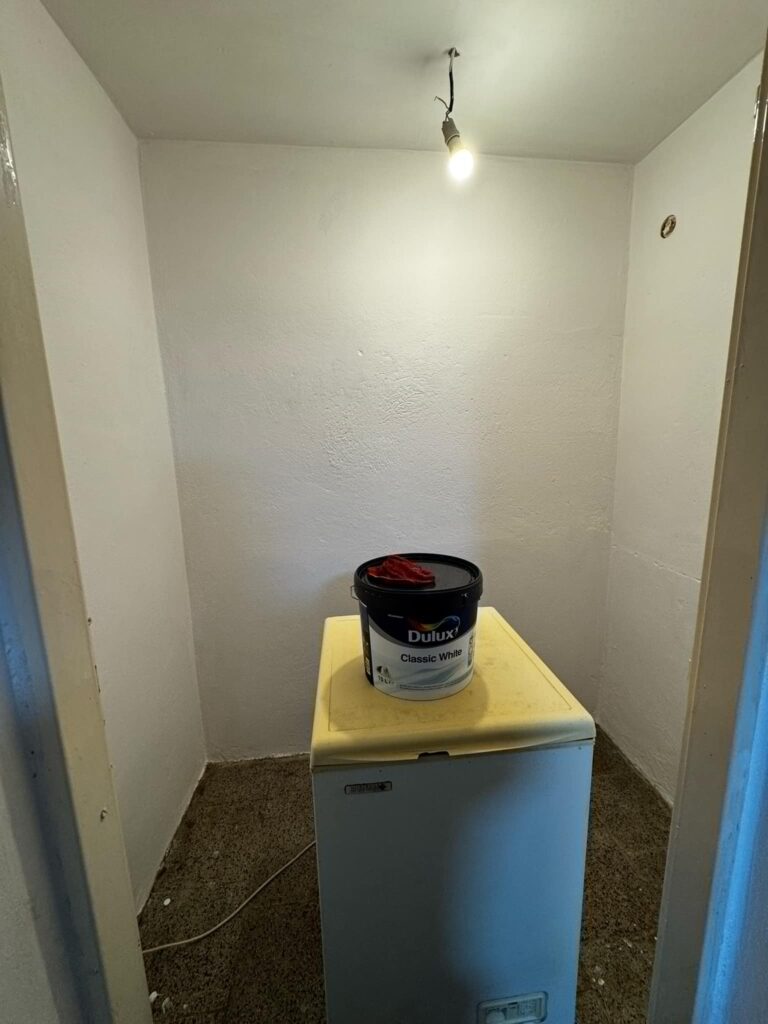
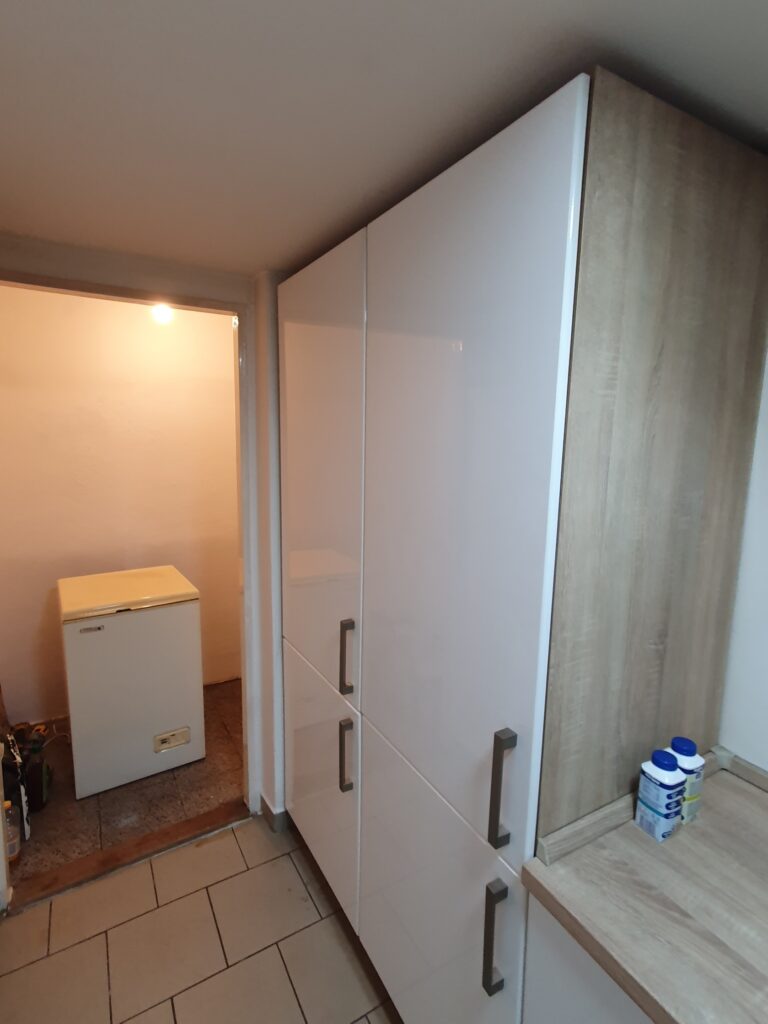
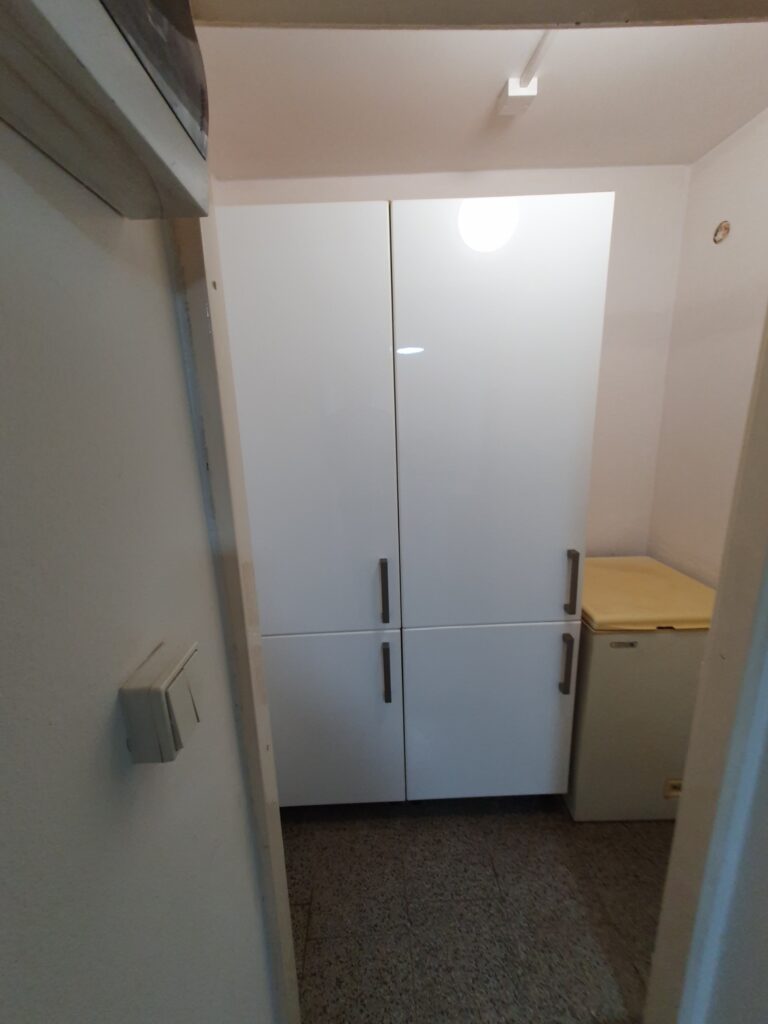
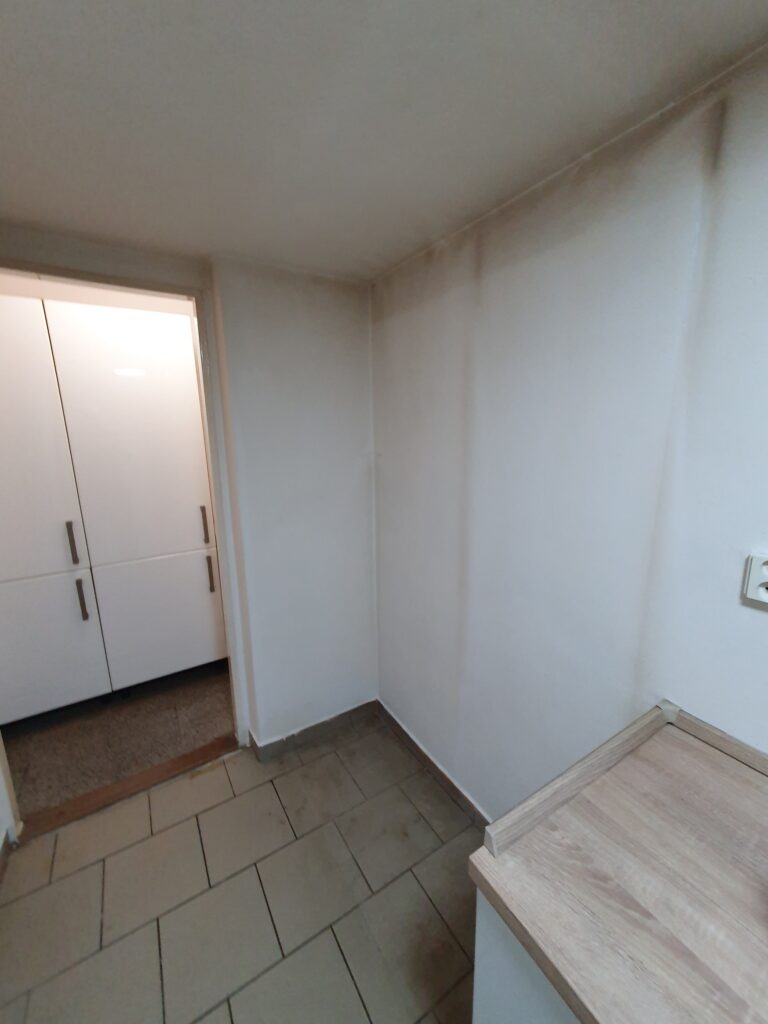
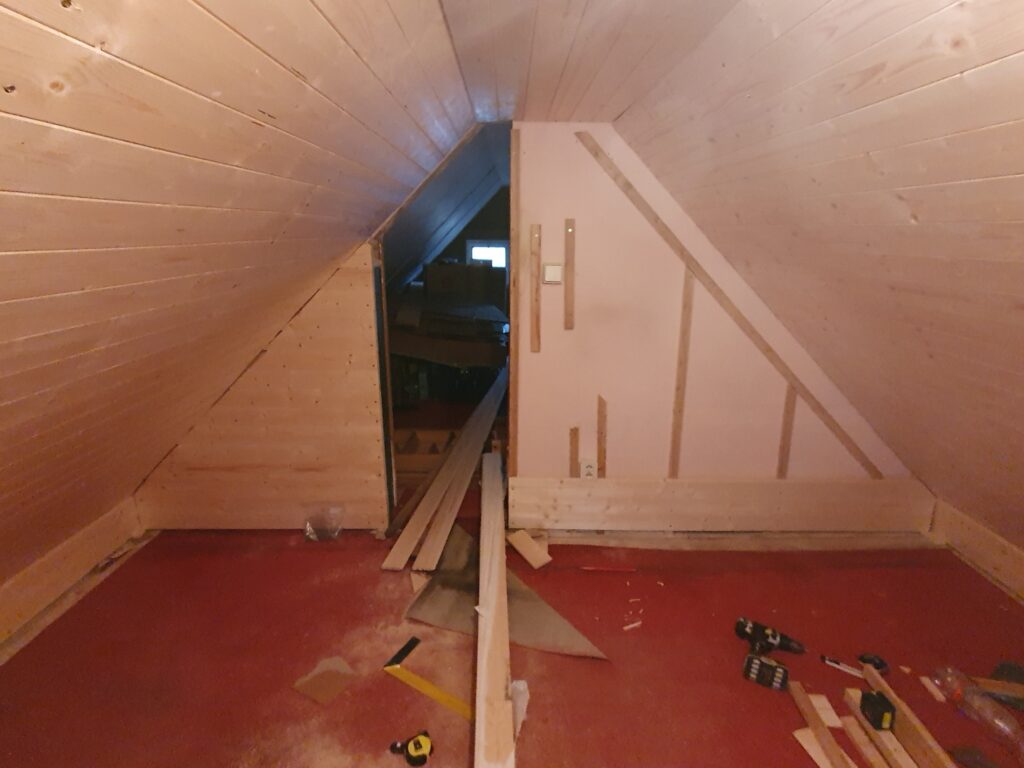
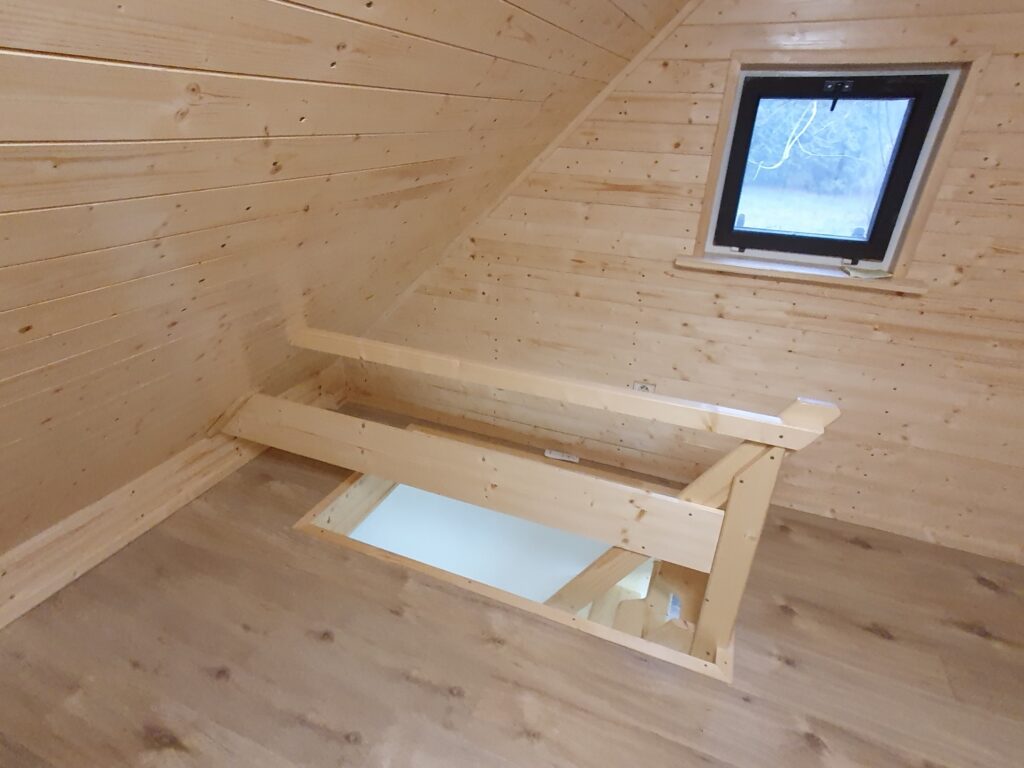
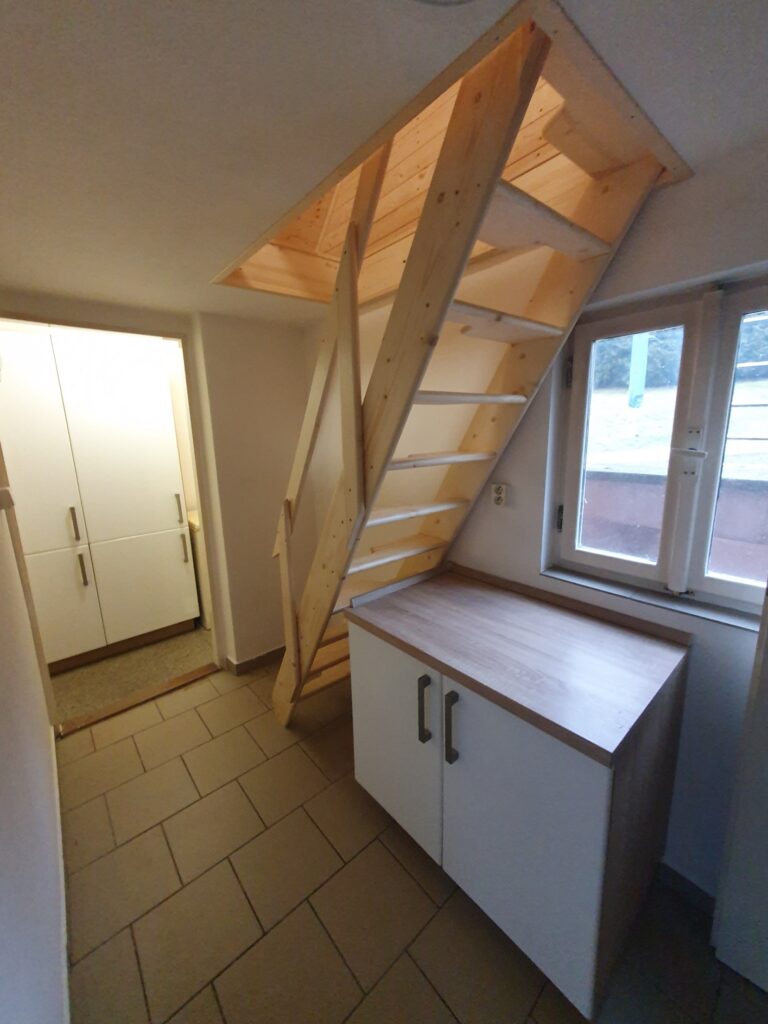
Back in March 2024, I wrote a post entitled, ‘House renovation – the next stage‘, in which I outlined how I wanted a staircase installed to give decent access to the two rooms in the roof space which were then only accessible by a drop-down loft ladder into my study bedroom. Karel junior of K & K renovace nemovitostí Decín, had assured me previously that he doesn’t know anything that isn’t feasible. So on Monday 16th December 2024, he and Karel senior, came to look at what I wanted.
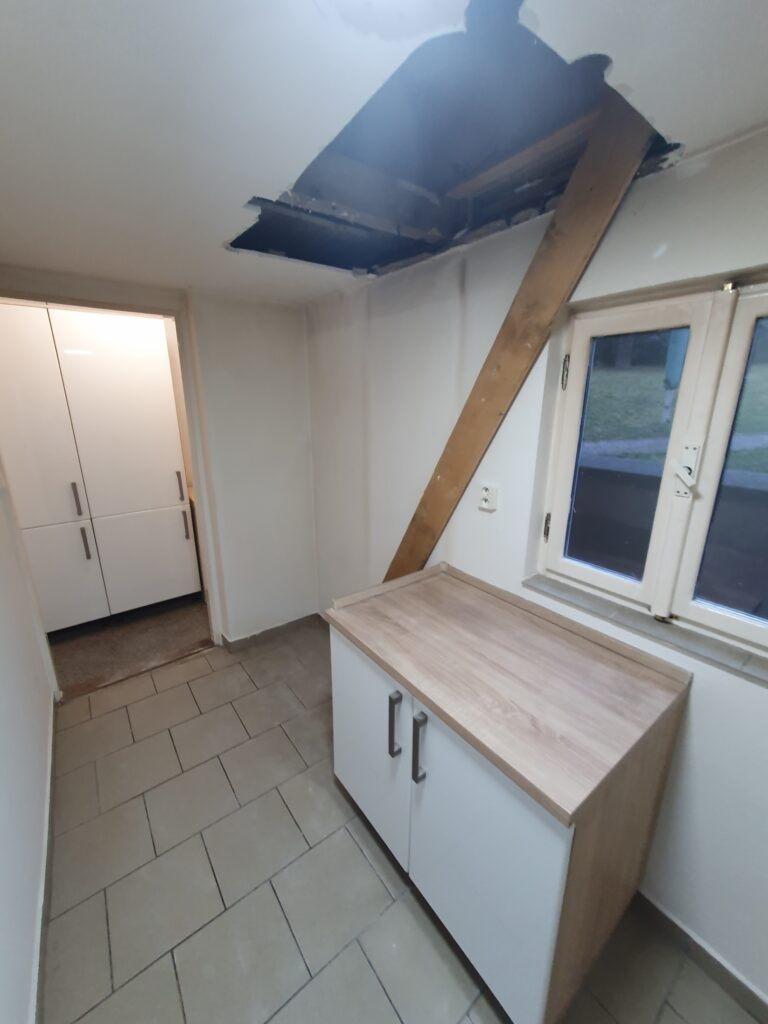
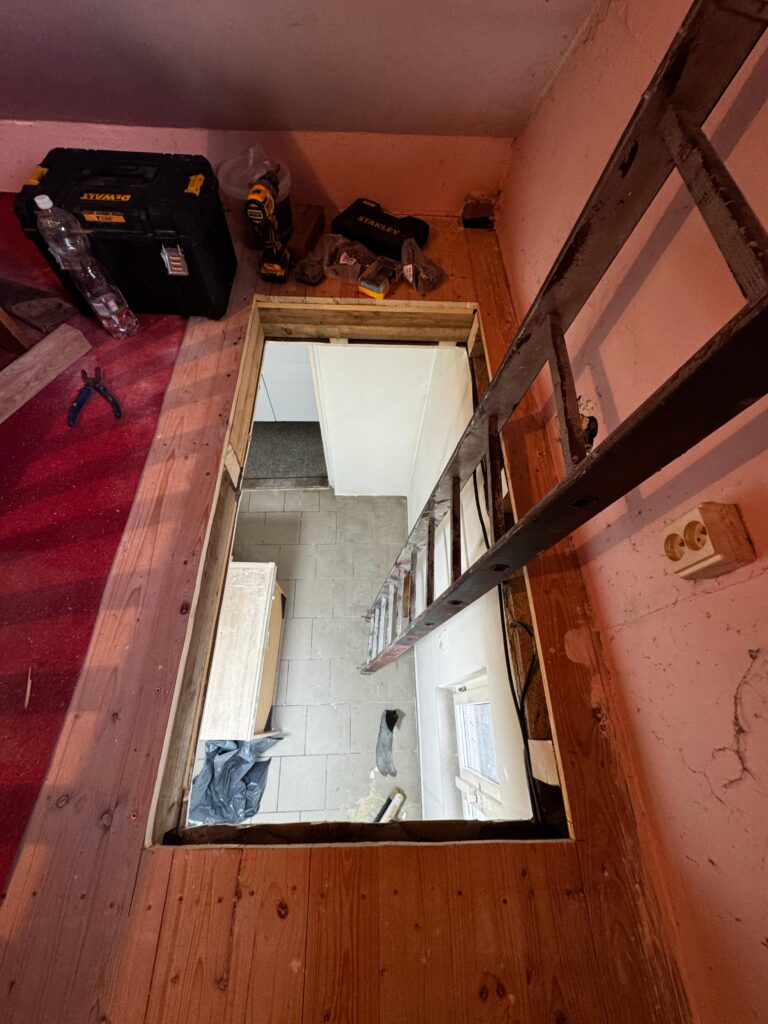
They said that to insert a staircase in the little un-renovated room, as I outlined in my March 2024 post, would involve making alterations to the roof and would be very expensive. Instead, they suggested completely dismantling the tall double cupboard just outside that room, (which I had installed back in May 2018), and reassembling it in the little room and installing a staircase in the space vacated by the cupboard. This would involve no external alterations. So I accepted their suggestion and work commenced on Monday 6th January 2025. I’ll let the photographs do the talking.
I was expecting that K & K would then install the new stairs. But they told me that they wouldn’t do that until they had completely renovated the two rooms in the roof space as they wanted the stairs to abut the floor of those rooms at exactly the correct height. So whilst they worked, they used their own ladder in the newly created hole to get up and down.
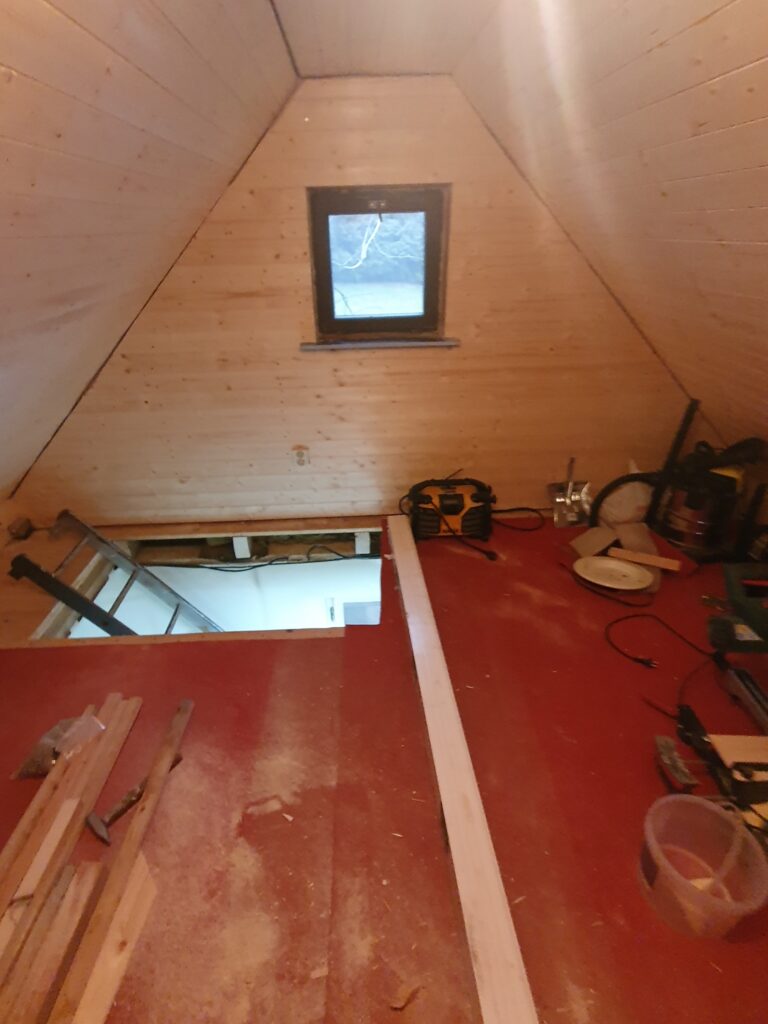
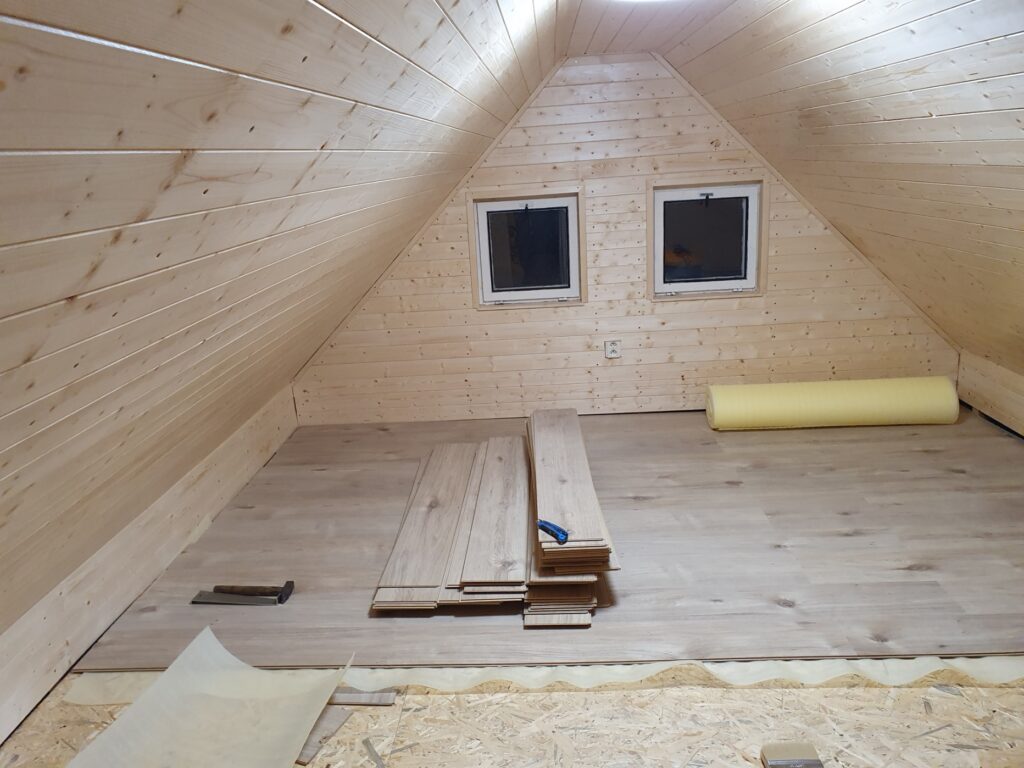
Over the following couple of weeks, K & K lined the sloping sides, the narrow central strip of ceiling, the triangular walls at either end and the dividing wall between the two rooms.
Only once this was done, together with removing the old drop-down ladder and new floorboards being laid over the resultant hole, could the final task of laying a new wood laminate floor be carried out.
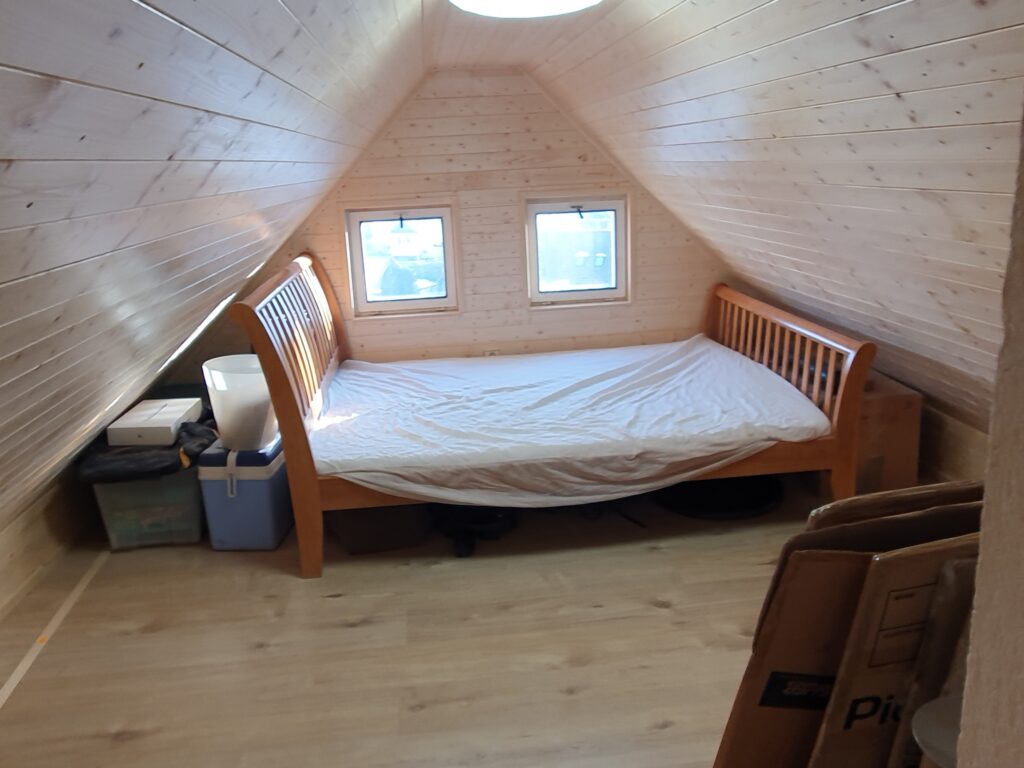
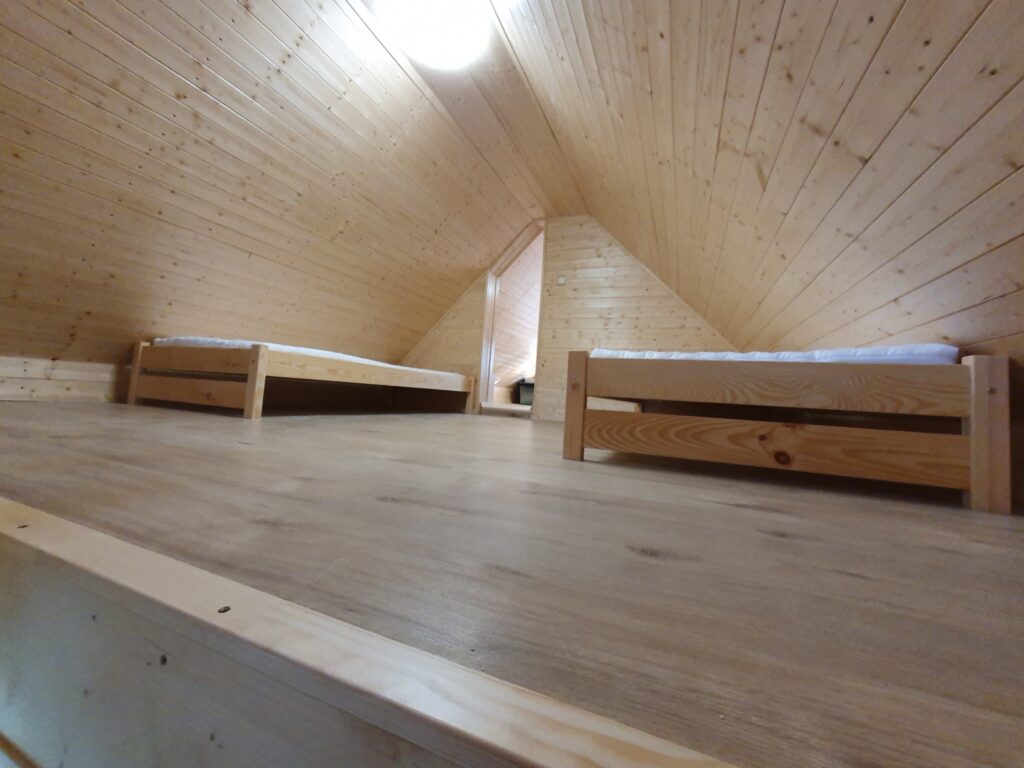
I’ll let the following photos speak for themselves to show what has been achieved and the high quality of K & Ks workmanship.
So after living here in my retirement home in Stará Oleška for eight years, I finally have the ability to host guests. My son Phillip has already asked when the Airbnb listing is going to happen 😉 It isn’t – the two renovated and accessible rooms will be purely for visiting friends and family. And I’m pleased to say I’ve already had my first guest 🙂
Kralupy nad Vltavou is a city with a population of around 20,000, situated on the Vltava river, sixteen kilometres north of Prague. On 22nd March 1945, it was subject to a devastating bombing attack by USAF planes. The two reasons given for the attack were the presence of an important oil refinery and the city being a key railway hub. The aim was to disrupt the ongoing Nazi war effort.
The first wave of bombers successfully hit the refinery, setting an oil storage tank on fire, from which erupted a very large cloud of thick black smoke. This left the follow-up wave of bombers with very poor visibility to see their targets. As a result, further bombs were dropped fairly randomly, hitting residential areas of the city.
Of the 1,884 buildings in the city at that time, 117 were completely destroyed and another 993 were seriously damaged. 248 people lost their lives in the immediate aftermath of the bombing of whom 145 were Czechs. The remaining victims were mainly German soldiers. The devastation was so great that Kralupy earned the nickname of ‘Little Dresden’. The allied bombing of Dresden, with the massive destruction of its central area including the Frauenkirche, and the death of around 25,000 people, had taken place only five weeks earlier on 13th – 14th February 1945.
In January this year, the director of the city museum in Kralupy, wrote to the director of the city museum in Dresden, with what he admitted was a somewhat unusual request. He was planning a commemorative ceremony on 22nd March to mark the 80th anniversary of the bombing of Kralupy. He wrote that since a large number of German citizens also lost their lives in those bombings, he planned that a large candle—an Easter candle—be lit for all the victims during the ceremony. He wanted the candle to be donated by a German city that had suffered a similar fate, hence his request to the city of Dresden. This would be an act of reconciliation and shared remembrance.
The director of the Dresden city museum sought the help of the Frauenkirche who arranged for the production of the requested candle. Then, just over a week before the commemorative ceremony, I got an email from Maria Noth, the Geschäftsführerin / CEO of the Stiftung, the charitable foundation that runs the Frauenkirche, asking whether I would be willing to travel to Kralupy, representing the Frauenkirche, and present the candle on their behalf. Her reasoning for doing so was because of my strong ties to the Frauenkirche, (her words, not mine), because I live in the Czech Republic, and because of originally coming from Coventry & its experience of aerial bombing.
Fortunately, I was at the Frauenkirche on Sunday 16th March, conducting my regular monthly English-language Anglican service of Evening Prayer. I was therefore able to pick up the heavily packaged candle from the vestry that evening, together with my black cassock which normally lives there, and carry them both to my car following the service, ready for onward transportation to Kralupy, on Saturday 22nd March.
At the request of the Kralupy museum director, Maria Noth sent the following message to accompany the candle, which I reproduce here in full. A Czech translation of it was printed in the programme for the Commemorative Ceremony.
‘Kralupy nad Vltavou was severely damaged on March 22, 1945 – just over a month after the City of Dresden, Germany, and the Frauenkirche, located in the heart of our city, were also devastated by Allied bombers. By commemorating the destruction of Kralupy and acknowledging the shared experiences of pain and loss in both our cities, the peace candle the Frauenkirche Dresden Foundation is dedicating to Kralupy today symbolizes the power of reconciliation and healing across nations and generations. At the same time, we remember the victims of World War II on all sides, as well as those who continue to suffer from wars in Europe and around the world today.
Furthermore, we in Dresden and Germany humbly remind ourselves that the war that led to the destruction of both Kralupy and Dresden was initiated by Germany and a dictatorial regime. The Frauenkirche in Dresden was painstakingly rebuilt between 1994 and 2005, and today it stands as a strong symbol of reconciliation, a beacon of hope, and a place where we advocate for an open and democratic society. The candle serves to unite our two cities in friendship and their shared quest for peace. It will be handed over by Reverend Ricky Yates, an Anglican priest with strong ties to the Frauenkirche in Dresden, who originally comes from Coventry – the first English city to be heavily damaged by German bombs in 1940. His presence at the commemoration of the 80th anniversary of Kralupy’s destruction delivers a message of unity, humility, and collective hope for a peaceful future.’
The Commemorative Ceremony took place in the Roman Catholic Kostel Nanebevzetí Panny Marie a sv. Václava, amazingly one of the few historic buildings not destroyed in the bombing. The ceremony began with the sounding of a siren followed by the playing and singing of ‘Kde domov muj?’, the Czech National Anthem, which I managed to sing completely 🙂 Then I was invited to light the candle, assisted by Hana Matoušková, a ninety years old survivor of the bombing.
The ceremony continued with a speech from the mayor, the singing of the song ‘To Místo’, which had been especially composed for the occasion, and prayers led by the Roman Catholic Bishop of Plsen. There was a poetry reading and an interview with the artist Martin Frind, who had produced a painting entitled Rekviem/Requiem, containing all of the victims names.
Rekviem/Requiem by Martin Frind
For me, one of the most moving parts of the ceremony was the reading by two local teenage girls, of all the names of the victims. Several times, the same name was repeated twice and occasionally three times. Many Czech men have the same name as their father and Czech ladies, the same name as their mother. A reminder that whole families were eliminated – two, or even three generations. The reading of the names was then followed by a one minute silence.
We were then invited to go outside and lay flowers or lighted candles below the memorial on the south wall of the Church. Here, I was spoken to by numerous people either in Czech, German or English. Each one expressed their grateful thanks that I had come and participated in the ceremony and the expression of peace and reconciliation conveyed by the candle. Throughout the day, if I did have any Czech language difficulties, I was accompanied by the friendly and helpful fluent English-speaking Hana Bozdechová, the wife of the Deputy Mayor.
In conclusion, I have to say that I felt very honoured to be asked to take part in this Commemorative Ceremony, representing the Dresden Frauenkirche. On my emails, I sign myself as ‘Coordinator of English-language Anglican worship in Dresden’, because that is what I do. But it isn’t an official position at the Frauenkirche or within the EKD. Likewise in the Church of England, I function purely by holding ‘Bishop’s Permission to Officiate’ (PTO). My Archdeacon kindly says that he regards me as the Chaplain of Dresden, but I’m not, as Dresden isn’t a Chaplaincy.
However, my involvement with the life and ministry of the Frauenkirche during these past nine and a bit years, albeit in an unofficial capacity, has been extremely meaningful to me. Taking part in last Saturday’s ceremony was one additional moving experience.