The first five months of 2026

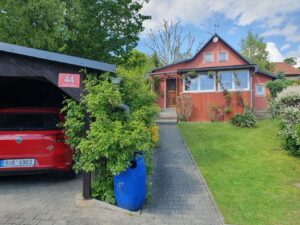
My home, Stará Oleška 44, 19th May 2026 © Ricky Yates

I know, I know, there hasn’t been a blog post since early January. Sadly, good intentions to write one have never come to fruition – until now! So here’s a bit of what’s been happening since I returned from Zermatt on New Year’s Eve 2025.

Health update

Let’s start with the good news!

Unlike in the UK, where when you reach the age of seventy, you have to self-declare that you are still fit to drive if you want to retain your driving license, in the Czech Republic, you are required to pass a medical examination. And the process starts five years earlier, on reaching your sixty-fifth birthday. A further examination is then required at age sixty-eight and every two years thereafter.

On 5th January 2026, a few weeks before my seventy-fourth birthday, I was medically examined by my GP and deemed fit to drive my car for a further two years, until the day before my seventy-sixth birthday in February 2028. I had to pay CZK 1100/GBP 39.15 for the privilege as it is one of the few things not covered by my otherwise totally free healthcare. But without having the resultant certificate, my car insurance would be invalid.

Also on a positive note, my INR, (level of thinness of my blood), has now fully settled down having been seriously disrupted by taking antibiotics to treat my Erysipelas infection. I am back to only needing to have it checked once every six weeks.

On the downside, the swelling of the lower part of my left leg, which never completely subsided following my Erysipelas infection has partially returned. I am back to taking anti-inflammatory tablets again to try and bring it under control. It subsides overnight but returns soon after getting out of bed each day. A further consultation with my GP will take place on Friday 26th June along with the regular check of my INR.

House

Over a period of several weeks from late March to mid-May, the father and son team of K & K renovace nemovitostí have renewed the cladding & improved the insulation of the enclosed verandah at the front of my house. Why it took so long to complete is another story 😉 but the end result is excellent.

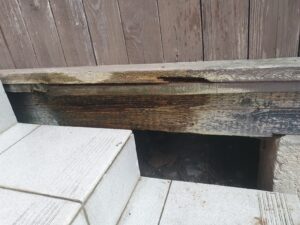
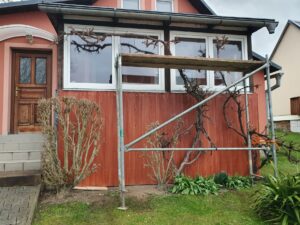
Rainwater-damaged cladding © Ricky Yates

What prompted this work was me asking Karel junior if they could repair this damaged section of the existing cladding, alongside the steps to the front door. Whilst he said they could repair it, he suggested that it would be much better to undertake a complete renovation of the whole exterior of the enclosed verandah and, as part of the work, improve the insulation. As in previous posts about the renovation of my house, I’ll let the photographs do most of the talking.

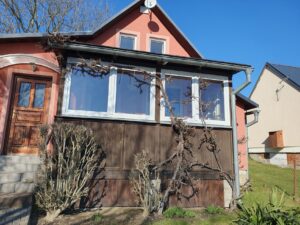
Stará Oleška 44 before renovation work on the enclosed verandah © Ricky Yates

The photograph above shows what the front of the house looked like before work commenced.

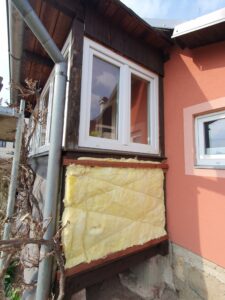
Insulation material attached to the exterior sides of the enclosed verandah © Ricky Yates

Insulation material was inserted on the three exterior sides of the enclosed verandah, held in place by wire. Then a couple of wooden batons were attached to hold the new cladding.

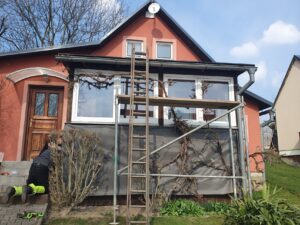
Insulation material covered by a waterproof membrane © Ricky Yates

All the new insulation material was then covered by a waterproof membrane.

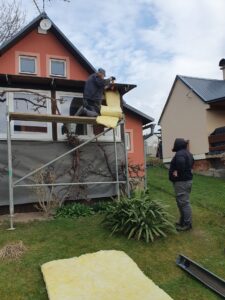
Insulation being inserted between the roof and the ceiling of the enclosed verandah © Ricky Yates

Fresh insulation material was also inserted between the roof and the ceiling of the enclosed verandah.

New cladding © Ricky Yates

New cladding was then attached.

The cause of the damage to the old cladding, as seen in the photograph at the beginning of this section, was rainwater dripping from the small gutter on the side of the perspex shelter above the front door, onto the steps and then splashing onto the wooden cladding.

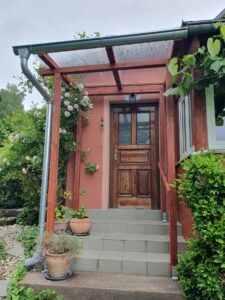
New shelter over the front steps © Ricky Yates

So the old perspex shelter has been removed and a more extensive shelter erected over the front steps, with a gutter and downpipe to take rainwater well away from the new cladding.

Garden

A year ago, I discovered a tree surgeon called Michal who lives locally to me in Decín. He is the husband of Marcela who I’ve known for a few years through her teaching English classes held at the Hussite Church in Podmokly, the western part of Decín. Michal doesn’t have a word of English but communication via Marcela has worked perfectly 🙂

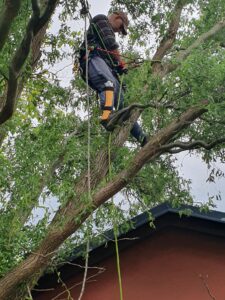
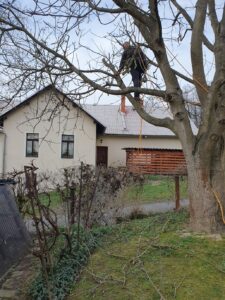
Michal working up in the poplar tree © Ricky Yates
Fallen branches stuck in the poplar tree © Ricky Yates

In June 2025, he cut down the branches of the poplar tree that were hanging over the roof of my house, as well as removing two branches that had snapped off in a storm but were still caught up in the tree. He also seriously reduced part of the massive walnut tree in my back garden.

Michal working on my walnut tree © Ricky Yates

Through Marcela, I asked him to return this Spring, as he had previously said it would be the best time for him to work on the trees, and complete the reduction of the walnut tree.

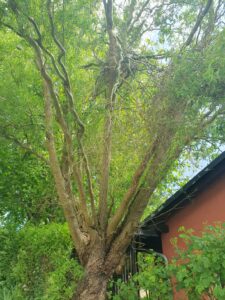
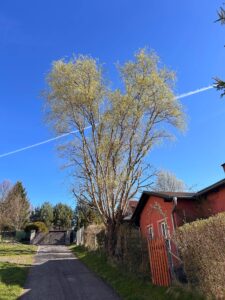
The poplar tree before © Michal Drobný
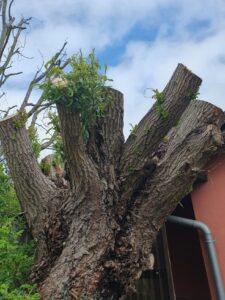
Poplar tree after © Ricky Yates

He also said that the poplar tree should cut right down drastically, assuring me that it would survive and sprout again. As it is very close to the house, I agreed to his suggestion.

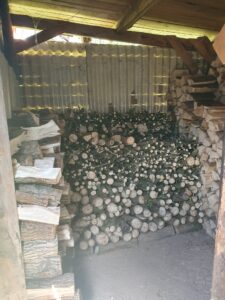
New supply of firewood © Ricky Yates

One benefit of having all this work done has been the creation of a considerable new supply of firewood for next winter which Michal has kindly cut up and stacked in my woodshed. And I am hopeful that I will experience another benefit this coming Autumn with a much smaller leaf fall to rake and clear up.

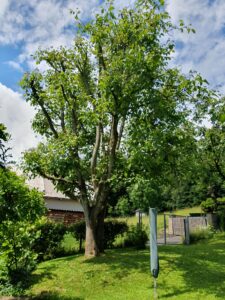
Walnut tree 13th June 2026 © Ricky Yates
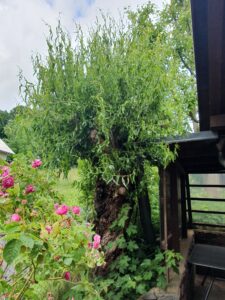
Poplar tree 13th June 2026 © Ricky Yates

Here are two photographs, taken yesterday, showing that both trees are still flourishing.

English-language ministry at the Dresden Frauenkirche

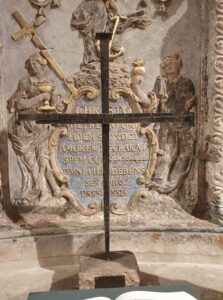
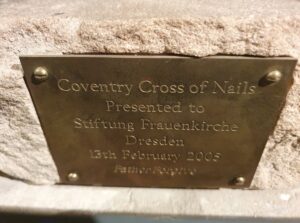
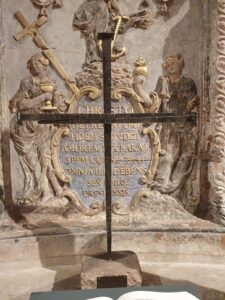
The Coventry Cross of Nails/Nagelkreuz on the Frauenkirche altar © Ricky Yates

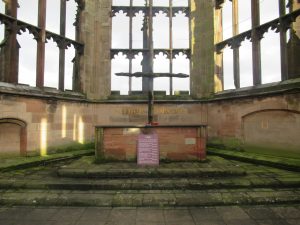
As I have explained previously, one of the two main reasons that the Church of England in Germany, was offered a monthly evening English-language Anglican service at the Frauenkirche, twenty years ago, is the strong links the Frauenkirche has with Coventry Cathedral through the Community of the Cross of Nails. Being born in Coventry and living and being educated in the city until the age of eighteen, makes my English-language ministry at the Frauenkirche very significant to me.

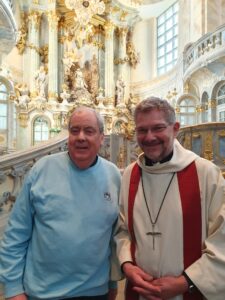
With John Witcombe, Dean of Coventry Cathedral © Ricky Yates

Over the past couple of years, I have got to know John Witcombe, the Dean of Coventry Cathedral, through his visit to Dresden in February 2025 and by attending worship at Coventry Cathedral when I’ve been in the UK.

With Bishop Sophie Jelley at the Frauenkirche 26th October 2025 © Ricky Yates

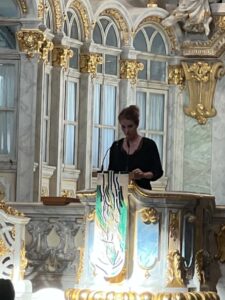
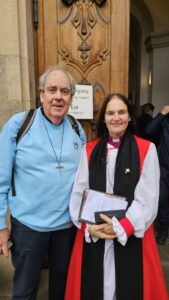
More recently, the new Bishop of Coventry, Sophie Jelley, a fellow graduate of Wycliffe Hall, Oxford 🙂 made her first visit to Dresden on Sunday 26th October 2025 and was the preacher at the Festgottesdienst, celebrating the twentieth anniversary of the consecration of the rebuilt Frauenkirche. I attended the service and got to meet her afterwards.

Over Easter 2026, I made my first UK visit of this year and worshiped at Coventry Cathedral on Easter Sunday morning. Dean John was the celebrant and +Sophie the preacher at the Eucharist and she recognised me in the congregation and greeted me warmly at the Peace. In her sermon, +Sophie spoke of her first visit to the Frauenkirche and of the shared ministry of reconciliation. It has been a real privilege to be a part of the significant relationship between the Cathedral of my home city and the Frauenkirche where I minister.

My new PTO

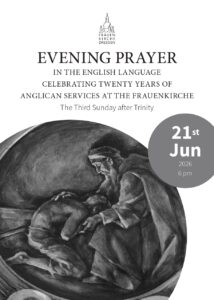
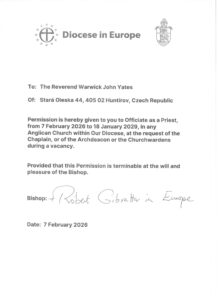
Having updated my safeguarding training and once more proved my lack of criminality in the Czech Republic, earlier this year, my Bishop’s Permission to Officiate (PTO) was renewed for a further three years, meaning I can continue to lead worship and preach in my active retirement. I’m very much looking forward to my next service at the Frauenkirche on the evening of Sunday 21st June when we will be celebrating the twentieth anniversary of English-language Anglican services, the first ever service being held on Sunday 18th June 2006.

The view from the Beatenberg Conference Centre © Ricky Yates

I remain very grateful to the Intercontinental Church Society for their continued prayer support of my Dresden ministry. At the end of April, I was again able to attend their annual Chaplain’s conference held in Beatenberg, near Interlaken, in Switzerland. A lovely mixture of good teaching, fellowship and relaxation and you can’t really beat the view from my bedroom window 🙂

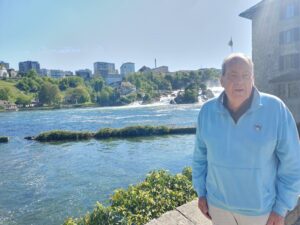
Yours Truly at the Rhine Falls/ Rheinfall © Ricky Yates

On my way back from the conference, I broke my journey, staying overnight in Bülach, near Zürich, meeting up with my friend Benedikt who I first met in Bavaria in 2004, when he was only sixteen years old. On the following morning, I drove us to Neuhausen am Rheinfall on the Swiss-German border and visited the impressive Rheinfall/ Rhine Falls where Benedikt kindly took this photograph of me. He then got the train back to Bülach and I drove on to Stará Oleška.

Postscript

There are several more things I could write about, particularly from my UK visit where I met up with both of my sisters as well as my two adult children and four grandchildren, watched Coventry City beat Derby County 3 – 2 at the CBS Arena, and at great expense, obtained a new British passport in Peterborough. But I want to get this published before it becomes six months since my last post.

Commemorative Ceremony in Kralupy nad Vltavou

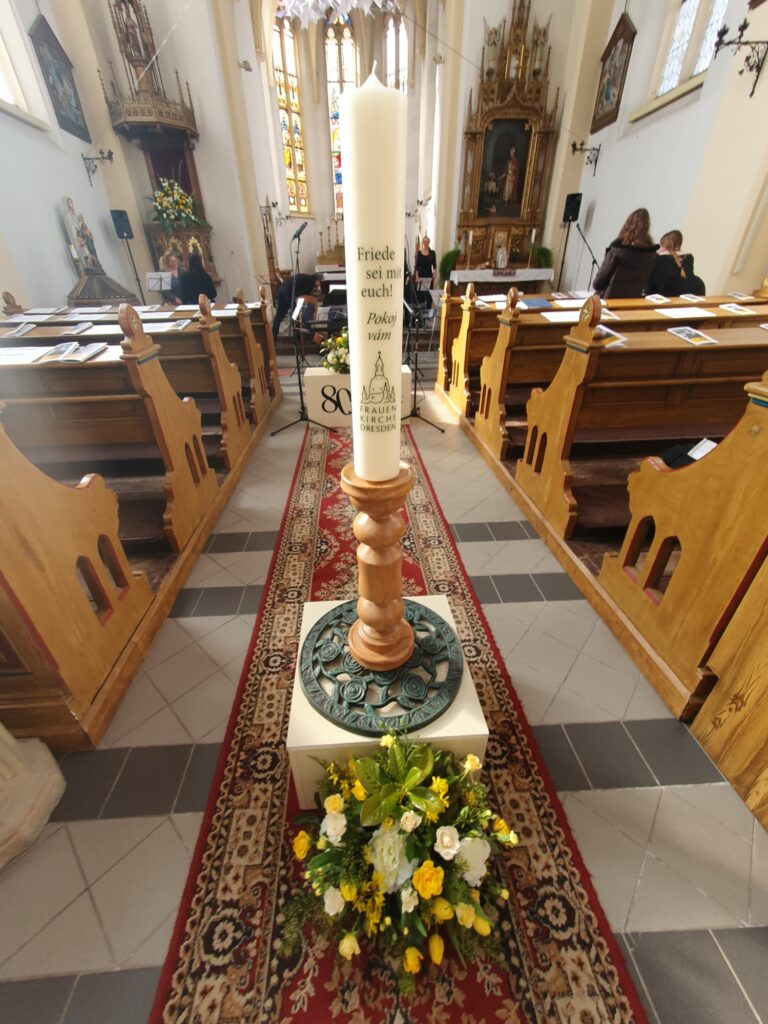
The candle with ‘Peace be with you’ in German & Czech © Ricky Yates

Kralupy nad Vltavou is a city with a population of around 20,000, situated on the Vltava river, sixteen kilometres north of Prague. On 22nd March 1945, it was subject to a devastating bombing attack by USAF planes. The two reasons given for the attack were the presence of an important oil refinery and the city being a key railway hub. The aim was to disrupt the ongoing Nazi war effort.

The first wave of bombers successfully hit the refinery, setting an oil storage tank on fire, from which erupted a very large cloud of thick black smoke. This left the follow-up wave of bombers with very poor visibility to see their targets. As a result, further bombs were dropped fairly randomly, hitting residential areas of the city.

Of the 1,884 buildings in the city at that time, 117 were completely destroyed and another 993 were seriously damaged. 248 people lost their lives in the immediate aftermath of the bombing of whom 145 were Czechs. The remaining victims were mainly German soldiers. The devastation was so great that Kralupy earned the nickname of ‘Little Dresden’. The allied bombing of Dresden, with the massive destruction of its central area including the Frauenkirche, and the death of around 25,000 people, had taken place only five weeks earlier on 13th – 14th February 1945.

In January this year, the director of the city museum in Kralupy, wrote to the director of the city museum in Dresden, with what he admitted was a somewhat unusual request. He was planning a commemorative ceremony on 22nd March to mark the 80th anniversary of the bombing of Kralupy. He wrote that since a large number of German citizens also lost their lives in those bombings, he planned that a large candle—an Easter candle—be lit for all the victims during the ceremony. He wanted the candle to be donated by a German city that had suffered a similar fate, hence his request to the city of Dresden. This would be an act of reconciliation and shared remembrance.

The director of the Dresden city museum sought the help of the Frauenkirche who arranged for the production of the requested candle. Then, just over a week before the commemorative ceremony, I got an email from Maria Noth, the Geschäftsführerin / CEO of the Stiftung, the charitable foundation that runs the Frauenkirche, asking whether I would be willing to travel to Kralupy, representing the Frauenkirche, and present the candle on their behalf. Her reasoning for doing so was because of my strong ties to the Frauenkirche, (her words, not mine), because I live in the Czech Republic, and because of originally coming from Coventry & its experience of aerial bombing.

Fortunately, I was at the Frauenkirche on Sunday 16th March, conducting my regular monthly English-language Anglican service of Evening Prayer. I was therefore able to pick up the heavily packaged candle from the vestry that evening, together with my black cassock which normally lives there, and carry them both to my car following the service, ready for onward transportation to Kralupy, on Saturday 22nd March.

At the request of the Kralupy museum director, Maria Noth sent the following message to accompany the candle, which I reproduce here in full. A Czech translation of it was printed in the programme for the Commemorative Ceremony.

‘Kralupy nad Vltavou was severely damaged on March 22, 1945 – just over a month after the City of Dresden, Germany, and the Frauenkirche, located in the heart of our city, were also devastated by Allied bombers. By commemorating the destruction of Kralupy and acknowledging the shared experiences of pain and loss in both our cities, the peace candle the Frauenkirche Dresden Foundation is dedicating to Kralupy today symbolizes the power of reconciliation and healing across nations and generations. At the same time, we remember the victims of World War II on all sides, as well as those who continue to suffer from wars in Europe and around the world today.

Furthermore, we in Dresden and Germany humbly remind ourselves that the war that led to the destruction of both Kralupy and Dresden was initiated by Germany and a dictatorial regime. The Frauenkirche in Dresden was painstakingly rebuilt between 1994 and 2005, and today it stands as a strong symbol of reconciliation, a beacon of hope, and a place where we advocate for an open and democratic society. The candle serves to unite our two cities in friendship and their shared quest for peace. It will be handed over by Reverend Ricky Yates, an Anglican priest with strong ties to the Frauenkirche in Dresden, who originally comes from Coventry – the first English city to be heavily damaged by German bombs in 1940. His presence at the commemoration of the 80th anniversary of Kralupy’s destruction delivers a message of unity, humility, and collective hope for a peaceful future.’

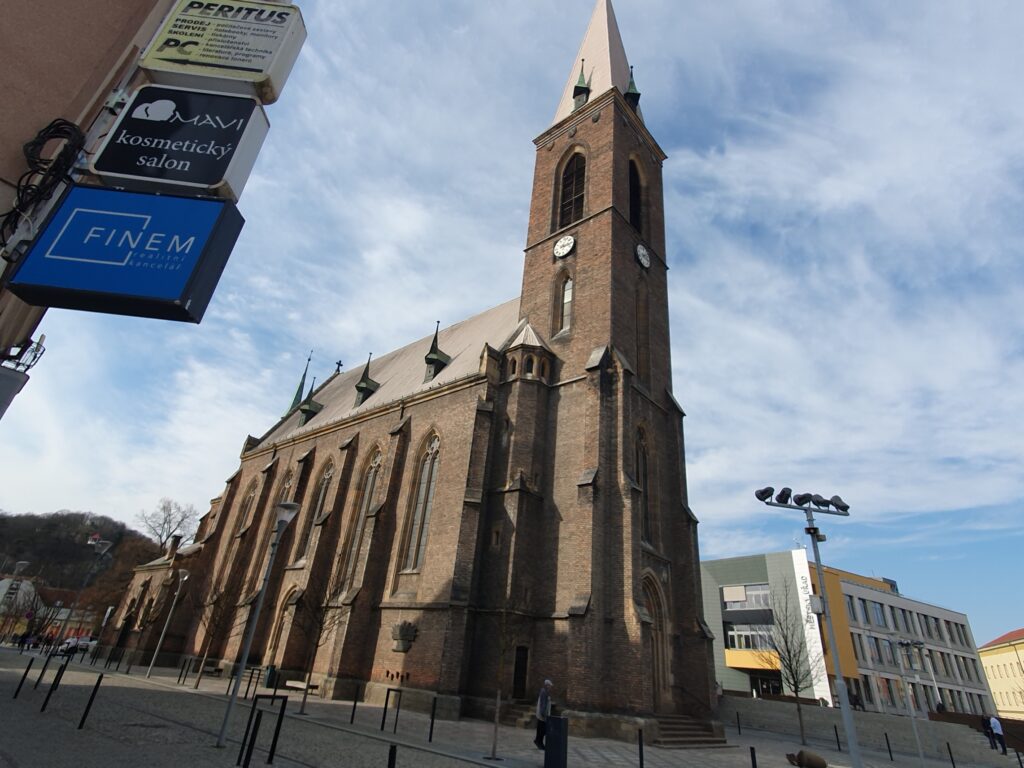
Kostel Nanebevzetí Panny Marie a sv. Václava, Kralupy nad Vltavou © Ricky Yates

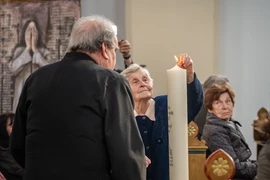
The Commemorative Ceremony took place in the Roman Catholic Kostel Nanebevzetí Panny Marie a sv. Václava, amazingly one of the few historic buildings not destroyed in the bombing. The ceremony began with the sounding of a siren followed by the playing and singing of ‘Kde domov muj?’, the Czech National Anthem, which I managed to sing completely 🙂 Then I was invited to light the candle, assisted by Hana Matoušková, a ninety years old survivor of the bombing.

Lighting the candle with Hana Matoušková © Anicka Guthrie
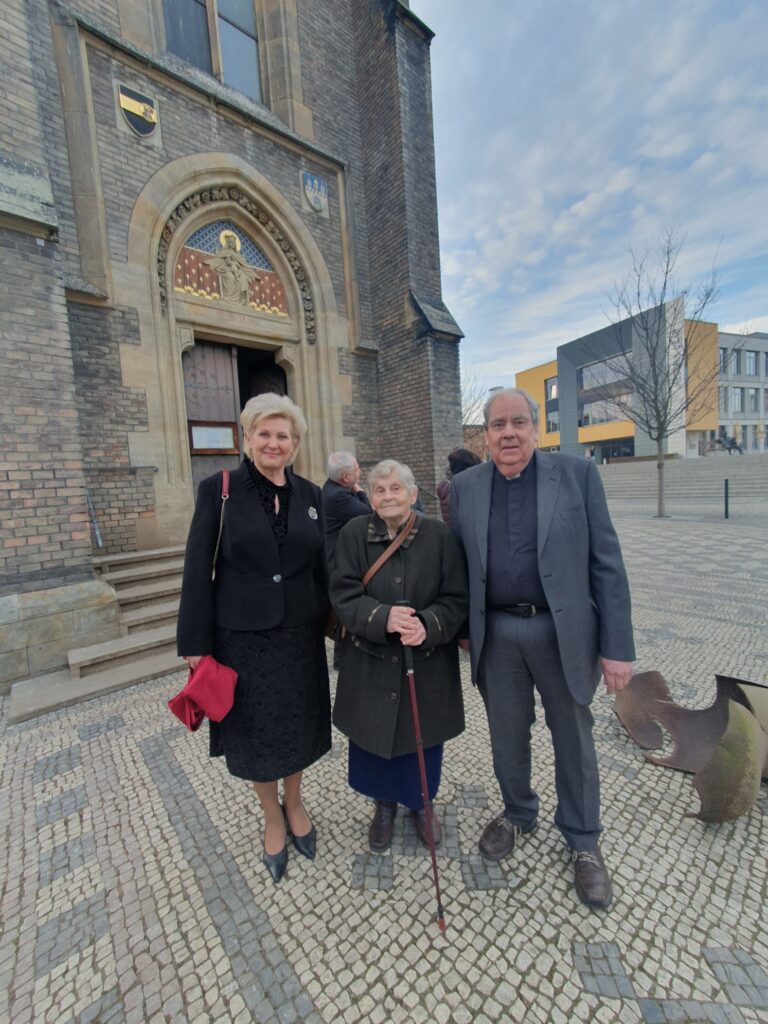
With Hana Matoušková following the ceremony © Ricky Yates

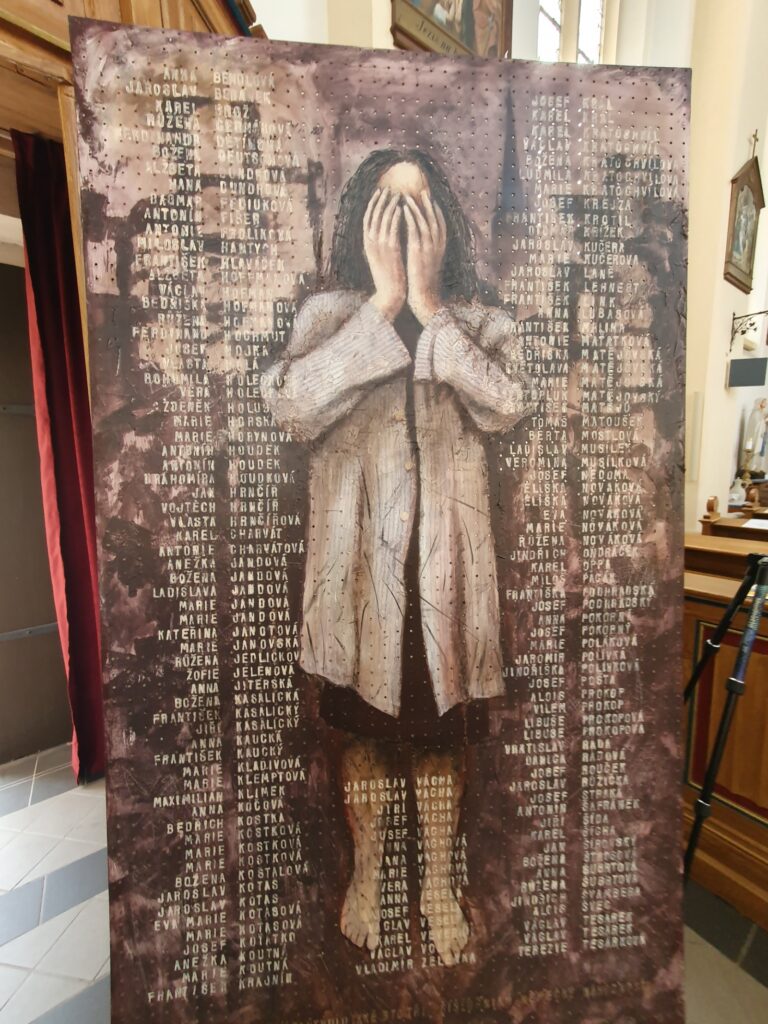
The ceremony continued with a speech from the mayor, the singing of the song ‘To Místo’, which had been especially composed for the occasion, and prayers led by the Roman Catholic Bishop of Plsen. There was a poetry reading and an interview with the artist Martin Frind, who had produced a painting entitled Rekviem/Requiem, containing all of the victims names.

Rekviem/Requiem by Martin Frind

For me, one of the most moving parts of the ceremony was the reading by two local teenage girls, of all the names of the victims. Several times, the same name was repeated twice and occasionally three times. Many Czech men have the same name as their father and Czech ladies, the same name as their mother. A reminder that whole families were eliminated – two, or even three generations. The reading of the names was then followed by a one minute silence.

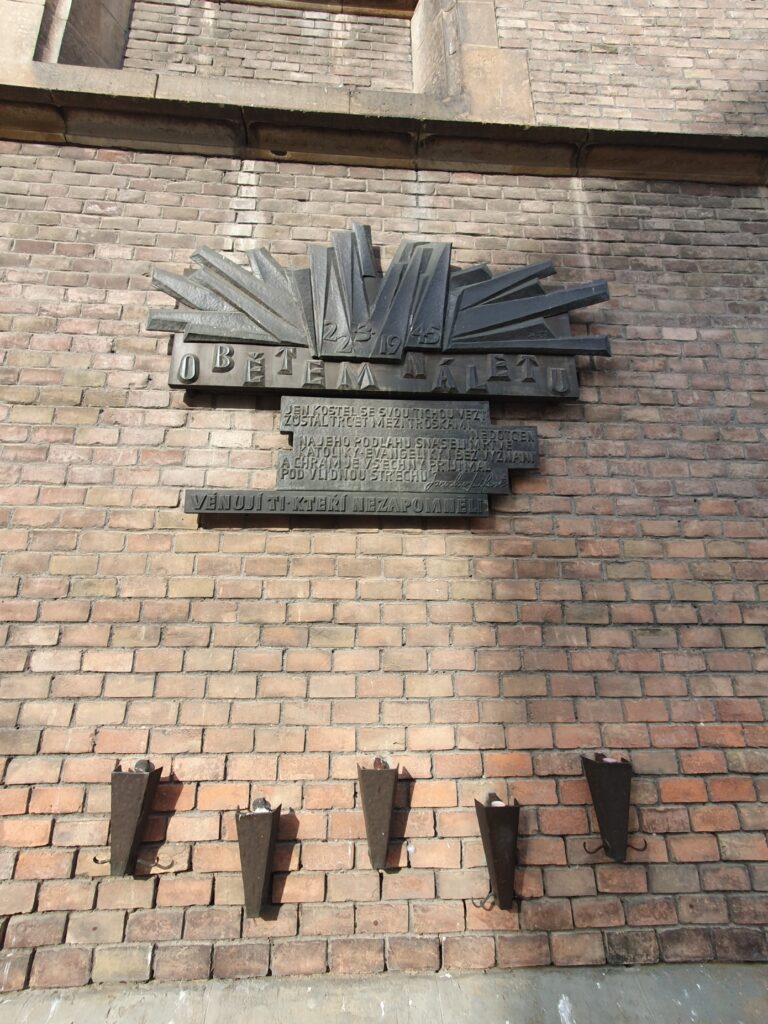
Memorial on the outside south wall of the Church © Ricky Yates
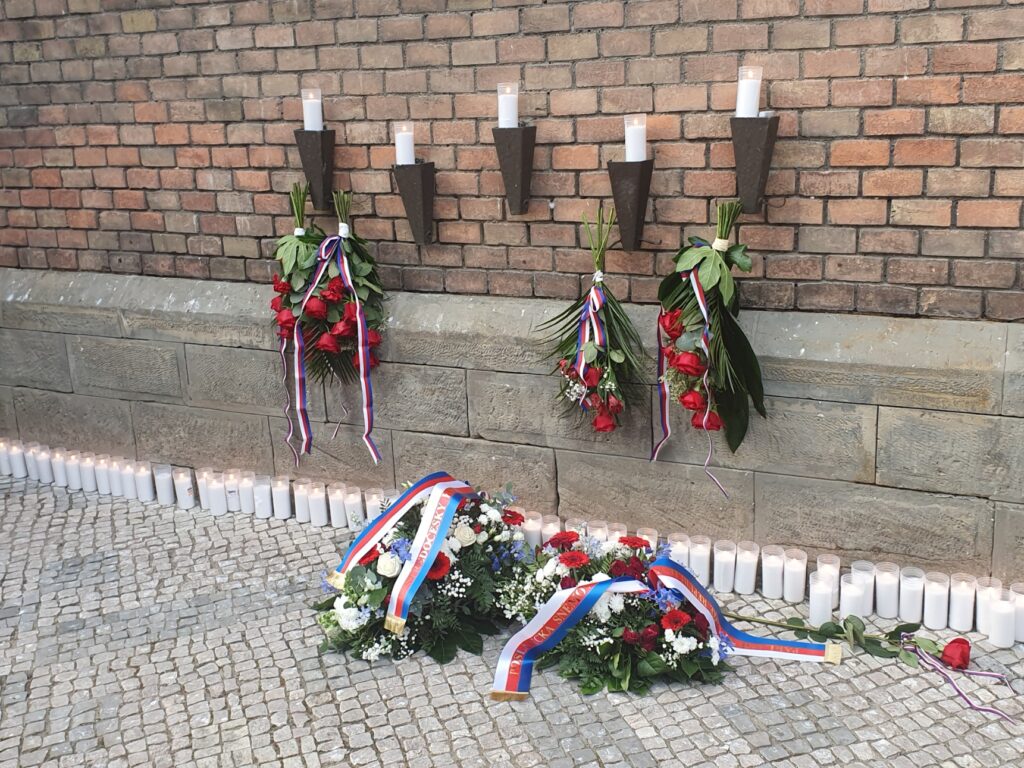
Floral tributes & candles laid under the memorial © Ricky Yates

We were then invited to go outside and lay flowers or lighted candles below the memorial on the south wall of the Church. Here, I was spoken to by numerous people either in Czech, German or English. Each one expressed their grateful thanks that I had come and participated in the ceremony and the expression of peace and reconciliation conveyed by the candle. Throughout the day, if I did have any Czech language difficulties, I was accompanied by the friendly and helpful fluent English-speaking Hana Bozdechová, the wife of the Deputy Mayor.

In conclusion, I have to say that I felt very honoured to be asked to take part in this Commemorative Ceremony, representing the Dresden Frauenkirche. On my emails, I sign myself as ‘Coordinator of English-language Anglican worship in Dresden’, because that is what I do. But it isn’t an official position at the Frauenkirche or within the EKD. Likewise in the Church of England, I function purely by holding ‘Bishop’s Permission to Officiate’ (PTO). My Archdeacon kindly says that he regards me as the Chaplain of Dresden, but I’m not, as Dresden isn’t a Chaplaincy.

However, my involvement with the life and ministry of the Frauenkirche during these past nine and a bit years, albeit in an unofficial capacity, has been extremely meaningful to me. Taking part in last Saturday’s ceremony was one additional moving experience.

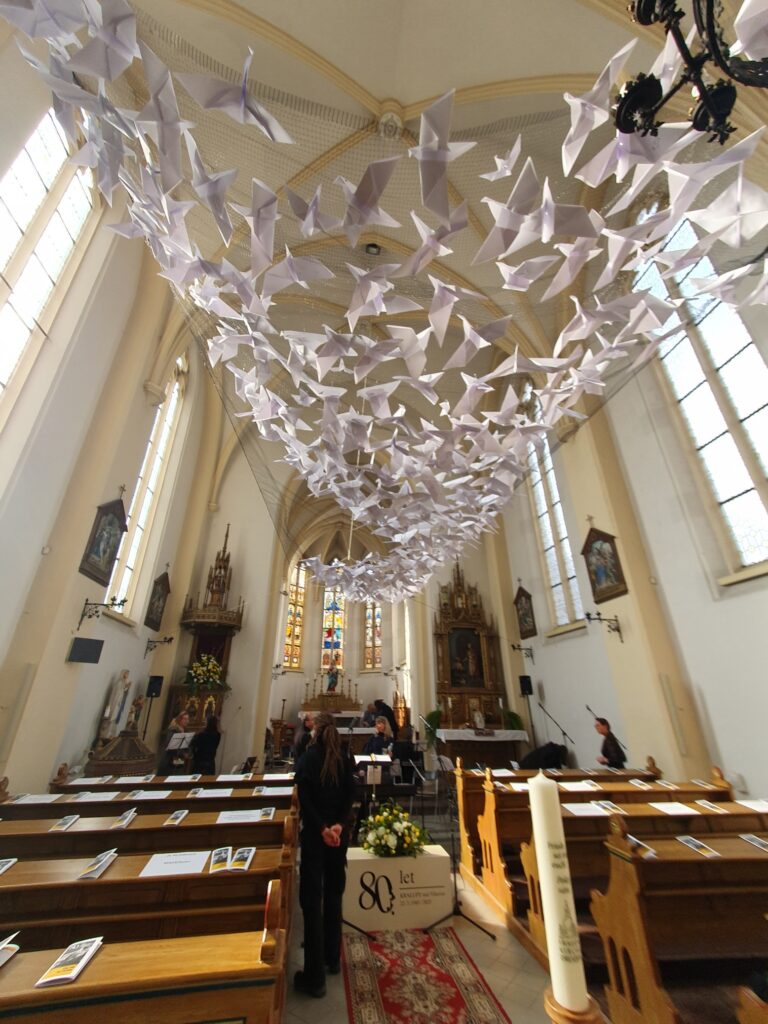
Hanging decoration inside the Church © Ricky Yates

How I became a hymn book smuggler into the EU

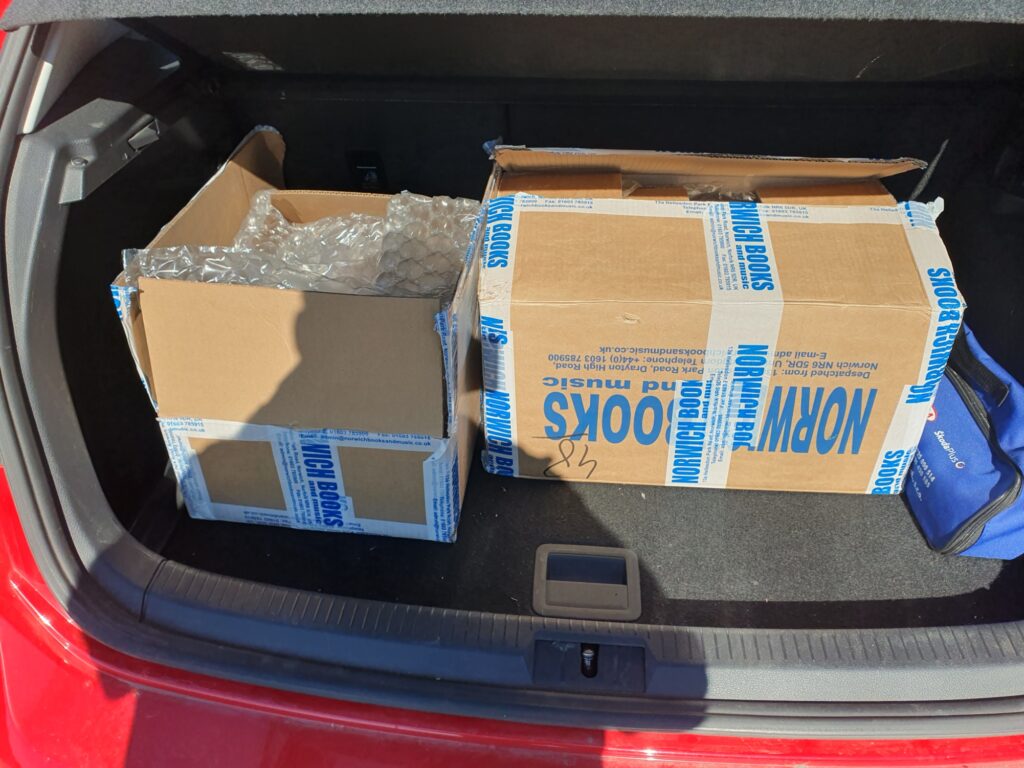
Smuggled hymn books in the boot of my car © Ricky Yates

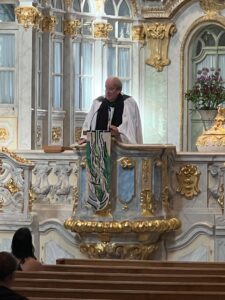
As I posted here a year ago, since May 2023, I have been officiating at a monthly English-language Anglican service of Evening Prayer held on a Thursday evening in the Unterkirche of the Dresden Frauenkirche. This is in addition to the monthly Sunday evening service in the Hauptraum for which I’ve had responsibility since January 2015.

For my monthly Sunday evening service, the Pfarrbüro produce a twelve-page complete Order of Service based on the text I send them at least a week earlier. Hymns are taken from ‘Hymns Ancient & Modern New Standard’, published in 1983, with the melody line of the tune, as well as all the words, reproduced. As I understand it, the Pfarrbüro was given a copy of this hymn book by the late Rev’d Dr Irene Ahrens when the monthly Sunday evening service began in June 2006. I presume that this was the hymn book used by St George’s, Berlin where she was the Assistant Priest.

For the German-language services held on the other three or four Thursdays each month, only a simple four-page folded A4 sheet with limited text, is produced, with hymns being sung from the Evangelisches Gesangbuch, copies of which are kept on a mobile bookcase in the Unterkirche. I was asked whether I could obtain some English-language hymn books so the same procedure could be adopted for my services.

The Church of England’s Diocese in Europe, has a Dresden Fund, which I can tap into for anything that is ‘ministry in Dresden’. So the cost of purchasing hymn books could be covered. But I had two decisions to make. Which hymn book to choose and how to get copies from the UK to Dresden without incurring huge costs.

Two revised and updated editions of Hymns Ancient & Modern (A&M) have been published since ‘New Standard’ was produced forty-one years ago. ‘Common Praise’ was published in 2000 to coincide with adoption by the Church of England of Common Worship, the liturgy in contemporary English. Then in 2013, reverting to the original title, ‘Ancient & Modern – Hymns & Songs for Refreshing Worship’, was published.

I have a music edition of ‘Common Praise’ but have only once briefly seen the A&M 2013 edition when attending a service at Wimborne Minster in April last year where it was in use. So I sent an email to Norwich Books & Music, the umbrella organisation for A&M, asking if they could send me a complete list of all the hymns contained in the 2013 edition. A prompt reply promised to send me a free sampler booklet, produced back in 2013, which included an alphabetical list of all the hymns.

Before Brexit, that sampler booklet would have dropped into my mail box, five to seven days later. But instead, what did drop into my mail box was a registered letter saying that my free booklet was held by Czech Customs in Prague. If I wanted to have it delivered, I needed to pay CZK 334/GBP 11.25/EUR 13.30 in customs duty and to gain customs clearance. Yet another example of the wonderful benefits of Brexit!

Having reluctantly paid up and then studied the sampler booklet, I decided this was the hymn book I wanted to purchase. But my mind boggled as to what customs duties might be levied on twenty-five copies of the melody edition and three full music editions. And of course, there would be legitimate carriage costs too. Therefore I decided that I would become a hymn book smuggler into the EU 😉

I have to say that Norwich Books & Music were extremely helpful and cooperative. They agreed to treat my services at the Frauenkirche as though they were a congregation in the UK, providing five of the melody editions free – I only had to pay for twenty copies. They also happily agreed to deliver them to my son’s home address in Nottingham. And because of the value of the order, delivery within the UK was carriage free.

In July this year, I drove to the UK to visit my children and grandchildren and to spend a most enjoyable week, exploring sites of religious and historic interest in the Northeast of England with a small group, led by my good friend Ken Dimmick. Whilst staying with my son Phillip, I loaded the two boxes of hymn books into the boot of my car.

I returned to continental Europe by overnight ferry from North Shields to IJmuiden in the Netherlands. At Dutch customs, all the officer wanted to know was whether I was importing large quantities of alcohol. I assured him I wasn’t and, after that, I was free to travel onwards with my hymn book booty 😉 It was a pleasure to sing from these hymn books for the first time at my service on Thursday 1st August.

I’ve written this post to illustrate once again, the absurdity of Brexit and the lengths one now has to go to, in order to mitigate the innumerable problems it has created. Why is it beneficial to the UK for me to be forced to pay CZK 334/GBP 11.25/EUR 13.30 in order to receive a free booklet? Can Boris Johnson, Nigel Farage, the Daily Fail, the Daily Excrement, the Daily Torygraph et al, please explain.

My ongoing ministry at the Frauenkirche, Dresden

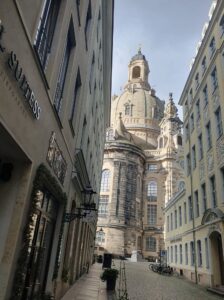
Walking towards the Frauenkirche © Ricky Yates

I’m very conscious of two things. That I haven’t posted here for two months and that most of my more recent posts have either been about my disputes with UK banks or about the renovation of my house. So here is a new post about my ongoing ministry at the Frauenkirche in Dresden, a topic I haven’t written about since February 2020, except for briefly mentioning it in my post about last winter.

The day after our December 2022 service of ‘Nine Lessons & Carols for Christmas’, my Archdeacon Leslie Nathaniel and I had a most useful meeting with the two Frauenkirche clergy – Pfarrer Markus Engelhardt and Pfarrerin Angelika Behnke. Archdeacon Leslie asked about the possibility of having a second English-language Anglican service each month, on a weekday, with it being held in the Unterkirche, beneath the main Hauptraum of the Frauenkirche. They promised to consider this idea and get back to me in due course.

There is a regular Ecumenical Evening Prayer service held at 18.00 each Thursday in the Unterkirche. Early in 2023, one of the groups who have normally led a service each month, withdrew, because of lack of personnel. Asking me to take over their timeslot both solved a problem for the Frauenkirche authorities and gave a positive answer to our request. Therefore, on Thursday 25th May, I held my first Thursday English-language Anglican Evening Prayer service in the Unterkirche.

The Unterkirche © Ricky Yates

The Unterkirche was the first part of the Frauenkirche to be rebuilt and was completed and consecrated in 1996. It was used for regular Sunday worship whilst rebuilding continued above it. Now, when the main Hauptraum is open for visitors, the Unterkirche is kept as a place to sit quietly and/or pray. It is a wonderful venue in which to conduct worship with a relatively small congregation.

To gain access you have to walk down a flight of stone steps. Unfortunately, in advance of my first service, I managed to trip on my cassock whilst descending the last few steps and ended up in a heap on the floor. There were no broken bones but plenty of swelling and bruising. It took over two months before my right leg finally returned to its normal shape and size. I now walk down those steps very carefully, lifting my cassock as a go!

Page 22 & 23 of ‘Leben in der Frauenkirche September-December 2023

A full colour magazine entitled, ‘Leben in der Frauenkirche‘ is published three times a year. The current September-December 2023 edition features a two page bilingual article, written by me, about English-language Anglican worship at the Frauenkirche which I reproduce here. I’m hoping it will help make the new Thursday evening services more widely known as well as giving some background and history to the regular monthly Sunday evening services.

One thing this double-page spread confirms, is something I already knew from my career in publishing, before I was ordained. German needs up to 20% more space than English 🙂 On page 25, the German column starts higher up the page than the English column and my last paragraph has not been translated in full, in order to make things fit 😉

HM Queen Elizabeth II – Ambassador for reconciliation in Europe

Frauenkirche, Dresden © Ricky Yates

Since the death of Queen Elizabeth II, much has been written about her life and legacy. Living in Central Europe and with my ongoing ministry at the Frauenkirche in Dresden, two articles have particularly resonated with me. The first, written by the Anglo-German historian Katja Hoyer and published in ‘The Spectator’, has the subtitle, ‘She (QE2) understood the importance of reconciliation’. The second, written by +Robert, my Diocesan Bishop, has the title that I’ve stolen for this post 😉

Both articles mention that the Queen paid an eleven day visit to the former West Germany in 1965, twenty years after the end of the Second World War. Katja Hoyer goes on to say that the Queen ‘did not shy away from making difficult trips to places that had seen large-scale devastation through RAF bombing campaigns.’ She cites the visit to Düsseldorf where 90 per cent of buildings had either been damaged or completely destroyed and 5000 civilians killed.

Hoyer rightly says that the visit was not an easy one to sell back in the UK. Many British cities had experienced bombing by the Nazi Luftwaffe causing serious damage and loss of life, including my own home city of Coventry. But the Queen was determined to move forward and help establish good relationships with the German people, who in turn, warmly welcomed her on that first visit.

Hoyer then recalls a visit in 1992 to Dresden, less than three years after the fall of the Berlin Wall and the Inner German border. Her Majesty visited the ruins of the Frauenkirche, destroyed by allied bombing raids in February 1945. I can do no better than to quote from her article.

‘Ignoring a number of people jeering and whistling, the Queen stoically took in the site and concentrated on the quiet majority of Dresdeners who had come to thank her for attending a reconciliation service nearby. The following year, the Dresden Trust was set up in Britain, collecting donations of over £1 million, including contributions from Her Majesty herself, to rebuild the famous church. Dresden and its partner city Coventry have been powerful symbols of post-war reconciliation – a process that the Queen and her family have lent their invaluable support.’

The Queen’s support for the work of reconciliation between two nations, previously at war with each other, stands in stark contrast to the words and actions of many right wing British politicians and much of the UK tabloid press. They portray modern-day Germany as the enemy that still needs to be fought against. Margaret Thatcher, for quite some time after the fall of Communist regimes in Central and Eastern Europe, was strongly opposed to the reunification of Germany that finally took place thirty-two years ago yesterday. She expressed the fear that a united Germany would be too powerful.

Part of the Brexit campaign was based on the premise that the EU was run by Germany and that the UK should ‘take back control’. In particular, the then German Chancellor Angela Merkel, was portrayed as someone to be disliked, even hated.

The tabloid press forever harks back the Second World War, which of course, the Brits won single-handedly. It is as though the UK is still fighting, seventy-seven years after the Second World War ended. As I wrote and preached back in February 2020, ‘the EU was founded in part, to prevent a repetition of the two World Wars which had laid waste the continent of Europe in the first half of the twentieth century, something which the city of Dresden and my own city of birth, Coventry, know about all too well. Seventy-five years of peace have ensued!’

So I am thankful for Her Majesty being an ‘Ambassador for reconciliation in Europe’, especially in Germany, where it is still my privilege to minister once a month in the Dresden Frauenkirche. As Bishop Robert writes, when opening a meeting of General Synod in 2015, the Queen quoted St Paul writing in his second letter to the Corinthians – ‘As ambassadors for Christ [we] are entrusted with the ministry of reconciliation’.