Another insight into Czech life and culture

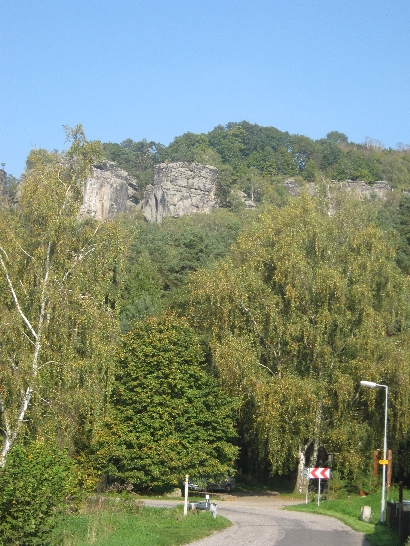
The rocks and forests of the Czech countryside © Ricky Yates

Yesterday, I officiated at the burial of ashes of two people, a husband and wife, into the family grave. Whilst this is something I would quite regularly do when Rector of a group of North Oxfordshire villages, this was the first time of doing so in just over six years of ministry here in the Czech Republic. I have also only conducted four funerals during that time, a reflection of the predominantly young age of the English-speaking expatriate population resident here.

However, although I conducted yesterday’s graveside service in English, it was very much a Czech occasion and was an illustration of several aspects of Czech life and culture. And because I want to protect the privacy of the family, I hope readers will forgive me for not referring to people or exact locations by name.

The existing family grave is located in the massive Olšanské Cemetery that lies in the Prague suburb of Žižkov. Whilst the cemetery is well-maintained by the local authority, like so much of Czech officialdom, it is not managed to encourage the practice of religious faith. Two things illustrated this.

The first was the attitude of the two cemetery staff who were present when we arrived at the grave. Whilst the grave had been opened and the appropriate hole dug, in true Czech bureaucratic style, the only thing that mattered to them was thoroughly checking the paperwork brought by the next of kin, the son of the deceased. Once they were convinced that the paperwork was in order, they just left us to it with a, ‘we’ll be back later to fill in’.

The second was the complete lack of provision for me. There was no chapel or vestry where I could robe & leave my belongings securely. Instead, aided by the eldest grandson of the deceased, who kindly held various things for me, I robed standing alongside a bench adjacent to a path running behind the family grave.

I have previously written about the Czech love of flowers which helps to keep innumerable flower shops and stalls in business. This love was very clearly in evidence with every family member arriving with a bunch of fresh flowers to lay on the grave. And I mean everybody, right down to the six great-grandchildren of the deceased.

However, it was what followed the graveside service which struck me as being so much part of Czech culture. The service was at 11.00 in the morning, so afterwards, everyone who attended was invited back to lunch. But lunch was not at the family flat in Mala Strana where I’d met the next of kin the previous day. Nor was it at a restaurant, not so far from the cemetery. No – we were all transported over thirty kilometres out of Prague into the Bohemian countryside, to a large three storey house – the family chalupa.

The house was built in the early 1930s, in a time that is now always referred to as ‘the First Republic’, when Czechoslovakia was an independent state between 1918-1938. The deceased couple were responsible for having it built.

The history of the house reflects the history of the nation. During the Second World War, when the country was occupied by the Nazis, there was a German military base nearby, so the house was commandeered to house a senior Nazi military officer. Then, following the communist coup of February 1948, the family were confined to the basement whilst the two floors above were occupied by others. Even after the Velvet Revolution of 1989 and the subsequent restitution of property laws, the family allowed a remaining ‘tenant’ to live in part of the house, until her death in the mid 1990s.

The son of the deceased gave a speech in which he recalled his childhood weekends and summer holidays, spent living in the basement and sleeping in a wooden ‘summer house’ in the garden. They were memorable times, despite the deprivation of the communist era.

And although he and his parents escaped to Switzerland in 1968, when he was in his late teens, and he, along with his wife and three of their four children, now live in England, this house in the Bohemian countryside is still the family home. Here, where his elderly uncle still lives, is where the soul of the family resides and was the only place where the lives of his late parents, who both lived into their nineties, could be properly celebrated.

The story of this family, could be told with some variations, by so many Czech families. The story also reflects the psyche of the wider Czech nation – that deep down Czech people believe that the soul of the nation is found in the forests, rivers and lakes of the Czech countryside. Even whilst we were eating our lunch yesterday, Má vlast, ‘My Country’ or ‘My Fatherland’ by Bedrich Smetana, was being played in the sitting room, music that encapsulates that very concept.

A little change for the better

Before © Ricky Yates

The photograph on the left, shows the top of the organ in Kostel sv Kliment/St. Clement’s Church, as it was until August 2014, and as it had been for all of the previously nearly six years I’ve been Chaplain to the English-speaking Anglican congregation in Prague. At the centre of the picture is a mirror on a stand, to enable the organist to see beyond the front wall of the balcony, and know what is going on at the front of the Church – in particular, to know when to stop playing once the administration of Communion is complete.

But because the mirror stand is not sufficiently high, it has been propped up on three music and four words editions of our hymn book. Over that time, I have often observed this set up and thought how wasteful it was. We didn’t buy these hymn books to prop up a mirror – we bought them so people could sing from them to the praise and glory of God! And as in early 2012, I transferred three music and fifteen words editions of our hymn book permanently to Brno, for our congregation who worship there, the misuse of these books has become an ever more acute issue.

The problem has always been knowing what would be a suitable replacement for the mirror to sit on. In particular, knowing the correct dimensions – the required height, together with the length and breath of the base of the mirror stand. I always observed the problem just before, or following, Sunday worship. Therefore, my mind was inevitably on other things and I never have a measuring tape with me.

After © Ricky Yates
After © Ricky Yates

However, just over two months ago, I finally got around to measuring what was required. Then, when on a visit to IKEA, I spotted a little box storage unit, costing CZK 300, (less than £10.00 at current exchange rates), with the correct dimensions. The current value of the hymn books propping up the mirror, is £111.00. I bought the box!

Just as it took me nearly six years to solve this problem, so it has taken me over two months to finally complete this blog post and publish it. But in both cases, I did eventually get there 🙂

Ceský Ráj

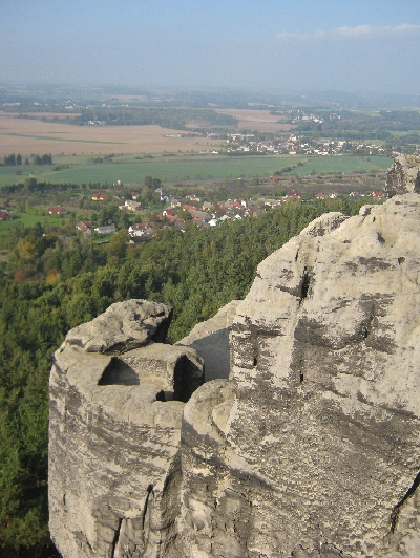
The view from Drábské svetnicky © Ricky Yates


Ceský Ráj, which literally translates into English as ‘Czech Paradise’ or ‘Bohemian Paradise’, is beautiful area of sandstone rocks and forests lying between 70-100 kilometres north east of Prague. Yesterday, on my first proper day-off for about a month, I took an 18 km walk through the western edge of Ceský Ráj, starting and finishing in the small town of Mnichovo Hradište.

After walking four kilometres from Mnichovo Hradište railway station, crossing the railway line, the Prague – Liberec motorway and then open fields, I reached the small village of Zásadka, which lies at the foot of the rocks. Here I enjoyed a traditional Czech lunch of Smažený sýr a hranolky, accompanied 0.5l of Svijany beer. Thus fortified, I set off further along the red waymarked route.


Valecov Castle © Ricky Yates

My walk first took me past the ruins of Valecov Castle, originally built to take full advantage of the sandstone rock towers on which it is situated.

Path between rocks © Ricky Yates

Then the path went between further rock outcrops……

Path through the forest © Ricky Yates

…and along forested valleys. My apologies for the sky being ‘blown out’, (as photographer Sybille would describe it 🙂 ), but there was such a contrast between the shade provided by the trees and the very bright Autumn sunshine.

View from Klamorna © Ricky Yates

A short detour from the path, took me to this viewpoint at Klamorna…..

Looking down to the village of Dneboh © Ricky Yates

..looking down to the village of Dneboh below.

Shortly afterwards, I reached a series of rock pillars known as Drábské svetnicky.

Inaccessible rock outcrop © Ricky Yates

Some are inaccessible…..

Viewpoint at Drábské svetnicky © Ricky Yates

..whilst others are connected by a series of bridges, steps and ladders.

The blue route - note the waymark on the right © Ricky Yates
The blue route – note the waymark on the right © Ricky Yates

My return journey was along the blue waymarked route, which passed through this gap in the rocks.

This walk was my first wearing my new walking boots. They proved extremely comfortable except that I gained one blister on the back of my left heel. May that be the first and only one!

Drábské svetnicky © Ricky Yates

The 2014 Eastern Archdeaconry Synod in Prague

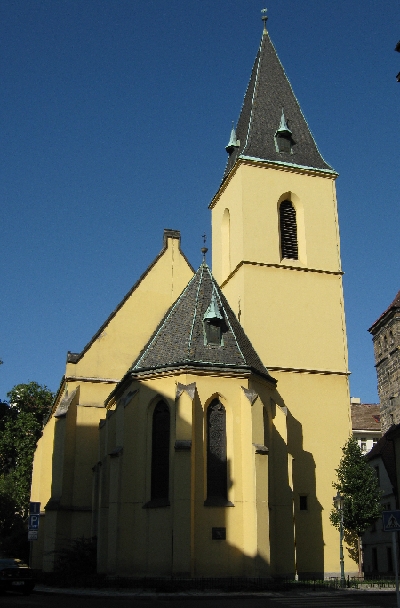
St. Clement's Anglican Episcopal Church, Prague © Ricky Yates
St. Clement’s Anglican Episcopal Church, Prague © Ricky Yates

As I explained at the end of my post about the 2013 Eastern Archdeaconry Synod, the Prague Anglican Chaplaincy volunteered to host the 2014 Synod meeting. It was held last week between Thursday 25th – Sunday 28th September and I have to say that I’m still recovering from the experience!

In agreeing to host the Synod meeting in Prague, I wanted to overcome two issues. Firstly, long-standing Synod members had told me that when the Synod had last met in Prague, during the time of my predecessor, it had been held in a suburban hotel and attendees had felt rather isolated from the heart of the city. Secondly, when being solely based in a hotel, for example as we were in Izmir in 2009 and Athens in 2012, worship has to take place in part of a conference room which always lacks the atmosphere of a church or chapel.

So with the support of my Church Council, I decided that we would host the Synod meeting using the facilities of our host Kliment congregation of the Ceskobratrská církve evangelické, that we use week by week. All worship could therefore take place in Church with our various sessions for Bible Study, talks, reports and business meetings being held in the hall on the third floor of Klimentská 18 that we use for post-Eucharistic Coffee Hour during the colder months of the year. Then, with several nearby hotels, I was sure we could negotiate suitable accommodation for everyone attending the Synod.

Eventually, this is what I was able to organise, though not without a few pitfalls along the way. One problem I encountered was that the hall in Klimentská 18, was already booked by another organisation for part of Friday 26th September which meant we had instead to use the Church for three of our sessions. Far greater problems were caused by people sending in bookings long after the specified date for doing so, or wanting to make last minute changes to bookings. As I said on numerous occasions, organising a meeting of the Eastern Archdeaconry Synod, ought to come with a serious health warning!

It was pleasing to have many positive responses to both the location and the way the Synod meeting was organised. MOODs Hotel, Klimentská 28, provided comfortable, high quality accommodation and the friendly staff and wonderful food received many appreciative comments. My thanks to Lenka, the reservations manager, and Mojmír, who masterminded the various meals.

Equally appreciated was being able to use the Church for all our acts of worship. And with the Diocesan Secretary, who is an excellent organist, being present for part of the Synod meeting, we were able to sing hymns as part of our Friday lunchtime Communion service and at Evening Prayer on both Friday and Saturday.

We enjoyed three challenging and extremely well prepared Bible Studies, led by Canon Leonard Doolan, Vicar of Cirencester. He came on the recommendation of Canon Malcolm Bradshaw, Senior Chaplain in Athens, a recommendation that was fully vindicated by the quality and method of presentation used by Leonard. As one who is constantly giving out week by week, it is always good to receive fresh spiritual input.

Our new Diocesan Bishop, Rt Rev’d Dr Robert Innes, joined us late on Friday afternoon, flying in, along with his Chaplain Canon Meurig Williams, from Palermo where they had been attending the Italy and Malta Archdeaconry Synod. A bit of poor planning meant that the two meetings slightly overlapped. He acknowledged that our Archdeaconry that covers Central and Eastern Europe, together with Turkey, was part of his diocese about which he knew little and was very keen to learn more.

Bishop Robert addressed the Synod meeting on Saturday morning, explaining a little about his background, what he had been doing since being consecrated as a bishop in Canterbury Cathedral on Sunday 20th July, and how he envisages his episcopate. But as well as answering questions, he was keen to hear from the Synod members about what issues they would like to see addressed as he begins to formulate strategic priorities for our far-flung Diocese in Europe.

As is always the case, some of the most valuable time at our residential Synod meetings is that spent over meals or late night drinks, enjoying social interaction with colleagues and leading lay people who often only see each other this one time a year. The Saturday evening was deliberately left free so people could do this and get out and enjoy Prague at the same time.

Synod members at Bar-Restaurace Pod Juliskou © Ricky Yates

I gave an invitation to any who would like to join me in having a meal at one of my favourite bar-restaurants near to where I live, Restaurace Pod Juliskou, and ended up being accompanied by one third of the Synod attendees, including Bishop, Bishop’s Chaplain and Archdeacon. It did give the bar-restaurant staff who know me well, a bit of a shock when I brought in thirteen guests!

The Synod meeting ended with all the attendees joining the regular St. Clement’s congregation for our Sunday Sung Eucharist at which Bishop Robert was the celebrant and preacher. It was a wonderfully joyful service with good music and great congregational singing. Bishop Robert preached a challenging sermon, interspersed with some humour, which you can listen to here on our Church website. Then, masterminded by Ata, the Synod members were provided with a splendid lunch with some Iranian flavours.

Standing between my new Bishop Robert Innes & my long-standing Archdeacon Patrick Curran, along with from l to r, Bishop's Chaplain Meurig Williams, Area Dean & Chaplain of Greater Athens Malcolm Bradshaw, and my Reader Jack Noonan © Ricky Yates
Standing between my new Bishop Robert Innes & my long-standing Archdeacon Patrick Curran, along with from l to r, Bishop’s Chaplain Meurig Williams, Area Dean & Chaplain of Greater Athens Malcolm Bradshaw, and my Reader Jack Noonan © Ricky Yates

Since my return from Switzerland……

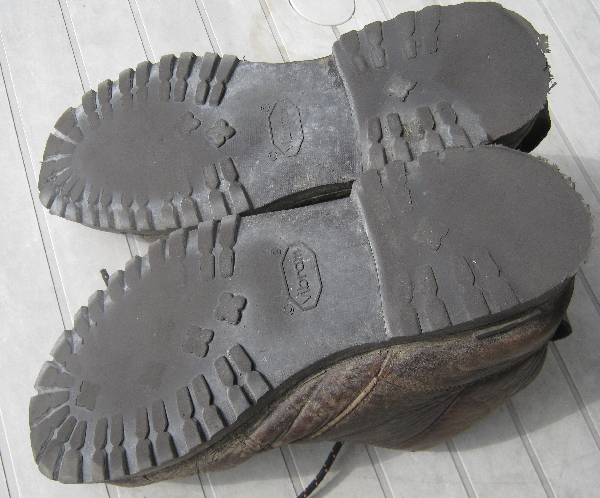
My worn-out boots © Ricky Yates

Five weeks ago today, I returned to Prague after spending a wonderful two weeks accompanying Sybille on her pilgrimage from Prague to Santiago de Compostela, walking with her across Switzerland. Since returning, I have successfully written and posted seven blog posts about our journey together. A big ‘Thank you’ to the faithful few who have left kind and appreciative comments on these recent posts.

The evidence of how far we walked can be seen by state of the soles and heels of my much loved walking boots. In the last couple of days of walking, I did slip slightly in a few muddy places, because of the increasing lack of tread. I also discovered that the waterproof cover, integral to my rucksack, was unfortunately no longer waterproof 🙁 . I have now invested in a new pair of walking boots, though I’ve yet to test them out over any serious distance. And I will buy a new, separate waterproof cover for my rucksack as, despite being twelve years old, it is otherwise still in good order.

Two other major things have happened since returning to Prague. On Tuesday 2nd September, I paid another visit to my dermatologist at Vojenské nemocnice, the Military Hospital. Unfortunately, one Basel Cell Carcinoma (BCC) on the right side of my forehead had, despite numerous treatments with liquid nitrogen, refused to disappear. So we mutually agreed that the only way forward was to have it cut out under local anaesthetic.

What then followed speaks volumes for the efficiency of the Czech Health Service. Armed with a brief report from my dermatologist, I went straight-away to the plastic surgery department in another nearby building. There, without an appointment, the surgeon quickly examined the BCC and promptly gave me an operation date of Wednesday 10th September – just eight days later.

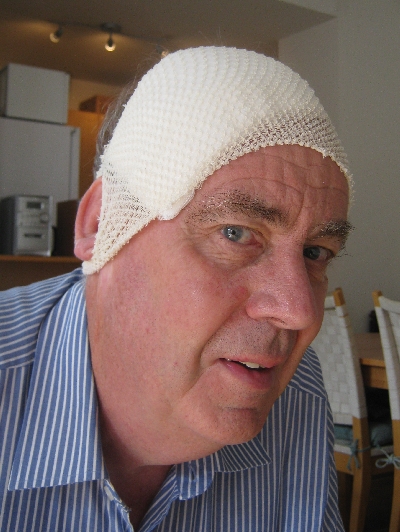
My head following surgery! © Ricky Yates

The operation on Wednesday 10th September, despite being under local anaesthetic, was a bit more major than I was expecting. I was grateful that I’d accepted the kind offer of my friend Rev’d Dr Karen Moritz, to accompany me to the hospital. This is how I looked following the operation – Karen being responsible for taking the photograph! Fortunately, when I returned to the hospital the next day for a follow-up visit, the head bandage was replaced by a large sticky plaster which I was able to remove the next day.

The wound was pulled together by six stitches, the last two of which, were only removed on Monday of this week. But the good news is that the histology report, whilst confirming that what was removed was a BCC, also said that it was completely removed – it was clear around the edges. I now have a return visit to the dermatologist booked for the middle of October.

Then on Monday 22nd September, the day I had the last of my stitches removed, came the news that my daughter Christa, had gone into labour with her first child. Later in the evening came word from my son-in-law Ian, that I had become a grandfather for the first time, following the birth of my grandson Finley.

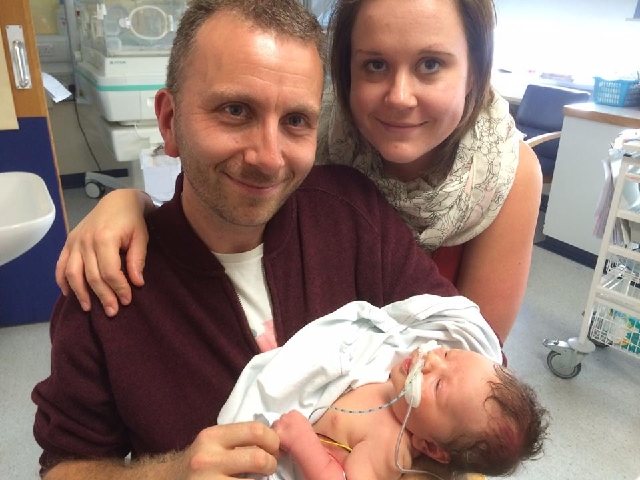
Because of breathing and other difficulties, Finley was immediately taken to the Special Care Baby Unit of the hospital in Northampton. But as this picture below, taken yesterday, shows, Christa and Ian were finally able to hold their newborn son for a short while. The latest news is that they hope to be able to take Finley home this weekend. I’m hoping to meet my grandson for the first time at the end of October when I’m visiting the UK for a few days.

My grandson Finley and his proud parents © Ian Margieson