Czechoslovak border fortifications

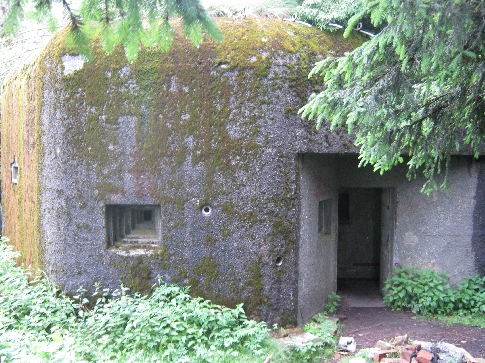
Border fortification in the Orlické hory © Ricky Yates

At the end of the First World War, Tomáš Garrigue Masaryk, President (1918-1935) of the newly declared independent nation of Czechoslovakia, was very keen that the western boundaries of the country should be the historic ones of Bohemia and Moravia which predominantly follow the ridges of the surrounding hills and mountains. This was for two main reasons. The first was to ensure that nearly all Czech speakers would be residing within the new nation. The second was to have borders that were relatively easy to defend, should conflict once more arise in the future.

However, as explained in a blogpost I wrote two years ago, one important consequence of the adoption of these borders was that many people of German ethnic origin were also incorporated within the new nation of Czechoslovakia. According to a census taken in 1921, just over three million Germans lived in Czechoslovakia, accounting for around 23% of the country’s total population. The areas where Germans formed a majority were known as Sudetenland and the people themselves as the Sudetendeutsche.

Soon after Hitler came to power in Germany in 1933, he started making demands for the incorporation of German minorities into a ‘Greater Germany’, in particular the Sudetendeutsche residing in Sudetenland. This alarmed the Czechoslovak government who began to make defensive plans to counteract any future Nazi invasion attempt.

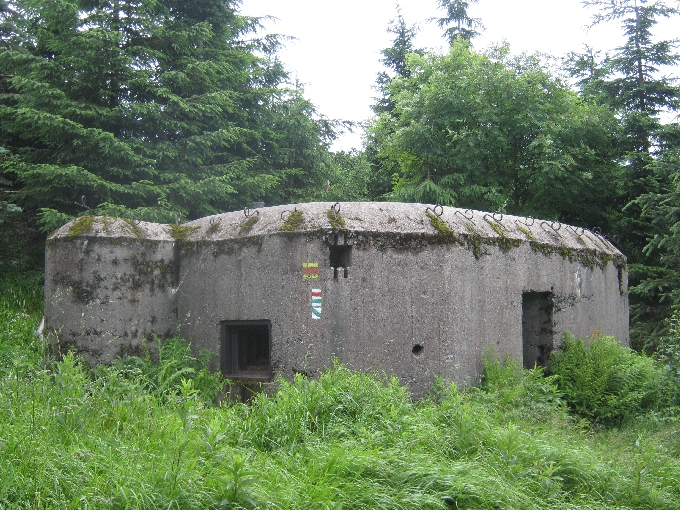
Border fortification in the Orlické hory © Ricky Yates
Border fortification in the © Ricky Yates
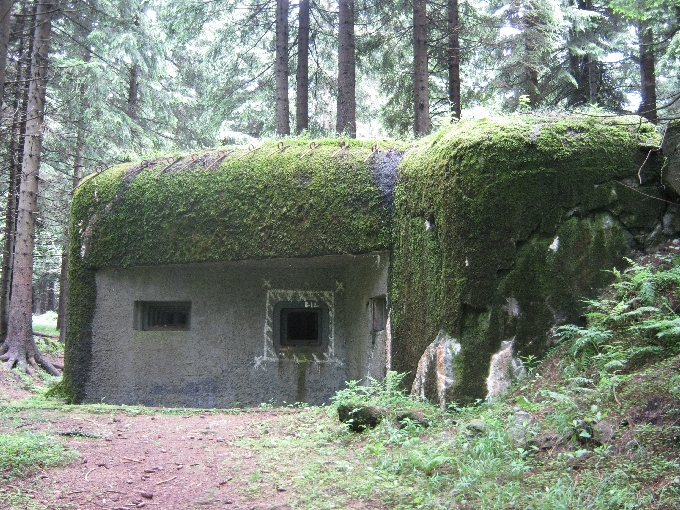
Border fortification in the Orlické hory © Ricky Yates

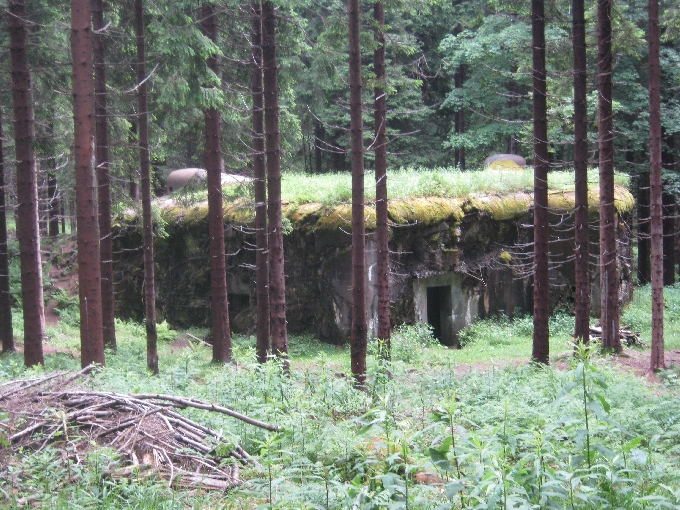
The Orlické hory now lie parallel to the border with Poland, but until 1945, this was the border with German Nieder Schlesien – Lower Silesia. Between 1935-1938, a whole series of defensive fortifications were built here, as can be seen in these photographs. The idea was that, from these positions, any possible invasion could be held in check, until the wider Czechoslovak Army could be mobilised to deal with it.

Border fortification in the Orlické hory © Ricky Yates

It is somewhat ironic that the construction of these defences, created much needed employment for the local population who had been hard hit by the financial crash of 1929 and the economic depression that followed. Yet the majority of these people were themselves, German speakers!

The whole issue of Sudetenland and the Sudetendeutsche, came to a head at the Munich Conference, held at the end of September 1938. In an effort to appease Hitler and avoid conflict, the then British Prime Minister Neville Chamberlain, along with his French counterpart Édouard Daladier, signed the infamous ‘Munich Agreement’, giving Hitler control of the Sudetenland. All this was done without the Czechoslovak government being consulted or represented at the conference.

As a result, all these border fortifications were never used for the purpose for which they were built. Despite Hitler promising that the the annexation of the Sudetenland would be the end of German territorial expansion, six months later, his forces occupied the rest of Czechoslovakia. And because Czechoslovakia had now lost the very defensive borders that Masaryk had insisted upon in 1918, the Nazi Army was able to do so, with hardly a shot being fired.

In the past few years, with the aid of EU funds, a walking trail with information boards has been established, linking the various fortifications and giving an explanation about their construction. The rather large fortification at Tvrz Hanicka, is now a museum.

Whilst walking the trail, I could not help but notice that a linguist choice had clearly been made by someone in authority. Information boards about the geology, geography, flora and fauna of the Orlické hory are in Czech, Polish and German, the three languages most likely to be spoken by visitors to this delightful area. Those explaining the origin of these defensive fortifications, are also in three languages – Czech, Polish and English. I will leave my readers to decide about the significance of this difference.

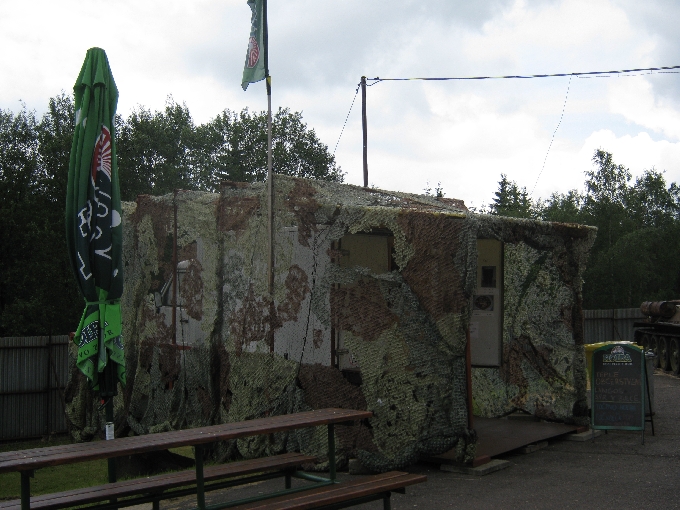
A refreshment truck at Tvrz Hanicka, covered with camouflage netting!  © Ricky Yates
A refreshment truck at Tvrz Hanicka, covered with camouflage netting! © Ricky Yates

Neratov

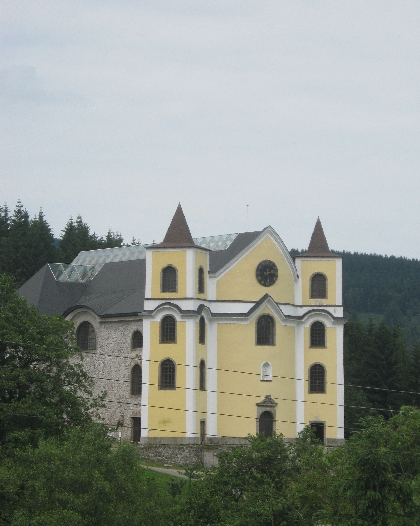
Neratov Church © Ricky Yates

Neratov is a small village located on the eastern side of the Orlické hory, in the valley of the Divorká Orlice – ‘Wild Eagle River’, which forms the border between the Czech Republic and Poland. Between 1723-33, a large baroque Church was built here, to house a statue of the Virgin Mary that had been previously donated by the parish priest of Rokynice v Orlických horách, situated on the other side of mountain range. Thus Neratov became a place of pilgrimage and Marian devotion.

The Church, built on a rocky promontory overlooking the village, is most unusual in one particular aspect. It has a north-south, rather than the traditional east-west, axis. The only other Church I know built in this manner, is the new Coventry Cathedral, which is at right-angles to the old ruined Cathedral.

On 10th May 1945, two days after the Second World War was supposed to have come to an end, the Church was hit by a Soviet Red Army anti-tank rocket and was gutted by fire. The roof and interior fittings were completely destroyed, just leaving the exterior walls standing. Then in 1957, some supporting arches collapsed. In 1973, an order was issued for the demolition of the ruined remains and the only reason the building survived, was because the local communist authorities, lacked the finances to put the demolition order into effect 🙂

Neratov 2
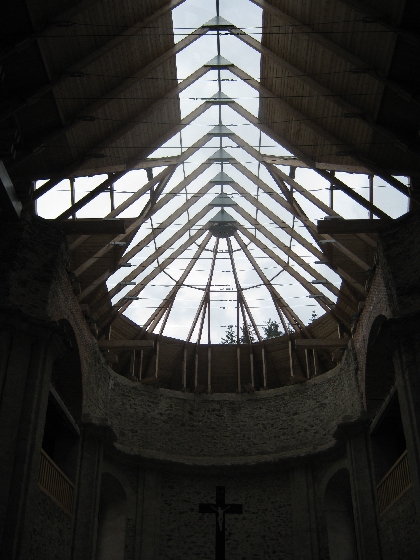
The new glass roof of Neratov Church © Ricky Yates

Following the Velvet Revolution of 1989, moves began to be made to preserve and then restore the Church. In 1992, it was declared the equivalent of a British ‘listed building’. Then in 2006-2007, it was completely re-roofed. This has been done in the most imaginative way with timber framing supporting clear glass, allowing a remarkable amount of light into the interior of the Church. The money to carry out the restoration came from a variety of sources including Germany. This website in German, is maintained by supporters of the project. It uses the name Bärnwald, which is how the village is known in German.

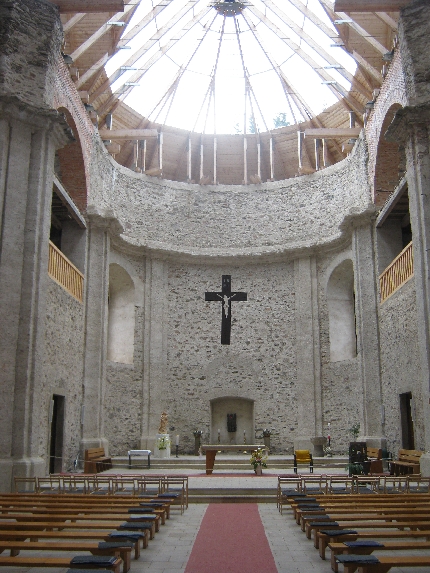
The interior of Neratov Church © Ricky Yates

Both Sybille and I very much enjoyed our ‘pilgrimage’ to Neratov – we did walk around 15 km from Rícky v Orlických horách to get there! Unlike so many Czech Churches, Neratov Church is kept open during daylight hours. Also, because of the 1945 fire, unlike so many baroque Churches in Prague and elsewhere in the Czech Republic, the interior walls are plain with just a large crucifix on the north wall behind the altar, and a small new statue of the Virgin Mary in the north-west corner. It is very hard to find the right words to articulate the real sense of peace and holiness that I felt whilst being there.

The village itself has also been brought to life by the Neratov Association, which has provided sheltered housing and employment, for people with light to medium mental handicaps. As explained in a small colour leaflet that I picked up in the Church, ‘the aim is to help these people to live a free, independent, and responsible life with the support of a team of assistants in a friendly family-like environment’.

Neratov 4
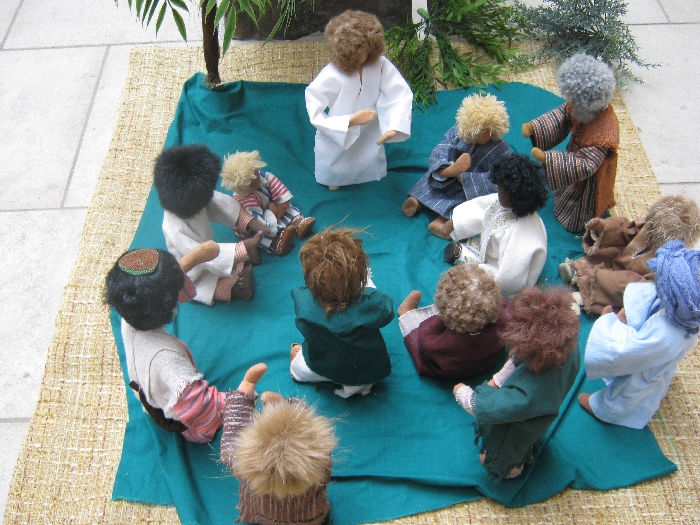
Jesus asking questions of his twelve disciples © Ricky Yates

I suspect that these figures, sitting in front of the lectern in the sanctuary of the Church, are the work of some of those in the care of the Neratov Association. The text in Czech, of Luke 9. 18-20, was on display alongside them. Jesus is asking first, ‘Who do the crowds say I am?’ And then more pointedly, ‘Who do you say I am?’

Our visit to Neratov was the first of several days of fascinating discoveries, as we explored the Orlické hory. I hope to write and post more about our experiences in the coming days.

Ricky has returned to Rícky

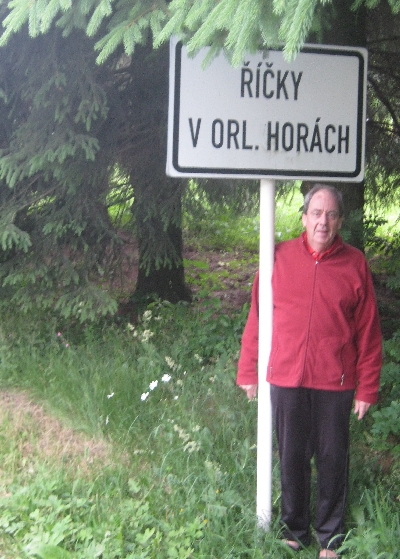
Ricky at Rícky v Orlických horách © Ricky Yates

I am writing this, sitting in the bar/dining room/lounge of Hotel Konšel, located in the small settlement that bears my name, Rícky v Orlických horách. Yes, after our short, very snowbound visit in early April this year, Ricky has returned to Rícky 🙂

This time, Sybille and I are here, hoping to spend the first eight days of two weeks of my annual leave, enjoying a walking holiday in the Orlické hory. And, if the hotel’s slightly dodgy wifi internet connection had allowed me, I would have posted this on the evening of Wednesday 26th June, as my first ever blogpost not posted from my office in the Chaplaincy Flat in Prague.

We arrived here on the afternoon of Monday 24th June, following a good week in which several positive things occurred.

On Thursday 20th June, TelefonicaO2 finally reconnected our landline phone and internet access at the Chaplaincy Flat, a few hours short of seventeen days from when it ceased to function. To once more have reliable internet access with a reasonable download speed, was a welcome relief for which we are both very thankful. Of course, now we are away from the Chaplaincy Flat, internet connections have once more become a little more intermittent 🙁

The same day, I drove out to Horažd’ovice, to meet up with my good friend Adrian Blank, in order to help me get the ‘Carly’ through its STK, the equivalent of a British MOT Test. It did eventually get through but, at the expense of two new front tyres and some work to re-align the front wheels. Adrian reckons, probably quite rightly, that hitting a few Czech potholes was probably the cause of the problem. But at least the ‘Carly’ is now deemed fit to be driven on Czech roads for another two years.

The third thing of note was our worship and post-services activities last Sunday. Not only was our Sung Eucharist extremely well attended, we also had the privilege of having a guest preacher, Rev’d Dr Peter Walker. Peter and I trained for ordained ministry together at Wycliffe Hall, between 1987-1989. After serving his title in a parish in Kent, Peter has had an academic career, including a spell back at Wycliffe on the teaching staff. He is now Professor of Biblical Studies at Trinity School for Ministry, near Pittsburgh, Pennsylvania, USA. His challenging sermon, which has now been uploaded to our Church website, was widely appreciated by the congregation.

Churchwarden Richard York with Rev'd Dr Peter Walker © Ricky Yates
Churchwarden Richard York with Rev’d Dr Peter Walker © Ricky Yates

Following worship, many of us migrated to the nearby park on Lannova, a street that lies between the Church and the Vltava River, for our annual summer Picnic-in-the-Park. The picnic is always a good opportunity for fun & fellowship before many in the congregation are often away from Prague for several weeks, visiting family and friends in their home countries. Peter and his wife Georgie were able to join us for the picnic and very much enjoyed meeting and talking to members of the St. Clement’s congregation.

Last week was also notable for some very hot and sticky weather, in stark contrast to all of the rain earlier in the month, which was responsible for the very serious flooding in Prague and elsewhere in the western half of the Czech Republic. Fortunately the weather turned a little cooler at the weekend, but still dry except for a few spots of rain – ideal conditions for our picnic. Ideal weather, so I thought, for our walking holiday commencing the next day.

Unfortunately, Monday 24th June dawned cold, grey and with light rain. And when we set out late that morning on the Prague-Hradec Králové motorway, we drove through a positive downpour! However, just before reaching Rícky some three hours later, the rain stopped, allowing us an enjoyable short circular walk around the somewhat scattered settlement, after we had checked into the hotel.

But that dry couple of hours proved illusory. It was followed by forty-eight hours of continuous rain, meaning a couple of expeditions in the car but no walking in the hills. The rain finally stopped on Wednesday evening, so our walking holiday in the Orlické hory finally began today. Watch this space!

I do not have a criminal record in the Czech Republic

My certified 'Extract from the Criminal Records of individuals' which declares that 'there is no information about convictions regarding this person'.
My certified ‘Extract from the Criminal Records of individuals’ which declares that ‘there is no information about convictions regarding this person’.

This is what this two page official document, which I successfully obtained today, declares. In the nearly five years I have now lived in the Czech Republic, I have thankfully, done nothing to officially trouble the Czech Police or judicial authorities.

Whilst I can, and have 🙂 , made jokes about having evidence of my lack of criminality, the reason behind my obtaining this certified ‘Extract from the Criminal Records of individuals’ today, is quite serious. It is part of fulfilling the requirements of the ‘Safeguarding of Children, Young People and Vulnerable Adults Policy’ of the Diocese in Europe and the wider Church of England.

When I was offered the post of being the Anglican Chaplain in the Czech Republic, back in May 2008, it was subject to a ‘UK Criminal Records Bureau (CRB) Enhanced Disclosure’ being obtained. This was despite already holding such a document, applied for by the Diocese of Oxford, some four years previously. Only when the new ‘Enhanced Disclosure Certificate’ came through, showing I had no criminal record of any description, could my appointment be officially confirmed and publicly announced.

The policy of the Diocese in Europe, in line with the rest of the Church of England, is that every person exercising a licensed ministry in the diocese, should be re-checked not less than once every five years. It was because my current UK CRB clearance dates from July 2008, that the Diocesan Safeguarding Administrator wrote to me some weeks ago, asking me to complete a fresh ‘Self Declaration Form’, but also to obtain the equivalent of a UK CRB clearance from the Czech authorities.

I was greatly helped in obtaining my Czech certified ‘Extract from the Criminal Records of individuals’, declaring that, ‘there is no information about convictions regarding this person’, by my good friend and colleague, Rev’d Dr Karen Moritz. She was previously required to obtain a similar document, before being licensed to help in the ministry of the Anglican Chaplaincy in the Czech Republic, under the Ecumenical Canons of the Church of England. However, whilst her certificate came out of the system within a couple of hours, mine ended up taking the full twenty working days that are officially allowed.

The reason for this discrepancy became clear today. For along with the official Czech documentation, there was a further two pages in English, declaring what the Diocese in Europe and I already know – that there is no record of any convictions against my name, recorded in the UK.

As a result of the EU Council of Ministers Decision 2009/315/JHA, each EU member state, shares with each other, evidence of criminality recorded within their jurisdiction. Therefore, although I had not requested it, I also effectively received, an updated CRB clearance from the UK. Actually, it is from the ‘Disclosing and Barring Service (DBS), which is what the CRB was renamed in September 2012, for reasons that are beyond my comprehension!

Whilst fulfilling all the requirements of the ‘Safeguarding of Children, Young People and Vulnerable Adults Policy’ of my diocese, can at times, feel excessive and burdensome, I completely understand the reasons for them. For it has been the failure of the Roman Catholic Church to have a similar policy in place until recently, or even when belatedly put in place, the policy being bypassed or ignored, that has caused it so much adverse publicity in recent years, not forgetting the lives of the many innocent victims who have suffered at the hands of those who should have been caring for them.

Finally, on a lighter note, I could not help but notice the contrast in costs between the Czech Republic and the United Kingdom. To obtain my Czech certified ‘Extract from the Criminal Records of individuals’ today, cost me CZK 100 / £3.33 at current exchange rates. A new CRB (now DBS 😉 ) enhanced disclosure, currently costs £44.00 to obtain!

Living without being connected to the internet for a week

The Lahovice interchange south of Prague where the ring road crosses the main road south from Prague city centre. The top photo is how it should be; the bottom photo is how it was on Monday 3rd March
The Lahovice interchange south of Prague where the ring road crosses the main road south from Prague city centre. The top photo is how it should be; the bottom photo is how it was on Monday 3rd March 2013

Last Monday evening (3rd June), just as I was uploading photographs to illustrate a draft blog post about the serious flooding we were experiencing in Prague, our connection to the internet died. I soon discovered that the cause of the problem was that our landline phone was also dead – our broadband internet connection is via the landline.

Awaking on Tuesday morning, to find that we still did not have a functioning internet connection, I contacted Gordon the Church Treasurer using my mobile phone, to explain the problem. Although the contract with our service provider O2, is in my name, the monthly bill is sent electronically to Gordon, for him to settle directly from the Church account. Gordon assured me that O2 had an English-speaking helpline and he would contact them and let me know the outcome.

When Gordon contacted O2, the English-speaking helpline offered a recorded message saying that ‘no English-speaking operators were available’, whilst the Czech helpline, upon entering our phone number, produced another recorded message saying that there were ‘technical issues in our area’ but with no indication as to when these ‘technical issues’ might be resolved. The only contact Gordon or I have had from O2 was a Czech text message to my mobile phone last Friday afternoon, promising that compensation for loss of service will be included in next month’s bill.

Having no internet access in my office in the Chaplaincy Flat for six days, has been utterly frustrating. It has also made me very conscious of how reliant I am upon being able to send and receive emails, at little more than the click of a mouse.

But it isn’t just the restrictions that this situation has placed upon me, but also the expectations of those I serve. The assumption that if someone sends me an email, they will receive a prompt reply. Within a couple of days, I had a phone call on my mobile from one of the congregation, most surprised that I hadn’t replied to his email – a simple request for a contact name and phone number to which I would have normally have replied within a few hours.

Fortunately, the purchase of a new laptop computer just over a year ago, has meant that I have managed to make a connection with the internet from time to time, by going to various local bar-restaurants more frequently than normal 🙂 in order to avail myself of their wifi. So I’ve learned to write emails and save them in my drafts folder, and then send them once I get to the pub! But it isn’t the most ideal way to work. Honestly!

Sybille has a fairly common response whenever I ask her something. If she doesn’t immediately know the answer to my question, then she firmly tells me to ‘google it!’ But of course, I cannot ‘google it’, if we have no internet connection. Likewise, when compiling the ‘Weekly Bulletin’ for Sunday worship this past week, I couldn’t click onto the Church of England website and copy and paste the Collect of the Day – I ended up typing it word by word from a book instead. And trying to update the Chaplaincy website 🙁

All along, we have assumed that the ‘technical issues’ to which O2 referred in their recorded message, related to the serious flooding of recent days – that flood-water had got into their system somewhere. So when on Saturday morning, I met Jana who lives on the ground floor of our apartment block, I asked her if she had the same problems with phone and internet as we do. I was surprised when she said she had experienced no interruption to service at all.

Then yesterday evening, about an hour before I got back from Brno from officiating at our regular monthly evening service there, Sybille decided to ask Kamila who lives across the second floor landing from us, if her phone and internet were working. She too, had not had any problems. Even better, Kamila kindly gave Sybille the log-in details to her wifi network, to allow us to piggyback onto her system until O2 get around to resolving their ‘technical difficulties in our area’. So after six long days, both Sybille and I are finally back online.

Kamila’s network only works in our sitting room so I’ve had to temporarily migrate from my office, to the dining table. But her service provider, who also seem to be used by many others in our immediate neighbourhood, say they only need an existing phone landline, in order to provide broadband internet. Therefore, when we do finally get a functioning landline once again, O2 will promptly lose a customer. But when that will be is anyone’s guess. By the time I post this, our landline will have been dead for a whole seven days, and still counting 🙁