Prague Floods – June 2013

This was written and should have been posted late in the evening of Monday 3rd June. However, as I was uploading the photographs, the internet connection to the Chaplaincy Flat died, along with the landline phone. Nearly four days later, we are still without internet or phone. Our provider O2, tells us in a recorded message that they have ‘technical issues in our area’, with no information as to when these ‘technical issues’ will be resolved. We assume that floodwater has got into their system somewhere. I have finally managed to complete this post using the wifi connection in Bar-Restaurace U Topolu whilst eating my lunch 🙂

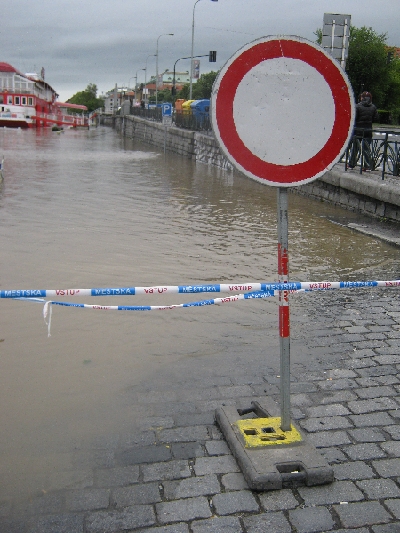
Don't try walking or parking your car here © Ricky Yates
Don’t try walking or parking your car here © Ricky Yates

I have previously written on this blog, about flooding in Prague. I wrote that post from a historical perspective and illustrated it with some photographs of flood level markers that can be found on several buildings near to the Vltava River, as flows through the centre of Prague. At the end of my post, I remarked that, as serious flooding seems to have occurred with one hundred year intervals, and the last very serious floods were in 2002, I didn’t expect there to be another occurrence during my lifetime. That was until the events of the past few days.

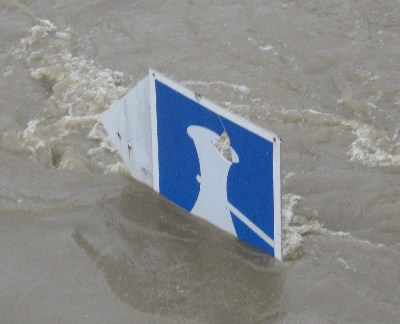
As well as being cold and miserable, as the weather has been throughout most of May, during the last week it has also been raining pretty consistently too. The inevitable consequence has been a rise in river levels which reached dangerous heights over the past forty-eight hours. This was the scene that greeted us after we walked down to the side of the Vltava after Church on Sunday morning. Normally you can walk along here and there is reserved parking for customers of the Botel Albatross in the distance – hence the ‘P’ sign sticking out of the water.


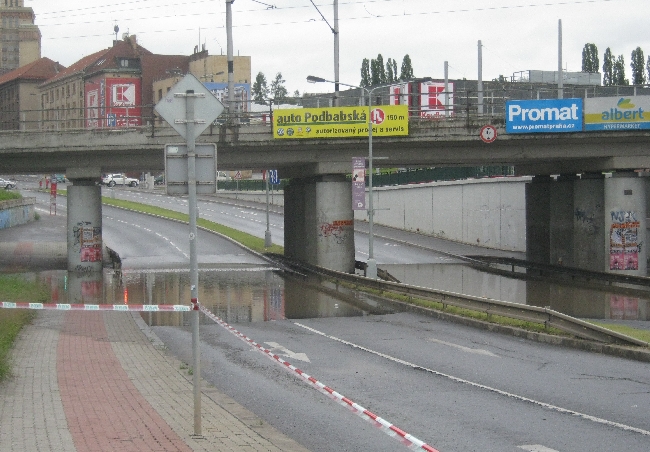
 Flooded road underpass at Podbaba © Ricky Yates
Flooded road underpass at Podbaba © Ricky Yates

Just beyond the Podbaba tram terminus, on our way home to the Chaplaincy Flat, we were greeted with this view, with the main road completely blocked because of flooding in the underpass beneath the Prague-Dresden railway line. I should add that this flooding has got considerably deeper in the past twenty-four hours.

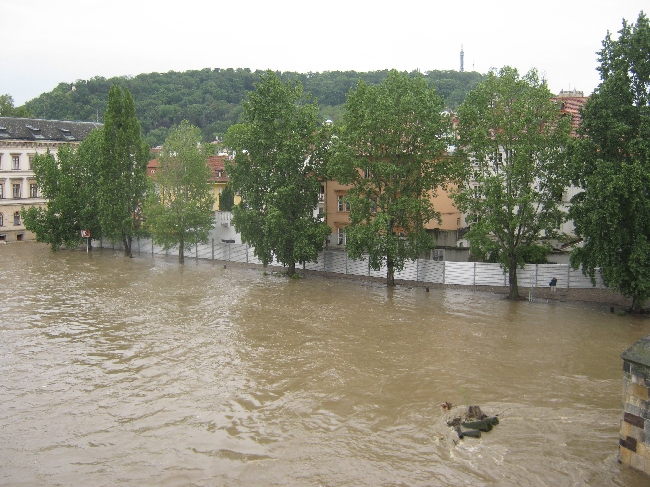
Flood defences erected on Kampa Island as seen from Charles Bridge © Ricky Yates

We returned to the city centre later on Sunday afternoon, to get an idea of how severe the flooding was likely to be. At that point in time, it was still possible to walk across Charles Bridge from where I took this photograph which shows the first flood defences having already been erected on Kampa Island. In the foreground, one of the wooden barriers which are meant to protect the buttresses of the bridge, is almost completely submerged.

The photographs that follow were taken by me this morning, Monday 3rd June. I hope they help to illustrate the flood situation as it currently is. Obviously, the situation is fluid if you will excuse my bad pun.

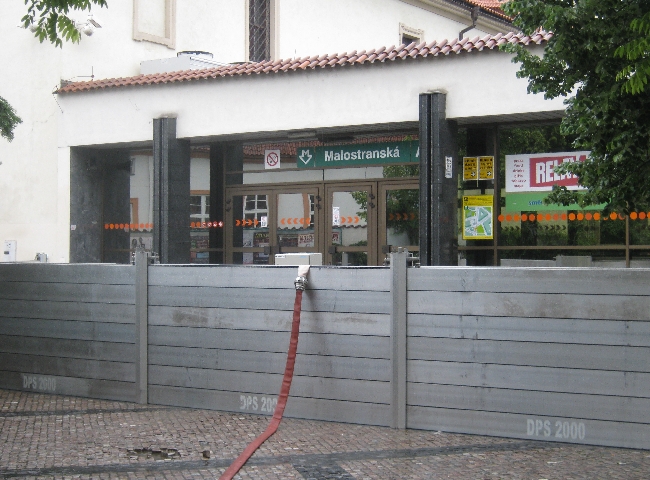
Malostranská Metro Station surrounded by flood barriers © Ricky Yates

Whilst we were travelling back into the centre of Prague on Sunday afternoon, we heard (and understood !!!) an announcement in Czech, that a a sizeable section of the Metro was being closed until further notice. Basically, any station near the Vltava River has been closed, with flood barriers erected around the entrance, to try to prevent any part of the system being inundated, as here at Malostranská.

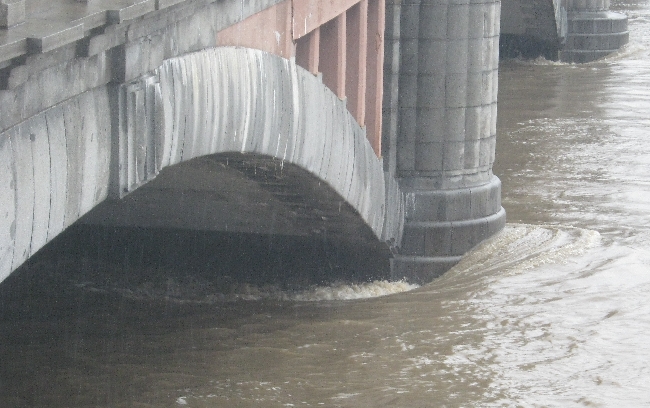
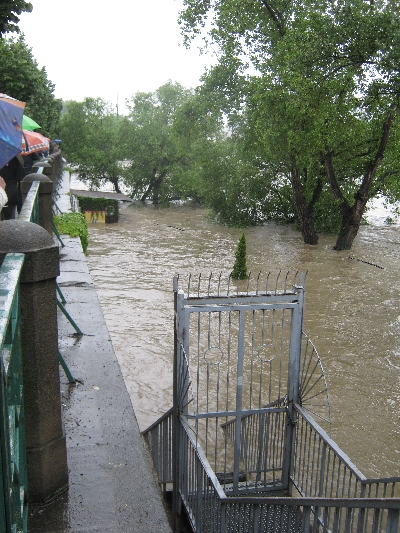
The Vltava at full force © Ricky Yates

Some indication of the strength of flow in the Vltava.

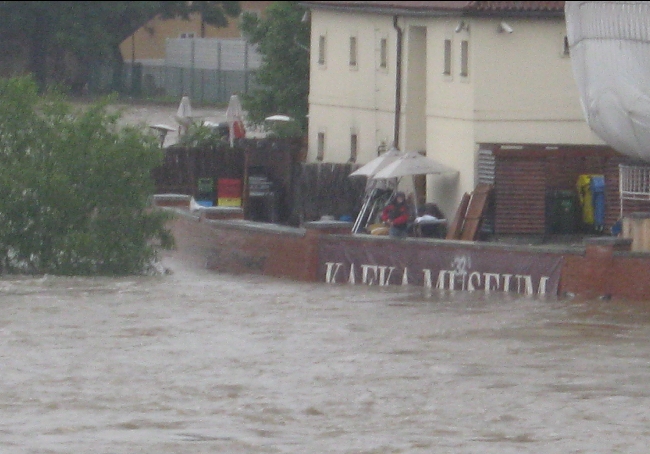
The Kafka Museum at risk of being inundated © Ricky Yates
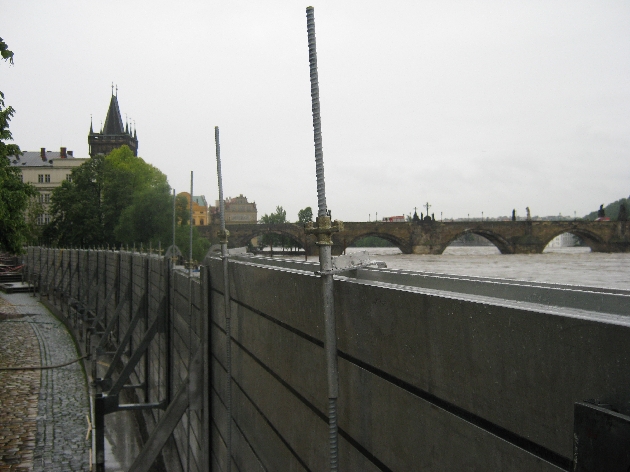
Flood defences and Charles Bridge © Ricky Yates

Flood defences were in place all alongside the most vulnerable parts of the historic city centre.

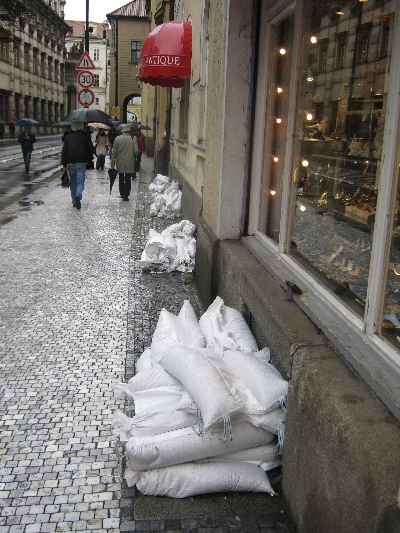
Protecting the antique shop with sandbags © Ricky Yates

And around the corner, they were busy filling more sandbags!

Charles Bridge without tourists! © Ricky Yates

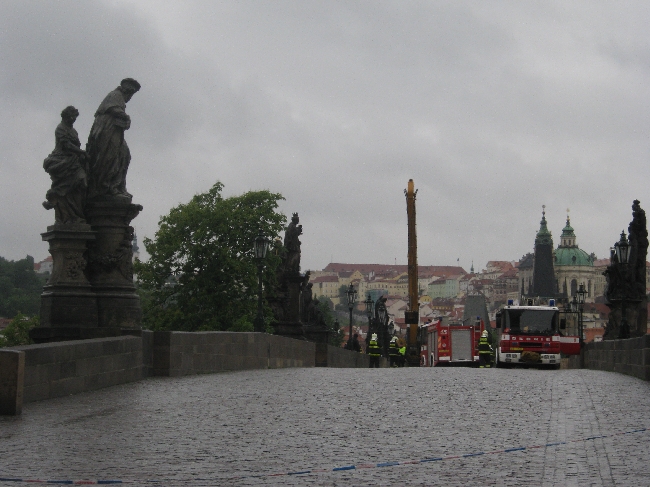
Whilst we had been able to walk across Charles Bridge on Sunday afternoon, later that evening, it was closed to the public. Here the fire service, aided by a mobile crane, are trying to remove large trees and other debris building up against the bridge parapets.

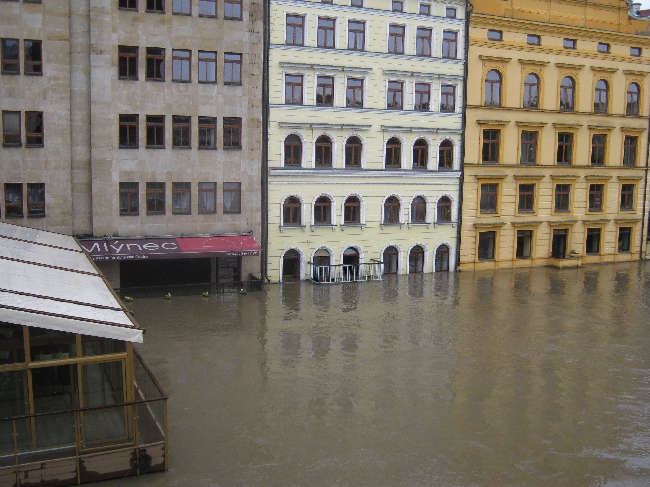
Flood defences cannot save these buildings adjacent to Charles Bridge © Ricky Yates

Some buildings that are so close to the Vltava cannot be protected from flooding such as these in the photograph above or this riverside bar in the photograph below.

Flooded riverside bar © Ricky Yates

Nor will boats be mooring here for sometime to come!

Don't try mooring here for a few days © Ricky Yates
Don’t try mooring here for a few days © Ricky Yates


Royal Gardens, Stalin and the Metronome

Towers at the eastern end of the Prague Castle complex © Ricky Yates

Many of us here in Prague, are beginning to think that someone has kidnapped Spring and early Summer, the weather having been cold and wet for most of May. So Sybille and I decided to take full advantage of a rare, fine, dry and partly sunny evening earlier this week, and take a walk through some of Prague’s wonderful green spaces.

We took the tram to Pražský hrad / Prague Castle. But instead of crossing Prašný most, the bridge over Jelení príkop, and entering the Castle complex, we turned left into Královská zahrada, the Royal Gardens. As well as a wonderful collection of mature trees, there were several rhododendron bushes still in flower – shades of our visit to Pruhonice Park the previous week.

From the Royal Gardens, there are splendid views of Prague Castle. This photo shows the towers at the eastern end of the Castle complex. However, surrounded by trees and other greenery, you could be forgiven for thinking it to be scene from a small historic village in the Bohemian countryside, rather than a location in the centre of the Czech capital.


The view from Chotkovy sady © Ricky Yates

At the eastern end of the Royal Gardens is Chotkovy sady, from where this view down to the Malostranská tram stop with Charles Bridge beyond, was taken. From this point, a pedestrian bridge allowed us to cross the road and tram tracks below, and enter a far bigger green space, Letenské sady or Letná Park, as it is commonly called in English.

The Metronome in Letná Park © Ricky Yates


Letná Park occupies a plateau from which a steep slope goes down to the Vltava river. Walking along the path at the top of the slope, there are extensive views across the whole of that part of Prague that lies on the eastern side of the river. But sitting on top of a massive plinth and occupying the best viewpoint of all, is this slightly incongruous metronome. At least when we saw the metronome on our walk earlier this week, it was actually working. More often than not, it is stationary!

The metronome was erected in 1991, but the massive plinth on which it sits, has a far longer history going back to late 1949, only eighteen months after the coup that brought the Communist Party to power in February 1948. For on it once stood the largest group statue in Europe, measuring 15.5 metres in height and 22 metres in length.

Seeking to kowtow to the Soviet Union, the Central Committee of the Communist Party in Czechoslovakia decided to build a massive statue of Joseph Stalin. It took them five and a half years to construct it and, by the time it was unveiled on 1st May 1955, Stalin had already been dead for over two years.

The Prague Stalin Statue - Image via Wikimedia & in public domain
The Prague Stalin Statue – Image via Wikimedia & in the public domain


As you can see, the group statue was a classic example Communist era art on a gigantic scale. Stalin stands proudly overlooking the Vltava River, with archetypal workers and soldiers lining up behind him. The statue was informally known as ‘Fronta na maso‘, the ‘meat queue’, which was a daily part of life at that time. I am given to understand that there were also some far more descriptive titles – those that referred to what comrades standing behind Stalin, might be doing to his rear 🙂 As long as they are not too offensive, I’d love to know what these were, via comments on this post.

Less than a year after the statue was unveiled, Nikita Khrushchev denounced Stalin, both for his dictatorial rule and his cult of personality. Thus, this grand monument became an increasing embarrassment to the Czechoslovak Communist hierarchy. Therefore, in October 1962, the whole colossus was blown up with the help of 800 kg of explosives.

From the platform, immediately below the metronome, there is a view straight across Cechuv most, towards Staromestké námestí / Old Town Square. The street from the bridge to the square is called Parižská / Paris Street. Either side of Parižská, are some of the most exclusive and expensive shops in Prague. It is a view I suspect, that Stalin would not enjoy. So it is probably good that he no longer has to observe it 🙂

The view from Letná over Cechuv most © Ricky Yates
The view from Letná Park over Cechuv most © Ricky Yates


Trinity Sunday

Fractal image of the Holy Trinity © Sybille Yates

‘The average Christian is as well equipped to meet an aggressive atheist or agnostic as a boy with a peashooter is to meet a tank’. So wrote my former Diocesan Bishop, Rt Rev’d John Pritchard, Bishop of Oxford. I am sure that comment could be a deemed a little unfair by some Christians but, when it comes to the doctrine of the Trinity, I fear that in most cases, Bishop John is probably right. For the doctrine of the Trinity is one that Christians know they ought to believe, but which many will tell you is one they have not, or cannot, fully grasp, let alone adequately explain.

Today, the first Sunday after the Feast of Pentecost, is always kept as Trinity Sunday, the only Sunday in the Christian calendar dedicated to a doctrine. It is the annual occasion when I have to preach, and hopefully explain, the doctrine of the Holy Trinity. How God is revealed as Creator and Father; took human form in the person of Jesus, the Word made flesh; and is at work in the world today by the person and power of the Holy Spirit who indwells each believer. Three persons yet, one God!

How well I succeeded in my task, I’ll leave to those who heard me preach today. Or you can judge for yourself as my sermon has now been uploaded to our Church website and you can listen to it by clicking on this link. However, I am always reassured by the quotation, attributed to St. Augustine of Hippo – ‘If you can understand it, it isn’t God’. It is a reminder that, by his very being and nature, the infinite Triune God is beyond our finite human understanding.

One of things I do enjoy about Trinity Sunday, is the opportunity it gives to sing some of the many wonderful Trinitarian hymns which are part of English hymnology. So it was that today we sang, ‘Holy, holy, holy! Lord God almighty’, ‘Thou, whose almighty word’ and the more recent twentieth century hymn, ‘Father, Lord of all creation’. But we ended with what is my favourite Trinitarian hymn – ‘We give immortal praise’, by the late seventeenth/early eighteenth century hymn writer, Isaac Watts.

The hymn has four verses, the first three of which are individually addressed to the three persons of the Holy Trinity. It is normally sung to the tune, ‘Croft’s 136th’, an organ rendition of which can be listened to here.

But the fourth and last verse, which gives praise to the Holy and Undivided Trinity, expresses both praise, but also the limits of our human understanding.

Almighty God, to thee

be endless honours done,

the undivided Three,

and the mysterious One:

where reason fails

with all her powers,

there faith prevails,

and love adores.

This side of heaven, we will never fully understand the Triune God. But where reason fails, faith does prevail, and love does adore.

Pruhonice Park revisited

Pruhonice Zámek/Chateau and Park © Ricky Yates

In June 2012, Sybille and I visited Pruhonice Park for the first time. In my blog post about that visit, I said that, as we had only explored about a quarter of the park, we planned to return to explore more of it at some future date. I also mentioned that Pruhonice Park is famous for is its collection of rhododendrons which flower in May. Knowing this, a return visit in May 2013 has been provisionally scheduled for some time. Therefore this week, on my day off, we finally made our second visit and saw the flowering rhododendrons in all their glory. We also got to explore some remoter areas of the park.

Rather than writing about the beautiful rhododendrons in all their immense variety of colours, this is an occasion when one picture can take the place of a thousand words. So here are a selection of photographs that I took during our visit earlier this week which I hope give some indication of the beauty of this UNESCO World Heritage Site and Czech National Historic Landmark.


Yellow rhododendrons © Ricky Yates
Pink rhododendrons © Ricky Yates
Red & yellow rhododendrons © Ricky Yates
Orange & yellow rhododendrons © Ricky Yates
White rhododendrons reflected in the lake © Ricky Yates
Seven new Pruhonice Park residents & their mother © Ricky Yates

A wonderful distraction from all the beautiful flowering rhododendrons 🙂

Rockery with rhododendrons © Ricky Yates

Pink & red rhododendrons © Ricky Yates

A view across Pruhonice Park © Ricky Yates

Walking in a remoter part of Pruhonice Park © Ricky Yates

Individual rhododendron bloom © Ricky Yates

White rhododendron bloom © Ricky Yates

Orange rhododendron bloom © Ricky Yates

Not a rhododendron but a white peony © Ricky Yates

The park contains many tree species from around the world. This is what is commonly known as a handkerchief tree, whose natural habitat is southern China.

Handkerchief Tree © Ricky Yates

Handkerchiefs on the handkerchief tree © Ricky Yates


ICS Chaplains Conference in Switzerland

The Swiss Alps from my conference centre bedroom balcony © Ricky Yates

I spent the week, (Monday 29th April – Friday 3rd May), attending the annual Intercontinental Church Society (ICS) Chaplains and Families Conference held in Beatenberg, near Interlaken in Switzerland. ICS is an international Church of England mission agency seeking to make known the good news of the Christian Gospel to people who speak English, who find themselves living, studying, working or holidaying away from home in countries where English is not the main language. ICS mainly works in continental Europe and other countries that surround the Mediterranean, together with few far-flung outposts such as the Falkland Islands.

ICS has financially and prayerfully supported the Prague Anglican Chaplaincy since August 2000, their support allowing the appointment of the first full-time Chaplain in Prague, my predecessor Canon John Philpott. They have continued to be incredibly supportive during my time as Chaplain and it is fair to say that without their financial help, the Prague Anglican Chaplaincy might easily have ceased to exist.

SBT Conference Centre, Beatenberg © Ricky Yates

Every year, ICS organise a conference for all Chaplains and their families who work in Chaplaincies that they are involved with. The location of the conference alternates between continental Europe and the UK. I attended my first conference in April 2009, also held in Switzerland, but surprisingly did not write a blog post about it! I have missed the last three conferences, mainly to save the Prague Chaplaincy some expense with our financial position being so precarious. One of the nice things this year was that the governing ICS Council, agreed to subsidise the conference to a greater degree than in previous years, thus reducing the cost of my attendance.

Whilst the conference centre venue was excellent and its location absolutely spectacular, there was the practical problem of how to get there from Prague and get back home again afterwards. After considering the various possibilities, I opted to drive. I left the Chaplaincy flat in Prague just before 07.30 on Monday morning and finally reached the Beatenberg conference centre some ten hours later at 17.30.

The journey took me through four countries, (Czech Republic, Germany, Austria & Switzerland) and was almost exclusively on autobahn/motorway, with the exception of the crossing from Austria to Switzerland and a most ‘interesting’ crossing of a mountain pass between Luzern and Interlaken. Unfortunately, my journey took thirty minutes longer than it should have done when I struggled to find my way through and out of the western extremity of Interlaken, onto the twisty mountain road leading up to Beatenberg. It was very much a case of being so near yet so far 🙁

Canon Chris Neal © Richard Bromley

The conference itself had been well planned and struck a nice balance between prayer, worship and teaching, and the opportunity for some rest and recreation surrounded by spectacular scenery. The main Speaker was Canon Chris Neal who I had known and heard speak previously over ten years ago, when he was Rector of Thame and I was Rector of the Shelswell Group of Parishes, both of which are in Oxfordshire. His analysis of the world in which we are called to ‘bring the grace and truth of Christ to this generation’ was both incisive and challenging.

Another most helpful part of the conference was the opportunity to learn from each other. On two of the evenings, a series of workshops were on offer, led by various of my fellow ICS Chaplains. I had the privilege of helping to jointly lead one of them with my colleague Paul Vrolijk, the Chaplain of Aquitaine, France, entitled ‘Starting new congregations’. I shared my experience of starting the Brno congregation as Paul in turn, explained how he has started new congregations across the the three French départements that make up the area of his Chaplaincy. There then followed a series of questions and answers regarding the various issues involved. For me, it was an opportunity to both give, but also to receive.

If I have any little gripes, it would be that many of the ‘worship songs’ that we sang, were totally unknown to me. We also sang them with the words projected onto a screen, rather than having the printed words in our hands. I have no problem in doing this and can see the value of people not needing to hold books or leaflets in their hands. But the screen onto which the words were projected, almost totally obliterated the congregational view of the cross on the wall at the front of the chapel, which I found disorientating to say the least. And I do wish that several of my ministerial colleagues would be able to offer extemporary prayer, without needing to constantly use the word ‘Lord’, as a comma 🙂

From l to r, Rev'd Richard Bromley, Rev'd Clive Atkinson, Ven Julian Henderson © Ricky Yates
From l to r, Rev’d Richard Bromley, Rev’d Clive Atkinson, Ven Julian Henderson © Ricky Yates

The conference was also the first opportunity to meet the newly appointed Mission Director of ICS, Rev’d Richard Bromley. It was also his first real opportunity to meet most of us as he only took up his post at the beginning of this year. Also present, was the Chairman of the ICS Council, Ven Julian Henderson, along with several other Council members. Between them, they are now providing firm leadership for ICS after a somewhat rocky last couple of years.

I hope both Richard and Julian will forgive me posting this photograph of them both, which was taken during a fun ‘awards ceremony’, held during the Thursday evening celebratory dinner. They were two of the three nominees for the award for having the least hair on the top of their heads. I was actually surprised that I wasn’t nominated in this category as well 🙂 . However, by the almost unanimous vote of the audience, the award went to Clive Atkinson, the Chaplain of Vevey and Château d’Oex in Switzerland.


The view from Vorass after our climb up the mountainside © Ricky Yates

The views all around the conference centre were absolutely stunning as I hope the accompanying photographs show. On the Wednesday afternoon, Mark Collinson, Senior Chaplain in Amsterdam, acted as Sherpa and guide to a group of us as we climbed up the mountain behind Beatenberg, to Vorsass where we enjoyed some well-earned refreshments. However, I could not help contrasting the price I paid for my 0.5l of beer on a Swiss mountainside, with what I would normally pay in a bar-restaurant in the suburbs of Prague – four times the price 🙁

The intrepid walk group of walkers, awaiting our well-earned liquid refreshments © Ricky Yates

The return journey back to Prague went smoothly and took nine and a half hours including stops. I made a slight detour from the route I had taken to get to the conference, and successfully added Lichtenstein to the the list of countries I’ve now visited. Whilst there, I filled up my car with petrol as it is reasonably priced because of relatively low taxation. So my car, which was originally British (it is right-hand drive), but constructed in France (it is a Renault), which is now registered in the Czech Republic, was filled with petrol in Lichtenstein, which I paid for in Swiss Francs 🙂

The Swiss Alps at 06.00 on Friday 3rd May. What a view to wake up to! © Ricky Yates