As I have written previously on this blog, not only did Sybille and I move to Prague in September 2008, so did our adopted cat Oscar. From time to time we get enquiries as to how Oscar is adapting to his new life in Prague. So I decided it was time to devote a blog post specifically to Oscar.
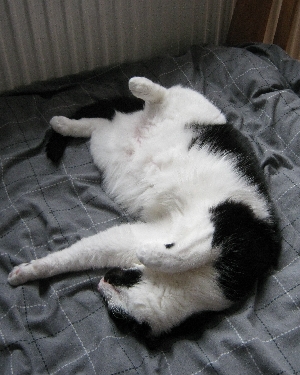
Like most cats, Oscar spends the vast majority of his time either sleeping or eating. I took the photo on the left this morning, when he adopted a rather interesting pose whilst sleeping on the double bed in our guest bedroom. Of course, as far as Oscar is concerned, it isn’t the guest bedroom, it is Oscar’s bedroom! Whenever we have visitors to stay overnight, we have a major exercise in advance of their arrival, removing cat hair from both beds in the guest bedroom.
The big difference for Oscar between living in a detached Rectory in North Oxfordshire and living in a second floor flat in the suburbs of Prague, is that he can no longer go outside and explore and supplement his diet with field mice and baby rabbits. Instead, he has become a ‘flat cat’. Overall he has adapted fairly well to this change, helped by the fact that in cat terms, he is now quite old. He will celebrate his thirteenth birthday next month. However, it must be said that quite frequently, his behaviour is what you might expect from a far younger cat. For example, he still quite regularly chases his own tail!
If you want to know more about Oscar and his life history, then I am instructed to provide a back link to Oscar’s own blog. It does need some updating but then, like everything else in Oscar’s life, he relies on his human slaves, (aka Sybille and me), to do it for him.
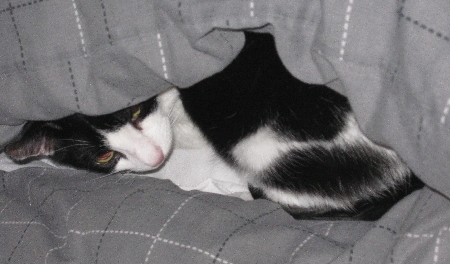
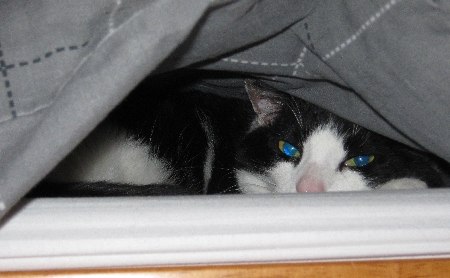
One of Oscar’s most recent habits has been, not just to sleep on top of the duvet on one of the beds in the guest bedroom, but under the duvet. Sometimes there is little more than a large bump in the duvet with a small amount of black and white fur protruding. The two photos below are good examples of this latest trend. You have to admit that he does look remarkably cute!
Prague is a beautiful city. One of the reasons it is so beautiful is being situated either side of the River Vltava. However, with the beauty of the riverside location comes the inherent danger of flooding. Unfortunately, over the centuries, this is something to which Prague has not been immune.
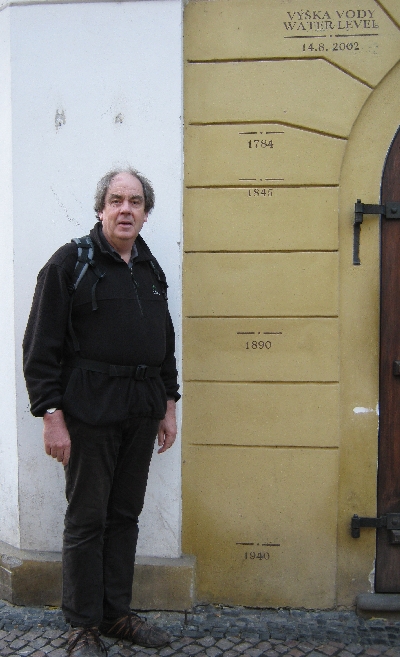
The picture on the left is of the wall of a building in Mala Strana, just south of Charles Bridge, and shows the height reached by floodwaters on several occasions during the last 300 years. Bearing in mind that I am quite tall, (1.87m or 6’ 1½”), and that where I am standing is well above the normal river level, it does illustrate the immensity and devastating nature of the flooding that engulfed Prague as recently as August 2002.
Apparently, there is an historic Prague expression, “The 100 Year Water”. As you can see, if you do a simple mathematical calculation, there actually was a 112 year gap between the last major flooding of 1890 before the flooding of 2002. And whilst the expression has no scientific evidence to support it, going further back, there were 106 years between the floods of 1784 and those of 1890.
The two photographs above show the location elsewhere in Mala Strana, of another marker of the height of the serious flooding in 1890. Here I was able to get a backwater/mill stream of the River Vltava into my picture which I hope will indicate the difference between the normal river height and where the floodwaters rose to 120 years ago.
In the floods of 1890, three arches of Charles Bridge were destroyed as shown in the historic photograph below. Fortunately, the floods of 2002 did not destroy any part of the historic bridge though they did leave it seriously weakened. Over the last two years, major renovation work has been undertaken to it, both above and below the waters of the Vltava, to strengthen it and restore it to its former glory. Hopefully, this work will be completed in the next few months, thus allowing locals and visitors to walk freely across it without having to negotiate their way around scaffolding and fenced off sections.
As for “The Hundred Year Water”, I don’t think I will be around to witness it in the early years of the 22nd century!
The damage caused to Charles Bridge by the floods of 1890. Image source; in public domain therefore assuming fair use.
This week, my blog celebrates its first birthday! I published my first blog post on 4th February 2009. Entitled ‘Episcopal Taxi Service’, it described the events that had taken place in the previous week at the end of January 2009. So now seems a good time to look back over my first year of being a blogger.
In one respect, the blog is more than two years old as my wife Sybille kindly bought my domain rickyyates.com more than a year earlier in December 2007. She did so at the same time as purchasing a domain for my son Phillip to help him promote his skills as a caricaturist. Not only was phillyates.com available but rickyyates.com was too. So she purchased them both as very unusual but highly useful Christmas presents to us both.
When I started the blog, I had two groups of people in mind. One was my family and friends back in the UK who wanted to know how I was getting on in my new home, new job and different circumstances in the Czech Republic. Rather than write individual emails or letters I could say instead, “Just look at my blog”.
My other initial intended audience were my former parishioners in the Shelswell Group of Parishes in North Oxfordshire whom I had served as Rector from January 1993 until September 2008. The Benefice of Shelswell (to give the group of parishes their correct legal name) produces an extremely good monthly magazine entitled ‘Shelswell News’ which is delivered to around two thirds of households in the parishes who in turn, pay £7.00 a year for the privilege of receiving it. In the first few months after my arrival in Prague, I wrote a couple of newsy pieces about my new life in the Czech Republic. However, I was very aware that I could not always continue doing so.
One unwritten, but very important rule for Anglican clergy is that, once you have ceased to be Rector/Vicar of a parish or group of parishes and have moved on to a new post or have retired, you do not interfere or remain involved in any way, in the life of your former parish(es). This is order that your successor can begin their ministry without any outside interference. So in the March 2009 edition of ‘Shelswell News’ I wrote saying, “In future, if you want to know the latest news from Ricky & Sybille in Prague, visit www.rickyyates.com”.
However, I was always conscious that, sooner or later, my new parishioners at St. Clement’s Anglican Episcopal Church, Prague would also find my blog and start reading it. Therefore, after a couple of months, rather than trying to hide it, I decided to add details of it to my ‘email signature’. Now, although hardly any of the congregation ever leaves a comment, I do know that it is quite widely read by congregational members. And yes – I am extremely careful not to say anything rude about any of them!!!!
Over the past twelve months I’ve managed to write 72 posts. On average, that is one every five and a half days – quite an achievement I reckon! Initially I relied on photographs or artwork legitimately downloaded from the internet, to illustrate my posts. Or I asked Sybille to photograph something for me so I could use it on my blog. Or I scanned the relevant item. But in June 2009, I bit the bullet and bought myself a relatively simple point and shoot digital camera and since then, the blog has almost exclusively been illustrated with my own photos. The exception is when I’m in the photo when I have to rely on my wife’s expertise.
I still get frustrated at my inability to quickly turn my thoughts and ideas into blog posts. I’m a stickler both for factual accuracy and correct spelling and getting both right takes time. And, as I’ve commented previously, I also try to spell Czech words, personal names and place names correctly, using the appropriate diacritics only to discover most web browsers turn some of them into ?????. Aagh!!!
My other frustration is the number of people who read my blog but never leave a comment. I do get comments, usually far too many of them. But most are spammers trying to promote online pharmacies, or sites offering pictures of so called ‘celebrities’ in various stages of undress, or comments that bear no relation to my post, trying to build back links to their own dubious websites. When someone clearly has read my post, then even if I don’t necessarily agree with what they say, I approve their comment. But sadly, such comments are few and far between.
Therefore as my blog enters its second year, if you enjoy reading it, don’t be afraid to say so. If you disagree with me or want to amplify what I’ve written, leave a comment. It will help me as I seek to articulate more of my experiences as an expat Anglican clergyman living in Central Europe during 2010.
One of the things anyone taking on being an Anglican Chaplain in the Diocese in Europe is warned about, is the fact that you will be working in relative isolation. In England, most Anglican clergy meet their nearby colleagues at regular meetings of the Deanery Clergy Chapter. These meetings provide an opportunity for mutual help and support as well as being a safe environment in which to sound off about difficult parishioners! Likewise, if you want to talk an issue over with your bishop or archdeacon, they are usually no more than a one hour journey away and a meeting can be easily organised.
Here in Prague, my nearest Anglican colleagues are in Warsaw to the north, Budapest to the east and Vienna to the south-east. As I have blogged previously, I only usually see my colleagues once a year at our Eastern Archdeaconry Synod. Actually, my nearest Anglican colleague is probably the Chaplain in Leipzig, but then he is in the Archdeaconry of Germany and Northern Europe!
Another contrast with England is that my Archdeacon Patrick Curran is not only Archdeacon of the Eastern Archdeaconry, but also Chaplain of Christ Church, Vienna. In England, most Archdeacons have no other responsibilities other than being Archdeacon. Some, including my previous Archdeacon Julian Hubbard, also have a role in the Diocesan Cathedral. But as Cathedrals have numerous ordained staff, duties are rarely very onerous.
Whilst Archdeacon Patrick does have a non-stipendiary colleague, Rev’d Aileen Hackl and more recently has been joined by a part-time curate, Rev’d Jady Koch, he still has an unenviable task of heading up a large chaplaincy in Vienna as well as trying to oversee our Archdeaconry which stretches from Poland, Czech Republic and Austria in the west, all the way to Vladivostok in the east and including all the former Yugoslavia together with Greece and Turkey.
Despite the distances and the workload, Archdeacon Patrick does try to visit each of the Chaplaincies within his Archdeaconry, once every three years. Although he was in Prague on 28th October 2008 for my licensing service, he had not made a Sunday visit here since the time of my predecessor John Philpott, who retired in April 2008. Therefore, he kindly agreed to make a weekend visit this past weekend, travelling by train from Vienna on Saturday 30th January and returning by train on the afternoon of Sunday 31st January.
Patrick’s visit got off to a slightly inauspicious start. Prague has four different mainline railway stations and the through train from Vienna to Hamburg stops at two of them. Patrick got off at the first station – we were waiting to meet him at the second! But realising what he must have done when he did not appear where we were expecting him; we made the reverse journey and eventually found him.
Although Archdeacon Patrick was only with us for twenty four hours, he still managed to pack in a two hour meeting with my Church Council and a private meeting with the Churchwardens, before Sybille and I shared an evening meal with him in one of our favourite eating places, the Na staré fare Bar-Restaurant, up the hill behind where we live.
On Sunday morning, he was the guest preacher at our Sung Eucharist as we celebrated the Feast of the Presentation of Christ in the Temple or Candlemas as it is commonly known. This was followed a very enjoyable soup and sandwich shared lunch with a large number of our congregation, held in the meeting room on the third floor of Klimentská 18 which, like the Church itself, we borrow from our host congregation, the Ceskobratrské Cíckve Evangelické / the Evangelical Church of Czech Brethren. After lunch, we successfully delivered him to the correct railway station for his return four hour journey back to Vienna.
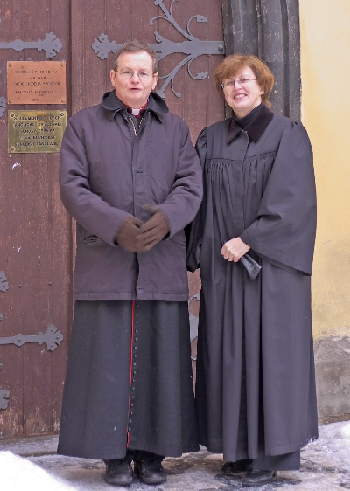
As you will see from the photo above, we were also joined for our service by the recently ordained Old Catholic priest, Petr Jan Vinš who is a fluent English-speaker. It was an extremely rare event to have three ordained clergy present for a service at St. Clements! Archdeacon Patrick also enjoyed meeting Pastor Eva Halamová who leads our host congregation. She is pictured here in her Geneva gown, alongside Patrick who put his coat over his cassock because it was so cold! The snow that you can also see in both photographs, is part of what fell on Friday 8th January and has yet to melt.
I have previously blogged about the issues that surround the fact that the United Kingdom drives on the left-hand side of the road in right-hand drive (RHD) vehicles, in contrast to the rest of continental Europe which drives on the right-hand side of the road in left-hand drive vehicles. However, it should be pointed out that the UK is not unique. Even within the European Union, three other member states also drive on the left in RHD vehicles, namely the Republic of Ireland, Malta and Cyprus.
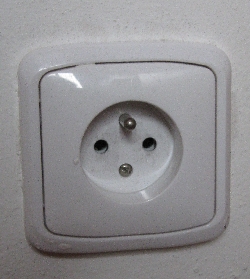
However, another difference between the UK together with the Republic of Ireland, in contrast to the rest of continental Europe, is in the design and format of their respective electrical plugs and sockets. All over continental Europe, electrical sockets take the form illustrated here; to receive a plug with two round pins. However, in the UK and Ireland, all electrical appliances are fitted with a plug that has three square pins and all buildings in both countries have the appropriate wall sockets to receive them.
Most British and Irish people, who have taken holidays in continental Europe, are well aware of this. Simple adaptors that allow you to plug your UK or Irish mobile phone charger or hairdryer into a continental socket, are sold in UK electrical shops and also on the ferries that travel across the English Channel.
One extremely helpful piece of advice I was given by a British member of the Prague congregation was that you could never have enough of these adaptors if you were to move to live in continental Europe. So it was that, when we moved to Prague in September 2008, we brought several adaptors with us. And when a British friend came to visit us five weeks later and asked before she travelled, if she could bring something with her that we needed, we immediately asked her to bring more adaptors!
For nearly a year after our move to Prague, every one of our electrical appliances that we had brought with us from the UK, worked perfectly well with a UK plug inserted into an adaptor and then into the appropriate continental wall socket. That was until mid-August 2009 when our dishwasher stopped working in mid-cycle. Thinking that the problem must be the plug not being properly connected to the wall socket, I investigated, only to find that part of the adaptor had melted and was black! Fortunately, the damaged adaptor easily disconnected, both from the UK plug and from the wall socket. I duly replaced it with a spare adaptor, assuming that the first adaptor must have been faulty.
It was on Christmas Eve 2009 of all days, that once again, the dishwasher stopped working. The problem was exactly the same as in August, only this time, not only had the adaptor melted but, in doing so, it had also damaged the wall socket and the UK plug on the dishwasher. It was a major battle to separate the adaptor from the wall socket on one side and from the UK plug on the other.
The resultant damage meant we had no dishwasher to wash the dirty dishes from our Christmas dinner and, to ensure that there would not be an electrical fire, we had to isolate most of the power points in our lounge/kitchen, meaning we couldn’t even have our Christmas tree lights on!
The eventual resolution of these problems does illustrate a marked contrast, both in work practices and costs, between the UK and the Czech Republic. On Christmas Day at our Family Eucharist, as I shook hands with an English/Slovak couple at the door of the Church, I mentioned our problem to them as they had previously helped us to find appropriate people to resolve issues relating to plumbing and domestic appliances.
Through their good offices, on the afternoon of Monday 28th December, an electrician arrived at our flat. He rapidly repaired the damaged wall socket, thus allowing us to once more use every electrical socket in the lounge. Then, having ascertained that we were very happy to have a heavy duty continental plug and lead attached to our dishwasher, to replace the damaged UK one, he quickly went out and purchased one and returned to fit it. For all of this – parts and labour – I was invoiced for the princely sum of 645 Kc/approximately £22.00.
From this unfortunate experience I have learned two things. One is that, adaptors sold to allow UK electrical appliances to be plugged into continental sockets are NOT designed for heavy duty appliances such as dishwashers. They are instead, designed for phone chargers, laptop computers, hair dryers and the like. That having been said, our washing machine has worked perfectly well with an adaptor, for the last sixteen months, without any problem. However, I nearly always wash clothes at 40 degrees Celsius whereas, even on the Eco cycle which I always use, the dishwasher heats water to 65 degrees Celsius.
The second thing is that, most Czech tradesmen are much more prepared to work hard, for far less remuneration, than their British counterparts. This may well explain why most plumbers now working in the UK are Polish. British tradesmen have priced themselves out of the market or, are unwilling to work slightly unsocial hours. If I had had a the same problem in the UK, my guess is that it would have been the week beginning 4th January before anyone would have been willing to pay me a visit. And the total cost would easily have been in excess of £100.00.