Snowy Prague

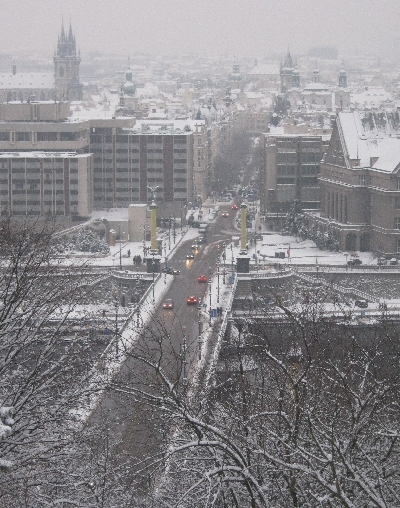
Chechuv Most, Prague; in the snow © Ricky Yates

Like much of Central and Northern Europe, the Czech Republic has recently experienced extremely heavy snowfall. Here in Prague, it started snowing just over a week ago on Friday 8th January and continued doing so, almost without interruption, until part way through Monday 11th January. According to the local media, around 40 centimetres of snow fell during this period, the heaviest snowfall here for 17 years.

Since it has stopped snowing, the weather has been overcast and grey with virtually no sunshine. Temperatures have risen slightly, but have rarely got above zero degrees Celsius, meaning that hardly any of the lying snow has melted. According to the weather forecast I have just looked at, it will start snowing once again tonight and ‘Heavy snow’ can be expected for the next two days!

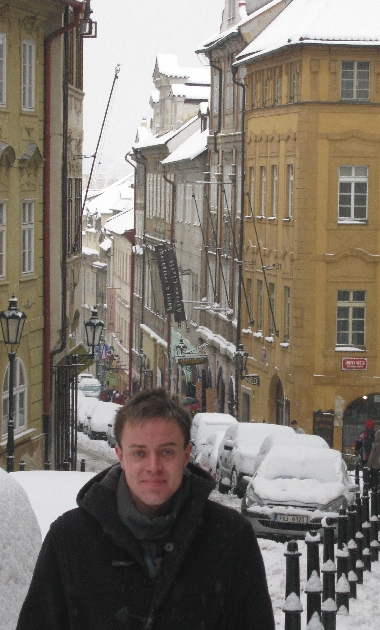
Phillip in the snow in Mala Strana © Ricky Yates

I was rather worried on Friday 8th January when it started snowing heavily, as my son Phillip was due to fly in that day from the UK to visit me over the weekend. Knowing that the UK had just experienced its worst snow for nearly thirty years, I had visions of his flight being cancelled, either because it couldn’t take off or because it couldn’t land. Fortunately, East Midlands Airport, which serves the city of Derby where Phillip lives, was less affected by snow than most other UK airports. Therefore his Friday afternoon flight was able to take off without any problems. And because the Czechs are used to dealing with snow, Prague Airport was still open and functioning, allowing his flight to land safely and on time.

I cannot help but contrast the way the UK deals with snow compared to the Czech Republic. As every British person knows, as soon as it snows in the UK, the country grinds to a halt. Last winter in London, snow falling caused the complete cessation of the capital’s bus services. Here in Prague last Sunday, despite two days of continuous falling snow, we travelled by tram from our flat in the north-western suburbs, to Church in the city centre, without any problems whatsoever. Likewise, the few flights to or from Prague Airport that were cancelled over last weekend, were almost all cancelled because of snow problems at other airports, particularly British ones, together with ones in northern Spain, not due to snow problems in Prague.

On Saturday 9th January, Sybille and I took Phillip on a walking tour of parts of Prague that he hadn’t had the opportunity of exploring on his three previous visits. We took the tram to Prague Castle and then walked down through Mala Strana, the ‘lesser town’ or ‘lower town’, that lies beneath the castle and is full of architectural delights. He was particularly keen to see the Lennon Wall and some of the artwork which lies outside the Kampa Museum alongside the Vltava River.

Phillip in front of the Lennon Wall © Ricky Yates
Father & Son in front of the Lennon Wall © Sybille Yates

I took this series of pictures during our walk last Saturday. I hope they help to convey the beauty and character of Mala Strana, together with Phillip’s enjoyment of his time with us.

Phillip outside the Kampa Museum © Ricky Yates

Phillip, Lion & Beer © Ricky Yates
The French Embassy in Mala Strana © Ricky Yates

Christmas in Prague

Update November 2012 – The post below was written by me nearly three years in January 2010, just after my second Christmas in Prague. It continues to rank very high in Google & other search engines for anyone using the search term ‘Christmas in Prague’. Therefore, if you have just arrived here because of doing exactly that, rest assured that much of what appears below is still true, three years on. And if you are in Prague over Christmas 2012, details of our Christmas services can be found here.

Original post.

Christmas Crib in Staromestské námestí/Old Town Square, Prague © Ricky Yates

Having arrived in Prague in September 2008 in order to take up my post as Anglican Chaplain, it meant that Christmas 2009 was my second Christmas here. Therefore this time, I had a far clearer understanding of what I might expect to experience over the festive season.

Most Anglican clergy in the UK, see their largest congregations over the Christmas period. It was certainly my experience in North Oxfordshire that I could frequently have up to 25% – 30% of the population of one of my villages in Church either for a service of Lessons and Carols or on Christmas Eve/Christmas Day. Historically, the Church of England always used to use the number of Easter communicants as a means of measuring its numerical strength. But whilst these are still counted, increasingly the largest Church attendance figures are registered at Christmas services.

I have often reflected upon why this should be and have concluded that most people find the infant lying in the manger, very non-threatening over and against an adult man being put to death upon a cross. There is comfortableness about Christmas whereas Easter provides a real challenge. However, the Prague Anglican Chaplaincy currently maintains the more historic pattern, as my largest congregation since being here is still all those who worshipped at St. Clement’s on Easter Day 2009 as I have described in a previous blog post.

The reason why this should be the case arises from the nature of the regular congregation. The majority are English-speaking expatriates. Thus the Christmas-New Year period is seen as an occasion to return to their own home countries in order to celebrate the festival with their wider families and friends. This is further exacerbated by the fact that many in the congregation either teach in one of the various international schools in Prague and/or have children who attend one of these schools. The three week Christmas school holidays, together with summer months of July and August, provide the only real opportunity for a trip back ‘home’.

Therefore, like many UK Churches, our service of Lessons and Carols was somewhat displaced into the Advent Season and was held on the evening of Sunday 13th December. This allowed nearly all the regular congregation to attend as it was before the beginning of the Christmas exodus. Additionally, we were joined by a number of other regular worshippers – those who regularly attend Church once a year for the Carol service!!!

Despite so many of my regular congregation being away over Christmas, I still held a Midnight Eucharist on Christmas Eve. There were a scattering of regulars in attendance, together with various visitors spending Christmas in Prague, including a number of South Asian young people staying at Sir Toby’s Hostel. On Christmas Day morning at 11am, there were many more members of the regular congregation in attendance for the Family Eucharist. These were mainly ‘English-speaker married to Czech’ couples and their children who form a growing part of the congregation and bring an ever-increasing stability to it. As at midnight, numbers were also boosted by numerous visitors to Prague.

Christmas Market stalls in Staromestské námestí/Old Town Square, Prague © Ricky Yates

Christmas Market stall in Staromestské námestí/Old Town Square, Prague © Ricky Yates

During December, Prague attracts many visitors because of its Christmas markets. These take place in various parts of the city, particularly in Staromestské námestí/Old Town Square. The markets are predominantly aimed at international visitors and we both particularly enjoyed seeing two more examples of ‘Czenglish’ that appear below.

‘Mulled Vine’ © Ricky Yates

‘Rousted Conkers’ © Ricky Yates


Št’astný nový rok! – Happy New Year

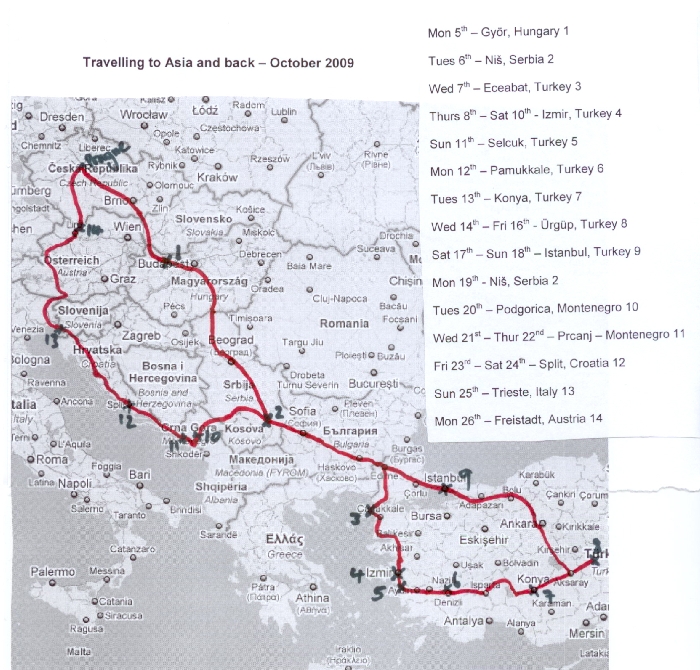
In my last post of 2009, I did promise to start blogging again about ex-pat life in the Czech Republic rather than our October journey to Turkey and back. However, this afternoon, I had a brainwave as to how I could produce a map that I could put online to show our journey. So here it is! I hope it will help readers understand better my previous twenty-one posts about our trip.

Št’astný nový rok! Happy New Year!

Home to Prague

Premošten, Croatia © Ricky Yates

When I wrote my first blog post about travelling to Asia and back which I posted on 30th October 2009, three days after our return to Prague, I promised to write about our trip ‘over the next few weeks…….’ As you can see, I was somewhat optimistic – it has taken me just over two months rather than a few weeks! But here on the last day of 2009 is my twenty-first and last post about our journey of 4,500 miles/7,200 kilometres, through twelve countries over a period of twenty-three days. Once this is posted, I shall return to writing about Church and expat life in Prague, something I’ve only done twice in the last two months on my blog.

We explored Trogir in the bright morning sunshine of Sunday 25th October before setting out to drive some serious kilometres in order to complete the journey home to Prague in two days. Initially, we continued driving along the main coastal highway reaching Premošten, the furthest south we had travelled in Croatia during our July holiday. Then it was on to nearby Šibenik where we left the coastal highway for the nearby motorway which runs parallel to the coast but some distance further inland. We rejoined the coastal highway north of Zadar where the motorway heads off further inland towards Zagreb.

After lunch, we drove further up the Croatian coastal highway with splendid views across to the offshore islands of Pag, Rab, and Krk. Then it was back onto another motorway which took us around the port city of Rijeka and on into the hills and to the Croatia – Slovenia border.

On the Slovenian side, we were most surprised to be waved across the border without even a cursory look at our passports bearing in mind this is the border of the Schengen area. The whole idea of the Schengen agreement is that thorough checks are carried out as people enter the Schengen area so that no checks need to be made at borders within the area. But if checks aren’t carried out at the border…….! Clearly we looked middle-aged and non-threatening!

We were only in Slovenia, (country number ten on our travels), for a relatively short time before we entered country number eleven, Italy. Here we headed downhill back to the Adriatic coast and into the city of Trieste where we stayed overnight.

The following day, we finally had to bid farewell to the sea as we headed northwards inland towards the Alps. One of the few disadvantages of living in Prague is that it is so far from the sea! We travelled via the Italian autostrade past Udine and up into the mountains to the Austrian border. Here we bought our final vignette, this time for the Austrian autobahnen. We then drove past Villach, Salzburg and Linz right across Austria, eventually reaching the small town of Freistadt where we had stayed on the first night of our journey to Croatia in July 2009 and where we stayed once more on the last night of our journey to Asia and back. Early the following afternoon, Tuesday 27th October, we arrived safely back at our Chaplaincy flat in Prague.

It was a most wonderful trip and our only regret is the number of places we had to drive by without the time to explore them. Looking back, on a few days, we were in the car for a bit longer than we would have liked to have been. I must admit to have forgotten how big Turkey is! But needing to attend the Synod meeting in Izmir, it was a travel opportunity not to be missed. In particular, it was fascinating for me to re-visit places nearly thirty-five years after my first visit and for Sybille to see them for the first time.

Trogir

Bell Tower of the Cathedral of St. Lovro, Trogir © Ricky Yates


About 30 km along the coast to the west of Split is the gorgeous and tiny medieval walled town of Trogir. It is situated on a small island that lies in the channel separating the Croatian mainland from the larger island of Ciovo. (There should be a hacek over the ‘C’ but most web browsers won’t cope if I put one in!) There is a road bridge linking Trogir to the mainland and another one linking Trogir with Ciovo.


Trogir is littered with Romanesque and Renaissance architecture, the result of many years of Venetian rule. Chief amongst its many glories is the Cathedral of St. Lovro with another exceedingly tall bell tower. The Romanesque portal dating from 1240 features some amazing intricate carving as can be seen in the photograph of the Tympanum below.


The Tympanum above the main entrance of the Cathedral of St. Lovro, Trogir © Ricky Yates

The pillars on either side of the doorway have a carved lion (the symbol of Venice), above which Adam and Eve are depicted. These are very similar to carvings either side of the door of the Cathedral of St. James at Šibenik that I featured in an earlier blog post about our trip there in July.

Adam depicted on the portal of the Cathedral of St. Lovro, Trogir © Ricky Yates

Eve depicted on the portal of the Cathedral of St. Lovro, Trogir © Ricky Yates

Wandering around the streets and alleyways of the old town, there are architectural delights to see at every turn. Below are two examples – the Town Hall and another Church whose dedication I was unable to ascertain.

The Town Hall, Trogir © Ricky Yates
Church in Trogir © Ricky Yates