Although Saint Clement’s Church is located in the centre of Prague, it does lie slightly away from the streets most frequented by visiting tourists. It is situated in Klimentská, the street taking its name from the Czech form of Saint Clement, Svatý Kliment. Klimentská is accessed from Revolucní, which runs from Námestí Republiky to the River Vltava. Whilst Námestí Republiky is bright and busy, particularly since the opening in October 2007 of the Palladium Shopping Centre, Revolucní has always struck me as being a little run down, with a number of empty premises at street level.
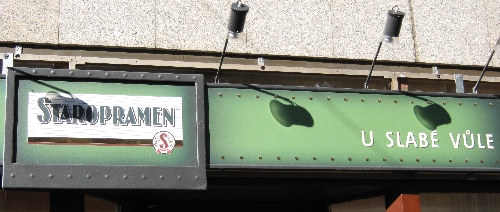
It was therefore a most pleasant surprise a couple of months ago, when alighting from the Number 8 tram at the Dlouhá Trída tram stop on Revolucní, to see that one of these vacant premises directly alongside the tram stop, had been transformed into a new Bar-Restaurant entitled U Slabé vule. A quick examination of their menu and price list displayed in the window convinced us to try it out for Sunday lunch after our service.
For their city centre location, prices at U Slabé vule are remarkably reasonable. 0.5l of Staropramen is 25 Kc (£0.90). Meal prices range from 120 – 150 Kc (£4.00 – £5.00) with generous portions very nicely presented. Their printed menu, in Czech, German and English, is most notable for the almost complete absence of ‘Czenglish‘.
The premises themselves are large, reaching through as far as the street parallel to Revolucní to the west. It is almost divided in two by the kitchen and bar with the whole of the section on the Revolucní side being ‘non-smoking’, a rare provision in the Czech Republic. What is more, they enforce it!!! In several other bar-restaurants we have frequented, whilst there is nominally a non-smoking area, as soon as a smoker lights up, rather than telling him/her to move, the waiter brings an ashtray. At U Slabé vule, the customer is told to move to the smoking area – Halelujah!
The last two Monday evenings, U Slabé vule has become the venue for a new activity in the life of St. Clement’s Anglican Episcopal Church – Czech conversation classes led by my native English, Czech-speaking Churchwarden, Gerry Turner. Over a glass or two of various varieties of liquid refreshment and a simple nicely presented meal, a small group of us are trying to lose our inhibitions and converse in Czech. Will I be successful or will I have what the name U Slabé vule actually means which is – ‘The Weak Will‘!!
PS – As you will see from the photo above, vule should really have a kroužek (ring) above the ‘u’ which is meant to lengthen the vowel sound by 30%. As with many other diacritics, most web browsers can’t cope and would render it as ‘?’, hence I’ve had to leave it out.
The imposing fortress and small town of Terezín lies about 80 km north of Prague. It is situated at the strategic location of the confluence of the Labe (Elbe) and Ohre (Eger) rivers and was constructed on the orders of the Austro-Hungarian Emperor Joseph II in order to keep the Prussians at bay. It was formerly known as Theresienstadt in honour of the Empress Maria Theresa. On the eastern side of the Ohre lies the original small fortress whilst on the western side there is a far larger fortress within which there is a small town with a sizeable central square and a grid iron pattern of streets.
In 1940, soon after the outbreak of the Second World War, the Gestapo took over the small fortress to use as a prison. A year later, the resident population of about 3000 people were evicted from the town inside the main fortress and the whole complex was then turned into a transit camp for European Jews as part of Hitler’s ‘final solution‘.
Over the following four years, more than 140,000 Jews passed through Terezín. Around 33,000 died here because of the appalling cramped conditions. At one point, there were over 58,000 inmates in a town that previously had a population of 3000! More than 87,000 were sent on to their death in concentration camps further east, in particular to Auschwitz. Only around 17,000 survived and some of these died from an outbreak of typhus around the time the camp was liberated by the Red Army in May 1945.
Ironically, despite the horrific role Terezín played in the Jewish holocaust, it was also used as a vehicle for Nazi propaganda and portrayed to visitors from the International Committee of the Red Cross as a self-administering ‘Jewish Refuge’. Despite the awful conditions, there was an amazing amount of community life with plays and concerts being performed and artwork and literature produced.
The Terezín Memorial was established in 1991 in order to retell the story of what happened here, to preserve and display art and literature produced by those interned, and to preserve numerous buildings including the crematorium, a fascinating Jewish Prayer room with Hebrew inscriptions from the Psalms on the walls, together with the whole of the small fortress, little changed from how it was in 1945.
Terezín had been on Sybille’s and my list of places to visit since we moved to the Czech Republic. Therefore when my sister Jenny stayed with us recently and also expressed an interest in going there, we took the opportunity to do so. It is not an enjoyable day out – far from it. Rather it is quite a sobering experience but certainly one I’m very glad I’ve experienced.
There is an excellent museum in two parts. The Ghetto Museum itself tells the story of Terezín and puts it in the context of the wider events of the Second World War. Then within the nearby Magdeburg Barracks there are displays of the amazing cramped conditions in which internees were forced to live, as well as displays of artwork, music and literature, all of which was produced in these appalling circumstances. You can then walk around the town to visit the other sites including exploring the whole of the small fortress. Everything is explained in four languages, Czech, German, English and Hebrew, and for once, the English is excellent with hardly any examples of that peculiar language I call Czenglish.
Terezín is a slightly eerie place and it must be somewhat strange for the nearly 3000 people who once again reside in the town to be surrounded by all this horrific relatively recent history. But as the seventieth anniversary of the outbreak of World War Two is currently being marked in Poland and elsewhere, it is important that all that happened at Terezín is preserved and re-told to the next generation.
Longstanding readers of my blog will remember that, back in May, I wrote about Karen and Anna, two American TEFL teachers from my congregation who were forced to leave the country because of the failure of their employer, the Caledonian School, to obtain work permits and visas for them. The original posts entitled ‘More Problems with Czech Bureaucracy’ and “Update on my previous post ‘More Problems with Czech Bureaucracy'”, can be found by clicking on these titles.
I gained a certain amount of notoriety because of these posts and as a result, received an invitation to meet with Monika Kubátová, the Executive Director of the Caledonian School, so she could explain to me all that they were doing to try and resolve the issues I had blogged about. This meeting took place on Thursday 21st May. I wrote a further blog post after the meeting in which I recounted what I was told by the Executive Director as well as expressing my own personal opinion regarding what and why all this had happened. Entitled ‘Discovering the Power of Blogging!!!’ it can also be found by clicking on the title.
In that third blog post, I famously said that I believed that “Caledonian have now got an agreed framework for visas with the Foreign Police that should work in the future” but I qualified my remark with the well known saying that “the proof of the pudding will be in the eating’. Sadly, all the assurances given to me by Monika Kubátová have proved worthless – the pudding has left a very foul taste.
Anna flew from Prague to Croatia and spent some time on the beach before travelling on to the capital Zagreb. Here, being outside the Schengen area, she reapplied for her work permit and visa at the Czech Embassy before travelling on to Bosnia, Montenegro and then Turkey. She is currently working as an au pair in Istanbul until the end of September.
Karen returned home to the USA and spent sometime with her daughters. Slightly later than Anna, she reapplied for her work permit and visa at the Czech Consulate in Chicago.
Whilst we were ourselves on holiday in Croatia in July, we received an email from Anna saying that she had heard that day from Caledonian School that her second visa application had been denied. There was no great clarity as to why this should be other than some vague reference to overstaying her original 90 day tourist visa. Then on 19th August, Karen finally heard that her second visa application had also been denied. You can read her own brave blog post, written a week later ‘The Czech government denied my visa’ by clicking on this title.
To say I’m angry would be putting it mildly. I feel so annoyed that a combination of incompetence by the Caledonian School and bloody-mindedness by the Czech Foreign Police, has completely messed up the lives of both these ladies. Karen in particular, has let her house, disposed of many of her possessions, in order to live and work in the Czech Republic for a number of years. She did all of this based on promises given to her by the Caledonian School which they have totally failed to fulfil.
I am also angry because I have effectively been made to look a like a fool. The reason I was asked to meet with Monika Kubátová back in May was because my first two blog posts were being found by prospective TEFL students and had begun to generate bad publicity for Caledonian School. By posting a third time, in part regurgitating what I was told by Monika Kubátová at my meeting with her, that bad publicity was counteracted. Yet what I was told – yes promised by her, has proved to be without foundation.
When I heard about Anna’s second visa application being refused, I wrote to Monika Kubátová to ask why all her reassurances had proved worthless. It took nearly three weeks, together with a reminder email, before I got a reply. The blame was inevitably put on the Czech Foreign Police. “The system is changing before our eyes“ was the lame excuse which was a wording effectively copied and pasted from an email reply I received from Caledonian back in April, when I first raised the matter.
At this point in time, poor Karen and Anna do not know what they can do. Both of them have belongings still sitting in Prague but cannot ascertain whether they can return, purely as tourists, to collect them. If they fly into Prague airport, will they be admitted?
In the meantime, I offer the following advice to any English-speaking, non-EU citizen who is thinking of coming to Prague to teach English as a foreign language. By all means plan to come – despite the economic downturn there is still a considerable demand from business people and others, who want to learn or improve their English. But don’t come to Prague on a tourist visa to undertake a TEFL teacher training course at one of the language schools here. Instead, take a TEFL course in your own home country, USA, Canada, Australia etc.
Once you have a TEFL teaching qualification, apply to work for one of the schools here. Once you have a job offer, then apply for a work permit and visa whilst still in your own home country and don’t try and travel here to work until it has been granted. Caledonian and and the other language schools will not like me saying this because they make good money from people paying for their TEFL teacher training courses. Not all students pass and, even some who do, decide not to stay on and teach. And that is where the various schools make quite a bit of money. They don’t just make money from providing English language classes.
At the present time and from my recent experience, I would not trust any promises made by Caledonian or other language schools about coming here to train as a TEFL teacher on a tourist visa and “we’ll help you get a work permit and permanent visa once you are here”. Let the experience of Karen and Anna be a salutory lesson.
As most people who know me will already be aware, I have had a lifelong interest in canals and inland waterways. I was therefore delighted to discover that the Vltava, the river on which Prague is situated, is navigable. Engineering works, begun in the nineteenth century, have provided locks, navigable cuts and a sufficient depth of water to allow quite sizeable craft to reach the city.
The Vltava (or Moldau in German) leaves the Labe (Elbe in German) at Melnik, about 50 km north of Prague. From Melnik, it is possible to travel downstream along the Labe/Elbe all the way to the North Sea at Hamburg as well as connecting with canals and rivers that lead to Berlin and other German cities. Upstream of Melnik, the Labe is also navigable as far as the Czech city of Pardubice.
Not only is the Vltava navigable, it still carries quite a considerable amount of commercial traffic as far as Prague. From my observations, this mainly consists of bulky materials such as sand and gravel. The use of river transport in this way saves the surrounding roads from a large number of additional truck journeys which would otherwise be required to shift these goods.
In the centre of Prague, the Vltava is populated by many passenger vessels offering tourists trips along the river to view the city sights or to enjoy a meal in a floating restaurant. Most of these vessels rarely pass a lock, confining themselves to the section of the river between Hlávkuv most (just east of St. Clement’s Church) and to just south of Karluv most (Charles Bridge). However, a few months ago, I was delighted to discover that one company does offer a far longer trip upstream on the Vltava, all the way to the head of navigation at Slapy, nearly 40 km south of Prague city centre.
Pražská Paroplavební Spolecnost only run this trip on Saturdays and Sundays between early May and mid September. As Sundays are out because of my profession, if I was going to make the trip this summer, it was going to have to be on a Saturday. And having my sister Jenny staying with us for ten days recently gave me the perfect excuse. Here was a day out that we would both enjoy! So having for once, completed the Sunday sermon on Friday, on Saturday 15th August we set out early from the flat, travelled by bus and metro to Palackého námestí, bought our tickets from the office on the quayside, all ready for our departure upstream at 9am.
The boat was smaller than I was expecting and was quite packed with standing room only. However, so far as I was aware, Jenny and I were the only non-Czechs on board. This trip clearly appeals to Czech people who want to head out of Prague into the surrounding countryside but clearly doesn’t normally appear on the agenda of visiting foreign tourists.
The initial part of the journey out of Prague goes past the Staropramen Brewery on one side of the river and the twin spires of the Church of St. Peter & St.Paul at Vyšehrad on the other. Then follows the southern suburbs of the city, together with passing our first lock at Modrany. Soon afterwards comes the confluence of the River Berounka and then the Vltava enters an ever increasingly beautiful wooded valley at Zbraslav.
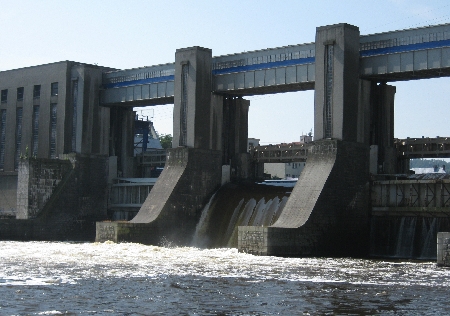
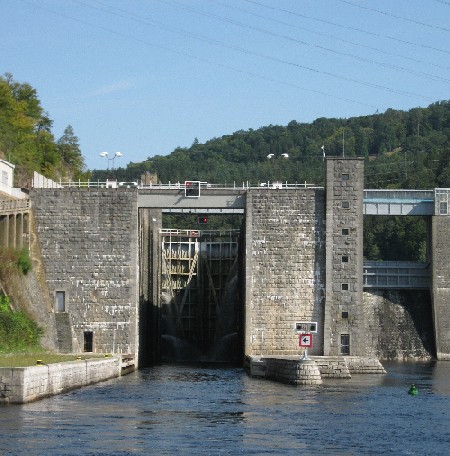
About 5 km further on lies the next lock at Vrané. This is situated at one side of a fairly substantial dam built across the river to generate hydro-electric power. Beyond this dam and lock, the river is wider because it is effectively a ribbon lake.
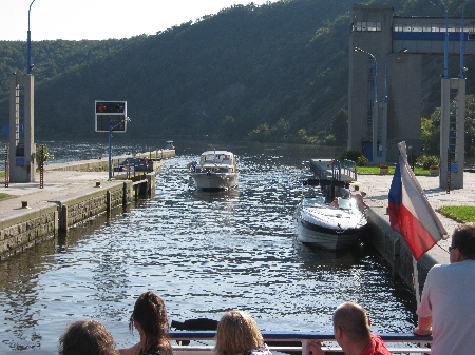
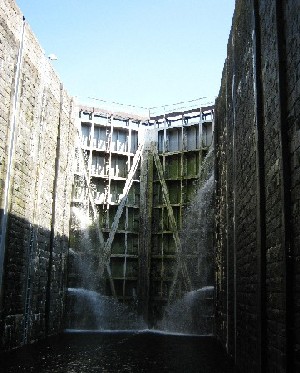
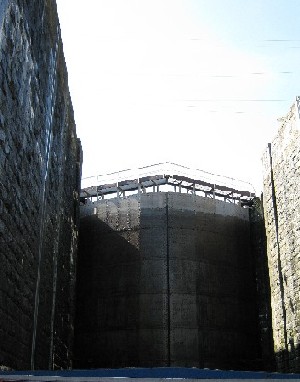
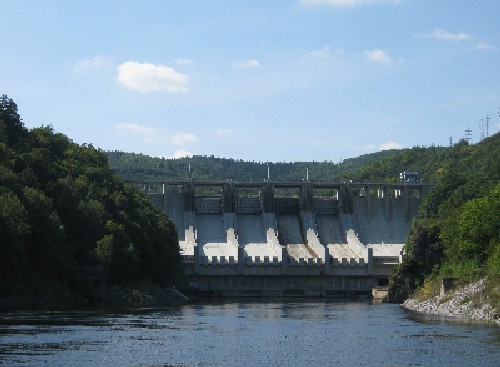
After cruising for over three hours and nearly 30 km, we arrived at the town of Štechovice. Here passengers both got off and on before we set out on the final leg of the journey. Ahead lay a much higher dam, also generating hydro-electricity, and therefore with a far deeper lock alongside. In fact the lock is monstrous – certainly the deepest lock I’ve ever passed through. The mind boggles as to how much water it takes to fill it! But eventually, our boat rose out of the bowels of the lock for a further forty minutes of cruising past beautiful wooded hills until we reached journeys end, the quay at Nové Trebenice, immediately below the very impressive Slapy Dam.
The Slapy Dam was built during the Communist era between 1949 – 1955. Like the earlier smaller dams we passed, it also enables the generation of hydro-electricity as well as helping to control the river flow, hopefully helping to prevent flooding further downstream during times of heavy rainfall. But for unknown reasons, no lock or boat lift was provided when it was built and the dam therefore prevents through navigation. The lake behind the dam is extremely popular with small yachts and pleasure boats. But none of them can cruise down the river to Prague because the Slapy Dam blocks the way.
After a quick lunch at a bar-restaurant in Nové Trebenice and a walk out on top of the dam, it was back to the boat for the return journey. This was fortunately less crowded as a number of people only did the journey one-way and got the bus back to Prague. It thus enabled me to more easily take the photographs that accompany this post. We arrived back at the quay alongside Palackého námestí at 6.30pm somewhat tired and a little sunburnt but having had a most enjoyable day.
I’m sorry for the two week delay in posting my final piece about our time in Croatia. Since being back in Prague we’ve had a succession of visitors which has left little time for blogging!
We spent the night of Monday 20th July, our last in Croatia, in the town of Karlovac. Although considerable work has been done to repair the damage caused to buildings in Karlovac during the 1991-95 conflicts that followed the break-up of the former Yugoslavia, there still remains much to do.
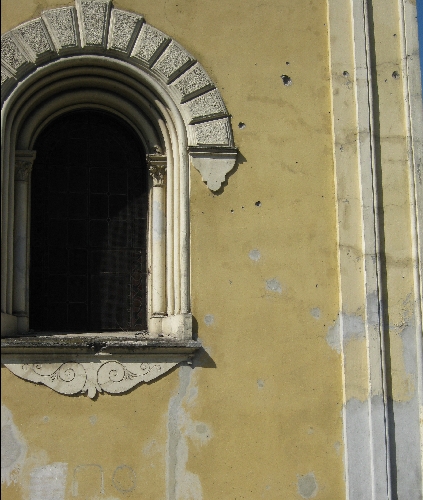
The picture on the left is of part of the outside wall of a Roman Catholic Church attached to a Franciscan Monastery in the centre of the town. You can clearly see where holes caused by bullets and shrapnel have been filled in at lower levels whilst higher up, they remain un-repaired. Within the nave of this Church there were three modern stained-glass windows, presumably replacing ones damaged beyond repair during the fighting.
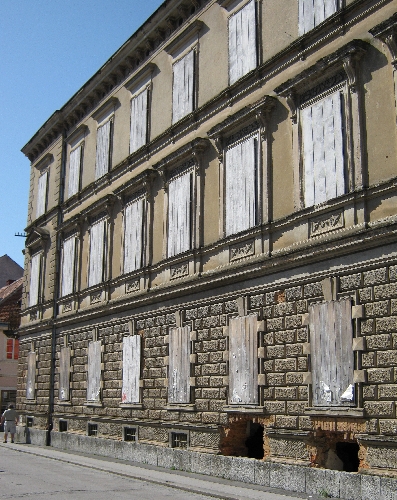
However, on another street corner not very far away, was this completely boarded up building that had clearly also been badly damaged in the conflict. The plaque on wall offered a partial explanation in Croatian, English and German. Until the ‘Croatian War of Independence’, it had served as an Orthodox Seminary and the administrative headquarters for the Orthodox Church in the surrounding area. The sign acknowledged that the building had been badly damaged in the war, but offered no further explanation as to why nothing has been done to repair it since.
The explanation unfortunately lies in the division between West and East that took place in the history of the Christian Church more than a thousand years ago. The division between Rome and Constantinople, between Roman Catholic and Orthodox which in turn is, the division between Roman Catholic Croat and Orthodox Serb. As with the area around Knin, when the Croatian army regained full control of Karlovac and the surrounding area, the vast majority of the Serb Orthodox population were either driven out or chose to flee. There is therefore now very little of the Serbian Orthodox Church functioning in Croatia so far as I could ascertain.
Much as we both enjoyed our time in Croatia, I did feel that this situation is a very bad reflection on Christianity as whole, regardless of different traditions. Christians ought to be at the heart of the important work of reconciliation. Instead, it seems that the respective Churches have allowed themselves to be far too closely associated with ardent nationalism.
The Roman Catholic Church is remarkably strong in Croatia. But I very much sense that this is in part due to its close association with the resurgence of the Croatian national identity which has shown very little concern for any minorities. Likewise, the Serbian Orthodox Church has been very much at the heart of the rise of Serbian nationalism with once more, very little concern for non-Serbs. This phenomenon is unfortunately not unique to the former Yugoslavia. The Russian Orthodox Church, seeking to recover from its suppression during the Soviet Communist era, is now very strongly associated with the rise of Russian nationalism and shows very little tolerance for anyone of a different persuasion.
Of course, these are the reflections of an outsider on a two week visit. There may be groups of Christians on either side of the divide who are working to bring about reconciliation. I hope there are! For whilst many buildings have been or are in process of being repaired, many lives have be irreparably damaged. The Christian Church, regardless of tradition, ought to be playing its part in bringing healing to the lives of those on both sides of the Croat-Serb divide, who have suffered so much as a result of this conflict.