A wonderful Sunday at the Frauenkirche, Dresden

Frauenkirche, Dresden © Ricky Yates

As is explained here on the Frauenkirche website, the monthly English-language Anglican service of Evening Prayer for which I am responsible, is made possible because of the Meissen Agreement. This is an ecumenical agreement, made in 1988, between the Evangelische Kirche in Deutschland (EKD) – the main German Protestant Church, and the Church of England. The implementation of this agreement and seeking to take it to the ultimate goal of full communion between the two Churches, is overseen by a body called the Meissen Commission.

In August last year, having ascertained that Rt Rev’d Dr Jonathan Gibbs, Suffragan Bishop of Huddersfield, is the current Anglican Co-Chair of the Meissen Commission, I wrote to him asking whether there was any space in his episcopal diary when, wearing his Meissen Commission ‘hat’, he could come to Dresden and be the preacher at the English-language Anglican service. Knowing that bishops can have very full diaries, I gave him all the dates of the 2019 services to choose from. He kindly replied a few days later, saying he would be very pleased to accept my invitation and that he would confirm a date very soon, once he had reviewed his 2019 diary commitments.

Bishop Jonathan’s reply arrived the same day as I was attending a meeting of the Predigerrunde in Dresden, to plan all the Frauenkirche evening services in the first four months of 2019. So I mentioned to Frauenkirchenpfarrer Sebastian Feydt, that I had invited Bishop Jonathan to preach at one of the English-language Anglican services in 2019 and was awaiting confirmation of a suitable date. He was most pleased & asked me to let him know when I had an agreed date. If the chosen date didn’t clash with an existing booked preacher, he would then like to invite him to preach auf Deutsch at their 11.00 service that morning.

Therefore, to cut a long story short, and to ensure that this blog post does actually get published, two months ago on Sunday 17th March, I spent a long but most enjoyable day in Dresden with Bishop Jonathan and his wife Toni.

For the 11.00 Morning Service in German, I sat with Toni Gibbs in the congregation. The service was led by Sebastian Feydt and Bishop Jonathan preached. Toni had the complete English text of her husband’s sermon on her tablet so we both were able to easily follow what he was saying in German. Bishop Jonathan explained to me afterwards that he had first written the sermon in English, then translated it into German, before sending it to a German native speaker, to double-check his grammar and sentence construction 😉

The sermon was based on John 3. 14-21 including those well-known words in verse 16, ‘God so loved the world that he gave his one and only Son…’ He challenged the congregation as to how we show the love of God to every human being, including those who are different to us. He said, ‘As we approach 29th March, the date of Brexit, we as Christians need to be speaking up for a better way of living, one that demonstrates the love of God for every single human being, both in Europe and throughout the world. We need to lift up Jesus Christ, not as a tribal symbol of a Christian sub-culture, but as the Lord and Saviour of the whole of humanity.’

If you can read German, then the complete text of Bishop Jonathan’s sermon is currently available on the Frauenkirche website here. In the week following his Dresden visit, the ‘Yorkshire Post’ published an edited extract of the sermon in English, which can be found here.

Within his sermon, Bishop Jonathan gave an outline of his own life story, explaining that for six years (1992-98) he was priest of the Anglican Church in Basel, as well as priest of the Anglican Church in Freiburg-im-Breisgau. He then said, ‘As perhaps you can hear, it was in Basel that I first learned German!’

These words were picked up by Sebastian Feydt when giving the notices near the end of the service. He reminded the congregation of the Anglican service that evening, at which Bishop Jonathan would once again be preaching, this time in English, but with a Swiss-German accent. The whole congregation collapsed with laughter!

Frauenkirchenpfarrer Sebastian Feydt & Bishop Jonathan Gibbs © Ricky Yates

Following the Morning Service, Sebastian Feydt gave +Jonathan, Toni and I, a personal guided tour of the Frauenkirche. This was followed by a most enjoyable lunch in a nearby restaurant, at episcopal expense 😉 +Jonathan was also very keen to climb to the top of the Frauenkirche dome to enjoy the spectacular views across Dresden, something I had done two and a half years ago. So after lunch, that is what we did.

It is interesting to compare this photo taken by me back in August 2016……
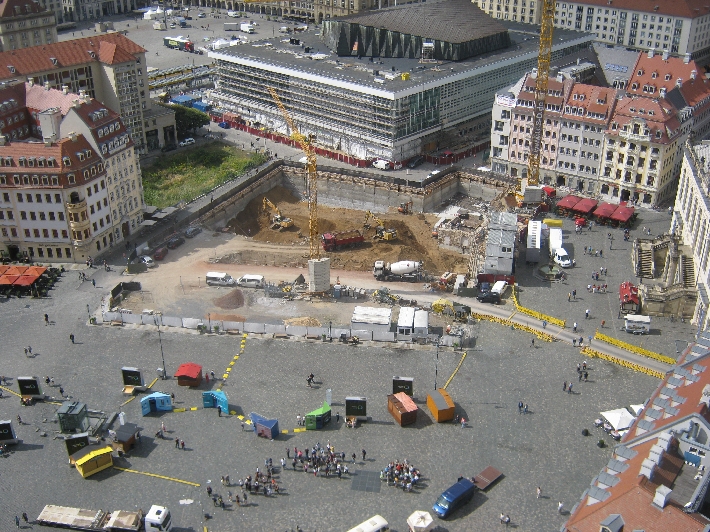
Neumarkt, with construction work continuing © Ricky Yates

.with this one that I took on Sunday 17th March 2019.

Neumarkt, with construction work complete © Ricky Yates

Then after a brief break, starting at 18.00, I led the English-language Anglican service of Evening Prayer at which +Jonathan preached. This service continued the theme of Versöhnung leben – Living reconciliation, which as I explained in my earlier post, has involved preaching our way through the Coventry Litany of Reconciliation. +Jonathan thus addressed the line, ‘Our indifference to the plight of the imprisoned, the homeless, the refugee, Father, forgive.’

+Jonathan took as his main Biblical text, Matthew 25. 31-46, where Jesus describes the judgement of the nations, ‘When the Son of Man comes in his glory’. Jesus describes how people will be separated just as a shepherd separates the sheep from the goats. The ‘sheep’ on the right will be invited to, ‘inherit the kingdom prepared for you’. The reason for the invitation is that when they saw the king hungry, they fed him, when they saw him thirsty, they gave him something to drink, when he was in prison, they visited him etc.

The ‘righteous’, as they are called, are surprised by this because they never saw the king in any of the situations he describes. The punchline of the story comes in the king’s reply. ‘Truly I tell you, just as you did it for the least of these who are members of my family, you did it to me’. In turn, those on the king’s left receive his judgement because their failure to care for the hungry, thirsty, naked, sick, or those in prison.

+Jonathan went on to point out that this passage should not be used to preach a gospel of justification by works, as some people try to do. Taking note of the context of the story in the Gospel of Matthew, it is the last instructions given by Jesus to his followers, before his death on the cross. In other words, if you want to be my disciples, this is how you should live out your faith.

With +Jonathan & Toni Gibbs following the evening service © Toni Gibbs

In the days following Sunday 17th March, I received an appreciative email of thanks from +Jonathan and was copied in on an equally appreciative email from Sebastian Feydt to +Jonathan. In his email, Sebastian Feydt expressed the hope that +Jonathan would be willing to re-visit the Frauenkirche at some future date. So I do hope to try and arrange a similar Sunday, some time in 2020.

Versöhnung leben – Living reconciliation

‘Building bridges, living reconciliation, strengthening faith’ © Ricky Yates

As I have previously written, the evening services at the Frauenkirche, Dresden, follow a theme over a period of several Sundays. The monthly English-language Anglican services of Evening Prayer for which I continue to have responsibility, are not regarded as an exception, but rather as part of the agreed theme. The themes are agreed at a meeting of the Predigerrunde/Preachers round, which is attended by several German Protestant pastors and theologians who, between them, conduct and preach at the evening services; and me!

At a meeting of the Predigerrunde last Autumn, it was agreed that in the period from Sunday 10th February through to Passion Sunday (7th April) we would preach our way through the Coventry Litany of Reconciliation, stanza by stanza, with our theme being Versöhnung leben – Living reconciliation. The litany is used regularly at the Frauenkirche, in particular, at midday prayers each Friday. Its use is part of the very strong links between the Frauenkirche and Coventry Cathedral, established through the Community of the Cross of Nails.

The Coventry Litany of Reconciliation

‘All have sinned and fallen short of the glory of God.

The hatred which divides nation from nation, race from race, class from class, Father, forgive.

The covetous desires of people and nations to possess what is not their own, Father, forgive.

The greed which exploits the work of human hands and lays waste the earth, Father, forgive.

Our envy of the welfare and happiness of others, Father, forgive.

Our indifference to the plight of the imprisoned, the homeless, the refugee, Father, forgive.

The lust which dishonours the bodies of men, women and children, Father, forgive.

The pride which leads us to trust in ourselves and not in you, Father, forgive.

Be kind to one another, tender-hearted, forgiving one another, as God in Christ forgave you.’

Therefore, after Superintendent Christian Behr had begun the sermon series on Sunday 10th February, preaching on the opening verse of scripture, ‘Alle haben gesündigt und ermangeln des Ruhmes, den sie bei Gott haben sollten‘ / ‘All have sinned and fallen short of the glory of God.’ (Romans 3. 23), it fell to me last Sunday, 17th February, to preach on ‘The hatred which divides nation from nation, race from race, class from class’.

Frauenkirche noticeboard © Ricky Yates

In the opening part of my sermon, I explained the origin of the litany, written in 1958 by Canon Joseph Poole, and the thinking that lies behind it. As is explained on the Coventry Cathedral website, ‘While framed around the seven deadly sins, it serves as a reminder that when we pray about the problems of the world around us, we need to begin by acknowledging the roots of those problems in our own hearts.’

I also pointed out how appropriate it was to be reflecting on, ‘The hatred which divides nation from nation, race from race, class from class’, when the previous week had seen the 74th anniversary of the bombing of Dresden which commenced on 13th February 1945 and resulted in the destruction of the Frauenkirche. But it was also the 60th anniversary of the twinning agreement, signed in 1959, between the city of Dresden and the city of Coventry, a civic move towards reconciliation which had been commemorated during the German Lutheran service that morning.

For the evening service, I had to choose two passages of scripture. For the second reading, I chose the familiar story of the Good Samaritan (Luke 10. 25-37). I pointed out that, whilst the expression ‘Good Samaritan’, easily trips of our tongues, to the first century Jews listening as Jesus told the story, it was a contradiction in terms. For first century Jews, ‘good’ and ‘Samaritan’, did not belong in the same sentence! Samaritans were a mixed race, they worshipped at Mount Samaria and not in Jerusalem, and didn’t keep laws relating to ritual purity.

But for the upstanding Jewish lawyer who asked, ‘Who is my neighbour? – the one I should love as myself, Jesus told this story. ‘Loving your neighbour as yourself’, includes loving those who are different from us – not hating them because they don’t behave or conform in the way we think they should.

The other passage of scripture I chose was Galatians 3. 23-29. I explained that in the life of the early Christian Church, there were disputes as to whether gentiles who had become Christians, needed to be circumcised, just like male Jews. The Council of Jerusalem, (Acts 15. 1ff) had clearly decided that the circumcision of gentile converts was not required. But there remained a ‘circumcision party’ who thought they should and it was clearly active in Galatia.

St Paul’s letter to the Galatian Churches was written partly to rebuke the ‘circumcision party’. He declares, using a favourite phrase of his, ‘in Christ’, that once someone has ‘faith in Christ’, has been ‘baptised into Christ’, has ‘put on Christ’, there should no longer be any distinctions. No one is better than another and no one should be shunned. ‘There is no longer Jew or Greek (gentile), there is no longer slave or free (no class discrimination), there is no longer male or female; for you are all one in Christ Jesus’.

‘Hate’ and ‘hatred’ are strong words. Maybe we don’t necessarily hate but we do very easily ‘blame’. I reminded the congregation that Hitler and the Nazis blamed the Jews. From various quarters these days it is ‘blame the Muslims’.

Addressing the issue that is currently making the United Kingdom look stupid in the eyes of most continental Europeans – Brexit – I pointed out that the vote to leave the EU was driven by politicians blaming the country’s problems on immigrants from Central and Eastern Europe for which, blame the EU. This despite nearly all of them being in work, paying taxes and often doing the jobs that British people don’t want to do.

The EU may not be perfect – it is a human institution. But it was founded in part, to prevent a repetition of the two World Wars which had laid waste the continent of Europe in the first half of the twentieth century, something which the city of Dresden and my own city of birth, Coventry, know about all too well. Seventy-five years of peace have ensued!

I ended my sermon as I end this blog post, with a challenge to those who wish to re-erect barriers that divide people and nations. As Christians, we are called to the ministry of reconciliation – Versöhnung leben – Living reconciliation. We are not to be putting up barriers of whatever form to divide groups of people, just because they are not exactly like us.

For the hatred which divides nation from nation, race from race, class from class, Father, forgive.

Why did I decide to retire and move to live in North Bohemia?

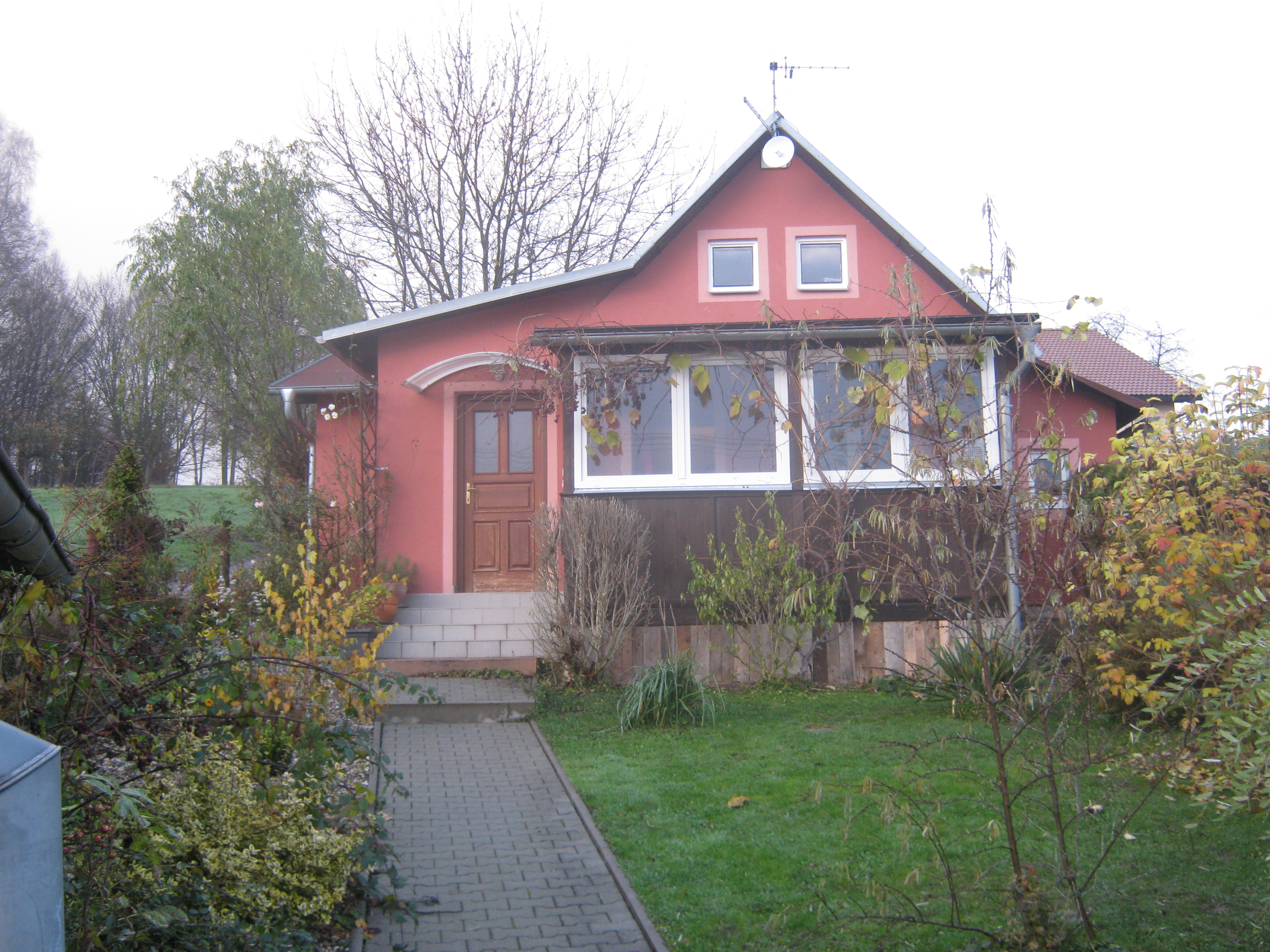
My home in Stará Oleška as it looks today © Ricky Yates

This is a question, sometimes with slight variations, that I’ve been asked time and again this past year. So as this is my four hundredth blog post 🙂 🙂 🙂 , I thought I would put into written form, the answers I’ve been giving to all those who have enquired. I’ve broken the question down into two parts, with four reasons under each heading. If you have further questions, please leave them in a comment and I promise to respond.

Why did I decide to retire?

1. Because I could

On 26th February 2017, I celebrated my sixty-fifth birthday. Although, because of increasing longevity and consequent increased costs, both the Church of England and the British government are raising the age of retirement for younger people, these changes have had very little effect on me. I remained entitled to retire at age sixty-five and claim both my Church and state pensions.

When I left the UK and moved to Prague in September 2008, I knew that in the previous financial year, I had completed paying sufficient National Insurance contributions, to be entitled to receive the minimum state pension at age sixty-five. Continuing working past my sixty-fifth birthday in the Czech Republic, was not going to increase my UK state pension 🙂 I did work on for two more months, retiring on 30th April 2017, but all that did was to slightly increase my Church of England pension.

2. It is what I always envisaged

When I was offered and accepted the position as Anglican Chaplain in Prague, I always envisaged being in post for the following eight and a half years and then retiring. My predecessor as Chaplain, John Philpott, had done exactly the same, except that when appointed, he was one year older than me and therefore served for seven and a half years before retiring at age sixty-five. As I pointed out to the Prague congregation at my final Annual Church Meeting on 9th April, compared to many other European Anglican Chaplaincies, Prague had enjoyed a long period of stability with only two chaplains in nearly seventeen years.

3. Repeating myself

Over my final two or three years at St Clement’s, Prague, I increasingly felt I was saying the same things over and over again in my preaching. Because of the relatively high turnover of congregational membership, with people only being in Prague for relatively short periods of time, this might not seem to be a problem. But I felt sorry for the long-standing members of the congregation who might well have heard me say something at least once too often 😉

4. My health

In August 2015, I had a pulmonary embolism, a blood clot in my lung, which nearly killed me. As a consequence, I have to permanently take the blood-thinning drug Warfarin, (aka ‘rat poison’), and wear a compression stocking on the lower half of my left leg.

The cause of my pulmonary embolism was a deep vein thrombosis (DVT) that formed in my left calf, then escaped from there and travelled to my lung. Despite wearing a compression stocking, I continue to have problems with my left calf and foot. Sometimes they become swollen with areas of bleeding through the skin, which in turn is difficult to stop, because of taking Warfarin 🙁 Currently the calf and skin are as good as can be expected but I had a serious flare up this summer, not helped by being stuck in cattle class for two hours on a Wizz Air flight to the UK.

Why did I retire to North Bohemia and not back in the UK?

1. Affordability

In simple terms, I can afford to retire here in North Bohemia and live fairly comfortably, but in no way could I do so in the UK.

For the nearly twenty-eight years I was in full-time ordained ministry, I was always housed as part of my job. But I do not own a house in the UK and with the absurd price of property, there is no way I could now afford to buy one. The Church of England does have various schemes to help retired clergy with housing. But they would all eat into my pension giving me much less income to live on.

In contrast, using just over half the lump sum from my Church pension, I have been able to purchase outright, my new home in Stará Oleška, and still have funds left over to make improvements to it – five new uPVC double-glazed window units were fitted last week 🙂 Major work to completely refit the kitchen, is due to commence on 8th January 2018.

2. Frauenkirche, Dresden

Although I have retired from full-time ministry, as I have previously explained, I have been granted Permission to Officiate (PTO) by my bishop, in order that I may continue as the Coordinator of Anglican worship in Dresden. This currently means officiating at the monthly English-language Anglican service of Evening Prayer, hosted by the Frauenkirche, but will hopefully lead to a second monthly service, starting in the new year.

Stará Oleška is only a twelve kilometre drive from the main railway station in Decín from where it is just forty-five minutes by train to Dresden. Therefore by living here, I can now return home following the evening service, rather than staying overnight and returning on Monday as I was doing whilst living Prague. To answer the question as to why I didn’t then choose to set up home in Germany, the answer is simple – cost! Housing, and so many other things, are considerably cheaper on this side of the border, as explained in this recent post.

3. ‘Location, location, location’

‘The three most important things to consider when buying a property are location, location, and location’. A quick check on the internet reveals that no one can be sure who first said this but it is a mantra that is often repeated. As well as proximity to Dresden, I love the surrounding environment of the CHKO Labské Pískovce, the landscape protected area in which Stará Oleška is situated. As I have already explained and illustrated in this post and this post, it offers wonderful opportunities for walks out in ‘the nature’ as English-speaking Czech people often say.

4. Xenophobia in the UK

Besides cost, the other main reason for not retiring back in the UK is the rise of xenophobia, at times bordering on racism, which is now being freely voiced in parts of British society as a result of David Cameron’s ill-thought out EU referendum. Each time I visit the UK, the more I feel like a stranger in a strange land. I visit in order to spend time with my two adult children, their spouses and my two grandchildren. But even if I could afford to do so, I’m not at all sure that at the present time, I would want to make the UK my home once again.

Not that the Czech Republic doesn’t also have a vocal right-wing, recently winning electoral support by voicing anti-refugee, anti-Islam, anti-Roma propaganda. It is a politics of fear, bearing mind that very few refugees have come here, there are extremely few Muslims, and the country has had no experience at all of so-called Islamic terrorism.

However, as an ‘immigrant’ myself, I have been made very welcome in the community where I have now chosen to live in my retirement, smiling and waving helping to overcome the language barrier.

Ricky Yates – an Anglican no longer in Prague

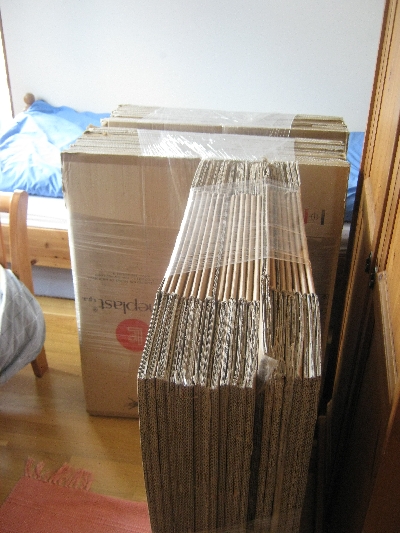
Packing boxes © Ricky Yates

Ever since I announced that I was going to retire as the Anglican Chaplain in Prague and move to live near the Czech-German border, I’ve been asked both, whether this blog would continue, and if so, would there be a new header and tag line. This post is a definitive answer to both questions.

Whilst we currently are still living in Prague – we don’t move to the new house in Stará Oleška until Monday 15th May, I decided this evening, to ask Sybille to upload the new header that she had created at my request some days previously, in anticipation of the forthcoming change.

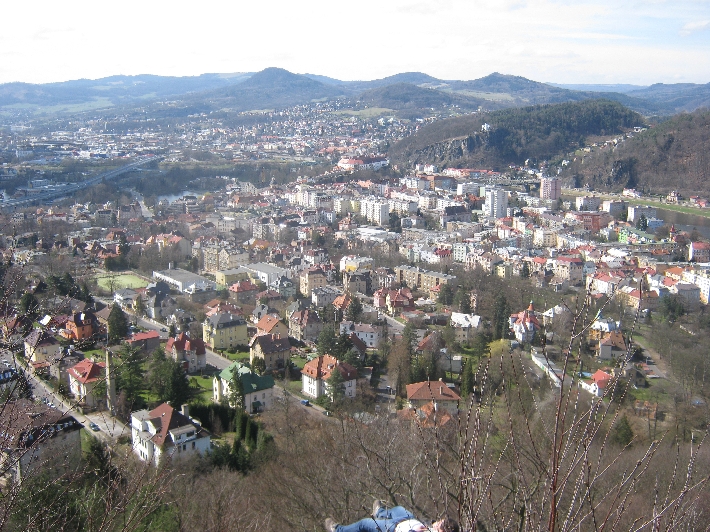
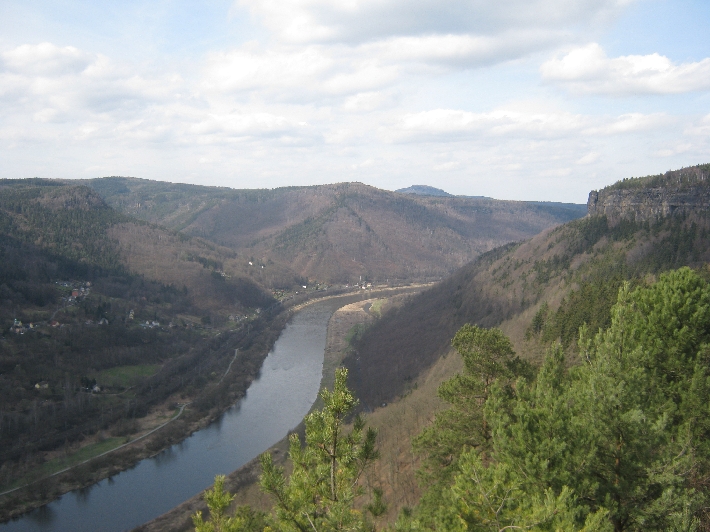
The new header is a combination of two photographs of mine. On the left is the gorge through which the Labe river flows north of Decín, on its way to cross the border with neighbouring Germany, where it becomes the Elbe river. On the right is the skyline of Dresden, featuring the prominent dome of the Frauenkirche.

The aim is to reflect my life over the next few years. I shall be living in Ústecký kraj, North Bohemia, but continuing in my role a coordinator of English-Language Anglican worship in Dresden, Saxony, or Freistaat Sachsen auf Deutsch.

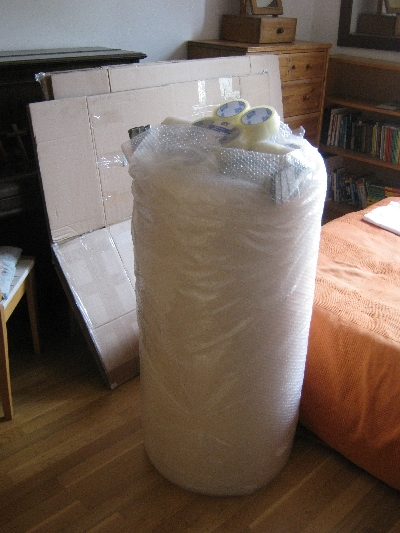
Getting the new header uploaded and writing this new blog post, is a nice distraction to the current major task in hand. On Monday 1st May, sixty cardboard boxes were delivered to the Chaplaincy Flat, along with a massive roll of bubble-wrap and several rolls of wide sticky tape. Yesterday & today have been two solid days of packing boxes, together with separating what belongs to the Chaplaincy from what belongs to us.

We’ve made good progress, but my sixty-five year old body is aching! This evening, I also discovered a rather large bruise on my right arm, presumably where I banged myself carrying a heavy box. This is an inevitable consequence of permanently taking Warfarin following my pulmonary embolism in August 2015.

I do hope that everyone who has enjoyed this blog for the past eight years, as I have reflected on my life in Prague and my travels further afield, will continue to visit and also hopefully comment, as I move into a new phase in life. No longer am I ‘An Anglican in Prague’ but instead, ‘An Anglican in Bohemia and Saxony’.

Bubble-wrap and sticky tape © Ricky Yates

Decín

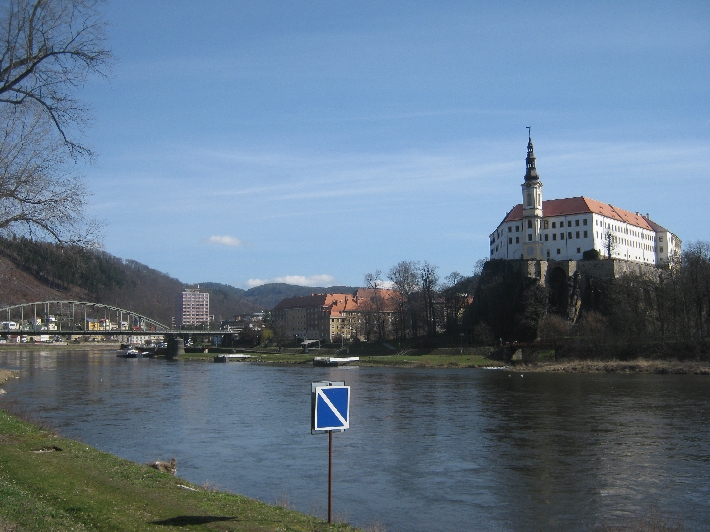
Decín on the Labe river with the Zámek/Château on the right © Ricky Yates

Decín is a town that lies either side of the Labe (Czech), Elbe (German), river. It is situated at the beginning of a deep gorge where the Labe cuts through the Elbe Sandstone Mountains, Labské pískovce (Czech), Elbsandsteingebirge (German), on its way to Dresden in Germany and eventually flowing into the North Sea beyond Hamburg. The area to the east of the Labe is known as Bohemian Switzerland, Ceské Švýcarsko (Czech), Böhmische Schweiz (German), about which I’ve written previously here on my blog.

Decín is 130km north-west of Prague and takes around one-and-a-half hours to reach by either road or rail. But its closeness to the German border means that it only takes forty-five minutes by train to get to Dresden. Therefore it is in the vicinity of Decín that I am hoping to buy my retirement home and continue with my English-language ministry at the Frauenkirche in Dresden.

A major feature of the town is a splendid Zámek or Château, overlooking the river. During the Communist era, it was occupied by military forces of the Soviet Union. Since their departure in 1991, it has been restored to its former glory and in 2005, it was opened as a museum and venue for private gatherings and public events.

Decín from the north-east © Ricky Yates

The historic centre of Decín, Tetschen (German), is on the east bank of the Labe, with a separate newer settlement on the west bank called Podmokly. But the two were amalgamated by the Nazi regime in 1942 and are now linked by two road and two railway bridges. Today, the population of the town is about 50,000 and it has all the facilities I might need, including major supermarkets and a hospital. I shall certainly use the former – hopefully not the latter!

Wharf © Ricky Yates

The Labe is navigable all the way to Hamburg as well as in the other direction, as far as Pardubice in the Czech Republic. This photograph shows one of the wharfs where freight can be unloaded from barges and transferred directly to trucks on the neighbouring railway.

The Labe gorge north of Decín © Ricky Yates

The gorge north of Decín is spectacular. The Prague-Decín-Dresden railway line runs along the west (left) bank of the Labe lying within the line of trees above the minor track visible in this photograph. The main road is on the east (right) bank of the river, immediately below the cliffs.

Decín main railway station © Ricky Yates

The closeness of Decín to the German border is well illustrated by this sign on Decín hl.n./ Decín main railway station, which informs passengers that they are on platform one, in both Czech and German 🙂

My apologies that once again I’ve had problems with Czech diacritics. There should be a hácek (little hook) above both the ‘e’ and ‘c’ in ‘Decín as there should be above the ‘c’ in ‘hácek‘. But unfortunately, if I insert them in my text, the town becomes D??ín 🙁