
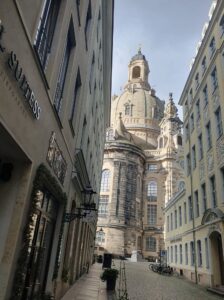
Celebrating twenty years of English-language Anglican services at the Dresden Frauenkirche

Frauenkirche, Dresden © Ricky Yates

On Sunday 21st June 2026, the monthly English-language Anglican service of Evening Prayer celebrated the twentieth anniversary of Anglican services at the Frauenkirche. The first such service was held on Sunday 18th June 2006, some eight months after the consecration of the re-built Frauenkirche on 30th October 2005.

From its inception, until the end of 2015, the service was overseen by the late Rev’d Dr Irene Ahrens, Assistant Priest of St George’s Church, Berlin. I took over responsibility at the beginning of January 2016.

As I have previously explained, the evening services at the Frauenkirche, both the German and English ones, follow a theme over several Sundays. The theme since Pentecost, through to Sunday 19th July, is the hymns of Paul Gerhardt (1607-1676), marking the 350th anniversary of his death. Several of Gerhardt’s hymns have been translated into English and the hymn I had earlier chosen for this service was, ‘O sacred head, surrounded by crown of piercing thorn!’, known in German by the opening line, ‘O Haupt voll Blut und Wunden’.

The text of the hymn is clearly based on the description of Christ’s passion and being mocked and put to scorn by Roman soldiers, as described in Matthew 27. 27-31 which was our first Bible reading. And the placing on his head of a crown of thorns which is also found in the narrative of chapter nineteen of John’s Gospel.
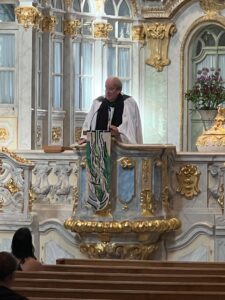
Preaching in the Frauenkirche Sunday 21st June 2026 © Titus Parade

As I said in my sermon, it may seem strange to be focusing on the Cross of Christ at this time of the Church’s year, a few Sundays after celebrating the Feast of Pentecost. But although the hymn does appear in the Good Friday section of our hymnal, the cross is central to the Christian faith and is a powerful Christian symbol.

In many ways, having the cross as probably the most important Christian symbol, is rather strange. It reminds us of the cruel death of Jesus, the founder of our faith. It is something St Paul addresses in 1 Corinthians 1. 18-25, which was our second Bible reading. He writes, ‘For the message about the cross is foolishness – even stupidity, to those who are perishing, but to us who are being saved, it is the power of God’.

As Paul goes on to say, ‘We proclaim Christ crucified’ – the redemption won for us through his death on the cross. As Gerhardt puts it in verse two of his hymn, ‘O agony and dying! O love for sinners free!’ Through the death of Jesus on the cross, God shows his love for fallen humanity and offers salvation, redemption, to those who believe.
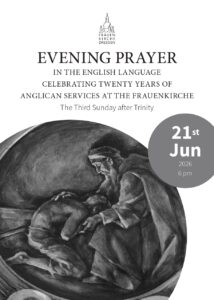
The Order of Service

But having reflected upon our two Biblical readings, I then spoke about the reasons why back in 2006, the Church of England in Germany was offered this monthly English-language Anglican service by the Evangelische Kirche in Deutschland (EKD), and more specifically by the Frauenkirche. There are two reasons.

One is the ecumenical Meissen agreement between the Church of England and the EKD which recognises each others ministry and ministers and allows me, an ordained Anglican priest, to lead worship and preach in the Frauenkirche, an EKD Church. But the second and very significant reason is the strong links that have been established between the Frauenkirche and Coventry Cathedral through their shared experience of wartime destruction and their shared commitment to work for peace and reconciliation.

As I have written and explained previously, on the night of 14th November 1940, the Nazi Luftwaffe carried out a major bombing raid on the city of Coventry which resulted in the death of 568 people – a far lower number than in Dresden four and a half years later, but the highest casualty figure for one night’s bombing of any English city. And the destruction of Coventry’s mediaeval Cathedral with its wooden roof and interior being set on fire and destroyed. Amazingly, the tall spire survived, along with most of the outside walls.

The Provost of the Cathedral, (who would now be called the Dean), was a man called Richard Howard. At Christmas 1940, only six weeks after the bombing, Provost Howard spoke on BBC national radio, not of retribution, but instead, that once the war was over, his vision was to work with those who had been enemies, ‘to build a kinder, more Christ-Child-like world’.

Speaking very personally as I did that Sunday evening, I believe my being able to stand in the pulpit of the Frauenkirche, lead worship and preach, as I have done for the past ten and a half years, is a fulfilment of Provost Howard’s vision. As some of you reading this blog know, as do some in the Frauenkirche congregation, it is particularly significant to me for I was born in the city of Coventry, it is where I lived and was educated up to the age of eighteen and I am a life-long supporter of Coventry City FC. I am a proud Coventrian.

All of this was completely unknown to those who approached me in the Summer of 2015 and asked if I would be willing to take on responsibility this monthly service, from the late Irene Ahrens. Many people have since remarked that it was a wonderful coincidence. I prefer to call it a ‘God-incidence’!
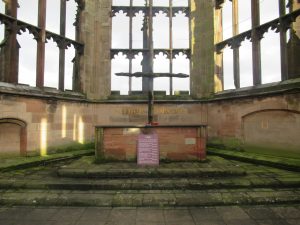
The charred roof beam cross & ‘Father, forgive’ © Ricky Yates

Provost Howard also did three significant physical things. He made a cross out of two of the charred roof beams of the Cathedral and erected it behind the altar of the ruined building, now open to the skies. And on the inside of the east wall, behind the altar, he had the words, ‘Father forgive’, carved in the stonework. Both are still there and can be seen today.

His third physical act was, out of three mediaeval metal roof nails, he made a simple cross, of which the one on the Frauenkirche altar immediately behind where I preach, is a replica. The original sits above the high altar of the new Coventry Cathedral. And this cross is now the symbol of what is known as the Community of the Cross of Nails, linking Churches together, committed to working for reconciliation between those formerly in conflict.
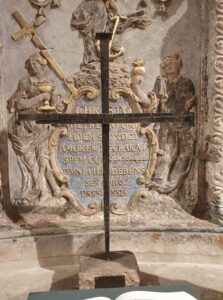
The Cross of Nails/Nagelkreuz on the Frauenkirche altar © Ricky Yates

The Cross of Nails/Nagelkreuz on the Frauenkirche altar, was presented to the Frauenkirche in February 2005, some eight months before the rebuilt Frauenkirche was consecrated. In February 2025, John Witcombe, the Dean of Coventry Cathedral visited Dresden to mark the twentieth anniversary, as well speaking at Nacht der Stimmen/Night of voices, marking the eightieth anniversary of the bombing of Dresden and the destruction of the Frauenkirche.

Engraved on the plaque at the base of the Cross of Nails is both the date of presentation but also those important words, ‘Father forgive’.
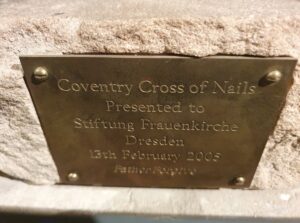
Plaque on the Cross of Nails/Nagelkreuz © Ricky Yates

So I concluded my sermon by giving thanks for those who had the vision for this regular English-language Anglican service to happen each month. And I gave thanks for the leadership of the Frauenkirche who have given me great freedom in leading worship and preaching.
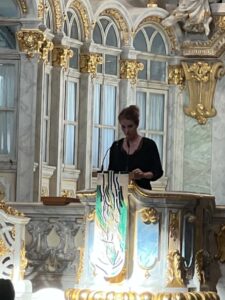
Maria Noth speaking during the service © Titus Parade

I was very pleased that Maria Noth, the Geschäftsführerin/CEO of the Stiftung, the charitable foundation that run the Frauenkirche, was present with me on the dais for the service. She has been very supportive of my English-language ministry. She read the second Bible reading but also asked if she could have a speaking slot. I will end this post with one paragraph of her speech.

‘Every Anglican service celebrated in this church bears witness to a simple but demanding truth: that community can grow where history once produced division, and trust where suspicion may seem inevitable. They remind us that reconciliation is not first and foremost our achievement, but a gift; and a responsibility. We live by the grace of the One who reconciles the world to himself and calls us to become servants of reconciliation.’

My ongoing ministry at the Frauenkirche, Dresden

Walking towards the Frauenkirche © Ricky Yates

I’m very conscious of two things. That I haven’t posted here for two months and that most of my more recent posts have either been about my disputes with UK banks or about the renovation of my house. So here is a new post about my ongoing ministry at the Frauenkirche in Dresden, a topic I haven’t written about since February 2020, except for briefly mentioning it in my post about last winter.

The day after our December 2022 service of ‘Nine Lessons & Carols for Christmas’, my Archdeacon Leslie Nathaniel and I had a most useful meeting with the two Frauenkirche clergy – Pfarrer Markus Engelhardt and Pfarrerin Angelika Behnke. Archdeacon Leslie asked about the possibility of having a second English-language Anglican service each month, on a weekday, with it being held in the Unterkirche, beneath the main Hauptraum of the Frauenkirche. They promised to consider this idea and get back to me in due course.

There is a regular Ecumenical Evening Prayer service held at 18.00 each Thursday in the Unterkirche. Early in 2023, one of the groups who have normally led a service each month, withdrew, because of lack of personnel. Asking me to take over their timeslot both solved a problem for the Frauenkirche authorities and gave a positive answer to our request. Therefore, on Thursday 25th May, I held my first Thursday English-language Anglican Evening Prayer service in the Unterkirche.

The Unterkirche © Ricky Yates

The Unterkirche was the first part of the Frauenkirche to be rebuilt and was completed and consecrated in 1996. It was used for regular Sunday worship whilst rebuilding continued above it. Now, when the main Hauptraum is open for visitors, the Unterkirche is kept as a place to sit quietly and/or pray. It is a wonderful venue in which to conduct worship with a relatively small congregation.

To gain access you have to walk down a flight of stone steps. Unfortunately, in advance of my first service, I managed to trip on my cassock whilst descending the last few steps and ended up in a heap on the floor. There were no broken bones but plenty of swelling and bruising. It took over two months before my right leg finally returned to its normal shape and size. I now walk down those steps very carefully, lifting my cassock as a go!

Page 22 & 23 of ‘Leben in der Frauenkirche September-December 2023

A full colour magazine entitled, ‘Leben in der Frauenkirche‘ is published three times a year. The current September-December 2023 edition features a two page bilingual article, written by me, about English-language Anglican worship at the Frauenkirche which I reproduce here. I’m hoping it will help make the new Thursday evening services more widely known as well as giving some background and history to the regular monthly Sunday evening services.

One thing this double-page spread confirms, is something I already knew from my career in publishing, before I was ordained. German needs up to 20% more space than English 🙂 On page 25, the German column starts higher up the page than the English column and my last paragraph has not been translated in full, in order to make things fit 😉

HM Queen Elizabeth II – Ambassador for reconciliation in Europe

Frauenkirche, Dresden © Ricky Yates

Since the death of Queen Elizabeth II, much has been written about her life and legacy. Living in Central Europe and with my ongoing ministry at the Frauenkirche in Dresden, two articles have particularly resonated with me. The first, written by the Anglo-German historian Katja Hoyer and published in ‘The Spectator’, has the subtitle, ‘She (QE2) understood the importance of reconciliation’. The second, written by +Robert, my Diocesan Bishop, has the title that I’ve stolen for this post 😉

Both articles mention that the Queen paid an eleven day visit to the former West Germany in 1965, twenty years after the end of the Second World War. Katja Hoyer goes on to say that the Queen ‘did not shy away from making difficult trips to places that had seen large-scale devastation through RAF bombing campaigns.’ She cites the visit to Düsseldorf where 90 per cent of buildings had either been damaged or completely destroyed and 5000 civilians killed.

Hoyer rightly says that the visit was not an easy one to sell back in the UK. Many British cities had experienced bombing by the Nazi Luftwaffe causing serious damage and loss of life, including my own home city of Coventry. But the Queen was determined to move forward and help establish good relationships with the German people, who in turn, warmly welcomed her on that first visit.

Hoyer then recalls a visit in 1992 to Dresden, less than three years after the fall of the Berlin Wall and the Inner German border. Her Majesty visited the ruins of the Frauenkirche, destroyed by allied bombing raids in February 1945. I can do no better than to quote from her article.

‘Ignoring a number of people jeering and whistling, the Queen stoically took in the site and concentrated on the quiet majority of Dresdeners who had come to thank her for attending a reconciliation service nearby. The following year, the Dresden Trust was set up in Britain, collecting donations of over £1 million, including contributions from Her Majesty herself, to rebuild the famous church. Dresden and its partner city Coventry have been powerful symbols of post-war reconciliation – a process that the Queen and her family have lent their invaluable support.’

The Queen’s support for the work of reconciliation between two nations, previously at war with each other, stands in stark contrast to the words and actions of many right wing British politicians and much of the UK tabloid press. They portray modern-day Germany as the enemy that still needs to be fought against. Margaret Thatcher, for quite some time after the fall of Communist regimes in Central and Eastern Europe, was strongly opposed to the reunification of Germany that finally took place thirty-two years ago yesterday. She expressed the fear that a united Germany would be too powerful.

Part of the Brexit campaign was based on the premise that the EU was run by Germany and that the UK should ‘take back control’. In particular, the then German Chancellor Angela Merkel, was portrayed as someone to be disliked, even hated.

The tabloid press forever harks back the Second World War, which of course, the Brits won single-handedly. It is as though the UK is still fighting, seventy-seven years after the Second World War ended. As I wrote and preached back in February 2020, ‘the EU was founded in part, to prevent a repetition of the two World Wars which had laid waste the continent of Europe in the first half of the twentieth century, something which the city of Dresden and my own city of birth, Coventry, know about all too well. Seventy-five years of peace have ensued!’

So I am thankful for Her Majesty being an ‘Ambassador for reconciliation in Europe’, especially in Germany, where it is still my privilege to minister once a month in the Dresden Frauenkirche. As Bishop Robert writes, when opening a meeting of General Synod in 2015, the Queen quoted St Paul writing in his second letter to the Corinthians – ‘As ambassadors for Christ [we] are entrusted with the ministry of reconciliation’.

Living Reconciliation – 75 years after the bombing of Dresden

Frauenkirche, Dresden © Ricky Yates

On Sunday 16th February 2020, I was once again preaching in the Frauenkirche, Dresden, at the monthly English-language Anglican service of Evening Prayer. The theme of the service and of my sermon, was the title of this blog post.

As I reminded the congregation at the beginning of my sermon, the previous week had seen the 75th anniversary of the bombing raid by British and US forces, on Dresden. Those bombing raids, on the nights of 13th and 14th February 1945, resulted in the destruction of the historic centre of the city and the deaths of about 25,000 people. As I further reminded the congregation, 75 years ago the previous day, the predecessor of the dome under which they were now sitting, collapsed!

What follows in this blog post, is the bulk of the text of my sermon. Several people who could not be present at the service, have asked me for the text of what I preached. And whilst I normally preach from handwritten notes, rather than a typed out text, I believe what follows is a fairly accurate account of what I said.

I have been responsible for the monthly English-language Anglican service of Evening Prayer at the rebuilt Frauenkirche, since the beginning of 2016. I’m into my fifth year. I regard coordinating English-language Anglican worship at the Frauenkirche as a great privilege – it is an amazing place in which to lead worship and preach. But it is particularly meaningful to me because of my background.

For I come from a city in England which also suffered from a serious bombing raid during World War Two, which resulted in a major loss of life and the destruction of its Cathedral – the city of Coventry. It is where I was born, lived and was educated up to the age of eighteen. I am proud to call myself a Coventrian.

And out of their mutual experience of the horrors of war and aerial bombing, there are now strong links between the cities of Dresden and Coventry, and particularly between the rebuilt Frauenkirche and the new Coventry Cathedral. These links express a desire to build peace and work for reconciliation.

Coventry

I want to start with Coventry as its experience dates from over four years earlier than that of Dresden. On the night of 14th November 1940, the Nazi Luftwaffe carried out a major bombing raid on the city which resulted in the death of 568 people – a far lower number than in Dresden, but the highest casualty figure for one night’s bombing of any English city. And the destruction of Coventry’s mediaeval Cathedral with its wooden roof and interior being set on fire and destroyed. Amazingly, the tall spire survived, along with most of the outside walls.

The Provost of the Cathedral, (who would now be called the Dean), was a man called Richard Howard. At Christmas 1940, only six weeks after the bombing, Provost Howard spoke on BBC national radio, not of retribution, but instead, that once the war was over, his vision was to work with those who had been enemies, ‘to build a kinder, more Christ-Child-like world’.

The charred roof beam cross & ‘Father, forgive’ © Ricky Yates

Provost Howard also did three significant physical things. He made a cross out of two of the charred roof beams of the Cathedral and erected it behind the altar of the ruined building, now open to the skies. And on the inside of the east wall, behind the altar, he had the words, ‘Father forgive’, carved in the stonework. Both are still there and can be seen today.

I will come to the third thing that Provost Howard did, shortly.

After the end of World War Two, the decision in Coventry was to leave the ruins of the old Cathedral intact, and to build a new Cathedral alongside. The new Cathedral is at a right angle to the ruins, which most unusually means it has a north-south axis, rather the traditional east-west axis.

The foundation stone of the new Coventry Cathedral © Ricky Yates

The foundation stone of the new Cathedral was laid by Her Majesty Queen Elizabeth II on 23rd March 1956 and is my earliest memory. For as well as laying the foundation stone that day, the Queen, along with the Duke of Edinburgh, also visited the Jaguar Car factory in Browns Lane, the street where I lived until I was ten. Thus, the royal motorcade drove past our house twice – first on its way to the factory and then the later return journey. At the time, I was a four year old boy who didn’t even have a television, so you can imagine the impact this had on me!

Just over six years later, on 25th May 1962, the new Cathedral was consecrated. As a ten year old schoolboy, a few weeks later, I attended a Cathedral service for children from Church of England schools within Coventry Diocese.

But back to the third physical act of Provost Richard Howard. Out of three mediaeval metal roof nails, he made a simple cross, of which the one on the Frauenkirche altar immediately behind where I was preaching, is a replica.

The Cross of Nails on the Frauenkirche altar © Ricky Yates

The original sits on the high altar of the new Coventry Cathedral. And this cross is now the symbol of what is known as the Community of the Cross of Nails, linking Churches together, committed to working for reconciliation between those formerly in conflict.

The original Cross of Nails on the high altar of the new Coventry Cathedral © Ricky Yates

Frauenkirche, Dresden

Because at the end of World War Two, Dresden was in the Soviet zone of occupation, which became the satellite communist state of East Germany, despite the desire of the Lutheran Church authorities to do so, the communists were not interested in rebuilding the Frauenkirche. Instead, in 1966, they declared the ruins as a ‘memorial against war’. A few years earlier in 1959, a twinning agreement was signed between the communist authorities in Dresden, and a fairly left-wing Labour Coventry City Council, both vowing to work for peace.

Only after the fall of communism, just over thirty years ago, could the desire to rebuild the Frauenkirche be realised. Work began in 1993 and was completed in 2005. The rebuilt Frauenkirche will celebrate its fifteenth birthday on 30th October later this year.

The Frauenkirche has what in English we would call a ‘Mission statement’. It consists of only six words and is sometimes displayed on a banner outside, on the Neumarkt.

‘Building bridges, living reconciliation, strengthening faith’ © Ricky Yates

Brücken bauen – Building bridges

Glauben stärken – Strengthening faith

Versöhnung leben – Living reconciliation

And it is the work of reconciliation, symbolised by the Coventry cross of nails on the altar, that I want to focus on.

2 Corinthians 5. 11-21

This was the first Biblical reading I chose for the service, part of what is probably the most passionate of St Paul’s letters. In this passage, Paul speaks of reconciliation between us human beings and God. Humanity is fallen/sinful, exemplified by resorting to violence/war to gain what we want.

But ‘one has died for all’ (v14) – Jesus Christ. And anyone who responds to what Christ has done for us on the cross; they are ‘in Christ, there is a new creation.’ (v17) ‘All this is from God who reconciled us to himself through Christ’. (v18a) When we recognise our own failures, then recognise the work of Christ and respond to it in faith and trust, we can be reconciled to God.

But – as a result of all this, ‘he has given us the ministry of reconciliation’ (v18b) and has ‘entrusted the message of reconciliation to us’. (v19b) Christians – followers of Christ, are to be people ‘Living reconciliation’; to be setting an example of reconciliation in practice.

My being able to stand in the pulpit of the Frauenkirche, leading worship and preaching, is reconciliation in practice. It has been made possible because of the Community of the Cross of Nails and because of the ecumenical Meissen agreement between the Church of England and the Evangelische Kirche in Deutschland. Two Churches from two countries who 75 years ago were at war with each other.

Sadly, at a political level, Brexit is starting to undo all the good work achieved by the EU and its predecessor the EEC. For it was set up to prevent further conflict and war, after two World Wars had devastated the continent during the first half of the twentieth century. Yet the British right-wing press in calling for Brexit, still uses the language of fighting World War Two, 75 years after it came to an end.

It is the voice of reconciliation, not division that so needs to be heard. Christians individually, and the Church corporately, need to be that voice.

Matthew 5. 21-24

But reconciliation needs to happen, not just between nations, peoples, Churches – it needs to happen at an individual level. The second Biblical reading I chose for the service is a small part of what we know as the Sermon on the Mount. Jesus gives us the picture of the good Jew who has travelled to Jerusalem to worship at the temple and offer a sacrifice for his sins. ‘So when you are offering your gift at the altar’, seeking reconciliation with God, ‘if you remember that your brother or sister has something against you’, leave your gift there, go and be reconciled, ‘and then come and offer your gift’. (v23-24)

We cannot expect reconciliation with God if we have not first sought to be reconciled with our fellow human beings, especially those we see as enemies or those we find difficult. It is what we pray when we say the Lord’s Prayer. ‘Forgive us our sins as we forgive those who sin against us’. And in the Greek text of the New Testament, the sense is, ‘as we have already forgiven those who sin against us’.

We cannot ask or expect God to forgive us our past wrongs and failures, if we have not first sought reconciliation with our fellow brothers and sisters, regardless of nationality, race or colour.

Conclusion

In 1958, some eighteen years after the destruction of the mediaeval Coventry Cathedral, the first Precentor of the new Cathedral, Canon Joseph Poole, wrote a Litany of Reconciliation. As is explained on the Coventry Cathedral website, (and as I have previously explained in this blog), ‘While framed around the seven deadly sins, it serves as a reminder that when we pray about the problems of the world around us, we need to begin by acknowledging the roots of those problems in our own hearts.’ The Litany is said on weekdays at 12noon in Coventry Cathedral and in member Churches of the Community of the Cross of Nails at midday on Fridays, as it is at the Frauenkirche each week.

Therefore my sermon ended by me using the Litany and inviting the congregation to respond to each stanza with ‘Father, forgive’, or if a first language German-speaker, ‘Vater, vergib‘.

The Coventry Litany of Reconciliation

All have sinned and fallen short of the glory of God.

The hatred which divides nation from nation, race from race, class from class, Father, forgive.

The covetous desires of people and nations to possess what is not their own, Father, forgive.

The greed which exploits the work of human hands and lays waste the earth, Father, forgive.

Our envy of the welfare and happiness of others, Father, forgive.

Our indifference to the plight of the imprisoned, the homeless, the refugee, Father, forgive.

The lust which dishonours the bodies of men, women and children, Father, forgive.

The pride which leads us to trust in ourselves and not in God, Father, forgive.

Be kind to one another, tender-hearted, forgiving one another, as God in Christ forgave you.’

Postscript

Following the service, shaking hands with members of the congregation at the door, I received many expressions of appreciation for my sermon. One lady told me that she had been bought up in the former East Germany, but about thirty years ago, soon after the collapse of the Inner German Border, she had been able to travel to Coventry. She recalled how moved she was to stand in the ruins of the old Cathedral before walking through into the new Cathedral. I have also had expressions of thanks online.

I am very aware that many people were specifically praying for me that day and I felt very much upheld by those prayers. If you were one one those people, please accept my grateful thanks.

Finally, it was encouraging to have a larger congregation than normal on a February Sunday evening. I think that many came specifically because the service was marking the 75th anniversary of the bombing raid and the theme of reconciliation.

Meißen

The twin spires of the Meißner Dom/Meissen Cathedral © Ricky Yates

On Sunday 16th June, I once more officiated and preached at the monthly English-language Anglican Service of Evening Prayer in the Frauenkirche, Dresden. I was also invited by the Stiftung Frauenkirche Dresden, to attend a sommerliches Grillbuffet, the following evening, an event laid on as a ‘Thank you’, for all the volunteers and staff who help at the Frauenkirche. Deciding it would be silly to return home on Sunday evening, only to drive back to Dresden the next day, I instead stayed overnight and spent several hours on Monday 17th June, exploring the city of Meißen.

Meißen lies about 25km north-west of Dresden on both banks of the Elbe river. It didn’t take that long to drive there and, having found a suitable car park alongside the Elbe, I then set out on foot to explore the historic city centre. Unlike Dresden, it appears not to have suffered much destruction during the Second World War, presumably because of having very little industry and not being a major transport hub.

Meißen Rathaus © Ricky Yates

Walking along Elbstrasse, I soon reached the Markt, overlooked by the Rathaus…

Frauenkirche, Meißen © Ricky Yates

.and by the Frauenkirche.

Burgstrasse © Ricky Yates

Then I headed up Burgstrasse.

A view across the rooftops of Meissen © Ricky Yates

At the end of the street, a series of stone steps took me up towards the Meißner Dom/Meissen Cathedral, to a place where there is this wonderful view across rooftops, towards the Elbe and the railway bridge that crosses the river.

Meißner Dom/Meissen Cathedral © Ricky Yates

Finally, I arrived in the Domplatz with the Meißner Dom/Meissen Cathedral towering in front of me.

Allerheiligenkapelle © Ricky Yates

Entrance to the Dom is not through the large doors at the west end but through another door part way down the south side. Adjacent to this entrance is the Allerheiligenkapelle which is specifically designated as a place of silence. I enjoyed spending time in prayer here, before going on to explore the main building.

There is a entrance fee for visiting the Dom. Arriving at the cash desk and whilst getting my wallet out of my pocket, I explained to the lady cashier in my best German 🙂 , that I was an Anglican priest and the previous evening, had conducted Anglican Evening Prayer in the Frauenkirche, Dresden. Upon hearing this, she gave me my entrance ticket free of charge! Maybe this was because of her name – Frau Engel/Mrs Angel 🙂

Below are some more photographs of the interior of the Dom.

The nave of the Dom © Ricky Yates
Interior of west end© Ricky Yates
Triptych behind the nave altar © Ricky Yates
The Hoher Chor © Ricky Yates
Triptych behind the altar in the Hoher Chor © Ricky Yates
Luther is watching you 😉 © Ricky Yates
Hymns of Praise © Ricky Yates

I would like to have attended this event, held the previous evening. Interestingly, it is called ‘Hymns of Praise’ in English, and featured the compositions of Antonín Dvorák from the country where I now live, and of John Rutter, from the country where I used to live.

View across the Elbe © Ricky Yates

Walking around the edge of the rocky outcrop on which the Dom is situated, there is a splendid view across the Elbe. Afterwards, I treated myself to an excellent lunch at a restaurant overlooking the Domplatz, accompanied by locally produced liquid refreshment 🙂

Meissner Bier © Ricky Yates

One place I didn’t visit was the Albrechtsburg, the castle that adjoins the Dom. As you can see, it is currently undergoing major restoration work which rather detracts from this iconic view from alongside the Elbe. A reason to make a return visit at some future date.

Meißner Dom and Albrechtsburg © Ricky Yates