
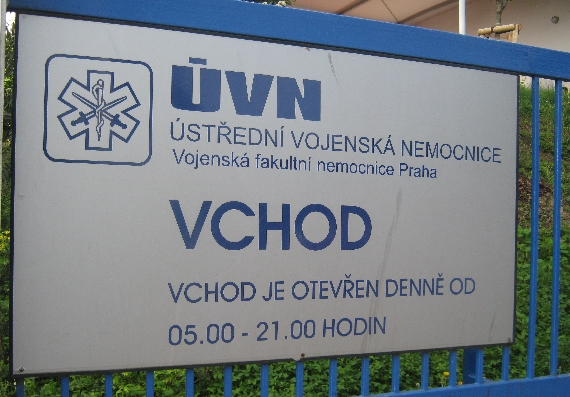
On Wednesday 30th April, I paid my fifth visit in the last nine months, to see a Czech dermatologist at Vojenská Nemocnice, the Military Hospital here in Prague. It prompted me to think that I really ought to write a blog post all about my experience, along with a brief explanation as to how the Czech Healthcare System works. But first a bit of background about me.
Between July 1970 and February 1975, I lived and worked in Australia. During my time there, I got badly sunburnt on several occasions and have since suffered from the consequences of being a pale, white, north-European, who exposed himself to far too much Australian sun.
It took nearly twenty years before I first experienced the unwanted consequences of my unwise actions. It was in 1988, whilst I was training for ordained ministry at Wycliffe Hall, Oxford, that I eventually went to see my GP about a scab, located on the hairline of my forehead, that refused to heal up. The GP sent me to see a dermatologist, who promptly diagnosed it as a Basel Cell Carcinoma (BCC), the commonest, but fortunately least dangerous, form of skin cancer.
Unfortunately, by that stage, it had become too big to be cut out under local anaesthetic, with a couple of stitches to pull the resultant wound together. Instead, the BCC had to be removed under general anaesthetic, with a skin graft taken from my chest, put across the gaping hole on my forehead. The evidence of that operation is still visible today, all the more so because my hairline has receded much further in the subsequent twenty-six years.
Ever since that operation in September 1988, I have kept a very watchful eye on any scab or spot on my face that refuses to heal up and promptly sought medical advice. As a consequence, over the years I’ve had several more small BCCs cut out under local anaesthetic. During the latter years of my time living in the UK, my BCCs were usually ‘frozen off’, by being treated with liquid nitrogen which destroys the cancerous cells.
During my first few years in Prague, I was pleased that I could not see any visible signs of further BCCs on my head and face. However, in the Spring of 2013, a tell-tale non-healing scab appeared on my current hairline, on the right side of my face. I also observed several smaller spots, all of which looked ominous. So in early June last year, I finally took myself off to see my GP, Dr Adriana Youngová.
Dr Youngová is a fluent English-speaking Czech, helped no doubt by being married to an Englishman called Mr Young, hence her unusual surname. Interestingly, although she has taken the Czech genitive form of Youngová, she calls the medical practice she heads, ‘Young & Co‘, without the ‘ová’ 🙂 But I digress.
Dr Youngová immediately agreed that I almost certainly had a BCC and promptly wrote a letter of referral for me. She recommended that I see a dermatologist at the Military Hospital as she knew that many of the medical staff there, spoke English. However, unlike in the UK, where your GP sends your letter of referral to a hospital and the hospital then writes back, giving you an appointment, in the Czech Republic, the patient has to contact the hospital themselves and make their own appointment.
I therefore went in person to the Military Hospital in order to make my first appointment. I could just have telephoned, but realised that if language was going to be a difficulty, which it was, you cannot make hand signals over the phone 🙂 Surprisingly, the young female receptionist on the main hospital entrance, spoke better German than English, and successfully directed me ‘auf Deutsch‘, to the building where the dermatology department is situated. However, the receptionist in the dermatology department itself, only spoke Czech, so I was most glad that I had not tried to phone. Eventually, my limited Czech, combined with appropriate hand signals, got me my first appointment for 15th July 2013.
As is required under Czech law, as an employed person, I and the Church as my employer, make contributions each month, to VZP CR, who in turn provide me with full medical cover under the Czech public health insurance scheme. VZP CR in turn, issue me with a European Health Insurance Card (EHIC) which I show in order to receive, almost free medical care.

I say ‘almost free’ as, on each occasion you visit your GP or have a hospital appointment, you are required to pay CZK 30 (just under £1.00 or US$1.50). On entering the dermatology department, there is this machine in the entrance hall, into which you put your CZK 30 and obtain a printed ticket, showing you have paid up. This is then retrieved from you, when you see the dermatologist.
My appointment yesterday, like a couple of previous ones, was for 08.00. This is very Czech as there is quite a tendency here to begin work early in the day. I first went to the machine to obtain my CZK 30 ticket. There was a delay whilst an elderly Czech lady in front of me, slowly managed to recover her coins, having first pushed them into the slot where the ticket comes out! I felt a certain sense of satisfaction that I understood the instructions on the machine, better than did a native Czech!
Then it was on to reception, to confirm my arrival. This receptionist is a classic example of what I have previously described as how to dress Czech. She regularly wears tops that reveal a large amount of cleavage. As I’ve previously written, it is look that would be appropriate for a romantic dinner with her husband or boyfriend, but not what I really want to see at 08.00 in the morning, in advance of being attacked with liquid nitrogen. Fortunately, the top on Wednesday, was somewhat less revealing than a couple of the previous ones 🙂
Once my arrival had been confirmed & the receptionist had found my file, I had to wait in the adjacent waiting room, until summoned. For the first time yesterday, I was summoned by a nurse who could actually pronounce my surname. My surname of ‘Yates’, causes great problems most of the time, as no Czech surname begins with the letter ‘Y’!
I saw the same young female Czech dermatologist that I’ve seen on four of my five visits. She speaks fluent English and has a helpful and friendly manner. She agreed with me that the original large BCC on my hairline, has still not completely disappeared, despite four previous treatments with liquid nitrogen. However, she was convinced that it was now much smaller and that one further treatment might finally do the trick.
So it was out with what I would describe as a cotton bud on the end of a large stick, first placed into the flask of liquid nitrogen, and then dabbed firmly on the offending area, several times over. She also treated a new spot I had identified, alongside my ear on the other side of my face. After treatment, she dusted both with a white antibiotic powder which does leave me looking slightly ghostly.
Having received treatment, I was duly given my next appointment for two months time at the end of June, along with a written report about my treatment, all in Czech! Then it was back to the tram for my journey home.
In conclusion, I have to say that I have been most impressed by my experience of the Czech Healthcare System. It is effective and efficient and gives an excellent level of care. Even as a foreigner, once you get to know the basics as to how the system works, then you should not have any real problems or concerns. And because most well-educated Czechs, especially the younger ones, speak reasonable English, language is usually not a problem with many doctors or with some nurses.


