Liberation Day – 8th May 2012

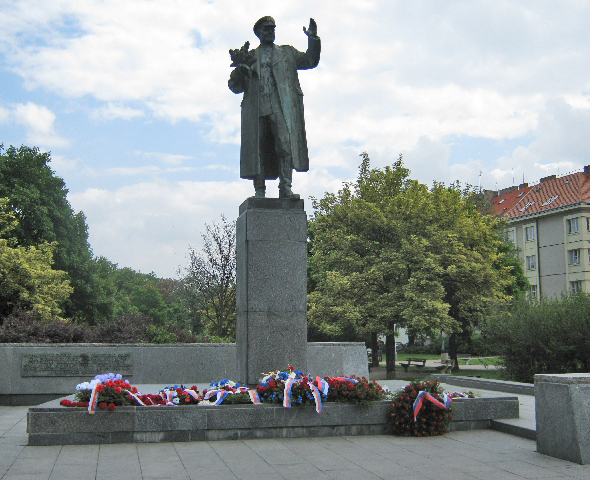
Statue of Soviet Marshall Ivan Konev with floral tributes © Ricky Yates
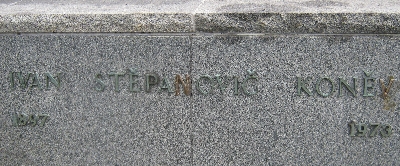
Inscription alongside the statue © Ricky Yates

Today is a public holiday here in the Czech Republic, as it is in several other European countries. The public holiday marks the ending of World War Two, sixty-seven years ago, on 8th May 1945.

I took the photograph on the left today. It is of a statue that stands in Námestí Interbrigády, a large square on one side of Jugoslávských partyzánu, the main thoroughfare leading from our nearest Metro station at Dejvická, to Podbaba where we live. And the person it portrays is Marshall Ivan Stepanovich Konev of the Soviet Red Army, who led the troops that liberated Prague from Nazi occupation, finally entering the city early on 9th May 1945, just a few hours after the unconditional surrender of all Nazi troops across Europe, had come into force.

As I wrote in an earlier post on this same topic two years ago, this statue is a rare sight today, anywhere in the Czech Republic or Slovakia, as it features a leading figure of the Soviet Army which, during nearly forty-two years of communism, was regarded as an army of occupation by the people of Czechoslovakia. Nearly all public monuments featuring or seeking to celebrate, ‘Soviet friendship and brotherhood’ have, since the Velvet Revolution of 1989, been quietly removed. But, because it commemorates an event that took place before the communist coup in 1948, it remains standing.

As you can see, a large number of floral tributes have been placed at the foot of the statue in recent days. Some are official, such as the ones from the Czech Military and from the Defence Office of the Czech President. Others are simple bunches of flowers, left by private individuals. Although there is a considerable dislike of Russia and Russians amongst the Czech people today, (see some of the comments on my previous post), there is a recognition that it was the Soviet Army that was responsible for liberating Prague and two thirds of what is now the Czech Republic, early in May 1945.

Floral tribute with Cyrillic writing © Ricky Yates

However, I was intrigued by one large floral tribute pictured here, whose ribbons have an inscription written in a language using the Cyrillic alphabet, presumably Russian. If anyone can tell me what it says or which organisation might be responsible for it, I would love to know.

Inscription behind the statue which refers to the Czechoslovak Socialist Republic © Ricky Yates

And I was also intrigued by this inscription on the low wall behind the statue, which refers to the country as the Czechoslovak Socialist Republic, the name used only during the years of communist rule. Whereas elsewhere in the Czech Republic, specific communist logos and references have been removed from war memorials such as in Tábor, here communist nomenclature remains.

Whilst the liberation of the country from Nazi occupation is still marked each year here in the Czech Republic, what has changed since the Velvet Revolution, is the attitude of Czech people towards Germany and the German people. Most Czechs are now freely able to distinguish between Nazi Fascist ideology as exemplified by Hitler’s Third Reich, and present-day democratic Germany, still very much aware of it’s relatively recent past history.

Therefore these days, Germany is the Czech Republic’s biggest trading partner. Germans also travel here in considerable numbers to enjoy the delights of what this country has to offer and in doing so, make a major contribution to the Czech Republic’s tourist income.

On the other hand, although the part played by Russia and the Soviet Red Army to liberate the country from Nazi occupation is still acknowledged each year, those who liberated, in turn became an army of occupation. And although all Russian troops had left Czech soil by June 1991, there remains a strong feeling that Russia still wants to control its former republics and satellite states using its economic power, particularly with regard to the supply and distribution of natural gas.

Rivalries within small states & nations

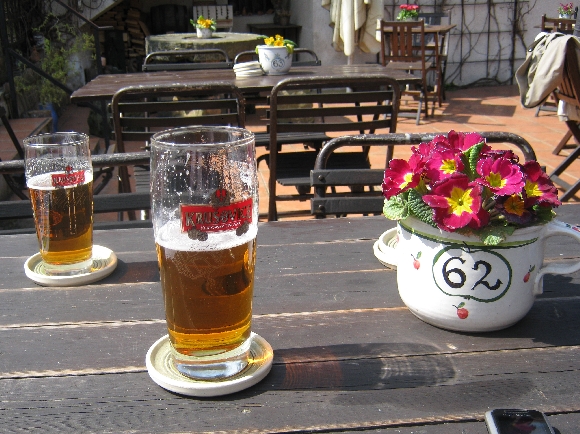
Our first outdoor beers of 2012 © Ricky Yates

Back in 1970 when I was just eighteen years old, I went off to see the world and emigrated from England to live in the Australian island state of Tasmania. As well as being a formative experience, one thing I discovered whilst living there, really surprised me. Despite Tasmania having at that time, a population of only just over 400,000, there was a great rivalry between those who lived in the south of the island, particularly in the state capital Hobart, and those who lived in the north of the island, either in the second city Launceston, or in the string of towns along the North-West coast.

Bearing in mind that Tasmania was and still is the smallest of the six Australian states, both in area and population, it did seem odd to me that there should be such a rivalry between fellow Tasmanians. Surely, they needed to stand together against the might of the other five much larger states located on ‘the mainland’, the term used by all Tasmanians to describe that rather large island just to the north of them.

Five years later, I returned to the UK and in September 1975, went to live in Lampeter, West Wales, in order to study as an undergraduate at what was then known as St. David’s University College. Wales is also quite small with a population of about 3 million. Of those, about 20% fluently speak the native language of Welsh.

Two of my best friends at university, Aled and Hedd, were native first language Welsh speakers. Yet because Aled came from Trawsfynydd in North Wales whilst Hedd was from near Fishguard/Abergwaun in South-West Wales, each used to quite regularly tell the other that they did not speak Welsh properly! This was a reflection of the rivalry between those from North Wales and those from South & West Wales and the slight variation in the way Welsh is spoken in these different parts of the principality.

I can better understand rivalries when they occur within much larger nations, especially when those nations have only become united in relatively recent times. My wife Sybille, who is German, has frequently pointed out to me the ongoing rivalry between those from the north and south of Germany. Complete German unification only came about at the beginning of 1871.

German citizens from both north and south, rudely refer to each other based on what each believes the other to supposedly eat. A South German will call a North German, ‘ein Fischkopf‘/’a fish head’, whilst a North German will call a South German, ‘eine Weisswurst‘/’a white sausage’. Sybille, who ‘ist ein Fischkopf, keine Weisswurst‘, will point out that if you drive west from Prague to the border with Germany, whilst there is a sign saying that you are entering ‘die Bundesrepublik Deutschland‘, there is a far larger sign saying ‘Herzlich Willkommen im Freistaat Bayern‘/’Welcome to the Free State of Bavaria’!

The Czech Republic is a relatively small nation with a population, according to the 2011 census, of about 10.5 million people. As I explained in a previous post, the country is made up of what was historically known as Bohemia and Moravia, together with a small part of Silesia. Bohemia forms the western part of the country with Prague at its centre, whilst Moravia forms the eastern part where the country’s second city Brno, is located. And as I have discovered, there is quite a rivalry between Bohemia and Moravia.

I first became aware of this rivalry, when Honza, a Czech member of my Prague congregation, said to me, that he would never leave his car, with its number plates indicating he is from Prague, parked unattended in Brno, fearing one of the local Moravians would damage it! The second letter of a seven letter/digit Czech number plate, indicates where the car is from. ‘A’ is Prague, ‘B’ is Brno. In case you’re wondering why Prague isn’t ‘P’, it is because ‘P’ is used for Plzen.

More recently, my friend Katka from Brno remarked that, “…as many of my fellow townspeople like to point out, our favourite view of Prague is in the rear view mirror of a car!” I think you can see from these two remarks, there is quite a friendly rivalry, which can at times, become a certain animosity, between Prague and Brno – between Bohemia and Moravia.

Some of this rivalry can be relatively light-hearted. Back in October 2011, I listened to a speech by the Mayor of Brno in which he declared that Brno was the largest city in the Czech Republic, despite only having a population of no more than 400,000, whereas the population of Prague is 1.3 million. However, his reasoning was based on the fact that Prague is officially a region in its own right, whereas Brno is a city within the region of South Moravia.

Another reason for this rivalry is linguistic. The Czech word ‘Cesky’ can mean both ‘Czech’, referring to the whole country, or ‘Bohemian’, only referring to Bohemia. This was reflected in the recent 2011 census when in answer to a voluntary question, over 500,000 people declared themselves to be ‘Moravian’ rather than ‘Czech’.

Besides the linguistic explanation, I think another reason for this rivalry is that Moravia doesn’t have the country’s capital city – for some things, you have to travel to Prague in Bohemia. This in turn leads to Prague people looking down on the citizens of Brno. In many ways this reflects a wider attitude to which I was alerted very early in my time here. Czech people (both Bohemians and Moravians) look down on Slovaks, who in turn look down on Ukrainians!

Just like Tasmanians and the Welsh, once Czech citizens are outside of their nation’s borders, they stick together regardless of where they originally come from. But as a foreigner living in the Czech Republic, it is good to be aware of the Prague-Brno / Bohemia-Moravia rivalry, if only to be able to appreciate the humour it engenders.

The Vltava River

The Vltava River in central Prague © Ricky Yates

The longest river wholly within the Czech Republic is the Vltava, known to Germans as the Moldau. It rises in the Šumava mountains near the Austrian border and then flows north through the centre of Prague going on further north to join the Labe/Elbe at Melník.

The Vltava was portrayed musically, by the nineteenth century Czech composer Bedrich Smetana, in the second of six symphonic poems that form his symphonic cycle called Má vlast – My Fatherland. Click on this link below and listen to the music whilst enjoying my illustrated guide to the river.

The picture at the beginning of this post is the view most tourist visitors to Prague have of the Vltava, overlooked by St Vitus Cathedral and the walls of Prague Castle. On the river in the foreground, is an ancient paddle steamer, one of the many boats that offer trips on the river through the centre of the city.

The Vltava River seen from Letna Park © Ricky Yates

Above is a view looking upstream from Letna Park. The second of the bridges is the first and most famous crossing of the river – Karluv most/Charles Bridge.

The Vltava River looking downstream from Letna Park © Ricky Yates

And here is a view looking downstream from the same spot, with Cechuv most, the bridge in the foreground.

Karluv most/Charles Bridge © Ricky Yates

Here is a view of Karluv most/Charles Bridge which, until 1841, was the only crossing of the Vltava within the city of Prague.

Ostrov Štvanice/ Štvanice Island © Ricky Yates

This is Ostrov Štvanice/ Štvanice Island – the building located where the river divides is a former small hydro-electric plant. Behind it lies the navigation channel leading to a lock whilst the rest of the river flows over a weir in the foreground.

Dumb barge being pushed upriver © Ricky Yates

The Vltava is still used for the commercial carrying of freight, in particular sand and gravel. Large dumb barges are pushed upriver by powerful tugs.

Podbaba Lock © Ricky Yates

Major engineering works were carried out in the nineteenth century to improve navigation with the construction of locks and new artificial channels to bypass obstructions. This is Podbaba Lock which is located very close to the Chaplaincy Flat where we live.

Loaded dumb barge being pushed upstream above Podbaba Lock © Ricky Yates

And here is a loaded dumb barge being pushed upstream, above Podbaba Lock.

Commercial port at Holešovice © Ricky Yates

Most freight is unloaded here at the wharfs in Holešovice, north-east of Prague city centre.

Pleasue craft moored below Vyšehrad © Ricky Yates

The Vltava is now increasingly used by private pleasure craft, many of which moor here below the ancient citadel at Vyšehrad, south of Prague city centre.

Markers showing past flood levels © Ricky Yates

Beautiful and useful as the Vltava is, like any river, it can overflow and cause serious flood damage. Here is a reminder of past flood levels, reading upwards they mark the floods of 1890, 1845, 1784 and 2002.


Easter Day worship in Prague and Brno

My pottery paten and chalice that I use for celebrating the Eucharist in Brno © Ricky Yates

When I was Rector of the Shelswell Group of Parishes in North Oxfordshire, quite frequently on Sundays, I would officiate at three services during the day – and occasionally at four. Certainly on Easter Day, I would always celebrate the Eucharist three times during the morning, in three different Churches, at 08.00, 09.15 and 10.45.

One of the joys of being the Anglican Chaplain in Prague, is normally only having one service to take each Sunday. And because our Ceskobratrské Církve Evangelické host congregation meets for worship at 09.30 each Sunday, our Sung Eucharist cannot begin until 11.00.

However, having held the first ever English-language service of Lessons and Carols in Brno last December, since the New Year, I am now travelling there to officiate at 18.00 in the evening on the second Sunday of each month.  My aim is to establish a satellite congregation in Brno, thus providing a second place of English-speaking Anglican worship in the Czech Republic.

On most Sundays, our Czech hosts in Prague, finish their service at about 10.30 which gives us a full thirty minutes to set up to begin our worship at 11.00. Being partly Presbyterian, they do not have Communion that often. But when they do have Communion, their service is nearly always fifteen minutes longer. And on Easter Day they do, of course, have Communion. Thus last Sunday, we had to wait outside until nearly 10.45, until we could gain access to the Church building.

This was my fourth Easter in Prague so I knew to expect many visitors in the congregation. And whilst a small number of the regular congregation are away from Prague at Easter, we lose far fewer than we do at Christmas or during July and August. However Easter Day 2012, not only saw a very good turnout of the regular congregation including several ‘lost sheep’ who we hadn’t seen for some time, but also a very large number of visitors. According to Honza, who went up to the balcony and counted, we were 90 adults and 22 children. The congregation was therefore bigger than any in the whole of 2011.

As on most Sundays, there were double figure nationalities present. We had a large number of American visitors and a smaller numbers of Brits. But we also had two visitors from Denmark, another from Malta and a young Ghanaian couple who told me they had travelled in from Hradec Kralové, 120 km outside Prague, in order to attend Easter Day worship.

We celebrated Christ’s triumph over sin and death in liturgy and song, making an extremely ‘joyful noise’ as our worship culminated in singing ‘Thine be the glory’ to the wonderful Handel tune ‘Maccabaeus’. As in previous years, this was the second time on Easter morning that the Church walls had resounded to the tune as our host congregation ended their worship with the self-same hymn sung in Czech.

After the service, as I and Gordon the Church Treasurer, together with David, another member of the Church Council, exited the vestry and locked up the Church, we once more experienced the peculiarities of the weather of recent months when we were greeted by a snow shower. So none of the three of us could resist starting to sing, “I’m dreaming of a white Easter” as we made our way across the road for Coffee Hour.

Then for me, it was back to my Oxfordshire days as I set off for my second service of Easter Day. But instead of hopping in the car for a ten minute drive to the next village, it was a three-stop journey on the tram, followed by a two hours and forty minute journey on the 14.42 Prague-Brno train, followed by a short walk to the little Czechoslovak Hussite Church which we are currently using for worship in Brno.

There was a great contrast to our worship in Prague in the morning. But as twelve of us gathered to celebrate the Eucharist on Easter Sunday evening, the worship was just as meaningful. Only one person present was a visitor, a British lady who comes to Brno at least three times a year to visit a close relative. The rest were English-speakers currently resident in Brno who I trust and pray will help form a new worshipping community in the second city of the Czech Republic.

Whilst it is feasible to return to Prague on the last train of the evening, as on my previous visit, I decided to stay overnight and travel back the next day. It makes the trip less tiring and gives more opportunity to talk with people after the service. And in this amazing small world, through the publicity put out by the Brno Expat Centre about our monthly services, I’ve reconnected with a young lady called Lynsey who I first met fourteen years ago with her parents on a French camp-site. Lynsey and her partner Johnny have recently moved to Brno to work for Monster, an online recruitment agency who have established their main European base in Brno. So I had the privilege of being the first guest to sleep on their newly purchased sofa bed on Easter Sunday night.

The Prague-Brno-Vienna train awaits departure © Ricky Yates

Golden Wedding celebration

My sister June & brother-in-law Garry on their wedding day 31st March 1962

I am the youngest of three children. My eldest sister June, is nearly nine years my senior. On Saturday 31st March 1962, at the tender age of eighteen, June married my brother-in-law Garry, the wedding taking place at Warwick Road Congregational (now United Reformed) Church in Coventry. The picture on the left is of the happy couple outside the Church following their marriage and the boyish face behind Garry’s shoulder is none other than Yours Truly, aged ten!

Exactly fifty years later, on Saturday 31st March 2012, June and Garry celebrated their Golden Wedding anniversary. They marked the occasion by holding a most enjoyable buffet lunch in the Branksome Dene Community Rooms, Poole which overlook the beach near their home for the past twenty years in Westbourne, Bournemouth. The Prague Church Council kindly agreed to me having a pre-Easter rather than my normal post-Easter break, which allowed Sybille and I to be present and join the celebrations.

June and Garry 31st March 2012 © Ricky Yates

Our trip to the UK was only my second since moving to Prague just over three and a half years ago and was Sybille’s first during this same period of time. We flew from Prague to London Gatwick late in the evening of Thursday 29th March and stayed that night and the following one, in a little cottage in the grounds of Bishop’s Lodge, Worth, on the outskirts of Crawley. The Bishop’s Lodge of  Rt Rev’d Dr Geoffrey Rowell, Anglican Diocesan Bishop in Europe, is deliberately located only ten minutes drive from Gatwick making it very convenient both for him and us!

In order to make the most of our four days in the UK, I had arranged online in advance, to hire a car at the airport. In order save money on both hire charges and fuel, I chose to hire a vehicle from the ‘small car’ category. You can probably imagine my amusement when I discovered that the car allocated to me was a brand-new Skoda Fabia – made in the Czech Republic!

Whilst I am well used to driving my own right-hand drive (RHD) car on the right (as opposed to left) side of the road here in the Czech Republic, what did seem strange was driving a RHD car on the left side of the road, something I hadn’t done for over three and a half years. Several times I came very close to driving on the right with Sybille regularly telling me ‘links fahren’, in order to remind me not to cause an accident!

Just before 9am on Saturday 31st March, we set out from the cottage, to drive to Bournemouth/Poole. The journey took us diagonally across West Sussex, a part of England that was new to me having only previously visited the very north-eastern corner of the county to get to Gatwick Airport on several previous occasions and having once driven further south to Brighton. However, once we reached Hampshire and the M27 around Portsmouth, we were back on more familiar territory. We arrived at the Premier Inn in Bournemouth, where we were booked to stay the night, with plenty of time to park the car, get appropriately dressed and then walk down to the sea front to the celebratory lunch venue.

Garry & June cutting their Golden Wedding anniversary cake © Ricky Yates

My nephew Tim making his speech about his parents at their Golden Wedding celebration © Ricky Yates

It was interesting to realise that I was one of a handful of people present at the Buffet Lunch, who had also been present fifty years previously at June and Garry’s wedding. Most of the guests last Saturday, were friends that June and Garry have made locally since they moved to Bournemouth from just outside Leamington Spa in the Midlands, more that twenty years ago. Sybille and I also had the distinction of being the two who had travelled the furthest in order to join the celebrations.

June and Garry have two children, Tim and Tom – the arrival of Tim into this world making me an uncle at the age of twelve. Tim and his partner Deborah have since made June and Garry grandparents and in turn, have made me a great uncle! It was lovely to see my great niece Lilith and my great nephew Silas, for only the second time in theirs and my lifetime.

Below is the, probably never to be repeated family photo, unless that is, we all come together again to mark June and Garry’s Diamond Wedding Anniversary, now due in less than ten years time!

The family photo. From l to r: Deborah (Tim’s partner), Silas (great nephew), Jenny (sister), June (sister), Tim (nephew), Garry (brother-in-law), Tom (nephew), Lilith (great neice), Sybille & myself © Ricky Yates