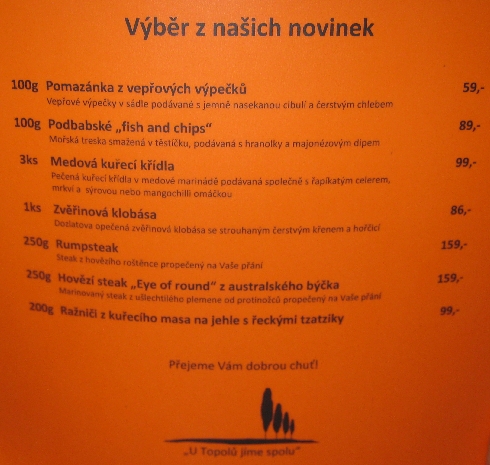
This evening, we went to eat at one of our favourite local bar-restaurants – U Topolu. The name means, ‘to the poplars’, hence the logo at the bottom of the menu in this photo. On each of the tables, there was this laminated card advertising various new additions to their main menu.
The penultimate item yet again had us in stitches. For those who cannot read or understand Czech, it is seeking to describe what, in English, would be called an ‘Australian rump steak’ or a ‘Rump steak from Australian beef’.
There was no supposedly English version of these additions to the menu. What you have here is Czech Czenglish – a menu in Czech, trying to appear sophisticated, by using English to describe a certain item. But in describing the steak as, ‘Eye of round’, they have used Czenglish.
U Topoluis one of several places where we have offered our help, as native speakers of English or German, to translate their menus so that they make sense, rather than being the source of amusement. As ever, our offers have been spurned, leaving the bar-restaurant owners looking totally stupid in the eyes of every non-Czech speaker who enters their premises. But do they care?
The Pfarrer Initiativeis an open call to disobedience by nearly 400 Roman Catholic priests and deacons in Austria. As such, they constitute roughly 10% of the Austrian Roman Catholic clergy. You can read their original ‘Appeal to Disobedience’ in English, by following this link. However inevitably, most other online material about this radical reform movement is only available in German.
This initiative arises out of two major issues that increasingly face Roman Catholic priests across Europe and North America. How to offer the sacraments and pastoral care, to the ever increasing number of people whose lives do not conform exactly to official Roman Catholic doctrine. And how to overcome the ever increasing shortage of priests. What the Pfarrer Initiative calls for is radical change. But it is also a call for honesty rather than the hypocrisy that exists at present
The official position of the Roman Catholic Church is that anyone who has been married in Church and later divorced and remarried in a civil ceremony, cannot be admitted to receive the sacrament of Holy Communion. Likewise, it is only paid-up members of the Roman Catholic Church that can be admitted, not members of any other Christian Church.
With the ever increasing number of Roman Catholics who are divorced and remarried, the official position creates major pastoral problems for Roman Catholic priests. Many overcome the problem by simply ignoring official RC teaching and allow those who are divorced and remarried to receive the sacraments. Alternatively, these individuals take themselves off to a Church two or three parishes removed from where they live, where their past marital affairs are unknown.
Likewise, I have received the sacrament of Holy Communion from a Roman Catholic priest, with his permission, on numerous occasions. The most memorable occasion was in Spain where the priest was a paid-up member of Opus Dei. When administering Holy Communion, he gave the consecrated host/communion wafer to each individual and invited them to take the consecrated wine by intinction. But when he came to me, he insisted that I should take the chalice in my own hands and drink the consecrated wine, ‘because I was a priest’. Of course, the official Roman Catholic position is that all Anglican orders are invalid!
In Austria, the problem of the shortage of priests is currently being dealt with in one of two ways, both of which are causing increasing anger and frustration from clergy and laity alike. Parishes are being amalgamated and priests are being forced to run around between Churches, celebrating mass one time after another, with little time for pastoral conversations following worship. Or African clergy are being imported who cannot speak German properly, let alone Österreichisch, and who inevitably have little understanding of the people or their culture.
The Pfarrer Initiative calls for ‘the admission of women and married people to the priesthood’ as a very practical way of addressing this problem. But even if the official Roman Catholic position on this matter were to change overnight, and under the current Pope that most certainly will NOT happen, it would still take many years for such people to undertake theological training and then be ordained.
It is what then follows this call that I find most interesting. ‘We express solidarity with colleagues no longer permitted to exercise their ministry because they have married, and also with those in ministry who live in a permanent relationship’.
By implication, those behind the Pfarrer Initiative are saying that, if those priests forced to cease their ministry because they have fallen in love with a woman and have chosen to marry her, were allowed to resume their ministry, the number of available, already theologically trained priests, would promptly increase. They are also acknowledging what many people already know, including many in the RC hierarchy – that many supposedly celibate Roman Catholic priests, actually live, ‘in a permanent relationship’. Once more, what we have here is a clear call for honesty and an end to hypocrisy.
It is those Roman Catholic priests who openly admit that they have fallen in love with a woman and do the right and proper thing and marry the lady, who are being honest. Yet as things currently stand, such individuals are promptly deprived of their right to minister. Yet those priests who have a girlfriend three parishes down the road, or a live-in lover whom they declare to be their housekeeper – they are allowed to continue in ministry.
I found a news report on the BBC News website three years ago, absolutely fascinating as it bears out everything I’ve written in the previous paragraph. It relates the results of a survey of Roman Catholic priests in Poland, carried out by a sociologist. Responding to a questionnaire, aided by the cloak of anonymity, more than 30% admitted to having had sexual relations with a woman and 12% said they were living in stable relationships with a woman.
I am very aware that all of us, myself very much included, can be guilty of hypocrisy – of saying one thing and then doing another. The liturgy of Ash Wednesday in two days time, spells it out clearly. ‘We confess to you, Lord…. all our past unfaithfulness: the pride, hypocrisy and impatience of our lives’. In response we ask, ‘Lord, have mercy’. I for one, welcome all that the Pfarrer Initiative calls for. It is a clear call for honesty, in place of hypocrisy. However, whether the hierarchy of the Roman Catholic Church will ever take heed of it, is a very open question.
Today my blog is exactly three years old. My first ever blogpost was published here on 4th February 2009. So today is both a time for a little celebration as well as an occasion for some reflection on what I’ve written in the past as well as what might appear here in the coming year.
For any of my readers who are statistically minded, this is post number 163. In my first year, I published 73 posts, in my second year it was 48. In the past twelve months, I’ve published a further 41 as I will deem this post to be the first of my fourth blogging year.
The reason for the disparity in numbers stems mainly from my prolific period of writing and posting in November and December 2009 when I wrote in detail about our long distance trip to Turkey. That apart, it has normally been just under one blogpost a week. In the coming year my goal is to publish at least 52 posts – an average of one a week.
The aim will still be that as outlined in ‘About me – including a photo’. That is, to reflect on ministering here in Prague, to English-speakers from a variety of backgrounds and countries, and living as an expat myself in this fascinating city, as well as the wider Czech Republic. However, I do probably need to update the photograph that currently appears on that page. My hair is now far greyer, there is slightly less of it, and the shirt has long since disintegrated!
I shall try to continue to keep a balance between writing about everyday experiences seen from an expat perspective, recording my travels around, and occasionally beyond, the Czech Republic, together with addressing theological and ecclesiological issues. I’m aware that sometimes there is an imbalance between these things which I hope, corrects itself over a longer period of time.
According to Google analytics, this blog receives on average, between 60 and 70 visitors a day. Yet I get increasingly frustrated that so few of those visitors ever bother to leave me a coherent and relevant comment. My thanks to the two most faithful ones who do – Perpetua and Karen.
This issue was so clearly illustrated to me when I was standing at the Church door and shaking hands with members of the congregation after our Midnight Eucharist last Christmas Eve. A former member of the regular congregation, who still has a flat in Prague but is now based in London, shook my hand and warmly thanked me for the service. But he then said, “Whatever you do Ricky, don’t stop writing your blog”. I was most grateful for his words of encouragement. But that was the first I ever knew that he read and enjoyed this blog as he has never left a single comment!
Therefore as my blog enters its fourth year, if you visit here and regularly to read my musings, please tell me! Leave a comment – tell me if you agree or disagree with what I’ve written. Tell me if you would like me to focus more on a particular area or concern. Likewise, comments on Facebook, when I post a link, are also welcome. But I really would like to also have them here too.
My glass of wine is alongside my computer. I’m raising it and saying, “Here’s to year four of Ricky Yates – An Anglican in Prague!”
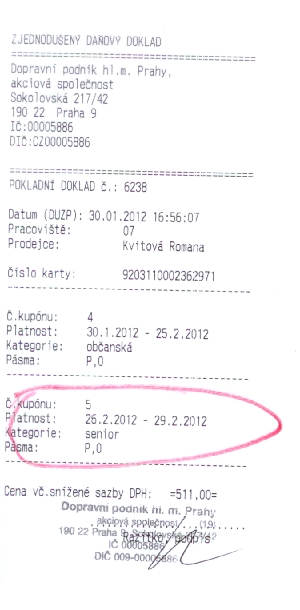
Receipt for the renewal for one month of my Prague public transport Open Card.
In 2012, Queen Elizabeth II celebrates her Diamond Jubilee – it is sixty years since she ascended to the throne of the United Kingdom. Whilst the major celebratory events to mark Her Majesty’s Diamond Jubilee are planned to take place on the first weekend of June 2012, in hope they will benefit from warm, sunny British summer weather 🙂 , she actually ascended to the throne on 6th February 1952 following the death of her father, King George VI.
Twenty days later, in the upstairs bedroom of a suburban semi-detached house on the outskirts of the city of Coventry, another significant event took place – I was born. Therefore, just like Her Majesty Queen Elizabeth II, in 2012 I too, celebrate my Diamond Jubilee!
I often wonder whether the day of my arrival in this world was indicative of my future character. I was born on a Tuesday which was the local district midwife’s day-off! Was I being difficult or awkward, right from the beginning? I’ll leave others to judge on that one. At least I did avoid being born three days later. If I had arrived then, I would only be celebrating my fifteenth birthday this year!
My sixtieth birthday is the first of three landmark family events this coming year. At the end of March, my eldest sister June and my brother-in-law Garry, celebrate their Golden Wedding Anniversary. Then on the last Saturday of July, my son Phillip will marry my future daughter-in-law Charlotte, a ceremony that they have asked me to conduct. I promise that both of these events will feature on this blog in due course.
However, being aware that once my ‘Diamond Jubilee’ had taken place, I would be entitled to cheaper travel on Prague public transport, yesterday I renewed my ‘Open Card’ for just one month rather than for a whole year. But the system was already aware of this forthcoming significant event – the last four days have been given to me at considerably reduced rates. Why? Because I have been categorised as ‘Senior’! Whilst I will continue to complain about Czech bureaucracy, at least it has recognised my Diamond Jubilee.
The Week of Prayer for Christian Unity takes place each year in the northern hemisphere, between 18th -25th January. On the evening of Monday 23rd January, Sybille and I, along with three other members of the St. Clement’s Anglican congregation, attended the main service held in Prague to mark this important week.
This Ecumenical Service was held in Kostel sv. Vojtecha, a large modernChurch attached the Roman Catholic Theological Faculty of Charles University. It was led by the Roman Catholic Archbishop of Prague, Dominik Duka and the preacher was Mgr. Joel Ruml, the Moderator of the Evangelical Church of Czech Brethren, (by far the largest Protestant Church in the Czech Republic), who is also the Chair of the Czech Ecumenical Council. They were assisted by my Czech boss, Bishop Dušan Hejbal of the Old Catholic Church, who is also Vice-Chair of the Czech Ecumenical Council.
Members of various other smaller Czech Churches also took part by reading from scripture and in leading intercessions. It was noticeable that amongst all of these there was only one woman! Obviously the service was all in Czech so I didn’t understand too much though I did get the response to Psalm 122. ‘Do domu Hospodinova pujdeme s radostí’ – ‘Let us go to the house of the Lord with joy’.
I was disappointed that at the end of the service, the host Roman Catholic Church had made no provision of light refreshments to encourage those who attended to stay around for post-service fellowship. Also, there was no opportunity to meet with the various Church leaders who had taken part – they all just processed out during the last verse of the last hymn and disappeared! Thus there was sadly, little opportunity to build good ecumenical relationships.
The other matter that saddened me was the actual way the service was officially organised. The invitation to attend came jointly from the Czech Ecumenical Council and the (Roman Catholic) Czech Bishops’ Conference. The reason for this is that the Roman Catholic Church is only affiliated to the Czech Ecumenical Council, rather than being a full member Church. The evidence of this can be seen on the order of service below. On the left is the logo of the Ecumenical Council, whilst on the right is the logo of the RC Czech Bishops’ Conference.
Front page of the Order of Service
This situation reflects the official attitude of the Roman Catholic Church in any country where it can be described as the ‘majority Church’, which is the reality in the Czech Republic, even allowing for the general low level of Church attendance and Christian belief that there is here. When the Roman Catholic Church is a minority Church, as it is in England, Wales & Scotland, then it chooses to become a full member of the national ecumenical body.
This is not a criticism of individual Roman Catholics, many of whom are very ecumenically minded. Nor is it a criticism of Archbishop Duka himself as I have a great admiration for him as he spent time in prison during the Communist era, because of his underground Church activities. I’ve twice previously had the privilege of meeting him and found him warm and very supportive towards the English-speaking Anglican Church in Prague.
Rather, it is a criticism of the official view that emanates from Rome, which is that it alone is the Catholic (i.e. universal) Church and that the only way to bring about Christian unity is for everybody to rejoin the Roman Catholic Church! Sadly, under the current Pope, that attitude is unlikely to change.
Encouragingly, there are movements within Roman Catholicism that are calling for change such as ‘We are the Church ‘and the Pfarrer Initiativein Austria. I think there are one or two more blog posts coming shortly to address these issues. Watch this space!