Kutná Hora

The Cathedral Church of St. Barbara, Kutná Hora © Ricky Yates

The historic small city of Kutná Hora lies about 70 kilometres east of Prague and it took us around an hour and twenty minutes to drive there on Tuesday 24th July. It is a popular place to visit on a day trip from Prague and of all the places we visited during our recent ‘staycation’, it was the one where we saw greatest number of other tourists.

The west end of the Cathedral Church of St. Barbara, Kutná Hora © Ricky Yates

During early mediaeval times, Kutná Hora was as significant a settlement as Prague, its wealth coming from the mining of silver in the surrounding hills. It was here that silver groschen were minted which was the hard currency of Central Europe during that time. However, a combination of the silver ore being depleted and the city being ravaged by both sides during the Thirty Years War, led to the city’s decline. It now has a population of 21,000 as against Prague with 1.3 million!

The crowning glory of Kutná Hora is its Cathedral, dedicated to St. Barbara, the patron saint of miners. It was begun in the late fourteenth century and was mainly completed by the middle of the sixteenth century. Its current form dates from restoration work undertaken in the late nineteenth and early twentieth century when a series of impressive stained glass windows were added.

Stained glass window © Ricky Yates

Stained glass window © Ricky Yates

Whilst the stained glass is relatively modern, frescos such as these below, date from mediaeval times. The sheer height of the nave, looking towards the high altar, is extremely impressive.

Mediaeval frescos © Ricky Yates

The nave & high altar © Ricky Yates

Following the upheavals of the Thirty Years War, the Jesuits arrived in Kutná Hora in the latter part of the seventeenth century, as part of the re-catholization of Bohemia that followed the defeat of the Hussites and their supporters. They were responsible for building a very large Jesuit College and various other buildings and Churches within the city. On the opposite side of the street that runs alongside the Jesuit College towards the Cathedral, is a wall with a series of statues of a variety of saints, the arrangement being apparently inspired by the statues on Charles Bridge in Prague.

The Jesuit College at Kutná Hora © Ricky Yates
The Church of St. James at Kutná Hora © Ricky Yates

Everywhere you look around Kutná Hora the architecture is quite stunning. In writing and illustrating this post, it is difficult to know what to leave out 🙂 However I couldn’t omit this Church, dedicated to St. James. If you look closely, you will see that it is incomplete. It was supposed to have a second tower but only the base was ever built which now has a simple roof and cross constructed on top of it.

Located in the outer suburb of Sedlec is the other main visitor attraction in Kutná Hora – probably the most famous ossuary in the whole of the Czech Republic. It is far better known and receives far more visitors than the ossuary at Melník that we visited the previous week. It is to be found in the crypt of All Saints Church and was created in the late nineteenth century by a local woodcarver, after the Schwarzenberg family purchased the buildings making up the former Sedlec Monastry.

Within the crypt, the remains of about 40,000 people have been rearranged to create, (amongst other things), a chandelier and the coat of arms of the Schwarzenberg family. In both a leaflet we were given and in a guidebook that I have, there is great emphasis that this creation is to remind us all of the transience of human life and the undeniable fact of death. It is right and proper that we are reminded of these things but I have to say that it is a rather unusual way of doing so.

Chandelier made of human bones in the Sedlec Ossuary © Ricky Yates

The coat of arms of the Schwarzenberg family in the Sedlec ossuary © Ricky Yates


All Saints Church, Sedlec © Ricky Yates

Prague Botanical Garden


A colourful flower bed in Prague Botanical Garden © Ricky Yates

The Prague Botanical Garden is situated in the suburb of Troja, adjacent to Prague Zoo. So our journey to get there on Monday 23rd July was exactly the same as the one I described in my earlier post about our visit to the zoo. We had only visited the Botanical Garden once previously, about three years ago, and it proved to be somewhere well worth re-visiting.

The southern section of the garden consists of a series of beds planted with a whole variety flowers from across Europe and beyond. The photograph on the left is of a bed of perennial and annual plants which over the summer months, sees more than 300 species in bloom. These beds are surrounded by manicured lawns with plenty of space for people just to sit and relax and enjoy the beauty of the flowers.

Another area is given over to plants that enjoy more moisture and has a small lake at it centre. Other areas that have more trees feature flowers and plants that prefer a little more shade.

Immediately below the southern section lies the much longer-established St. Claire’s Vineyard, now incorporated within the Botanical Garden. The vineyard takes its name from the little chapel dedicated to St. Claire that is situated right on the top of the south-facing slope of the vineyard. The photograph below was taken from alongside the chapel.

St. Claire’s Vineyard looking towards Zámek Troja © Ricky Yates

Below the vineyard, but outside of the Botanical Garden, is Zámek Troja. It too is surrounded by very attractive gardens including a long-established maze. But because the Zámek is now an art gallery in the care of Prague City Council, like nearly all art galleries and museums in the Czech Republic, it doesn’t open on Mondays. And unfortunately, as we discovered, the same applies to the grounds as well as to the Zámek.

A view of the Japanese Garden © Ricky Yates


Adjacent to the more ornamental beds of the southern section of the Botanical Garden is a separate Japanese Garden. It features broadleaved trees of Japanese and Chinese origin, together with a stream and small lake. Most significantly, it also has a collection of bonsai trees, one of which can be clearly seen in this photograph on the left.

The larger, wilder northern section of the Botanical Garden lies further uphill with more than half of it being forested. However, two sections display different aspects of the natural world of North America. One area is has plants from the prairie whilst another displays plants and flowers from the semi-desert regions including these bright purple flowers below.

With an entry fee of just CZK 50 for Sybille and only CZK 25 for me being ‘senior’ aged 60-69 🙂 , we shall certainly return to see the Prague Botanical Garden in another season. But we’ll try and avoid going on a Monday so we can visit the gardens of Zámek Troja as well!


Flowers from the North American semi-desert © Ricky Yates
 

Krivoklát Castle

Krivoklát Castle © Ricky Yates

About 50 kilometres west of Prague, in the beautiful wooded valley of the Berounka River, lies the village of Krivoklát with its historic 12th century castle. Whilst it is slightly further away from Prague and somewhat less accessible than the much better-known Karlštejn Castle, I was still surprised at the relatively small number of other visitors there were when we visited on Thursday 19th July.

The original castle was completed in 1109, just over 900 years ago. As with so many castles, over the following centuries it has been altered, extended and re-built after being badly damaged by fire. Once through the main gate, there is a large courtyard surrounded by buildings of different architectural styles. These house various artistic exhibitions and shops as well as providing some residential accommodation, presumably for staff who help maintain and run the castle today.


The courtyard inside Krivoklát Castle © Ricky Yates
The well inside the courtyard of Krivoklát Castle © Ricky Yates

In the centre of the courtyard is the well which in times past, would have been the only source of water for the castle residents.

Sundial on one of the courtyard walls © Ricky Yates

On one of the walls within the courtyard is the inevitable sundial 🙂

The view from the top of Krivoklát Castle tower © Ricky Yates


It is possible to explore the castle ramparts and then climb to the top of the round tower for this spectacular view down to the village in the valley below and across the nearby countryside. The beautiful forested area surrounding the village is designated as the Krivoklátsko Protected Landscape Region – a UNESCO ‘biosphere preservation’ area.


This was a most enjoyable day trip to a place and surrounding area which was completely new to us. There is so much more to tempt us to return in the not too distant future.

The main entrance and exit of Krivoklát Castle giving an indication of the thickness of the walls 🙂 © Ricky Yates

Prague Zoo

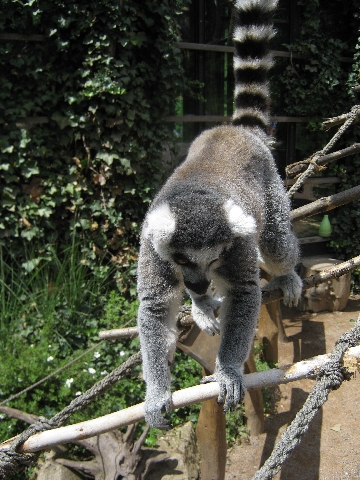
A ring-tailed lemur in Prague Zoo © Ricky Yates

Prague Zoo has always been one of our favourite places to visit on my ‘day-off’, ever since we moved to the Czech Republic nearly four years ago. It isn’t really feasible to see everything in one visit and, depending on the time of year, different animals and birds are more willing to show themselves each time we visit. And all the time, there are new developments at the zoo, some being the result of ongoing repairs to the damage caused by severe flooding in August 2002. Realising that we hadn’t visited Prague Zoo at all in 2012, we put it on our ‘staycation to visit list’ and we duly visited once more on Wednesday 18th July.

Prague Zoo is located directly across the Vltava River from where we live. Part of the fun of visiting it is the journey to get there. Why? Because there is no bridge across the river for many kilometres. Instead, we have to take the ferry.

On the western side of the river where we live, the little jetty from where the ferry leaves is two stops away on the bus. Then on the other side, it is a similar distance to the zoo entrance but with a much less frequent bus connection. So sometimes it is quicker just to walk. The ferry itself is quite tiny but as you can see, it still proudly displays a sticker to say that it is part of Prague’s integrated transport system!

The little ferry returning across the Vltava River © Ricky Yates
On board the ferry – part of Prague’s Integrated Public Transport System © Ricky Yates

Upon our arrival at the zoo entrance, we discovered two significant changes since our last visit in 2011. Firstly, the cost of a standard adult entrance ticket had gone up by 33.33% from CZK 150 to CZK 200. Secondly, the definition of being ‘senior’, allowing admission for CZK 1, had been altered from being 60 or above, to being 70 or above. Those of us aged between 60 and 69 were instead allowed in for the slightly reduced price of CZK 150.

An elephant enjoying his late lunch in his new enclosure at Prague Zoo © Ricky Yates


One new feature since our last visit was a freshly completed new home for the elephants. As you can see, it does look rather bare though no doubt it will be landscaped more in due course. Fresh fruit had just been scattered in the enclosure as we arrived and shortly afterwards, this character was allowed out of his house and was busy picking up the fruit off the ground with his trunk and putting it into his mouth.


An Emu resting comfortably in Prague Zoo © Ricky Yates

In the Australian section of the zoo, the kangaroos and wallabies were grazing in the farthest corners of their enclosures and were therefore somewhat difficult to see. But as usual, this emu seemed very happy to be observed sitting down quietly and enjoying the sun.

The zoo occupies a somewhat unusual site. Parts of it are relatively flat alongside the Vltava River whilst other sections are up on top of a hill overlooking both the river and the city of Prague.

The view from Prague Zoo towards Rezidence Podbaba © Ricky Yates

This view from the top of the hill looks directly across the Vltava River to Rezidence Podbaba, the development where the Chaplaincy Flat is located. On the left is the newly opened Kaufland supermarket, easily identified by the ‘K’ logo, whilst behind the apartment blocks is the Juliska Stadium, the home of FK Dukla Praha. In preparation for the new football season which begins next weekend, the club are obviously renewing the seating in the main stand which is why it says ‘ukl’ rather than ‘Dukla’ 🙂

An Owl in Prague Zoo © Ricky Yates

No visit to Prague Zoo is complete for me without visiting my favourite residents – the owls. I find them such attractive and fascinating creatures. I particularly admire the way they turn their heads so they can see in virtually every direction without moving their bodies. Because of the netting that surrounds each of their enclosures, it isn’t very easy to get a clear photograph of any of the various owls in the Prague Zoo collection. So I was particularly pleased with this one of an Owl, looking half asleep but almost certainly, very wide awake!


Melník

The Church of St. Peter & St. Paul, Melník © Ricky Yates

Following my recent busy July weekend, I am now on annual leave until the end of the month. For a variety of reasons, we’ve decided to have a stay-at-home holiday or ‘staycation’ as I gather Americans call it. For these next two weeks, we’ve written out a list of places in or around Prague that we either want to visit for the first time, or re-visit because we missed something previously, or because we want to go in summer having previously visited in another season.

On Tuesday 17th July, we visited Melník, a small town which lies around 35 km directly north of Prague at the confluence of the Vltava and Labe/Elbe rivers. Melník comes into the third category outlined in the previous paragraph as we had been there once previously at the beginning of January 2009. On that occasion, there was snow lying on the ground and the two main attractions were both closed! It was also a few weeks before I commenced writing this blog and some months before I bought my current camera, thus meaning I have no written or photographic record of that trip.

The historic centre of Melník is situated on the top of a hill overlooking the confluence of the two rivers with a steep drop down to the water’s edge. Right on top of the hill stand the two most significant buildings in the town – the Church of St. Peter and St. Paul with its tall tower, and ‘Zámek Melník‘, a Renaissance château belonging to the Lobkowicz family.

Cobbled street in the centre of Melník with Restaurace U Rytiru on the right © Ricky Yates

We drove to Melník and upon arrival, found a suitable parking spot for the car, and then walked into the centre of the town. We headed for the Church and Zámek, and just before reaching them, decided to have a late lunch at Restaurace U Rytiru, sitting under one of the red Budweiser umbrellas on the right in the photograph above.

Cross made from human skulls & bones in the crypt of the Church of St. Peter & St. Paul, Melník © Sybille Yates


Then it was off to see the somewhat macabre feature of the Church – the old crypt which is an ossuary containing the bones of more than 10,000 people, dug up to make room to bury plague victims in the sixteenth century. When the crypt, which had been previously walled up, was re-opened in the late nineteenth century during renovation work on the Church, a professor at Charles University in Prague undertook anthropological studies on the bones and arranged them into some interesting patterns including this cross.


The Labe/Elbe River at Melník with the navigation channel and lock that circumvent the first section of the Vltava River © Ricky Yates

Walking between the Church and Zámek Melník, we reached a spot from where there is a wonderful view across the Central Bohemian countryside and, in the foreground, the confluence of the Vltava and Labe/Elbe rivers. A navigation channel and lock, built in the first decade of the twentieth century, allows boats to circumvent the first few unnavigable kilometres of the Vltava. The metal plaque shown below, explains which waterway is which!

Plaque explaining which waterway is which! © Ricky Yates

We then headed for Zámek Melník, not least because of the onset of a very heavy thundery downpour! This photograph, taken in the courtyard of the Zámek, shows some of the sgraffito decoration on the exterior walls of the building.

Zámek Melník with exterior sgraffito decoration © Ricky Yates

There was also this sundial on one of the courtyard walls which was unfortunately rather redundant in view of the weather 😉

The sundial on the exterior of Zámek Melník © Ricky Yates

We took a most enjoyable tour of the interior of the Zámek but, as is sadly now commonplace in many historic houses, no photography was allowed. However, we did appreciate being able to walk through the various rooms at our own pace, without an accompanying guide. As might be expected, there was a variety of antique furniture and historic paintings to observe. We particularly liked the intricate decoration of many of the ceilings.

Church tower and vines at Melník © Ricky Yates


Before the heavens opened once again, I did manage to get this photograph which shows the Church tower, together with the vines that grow on the steep slope below the Church and Zámek Melník. Most Czech wine is produced in Moravia but some excellent, mainly white wines, are also produced in Bohemia, particularly in and around Melník.

The vineyard below the Church and Zámek Melník can also be clearly seen in the photograph below which I took, soon after we set out on our journey back to Prague by a different route to the one by which we came.


Zámek Melník and the Church tower with vineyards below © Ricky Yates

PS Before anybody points it out, I do know that there should be a hácek above the ‘e’ in ‘Melník’, just as there should be one above the ‘c’ in ‘hácek’. But as I have previously explained, for technical reasons beyond my comprehension, if I put one in, it will appear as ‘M?lník’ and ‘há?ek’.