Posts tagged ‘driving’

My sister June & brother-in-law Garry on their wedding day 31st March 1962

I am the youngest of three children. My eldest sister June, is nearly nine years my senior. On Saturday 31st March 1962, at the tender age of eighteen, June married my brother-in-law Garry, the wedding taking place at Warwick Road Congregational (now United Reformed) Church in Coventry. The picture on the left is of the happy couple outside the Church following their marriage and the boyish face behind Garry’s shoulder is none other than Yours Truly, aged ten!

Exactly fifty years later, on Saturday 31st March 2012, June and Garry celebrated their Golden Wedding anniversary. They marked the occasion by holding a most enjoyable buffet lunch in the Branksome Dene Community Rooms, Poole which overlook the beach near their home for the past twenty years in Westbourne, Bournemouth. The Prague Church Council kindly agreed to me having a pre-Easter rather than my normal post-Easter break, which allowed Sybille and I to be present and join the celebrations.

June and Garry 31st March 2012 © Ricky Yates

Our trip to the UK was only my second since moving to Prague just over three and a half years ago and was Sybille’s first during this same period of time. We flew from Prague to London Gatwick late in the evening of Thursday 29th March and stayed that night and the following one, in a little cottage in the grounds of Bishop’s Lodge, Worth, on the outskirts of Crawley. The Bishop’s Lodge of  Rt Rev’d Dr Geoffrey Rowell, Anglican Diocesan Bishop in Europe,  is deliberately located only ten minutes drive from Gatwick making it very convenient both for him and us!

In order to make the most of our four days in the UK, I had arranged online in advance, to hire a car at the airport. In order save money on both hire charges and fuel, I chose to hire a vehicle from the ‘small car’ category. You can probably imagine my amusement when I discovered that the car allocated to me was a brand-new Skoda Fabia – made in the Czech Republic!

Whilst I am well used to driving my own right-hand drive (RHD) car on the right (as opposed to left) side of the road here in the Czech Republic, what did seem strange was driving a RHD car on the left side of the road, something I hadn’t done for over three and a half years. Several times I came very close to driving on the right with Sybille regularly telling me ‘links fahren’, in order to remind me not to cause an accident!

Just before 9am on Saturday 31st March, we set out from the cottage, to drive to Bournemouth/Poole. The journey took us diagonally across West Sussex, a part of England that was new to me having only previously visited the very north-eastern corner of the county to get to Gatwick Airport on several previous occasions and having once driven further south to Brighton. However, once we reached Hampshire and the M27 around Portsmouth, we were back on more familiar territory. We arrived at the Premier Inn in Bournemouth, where we were booked to stay the night, with plenty of time to park the car, get appropriately dressed and then walk down to the sea front to the celebratory lunch venue.

Garry & June cutting their Golden Wedding anniversary cake © Ricky Yates

My nephew Tim making his speech about his parents at their Golden Wedding celebration © Ricky Yates

It was interesting to realise that I was one of a handful of people present at the Buffet Lunch, who had also been present fifty years previously at June and Garry’s wedding. Most of the guests last Saturday, were friends that June and Garry have made locally since they moved to Bournemouth from just outside Leamington Spa in the Midlands, more that twenty years ago. Sybille and I also had the distinction of being the two who had travelled the furthest in order to join the celebrations.

June and Garry have two children, Tim and Tom – the arrival of Tim into this world making me an uncle at the age of twelve. Tim and his partner Deborah have since made June and Garry grandparents and in turn, have made me a great uncle! It was lovely to see my great niece Lilith and my great nephew Silas, for only the second time in theirs and my lifetime.

Below is the, probably never to be repeated family photo, unless that is, we all come together again to mark June and Garry’s Diamond Wedding Anniversary, now due in less than ten years time!

The family photo. From l to r: Deborah (Tim's partner), Silas (great nephew), Jenny (sister), June (sister), Tim (nephew), Garry (brother-in-law), Tom (nephew), Lilith (great neice), Sybille & myself © Ricky Yates

The 'Carly' at Nepomuk having a new crankshaft sensor fitted © Ricky Yates

In order to legally keep a car on the road in the United Kingdom, it has to have an MOT certificate. This shows that it has passed its MOT test, proving that it is mechanically sound and its exhaust emissions are within the accepted limits. The abbreviation MOT comes from ‘Ministry of Transport’, the then government department which first introduced the test in 1960.

In the Czech Republic, the equivalent of an MOT test is also known by a set of initials – STK. These stand for Stanice technické kontroly / Technical Inspection Station. Whilst in the UK, once a car is three years old, it has to pass an MOT test annually, in the Czech Republic the STK test only has to be undertaken once every two years.

As I wrote in my June 2009 post entitled “Driving on the ‘right’ side of the road”, my RHD Renault Scenic underwent its first STK test in December 2008, as part of the complicated procedure of obtaining a Czech registration document and Czech number plates for it. But as I explained in a subsequent post entitled ‘Check this Czech car out!’, I didn’t successfully achieve this until 25th June 2009.

Knowing that any vehicle has to have an STK test once every two years, I had assumed that the ‘Carly’, as it is affectionately known, would need to be tested again in December 2010. But when I asked my good friend Adrian Blank of Nepomuk, who helped me negotiate the minefield to get the car registered here in the Czech Republic in the first place, he assured me that the date the authorities would use would be two years from the date of registration, meaning that it did not need to be tested again before 25th June 2011.

Theoretically, I could have taken the ‘Carly’ to any STK centre in Prague for its test. But being aware of both my limited Czech and recurrent expression by many Czech people of their belief that you cannot register a RHD car here, I decided that it would be wise to once more work through Adrian, even though it would mean a journey out into the south-western Bohemian countryside. Therefore last Thursday, two days before the second anniversary of the ‘Carly’ becoming Czech, I set off.

Adrian suggested that, rather than travelling via Nepomuk, I should drive directly to the test centre at Horažd’ovice and he would meet me there. Fortunately, this worked out perfectly as we arrived at the centre within thirty seconds of each other. There is no system of booking a test at Horažd’ovice – you just turn up and wait your turn. Adrian discovered that there were two other cars in front of us so, having paid the test fee and handed over the car’s paperwork and keys, we went off and enjoyed coffee and cake together in a nearby outdoor coffee shop.

Stickers on the rear number plate of the 'Carly' showing the validity of its STK tests © Ricky Yates

Upon our return to the test centre, I was pleased to discover that the car had duly passed both its emissions and mechanical tests and my papers had been dated and stamped for a further two years. But, much more importantly, I had two new little hexagonal stickers on my rear number plate – one green for emissions and the other red for the mechanical test.

As in many continental European countries, the way the police can easily check as to whether a car has a current STK test certificate, is to look at these two stickers as illustrated in this photograph. On the outer rim of each sticker, is a hole between ‘5’ & ‘7’ indicating June, the sixth month. Then on the inner part of the sticker, there is a hole in the same box as ‘13’. My STK certificates are now valid until June 2013.

Adrian had also kindly ordered a new sensor for the crankshaft to try and resolve the occasional recent problem of the ‘Carly’ not wanting to start, despite the starter motor turning over. So after the STK test, I drove across to Nepomuk where it only took one of Adrian’s mechanics half an hour to fit before I was able to drive on back home to Prague.

Instruction in both Czech & German to drive on the right!

I started this blog more than two years ago, mainly to keep my friends and family back in the UK and elsewhere, up-to-date about my life, work and activities in the Czech Republic since moving here in September 2008 when I took up my new appointment as Chaplain of the English-speaking Anglican congregation in Prague.

I wrote about the original motivation behind my blog in a February 2010 piece entitled ‘Happy first birthday to my blog’. There I explained that I now know that many of my Prague congregation also read this blog and how I always have to be careful about whom or what I write! But what I never really expected is how much more widely this blog would be read. But using the tools provided by Google analytics, I’ve discovered that in recent months, my blog receives on average, more than fifty visitors a day.

One of the most frequent subjects that brings people here are those looking via search engines, for an explanation as to why two thirds of the world drives in left-hand drive (LHD) vehicles on the ‘right’, (as in the opposite of left) side of the road, whilst one third of the world drives in right-hand drive (RHD) vehicles on the ‘left’ (as in the opposite of ‘right’) side of the road. My two posts from June 2009 entitled ‘Driving on the ‘right’ side of the road’ and ‘Check this Czech car out’ both rank highly in Google and other search engines for enquiries of this nature.

As I wrote back in June 2009, the whole of Czechoslovakia drove on the left in RHD vehicles until the change to driving on the right was imposed overnight by Hitler, following his invasion of the country in March 1939. This is the reason why most of the vintage cars that now offer visiting tourists, guided tours around the historic sights of central Prague, are RHD. They all date from the pre-1939 era.

It has been a privilege in the past few weeks to have Johanna, a young lady from Finland, worshipping with us at St. Clements. She has come to Prague to undertake a creative writing course, in particular researching written accounts of the Czech experience of World War Two. As part of her research at the Prague Military Archive, Johanna uncovered two photographs that illustrate the change in driving practice imposed by Hitler. Knowing my interest in this subject, she kindly forwarded them to me.

In view of the wider interest in this topic, I’m posting them here as they are a fascinating record of how this change was imposed by the Nazi authorities in 1939.

Instruction in both German and Czech to drive on the right!

Mindless graffiti in the centre of Prague © Ricky Yates

At the end of my first post of 2011 entitled ‘Why I like living in Prague’, I did say that there were a small number of things that I don’t like about living here but referred to them as ‘minor irritants’. At least two commenters have since remarked that they would really like to know what these things are. So for Karen and Vance, together with everyone else who read that post and thought the same but didn’t leave a comment, here goes!

Mindless graffiti – The picture on the left, together with the two below, illustrate far more clearly what I mean than anything I can write. This is mindless, pointless graffiti. Please don’t let anybody try to tell me that it is art – it isn’t! And sadly, it is very widespread right across Prague.

More mindless graffiti © Ricky Yates

I am well aware that it is a problem that is not unique to Prague – it occurs in very many urban areas around the world. When I lived in the Oxfordshire countryside before I moved to Prague, from time to time I used to travel into London by train. One of the things that always struck me as the train entered the London suburbs was the appearance of graffiti on walls and buildings alongside the railway tracks. In the villages of which I was Rector for over fifteen years, graffiti was virtually unknown.

Here in Prague, graffiti is more commonly seen on walls and buildings which are not in a very good state of repair. It is not often that you see it on newly renovated buildings. But it is rarely far away and it so detracts from nearby beautiful art and architecture. For example, the picture below shows a building in central Prague with a series of attractive mosaic squares on it. But the mindless graffiti underneath completely dissipates the beauty of the artwork.

Beautiful mosaic and pointless graffiti © Ricky Yates

As in the UK, once you leave the city and head out into the countryside, graffiti is rarely seen. Why this should be is a question to which I do not know the answer. Sybille rightly says to me that, rather than just complaining about it and suggesting that the police should do more to try and catch the culprits, one should rather ask what drives people to mindlessly spray or write things on buildings in the first place. Is it boredom, frustration or a feeling of helplessness and an expression of the social ills that there are here in Prague?

What ever the reasons – I do wish that graffiti wasn’t there defacing buildings.

Filthy ashtray © Ricky Yates

Smoking – Unfortunately, the enlightened practice of banning smoking in bars and restaurants that has been introduced by law in many European countries in recent years, has yet to penetrate very far into the life of the Czech Republic. Since the middle of last year, bars and restaurants have been required to display a sign saying whether smoking is allowed everywhere within the premises; or that they have separated areas for smokers and non-smokers; or that smoking is not allowed anywhere within the premises.

In the vast majority of bar –restaurants, particularly small to medium sized ones, most proprietors allow smoking everywhere. Some larger premises do have separate rooms or areas where smoking is allowed and those where it is not allowed. Even in these places, the level of separation often leaves much to be desired. Very few bar-restaurants, with the exception of some of the more upmarket ones in touristy areas, have opted to ban smoking altogether.

Change will eventually come – but it will take some years. In the meantime I have to suffer my clothing smelling of stale tobacco smoke and the unseen but very real dangers of passive smoking.

And now to two things which really can be described as Prague peculiarities or minor irritants.

Clock & timer on a Prague Metro station platform © Ricky Yates

On the left is a picture of a digital clock and timer of a variety that you will see at the end of the platform of every Prague Metro station. At the top is a very accurate clock showing the exact time in hours, minutes and seconds. Underneath is a timer. But instead of counting down to the time when the next train will arrive, it counts upwards telling you instead, how long it is since the last train departed! How absurd. Unless you know the frequency of trains on that line, at that time of day and on that day of the week, the information is useless!

Just for once, the London Underground is better. There you have clear electronic signs saying how many minutes until the next train arrives and what its destination will be as different trains share the same lines in certain places. Would it take that much work to make these timers on the Prague Metro do the same?

The second minor irritant is rather difficult to illustrate with a photograph so I won’t try. Since the middle of 2006, it has been compulsory to have dipped headlights turned on when driving in the Czech Republic, whatever the time of the day or time of the year. Research has shown that driving with dipped headlights during the many dark days of winter does help reduce the occurrence of accidents. However, I fail to see why on earth you need to use them on a bright sunny day in the height of summer. I much prefer the law adopted recently in Croatia which requires you to always use dipped headlights once the clocks have gone back at the end of October each year, until they go forward again at the end of March.

However, the Czech approach to road safety does appear to be somewhat contradictory. Research shows that most road accidents happen at dusk because of the change between daylight and darkness. Yet street lights which help mitigate this problem, never come on just as it is getting dark. Instead, it can sometimes be nearly dark for half an hour before they do. Even on days like today when the sky was very clear, near darkness had descended before they came on. On cloudy days, the situation is inevitably far worse.

Clearly, rather than working off light sensors which would make most sense, streetlights in Prague are turned on by timers, regardless of the level of light. Why do I have to drive with dipped headlights on a bright sunny day in June when the city authorities in Prague cannot turn the streetlights on as soon as it begins to get dark in mid-winter?

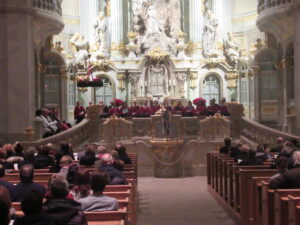
Christ Church, Vienna © Ricky Yates

On Thursday 16th September, only a week after our previous trip, we once more drove the length of the Prague – Brno motorway. This time we then headed further south over the border into Austria and travelled onwards to Vienna in order to attend the annual meeting of our Eastern Archdeaconry Synod.

As I’ve blogged previously, St. Clement’s Anglican Episcopal Church, Prague is part of the Church of England’s forty fourth diocese, the Diocese of Gibraltar in Europe. As with the other 43 dioceses that make up the Church of England, the Diocese in Europe is divided into Archdeaconries – in our case, into seven Archdeaconries. Even the smallest of these, the Archdeaconry of Switzerland, covers the whole of one country. And Prague belongs to the largest of the seven, the Eastern Archdeaconry, which consists of everything eastwards from Poland, Czech Republic and Austria, including all of the former Yugoslavia, Greece, Turkey and all the former Soviet Union except for the Baltic States.

Once a year, each Archdeaconry has an Archdeaconry Synod where the clergy, together with elected lay representatives, meet to discuss and report on issues facing our scattered congregations, to pray and to study, as well as to make decisions regarding the common life of our chaplaincies. Because of the distances involved, the synod meetings have to be residentiary. However, unlike in 2009 when the synod meeting took place in Izmir, Turkey, this time it was hosted by Christ Church, Vienna, meaning the car journey to get there took half a day rather than three & a half days!

The synod meeting took place in Pallottihaus, a Roman Catholic retreat house situated in the Vienna suburbs. It was an ideal venue with its own Chapel for worship, an excellent meeting room for listening to speakers and the discussion of synod business, as well as comfortable double and single rooms for overnight accommodation.

The major item for discussion was a plan, approved in principle by the Diocesan Synod earlier in the year, for the creation of four so-called ‘freestanding Archdeacons’ to provide better pastoral care and support for the clergy and Chaplaincies of our far flung diocese. The seven current Archdeacons have the almost impossible task of both being Archdeacon and being the Chaplain of a large Chaplaincy. My Archdeacon Patrick Curran is both Chaplain of Christ Church, Vienna as well as Archdeacon of the East.

The major issue regarding the scheme is, not surprisingly, one of cost. There is hope of some central funding coming from England and also the possibility of a private donor helping with accommodation. But inevitably, part of the funding will have to come from increased contributions from individual Chaplaincies. The Archdeaconry Synod gave its backing to the plan recognising the need for it and accepting the inevitable additional costs that will ensue.

On the morning of Sunday 19th September, the synod concluded with a Eucharist at Christ Church, in the centre of Vienna. The synod members joined the regular Vienna congregation and Archdeacon Patrick was the celebrant and preacher.

The Christ Church building itself is a typical product of nineteenth century British diplomacy and politics. It is situated directly opposite the British Embassy and even has a memorial on an inside wall commemorating the reign of Queen Victoria! However, like nearly all the Chaplaincies in our diocese, the Christ Church congregation has long since ceased to be solely ‘the Brits abroad’. As with St. Clement’s, Prague, there were a large variety of nationalities represented within the packed congregation including many black Africans.

After the service, refreshments and a sandwich lunch were served in the nearby parish centre, just around the corner from the Church. Unfortunately, I had to decline the alcoholic liquid refreshment on offer because of needing to drive back to Prague straightaway afterwards.

Next year, the Archdeaconry Synod will meet in Bucharest and as in 2009, Sybille and I will probably try and combine our attendance with two weeks of annual leave making the journey to Romania all the more worthwhile.